Chinese Class
45 degrees vs 90 degrees
90 degrees are theoretical.
Chen Style Taijiquan and Hunyuan Taiji email: practicalmethod@qq.com
View posts in sub-category:
Application Articles Body and Posture Class (Workshop) Notes Common Errors Glossary and terms Hunyuan Knowledge-Movement Explanations Learning Method Principle-Concept Principle-List Principle-Rule Principle-Technical Push Hands Quotations Routine Names Routines Videos Stories Student Evaluations (Private) Taiji Apparatus Taiji FAQ Taiji Sword Thoughts and Understanding Workshop and Class Notes
When we do the correct taiji actions, your opponent will always feel your actions are awkward to him. We just do what we train to do.
对手对不上。
Negative Circle
Dear All,
we’d like to announce the 2nd Online Workshop in German language, taking place on 28 Feb 2021, 2pm – 5pm GMT +1.
Please spread the word to everyone who might be interested. We will cover basics as well as some details, so it will suit beginners as well as advanced students.
The admission is free 🙂 Thanks a lot, c u soon!
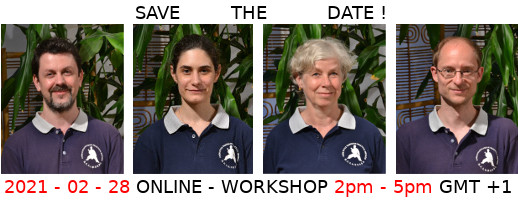
Please sign up here: https://practicalmethod.de/kontakt/
Best,
Sven & the Berlin Taiji PM Team
My impressions of the Chen Style Taijiquan Practical Method Online Workshop

Germany, 06.12.2020
The Taijiquan Practical Method Group in Berlin, Germany, organised an online workshop on 6 December 2020, marking their 10 years anniversary. The workshop took place under the lead of the head coach, Sven Carl Gusowski, in cooperation with the instructors Carlotta Viviani, Kerstin Kummle and Lutz Liese. The workshop focussed on basic Taiji Principles and their application in the foundational exercises and the Yilu Form. Read more

Presenter: Chen Zhonghua Length: 69 min. In: English Year: 2021 Difficulty:3/5
If you ever wonder how lessons are taught in Practical Method Online Classes, here is an opportunity to experience for free from Feb 22 to 25, 2021. People at different levels are participating in these classes.
 |
 |

Sink the Shoulder is a glossary for Chen Style Taijiquan Practical Method.
Presenter: Chen Zhonghua Length: 6 min. In: English Year: 2021 Difficulty:1/5 At:Edmonton Chen Zhonghua Taiji Academy
Hong was used to say his Taiji is like a garden. Everybody is welcome to come, have a look and take what he or she wants to take. If you cut a flower, it might last a week. If you can take the seeds, maybe in some years you’ll have your own garden.
Always teach everything, always present things in the same way. If someone understands, it has nothing to do with you. If somebody does not understand, don’t feel guilty: there’s nothing wrong with you and nothing wrong with him/her.

Presenter: Chen Zhonghua Length: 49 min. In: English Year: 2021 Difficulty:3/5
We practiced an empty handed exercise, standing on one leg:

Presenter: Chen Zhonghua Length: 61 min. In: English Year: 2021 Difficulty:3/5
Two power training exercises on BWAPM

Presenter: Kelvin Ho Length: 45 min. In: English Year: 2021 Difficulty:3/5

Master Chen Zhonghua only teaches a reference implementation, which represents an example of how the principle is applied. There are many parts that need to be examined, explored and learned. We must focus our effort on learning all the parts of the reference implementation, how they form part of a system, how each part functions, and the role each part plays, what the effect when all the parts work together, etc. We have to go over this reference implementation over and over again, because there is always something we miss previously.

Presenter: Chen Zhonghua Length: 62 min. In: English Year: 2021 Difficulty:3/5
Examples of fajin:
Master Chen demonstrated Lu, Cai, and Lie with in-with-elbow in “Shake the Pole”. These three belong to the same group.
Lu 捋 – You grab the opponent’s arm, pull him in, and throw him onto the other side. There is no severance of the arm in this case.
Cai 採 – You grab the opponent’s arm, and pull on it quickly to sever it at the shoulder. This is like plucking a flower.
Lie 挒- You grab the opponent’s arm, and pull him in. He hits your body, which provides a stop to the incoming force. This also allows the arm to be severed at the shoulder.
– Elbow/kua relationship. The elbow must touch the kua. Eventually the elbow always aims towards the kua.
– Integrity of the body. Keep the integrity by pulling the shoulders down and the kua up. The two must compress. Master showed this in relation to turning flowers out of the bottom of the sea on the R shoulder and R kua.
– Wavy Spoon/Pencil Illusion. Hold a pencil horizontally and shake it up and down. The pencil is totally firm, but the movement creates an illusion causing us to believe it is soft and wavy. Our body must be totally firm. When you hit it, it is like steel. The movements of the joints cause the illusion of being soft. Read more
– Form 70 High pat on horse. As step back, the R elbow need to keep going inward behind you. There is a second crack with the elbow as your opponent steps away. The elbow is tied to the kua with a rubber band, so there is integrity.
– Form 73 White ape presents the fruit. R in with elbow, rotate on R shoulder-kua line. Rotate on L shoulder-kua line fist stretches longer on the turn. Rotate the kua, hand does not move, the middle has to be tighter than the rest parts of the body. Elbow needs to aim to touch the kua so the moves are deep.
Read more
We practiced one knee up one knee down movement. The move after second Flash the back and before going into the jump.
It is the knee movements caused the kua to open, creating a hole which allows the torso to fall straight down.
The going down motion and the torso rotation are one move. The torso is passively dropping. The hands do not move, and the arms are adjusting accordingly.
Read more
https://youtu.be/RBnU67h-ZZo
https://youtu.be/RBnU67h-ZZo
Yilu Count: 2863.
I still have some same general mistakes from last month record.
http://practicalmethod.com/2020/12/self-correction-notes-for-yilu-record-9th-dec-2020-yuxin-liu/
Self correction:
– My head is a bit forward, not suspended enough. Center line is not strong.
– A few places, when doing the stretch, lost the non-moving points.
– First Cloud hands, when out with hand, shoulders popped.
– Single whip, R toes should close more.
– Turning flower at the bottom of the sea, I leaned, lost the axis.
Read more
For a special day to commemorate my master GM Feng Zhiqiang!
<iframe width=”560″ height=”315″ src=”https://www.youtube.com/embed/rzojq-4zONk” frameborder=”0″ allow=”accelerometer; autoplay; clipboard-write; encrypted-media; gyroscope; picture-in-picture” allowfullscreen></iframe>
A practice from the east to the west and the north to the south across the globe.
Read more
– Train the elbow – lock the hand and shoulder, only stretch the elbow. This is a small movement. No move on the hand and shoulder.
– Jade Girl Works at Shuttles – the jump is for length, not height.
– Step Back to Double Shake the Feet – the feet are switching. They cannot jump and land together.
– To train the elbow. Lock the shoulder and hand completely, better to ask someone else to hold it, only move the elbow. The movement is very small, like the door hinge. The movement of the elbow is the same as the knee.
– To change the direction of the fingers, we lock the wrist and the hand, move the elbow and the rest part of the body. Once the body is well trained, the movements can be much bigger.
Read more
To create a stick, we, we need to stretch.
To rotate, we also need to stretch.
In both cases, there are both restrictions and the attempts to break the restriction.
In the first case, A and C are restricted from moving, while B is forced to break the A and C apart along the A-C line.
In the second case, the rod is restricted from moving, while the rubber band is pulled and stretched away from the rod. If the rubber band is ever loose, the little nudge cannot cause the rotation.
Adjust Yourself, Not Your Opponent
First you make contact, then you adjust yourself, in the end you defeat your opponent. This process is what we generally call “Adjust yourself, not your opponent”.
On making the initial contact, Peng must be present. As soon as you touch your opponent you must establish superiority over him/her. You must be lose advantage.
If you succeed in dealing with the initial contact, you already have won half the battle. Where you make the contact, do not move it. You can only make some minor adjustments. The key to success is whether while holding (Peng) your opponent, you can adjust yourself. Beside the point of contact, adjust the rest of your body to the most advantageous position.
At this point, you can beat you opponent any way you chose to. If it is not the case, your first two steps were not done right.
The older and smaller person is Shao Changyu of Juxian, Shandong. She has been taking lessons at the Rizhao Chen Zhonghua Taiji Academy for almost two year. She is a conscientious student. Most of her training was at the Academy by attending afternoon classes. She has no Push Hands training. The opponent is a college student from the Irrigation College who has martial art experiences and is currently on the college Sanda team. This match is an impromptu match. Read more

In early Autumn 2019 I was training with Lutz and Fabian. I was doing a common drill for the Practical Method, Fabian as partner: He was pushing my arm repeatedly with same power, speed, distance and rhythm. On his move I was training the elbow-in/foot out (on the front side). Read more
– Movements need to be deep enough to make sure every body parts are stretched out. To feel the bottom. Fingers touching the wall and body sinks to find the solid. Read more
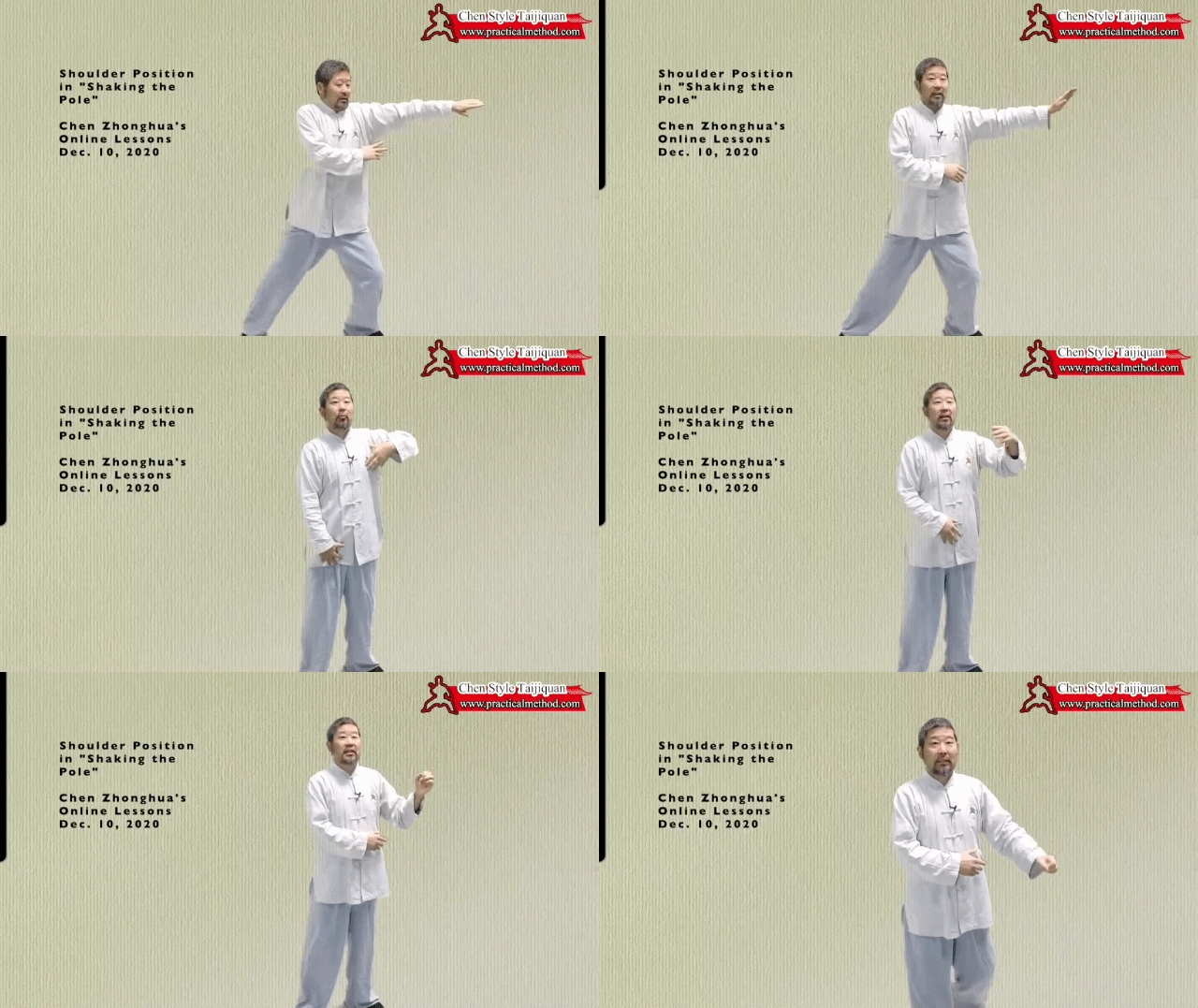
• Whenever you do a move with the arm, it doesn’t effect the torso.
• Then enhance the size of the arm movement.
• Then when you do arm movements, the torso can move up and down. They are still functioning separately.
Movements are separated when:
• If then they’re considered touched.
• If body specifications match, it is called real.
• movements need to be totally independent.