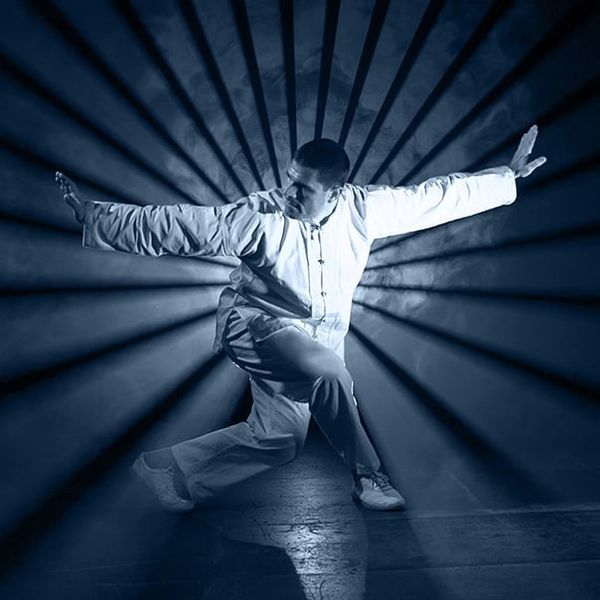
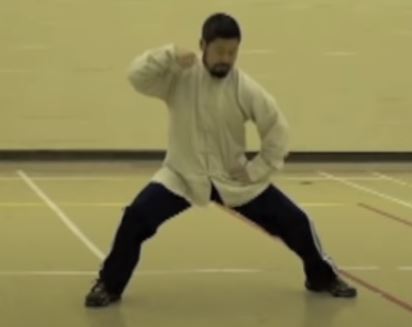
Exercise 1: Use the kua to push the hand out. Shoulder, kua and elbow are one piece. The hand stretches against the shoulder. This is a very practical push hand move.

Exercise 2: Elbow Strike (the elbow has to come out)

Exercise 3: Double Push Hands: Pull the opponent in, Front foot goes forward, rear foot follows. Two hands go out from the dantian with a trajectory. We use the back foot to push.

Kelvin corrected me on Rub Right Foot & Rub Left Foot. Here are my notes on his instructions and comments.

Rub R Foot

1)Starting posture is High Pat on Horse – chest facing NW, right arm slightly bent at chest level, above R knee, L arm extended to the side, weight on R foot.

2)Pull L foot closer to R foot and rotate on L heel so that L foot faces SE. Shift weight to L foot.

3)Adjust R foot slightly by dragging its tip forward so that the the tip of R foot is behind the heel of L foot.

4)R shoulder facing SW, L arm wraps around R arm, open both arms to shoulder height, L arm backward and R arm forward, both palms facing down.

5)Kick R foot in SW direction, foot slightly arched. Do not use force to kick. You must stay balanced after making the kick.
Read more

We started with forearm lever exercise. Aim at a dot to create a pivot. The distance the elbows goes down is the same as the distance the finger tip goes up (assuming the pivot is right in the middle).

Ratio 1:1

The meaning is that nothing is left in the middle. Every in-coming thing must go out. This is also called neutralization.

When we eat rice, ideally, we just want the energy, and other physical things should come out of the body. However, there is always some small amount of material, e.g. mineral that remains in the body. This is what causes us to be sick and become old.

Resolving door: One side comes in, the other side goes out. The key is that the door is very solid.

In our movement, redirect the incoming force to the rear foot without moving.

To be soft, it must be solid plus rotation.

Train with the rear foot at the corner, and a big enough stance to lock the body (especially upper body).

Taiji is only realized with speed.
Read more

Started with basic foundation teachings with Kelvin.

Concept 1-Twisting Towel

The hand leads elbow away from your body.  The elbow leads the hand in towards your body.   The movement is originated from the Kua and not the hand or elbow initiating the movement.  The concept of opening the elbow is to keep the hand and forearm on a straight line moving in and out of the tunnel or tube.  Opening the elbow allows the movement to come more from the center of my body.  Elbow and hand should not move too much into overextension.  The movement should be limited to only what your Kua can open.

Concept 2- Lifting water

Half horse stance-distance ideally should be 3 calf lengths, shifting forward 1/3 in front distance and 2/3 rear distance. The Kua initiates the motion.  The front shoulder, rear shoulder and hand begin in a triangle formation initially and then becomes a 3 points on a line.  Kua should be opening the elbow. Hand are in a shape of tile with slight curve.  Space between fingers and thumb closed and all fingers are extending.  Wrist is sitting by extension of wrist and opening separating into opposite direction.

Exercise 1: Use the left hand to grab the right wrist, stretch the right fingers. This is not just a demonstration, it is the method to train. People often ask Master Chen how to train, in fact, he just showed us. We only need to do it 60 times in each session. Doing it 60 times means to not use too much power, or using the right amount such that you can do it 60 times. When you use the left hand to grab the right, squeeze the armpit to lock the left hand, so that the left hand itself does not move. In order to stretch, we must lock something.
Read more

When the body action is correct, the energy is wrong.

When the energy is correct, the body action is wrong.
Read more

Maintain two lines (This exercise came from Twisting the towel.)

  1. Head to foot
  2. Front finger tip to the central vertical line on the back

We want to first stretch things out, and then add something in the middle to further stretch a little bit. We must constantly add that little bit of stretch in our training. This is neigong training.
Read more

Corrections of Negative Circle: 1st count: Elbow in, must come in over the shoulder, hand pointed outward (throughout entire Negative Circle, hand is always pointed outward.)
Read more

Presenter: Kelvin Ho   Length: 30 min.   In: English   Year: 2021  Difficulty:2/5  At:Toronto Chen Zhonghua Taiji Academy

hejiaweiguangdonghuasike20210320Fanquan
Access is keyed to your user account. You need to be logged in to buy access.
Please register or log in.

Fetch Water
Application: Shoulder strike (kao), power comes from dantian
Read more

For my yilu correction, after my front foot goes out during Lan Zha Yi (Block Touching Coat), as my foot settles on the ground, my front foot and knee needs to significantly close more.  After this, or during later on in my training, the knees and below doesn’t move and my waist moves forward into position through the action of the kuas making an adjustment, which moves the waist forward without disturbing what is underneath.  This then becomes a scale, lower body as the rod and elbow as the counterbalance.

Read more

On Mar 12, 2021, Master Chen was instructing on an exercise, in which, I put up my left forearm in front of and parallel to my chest. I need to push the elbow downwards with a pivot in the middle of my forearm, with the load on the hand. The desired outcome requires me to create an independent setup of a lever, and then press down on one side of the lever (elbow). This is separation of yin and yang because the downward force is independent of the lever setup. The lever setup cannot break or change its integrity when the downward force is applied. The outcome of the lever action is predetermined by the setup. The downward force when applied in a specific way simply makes it happen. If the downward force is not applied correctly or the lever setup breaks down, the desired outcome will not happen.
Read more

Today in class, Master Chen commented that there was new flow, clarity, and sharpness in my form. He said this day was a small milestone for me, and he wanted me to document it. He asked: Did I feel something different? Read more

What is success? It’s to never give up.

Why would one give up? He had a change of heart.

中文两字词语是阴阳的。信念 – 信往外,念往内。
Read more

Kelvin corrected my Upper Cloudy Hands starting from previous pose, Single Whip.

Corrections of my Single Whip pose: arms must extend further on either side, and hands are about shoulder height; elbows facing down; left palm facing down; sit the wrist; tips of thumb and middle finger of right hand touching, so right hand resembles the beak of a bird; sit the wrist. Hands must be tile hands (curved roof tiles on traditional Chinese building), fingers stretched tight outwards. Read more

Presenter: Kelvin Ho 何家伟   Length: 32 min.   In: Cantonese 广东话   Year: 2021  Difficulty:1/5  At:Toronton Chen Zhonghua Taiji Academy

Kelvin Ho Cantonese Private Online Lesson 20210313
Access is keyed to your user account. You need to be logged in to buy access.
Please register or log in.

Think about the rods/bars that link the old kind of train’s wheels together. Those rods only ever go forward even those each wheel only rotates. This is yin-yang reversal. There is a joint in the middle of the wheel, there is another joint at the place where the rod is attached to the wheel. If there is no such joint and the rod is totally glued to the wheel, as the wheel rotates, the rod will also turn around with the wheel.
Read more

Put the elbow on the table.

Shoulders goes down to the elbow.
Read more

https://youtu.be/FncBsswHZXI
Yilu count:3460

Foundations: https://youtu.be/DfRUeyU4xVY

During the class I was training the following exercise. I stopped now and then to write down what Master Chen was saying.
Read more

Importance of practicing yilu diligently – only then will you understand what Master Chen is saying – and your yilu will improve.

One principle 分陰陽 (Splitting Yin Yang).  Example: Left vs Right. You need a vertical central axis to distinguish L from R. (You need 3.) Same with top and bottom.

六字真言: 不動 旋轉 開胯 (Don’t Move; Rotate; Open Kua)
Read more

Presenter: Chen Zhonghua   Length: 10 min.   In: English   Year: 2018  Difficulty:1/5

Hunyuan QiGong Sg (5)
Access is keyed to your user account. You need to be logged in to buy access.
Please register or log in.

Presenter: Chen Zhonghua   Length: 10 min.   In: English   Year: 2020  Difficulty:1/5

Hunyuan QiGong Sg (4)
Access is keyed to your user account. You need to be logged in to buy access.
Please register or log in.

Presenter: Kelvin Ho   Length: 30 min.   In: English   Year: 2021  Difficulty:2/5  At:Toronto Chen Zhonghua Taiji Academy

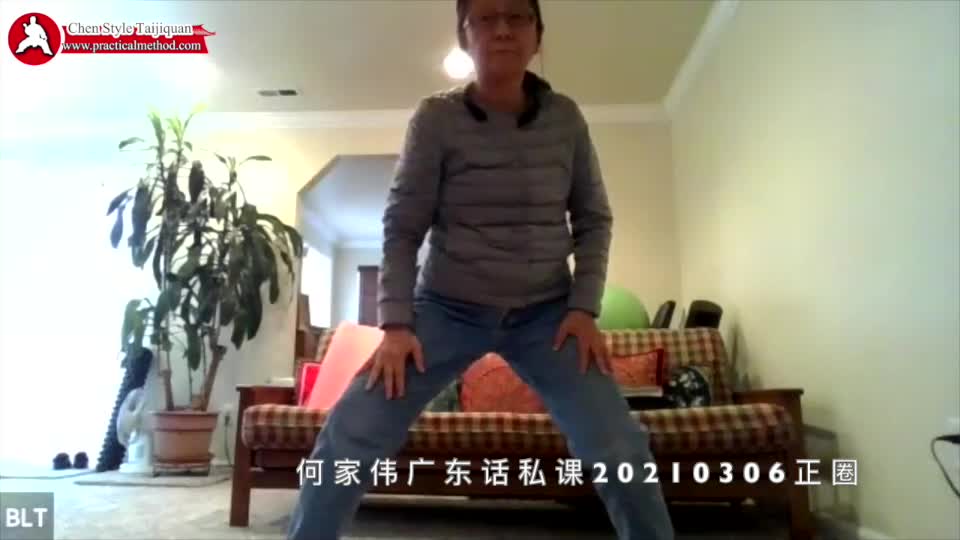
hejiaweiguangdonghuasike20210306zhengquan
Access is keyed to your user account. You need to be logged in to buy access.
Please register or log in.

Hold a rod not by grabing it with the whole palm, but split the span into two dots. One dot on the index finger underneath the rod acts as the pivot, and another one at the root of the palm placed above the rod acts as the balancing arm. We can tilt the rod the other end of the rod this way without lifting the rod itself.

This is what allows the power to go along the rod to the other end, and it is said to go over.
Read more

Presenter: Chen Zhonghua   Length: 10 min.   In: English   Year: 2020  Difficulty:1/5

Hunyuan QiGong Sg (3)
Access is keyed to your user account. You need to be logged in to buy access.
Please register or log in.

– Today we worked on Pole Shaking (Positive and Negative Circle).

Read more

Presenter: Chen Zhonghua   Length: 10 min.   In: English   Year: 2020  Difficulty:1/5

Hunyuan QiGong Sg (2)
Access is keyed to your user account. You need to be logged in to buy access.
Please register or log in.

Presenter: Chen Zhonghua   Length: 10 min.   In: English   Year: 2020  Difficulty:1/5

Hunyuan QiGong Sg (1)
Access is keyed to your user account. You need to be logged in to buy access.
Please register or log in.

During training (when we are not yet successful), we use extra effort and focus to get it. It is tiring.

Once you are successful, the body gets used to it and will not be tiring anymore. The hair has been combed. The effort has gone through a filter. Read more

This lesson is about staying on topic, and then categorization within a topic.

There are only 3 types of movements in Practical Method:

  1. Elbow-in (Pull)
  2. Hand-out (Push)
  3. Rotate Read more

The axis in real usage exists only functionally. 滚珠轴承 Ball Bearing.

We create a shell (restriction) on the outside, then the axis inside must exist, but you can’t touch it unlike a real rod in a globe.
Read more

Key things, e.g.

  1. Forward is to push.
  2. Backward is to pull.
  3. Middle is to rotate.
  4. Separation of yin and yang

We must remember the key things even if we don’t understand it. Read more

Presenter: Kelvin Ho   Length: 67 min.   In: English   Year: 2021  Difficulty:3/5

John Upshaw Yilu Correction Series: Turn Right Pound Mortar
Access is keyed to your user account. You need to be logged in to buy access.
Please register or log in.

德国慕尼黑实用拳法教练FlorianBartosch1

The Taijiquan Practical Method instructor team in Berlin, Germany, organised an online workshop on 6 December 2020, marking their 10th anniversary. The workshop took place under the lead of the head instructor, Sven Gusowski, in cooperation with the instructors Carlotta Viviani, Kerstin Kummle and Lutz Liese. The workshop focused on basic Taiji Principles and their application in the foundational exercises and the Yilu Form. Read more

I’m humbly posting here my practice.
3 month into the online classes with Master chen and I feel that finally, maybe? some small shift is happening….
please feel free to criticise

Chinese Class

Shoulder and kua must be open to be able to find a relationship.

Yin-yang is a relationship. We train to seek such relationship in different body parts.

Going straight is to hit (打).
Rotation is to avoid/neutralize (化).
Read more

Chinese Class

When we rotate, if the rotation goes forward, the entire object must move back to balance it.

Rear kua rotates forward, the kua itself must go backwards.
Read more