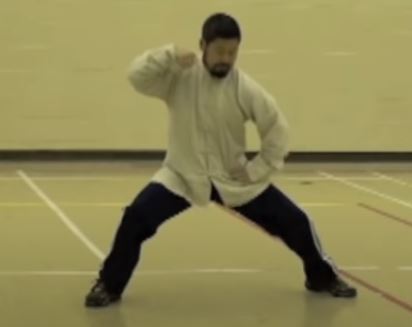
Corrections given to me were to do my movements bigger. Small movements at the beginning will cause you to make many mistakes in your movements. Read more
Knowledge
View posts in sub-category:
Application Articles Body and Posture Class (Workshop) Notes Common Errors Glossary and terms Hunyuan Knowledge-Movement Explanations Learning Method Principle-Concept Principle-List Principle-Rule Principle-Technical Push Hands Quotations Routine Names Routines Videos Stories Student Evaluations (Private) Taiji Apparatus Taiji FAQ Taiji Sword Thoughts and Understanding Workshop and Class Notes
1. Beginning. 2. Circle Corrections. 3. The Stretch. 4. The Replacement Stretch. 5. Dont’ Move Your Hand!
Author: Chen Zhonghua Length: 38 min. In: English Year: 2010 Difficulty:3/5 At:Edmonton
As master Chen requested, I am posting my raw notes from the Bentonville workshop. This was 4 days worth of notes. Read more
Fill it in, then add one.
- Get in – Loose – get into position, set it up, dissipate the opponent’s force. Two ways: Receive (a push from) the opponent. OR, Move into the opponent without pushing. (large circle) Read more
Just one brief observation i made sunday during PH with Martin – i think he will attend the WS in Freising too, since he is starting to appreciate your Taiji-wisdom. First, i led him push with both hands my pelvis-bones and i could resist his push by cennecting both contact-spots to my feet. Read more
Old analogies – Taiji is like a rolling log (in water).
Theory Method
Back silk knot Silk reeling Read more
- Hinge
Chest must move like a hinge in order to link. (Shifu Chen puts the ends of two bottle together and shows them bending and sliding off each other in various ways.) - Split
Do the form with a center split. Then learn to split at any point in the body. This is the same as the demarcation line discussed earlier.
Saturday PM session
Practiced first 13 movements of the Yilu
“Pole dancing”
Use pole to practice getting on the line. Practice with pole against arch of far (rear) foot slanted diagonally and against wall horizontally.
(Most of this session was spent in hands-on practice, so not many notes.)
Start with 3 or more contact points and add points. Drop strainght down. (Brush Knee)
Contact points, Far points. Read more
In taiji like in other practices, we tend to want to take in all the material at once. This is impossible as the requirements of taiji are extremely difficult to put into practice. The problem is that if we focus on too many things at once it become too difficult to negotiate all the rules.
It is actually better to work on one rule or one lesson at a time, until it is ingrained. When the body assimilates the rule, it is time to add a further one.
Friday PM session – Form instruction
Repetitions must be done to make the form go into the body. This can be done with 10 yilus/day for 3+ years, 25/day for 1 year or 60/day in 3 months. Read more
Shifu Chen asked me to post my notes, unedited, to our web site. This is not because I am such a great note taker, but it is part of transmitting the knowledge of Taijiquan. Read more
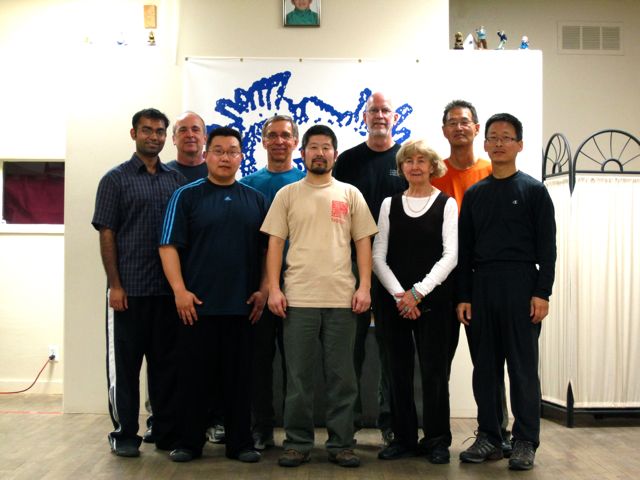
Wednesday Night Class in Phoenix
1. Beginning. 2. Tornado Kick Questions. 3. Structural Explanation of the Vertical Line. 4. Neutralization Without Absorption. 5. Neutralization with a bite. 6. Transfer of Weight on legs. 7. How to Get the 3 Vertical Lines? 8. Movement With a Center. 9. One Leg Movement in the Form. 10. Tornado Kick Explained. 11. Step Back to Whirl Arms. 12. White Ape Presents Fruit. 13. Rub Feet. 14. Kick with Heels.
Author: Chen Zhonghua Length: 25 min. In: English Year: 2010 Difficulty:2/5 At:Edmonton
- 5 of 8 Features of Practical Method:
- Eye fixed on the target.
- Concave circle.
- In with elbow, out with hand.
- No dynamic power, only structure power.
- Half horse stand, one third, one third, one third
“In the form it is slow but in usage it is much faster.” Read more
A clip of demonstration common in Master Chen workshops.
http://practicalmethod.com/2011/01/maple-ridge-workshop-jan-15-2011-online-video-trailer/
At the January, 2011 Maple Ridge Workshop, Master Chen talked about the levels of skill in push hands.
Author: Chen Zhonghua Length: 36 min. In: English Year: 2010 Difficulty: 3/5 At: Maple Ridge, Canada
1. Beginning. 2. Structure of the Dang. 3. Movement vs tranquility. 4. Principles of energy alignment. 5. Where is your center? 6. How does this relate to the circle? 7. What is front and what is back? 8. Foundation drills. 9. Cut the corner off. 10. Direction of energy. 11. Practice with variations. 12. Hold the body and move the finger. 13. The vertical line in turning the body.
Master Chen Zhonghua’s private lesson with Qi Yucheng group. Master Qi is a disciple of Grandmaster Ni Yuanhai. He was a gold medalist for the 65 kg class at the Chen Village push hands competition.
1. Positive and Negative Circles hands on corrections. 2. Adding space. 3. Foot is faster than the hand. 4. Demarcation line. 5. Don’t leak out.
Author: Chen Zhonghua Length: 10 min. In: Mixed English & Chinese Year: 2010 Difficulty: 3/5 At: Daqingshan Mountain Resort for Taiji
This lesson covers a foundation Taiji principle of Yin/Yang separation by opening the joints to generate power. Key words: normal / trained inside / outside differentiation. Two lines of energy. Author: Chen Zhonghua Length: 13 min. In: English Year: 2010 Difficulty:2/5 At:Edmonton
Master Hong’s Yilu demonstration in August on Daqingshan on behalf of the Hong family at Master Chen Zhonghua’s ceremony to accept new disciples. This is a photo-camera version. in recent years, Master Hong Sen has been prominent in representing the Hong family in many taiji events.

Excellent Article. It serves as a good reminder. Please be patient. It is being translated into English.
太极拳名家洪均生先生是太极宗师陈发科的入门弟子,一生致力于太极拳的研究,其功底深厚、松园缠 绵、缜密雄浑,在国内外影响很大,我成为师爷的再传弟于,实为三生有幸。 Read more