Excellent Article. It serves as a good reminder. Please be patient. It is being translated into English.
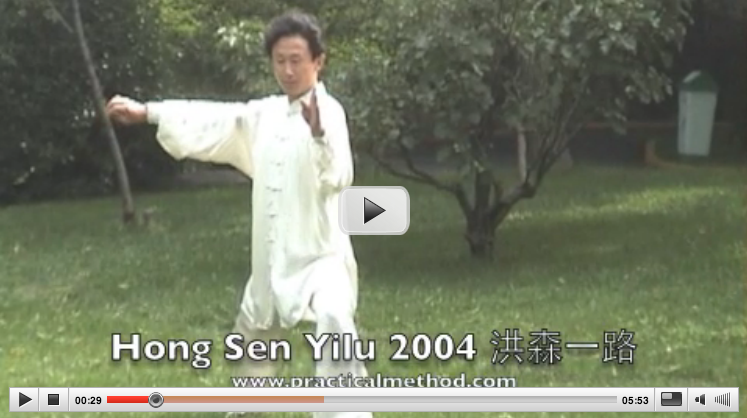
太极拳名家洪均生先生是太极宗师陈发科的入门弟子,一生致力于太极拳的研究,其功底深厚、松园缠 绵、缜密雄浑,在国内外影响很大,我成为师爷的再传弟于,实为三生有幸。 Read more
Chen Style Taijiquan and Hunyuan Taiji email: practicalmethod@qq.com
View posts in sub-category:
Application Articles Body and Posture Class (Workshop) Notes Common Errors Glossary and terms Hunyuan Knowledge-Movement Explanations Learning Method Principle-Concept Principle-List Principle-Rule Principle-Technical Push Hands Quotations Routine Names Routines Videos Stories Student Evaluations (Private) Taiji Apparatus Taiji FAQ Taiji Sword Thoughts and Understanding Workshop and Class Notes
Excellent Article. It serves as a good reminder. Please be patient. It is being translated into English.
太极拳名家洪均生先生是太极宗师陈发科的入门弟子,一生致力于太极拳的研究,其功底深厚、松园缠 绵、缜密雄浑,在国内外影响很大,我成为师爷的再传弟于,实为三生有幸。 Read more
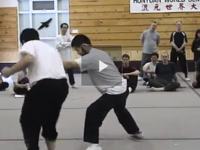
This is a record of the 2003 Hunyuan World Seminars held at Camp Van Es outside of Edmonton, Alberta, Canada. In this 14-chapter, 83-minute video, master Chen Zhonghua taught theory and practice of taijiquan. There are tons of applications and push hands. Master Chen Liansheng of Holland was a guest at this event.
Author: Chen Zhonguua Length: 83 min. In: English Year: 2005 Difficulty:3/5 At:Edmonton
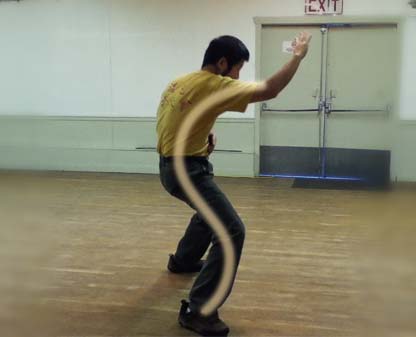
Power in Taiji comes from rotation, but how does rotation generate power?.
The key is S-Line structure that can transform rotation to movement.
Power and stability in rotation only come from proper S-Line alignment.
See Taiji S-Line Video Training for detailed explanation.
Taiji S-Line Demonstration Clip
Here is a short clip on the importance of mastering the concept of Zhuan Guan.
Training video on Zhuan Guan Zhuan Guan Online Video Trailer
Master Chen description on Zhuan Guan ( point 19 )
Hi Master Chen, lately I have been feeling a rotation or opening and closing of the lower back which seems to slightly precede and facilitate the switch from kau to kua and turning of the waist. Should this be persued or ignored?
Three months in taiji and he just started sword. This is the first taping.
Master Chen, I have a question for you related to the use of the dantian and coccyx. In reading the book “Chen Style Taijiquan Practical Method, Volume One: Theory” which you translated from Hong Junsheng’s writings, it says that the sinking of the qi to the dantian has a lot to do with the actions of the coccyx, and that the coccyx should actually curl up backwards. Read more
Every move must have three steps: contact, fill up and release. If this procedure is followed, a push is not a push instead, it is to release the opponent. Therefore, no effort. In this video taken at a workshop in Victoria, B.C. Canada, Master Chen demonstrated the procedure on Trevor Juuti of Drayton Valley, Alberta, Canada.
Two videos:
Front View
Read more
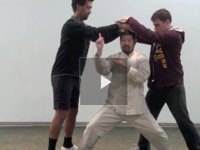
Suspended head is a taiji concept that refers to the state of the spine line being erect at all times. When done right, the head is always suspended like being pulled from above or having something underneath it that provides support.
Contents: 1. Introduction. 2. What is suspended head? 3. How does not work? 4. Connected. 5. Test it out. 6. Conclusion. Author: Chen ZhongHua Length: 21 min. In: English Year: 2010 Difficulty:3/5 At:Edmonton
Contents:
1. Introduction. 2. Embrace the Head. 3. Can two moves be identical? 4. Expansion. 5. Energy and Shape.
Author: Chen ZhongHua Length: 27 min. In: English Year: 2010 Difficulty:1/5 At:Edmonton

Dagos is a 17-year old in Edmonton, Canada. He has been studying from Allan Belsheim for two years attending evening lessons.
The grandmonk Yunxing said: During your teen aged years, you should repair yourself; in youth, you should face yourself; in adulthood, you should expand yourself; and in old age, you should complete yourself. In spring, you should be upbeat; in summer, you should raise yourself; in the fall, you should be diligent; and in winter, you should be retrospective. The four quarters of human life and four seasons of the year. Know yourself.
—That’s a lot of stuff to digest. Better get something to eat first. Philosophical words are good for the smart and the fool. The average guy needs actions such as what the next meal will be.
 |
Preface I would like to express my sincere gratitude to Master Chen Zhonghua for his dedication to promoting Chen Taiji in the Ottawa (渥太华) area. For more than a decade, Master Chen has made regular visits to Canada’s capital, ensuring that his disciples, students, and other Taiji enthusiasts receive proper training, grasp the principles of the Practical Method, and deepen their understanding of Taoist philosophy and Chinese culture. |
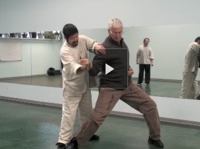
Concepts covered in this 32-minute video: 1. Three Way Split. 2. How to be continuous and don’t stop the momentum. 3. How the three way split functions and enhances fajin skill. 4. How to find the point to fajin from. 5. How to find the one point to fajin to. 6. Lever point. 7. Demarcation line.
Author: Chen ZhongHua Length: 32 min. In: English Year: 2010 Difficulty:4/5 At:Edmonton
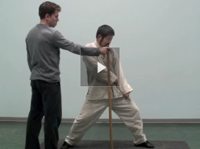
This is the third mini lesson on the topic of tossing. This one deals with the nature of tossing in turns of energy, not physical movements and shape.
Author: Chen ZhongHua Length: 11 min. In: English Year: 2010 Difficulty:4/5 At:Edmonton
Having just arrived home from the frozen tundra of Edmonton, it’s nice to be back in Tampa. The seminar was just what I needed. If any of you have spent time refinishing wooden furniture you may appreciate this. Start with an old scratched up painted and confused piece of wood like a bookcase and strip it all the way down to it’s base, sand out the scratches smooth so the original grain shows clearly. Then oil & polish it. Read more