Yilu corrections. Presenter: Chen Zhonghua Length: 79 min. In: English Year: 2020 Difficulty:2/5 At:Edmonton Chen Zhonghua Taiji Academy埃德蒙顿陈中华太极馆
Read moreChen Style Taijiquan and Hunyuan Taiji email: practicalmethod@qq.com
View posts in sub-category:
Application Articles Body and Posture Class (Workshop) Notes Common Errors Glossary and terms Hunyuan Knowledge-Movement Explanations Learning Method Principle-Concept Principle-List Principle-Rule Principle-Technical Push Hands Quotations Routine Names Routines Videos Stories Student Evaluations (Private) Taiji Apparatus Taiji FAQ Taiji Sword Thoughts and Understanding Workshop and Class Notes
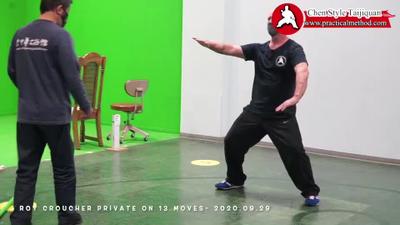
Master Chen Zhonghua corrected Roy Croucher’s first 13 moves of Yilu.
Presenter: Chen Zhonghua Length: 56 min. In: English Year: 2020 Difficulty:2/5 At:Edmonton Chen Zhonghua Taiji Academy
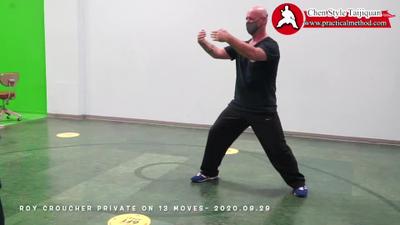
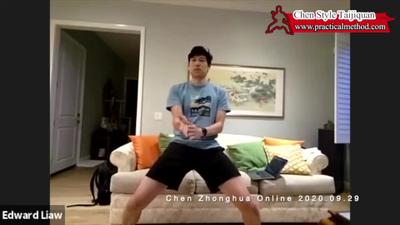
Foundations corrections on Sept. 29, 2020. Master Chen Zhonghua used the three primary foundations exercises (Twisting the Towel, Six Sealing and Four Closing, and Fetch Water) to train the closing and opening of the front kua. This action is called Folding and Opening, 折叠, zhe die.
Presenter: Chen Zhonghua Length: 64 min. In: English Year: 2020 Difficulty:2/5 At:Edmonton Chen Zhonghua Taiji Academy
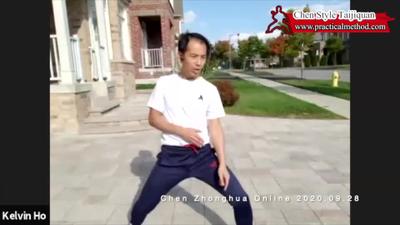
Master Chen Zhonghua’s online class on Chen Style Taijiquan Practical Method on Sept. 28, 2020.
This class is on foundations. Some topics:
1. Double negative circle.
2. Fist Draping Over Body.
3. Turning Flowers and Play with Sleeves.
Presenter: Chen Zhonghua Length: 65 min. In: English Year: 2020 Difficulty:1/5 At:Edmonton Chen Zhonghua Taiji Academy
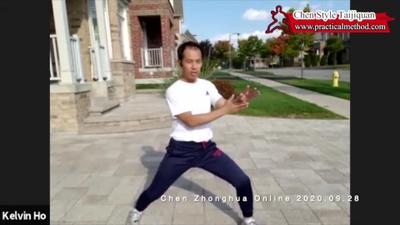

…during the Sept 23 Zoom class GM got that gleam in his eye, we’ve all come to know, “Little sparrow wags its tail…” and he went on to share a story about developing the skill of intention and about the skill of not telegraphing intent through micro-level somatic signals…
…what is the essential nature of Peng? …is there room for creativity in training processes as a PM beginner? …could be that how we answer these questions will affect the speed of our learning and our ability in PM over time, maybe…this is a speculative piece…

… I have been telling Anton and Eric that my review of their lesson with GM, above date, was already submitted to the PM website, but I can’t find it anywhere, must have made an error in saving or posting or forgot to rub my magic ring, no really guys the dog ate my homework, anyway here it is, though I suspect the original version contained some absolutely brilliant insights that would have improved your training immeasurably, c’est la vie… Read more
Click to view video: Suzhou Practical Method Practice in the Park 2020.09.22. 苏州陈中华太极馆2020.09.22
…class was a part of the online Zoom ‘Make it Real’ series of lessons, focusing on the double-positive circle…be sure to check out the posted video this review relates to…
GM reviews specific elements of ‘6 sealing, 4 closing’ movement…or Roy’s body get’s adjusted, again, some more.. Read more
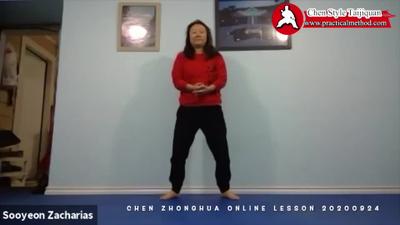
Yilu corrections for students. Mostly starting from Cross Hands. Presenter: Chen Zhonghua Length: 60 min. In: English Year: 2020 Difficulty:3/5 At:Edmonton Chen Zhonghua Taiji Academy
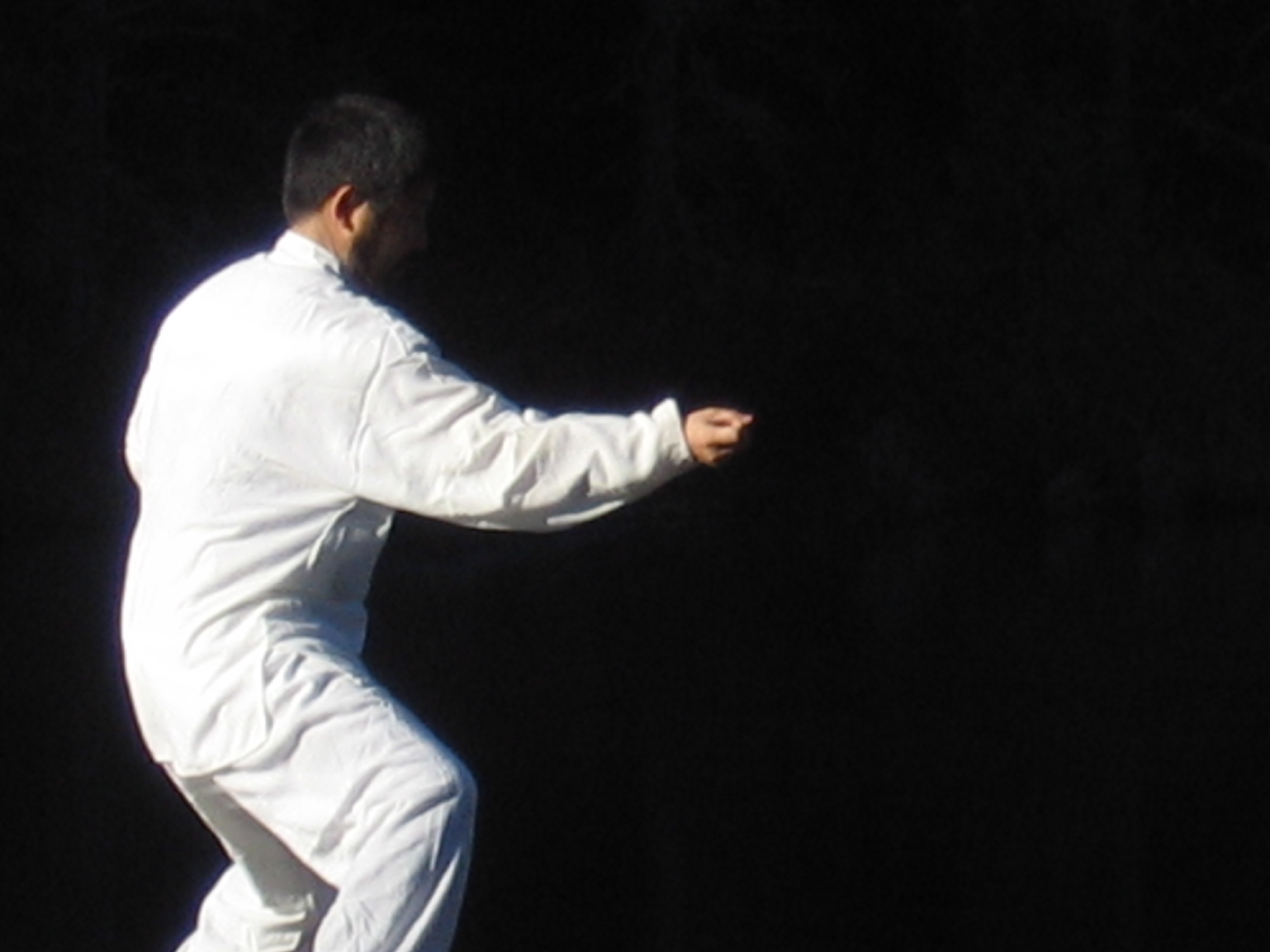
After many years of watching Master Chen practice taiji, it occurred to me that he moves like a predator. I have always known that he makes micro-adjustments in each muscle when he does the form, but watching it has always felt mechanical; like he is a machine, able to move each joint in his body independently. But, when I watched my cat hunt for the first time, I realized that his movements are actually very natural. Read more
Quick notes from my private lesson with Master Chen – Twisting The Towel
– assuming you know the basics adopt proper training stance with left hand forward and right hand rearward, distance between hands is the length of your opponents elbow to their wrist or hand.
– create 2 horizontal tracts, 1 thru the mid section and 1, in this case with the right hand moving forward, forearm parallel to the ground. Without proper guidance we only create 1 tract.
– the 2 tracks can only be created if if we lock or create a bite, in this case on the left side of the body
– to create the lock or bite we must stretch.
– push dow on the thigh muscle, open the kua and stretch in opposite directions, this is the lock or bite it cannot move.
– right hand can now begin moving forward.
– open the right kua and drop the right shoulder to cause compression, this will force the elbow in toward the dantien.
– the hand can now mov forward in a straight line, extend through the index finger.
– when the hand reaches a certain point in travel we must lock the shoulder and allow extension to continue by opening the elbow. to do this we must actiivate the small muscle on the inside of the elbow, This is very difficult and requires much training
– throughout the exercise the spine must be pulled up or stretched.
– when the right hand reaches full extension the process can now be reversed with the left hand moving forward.
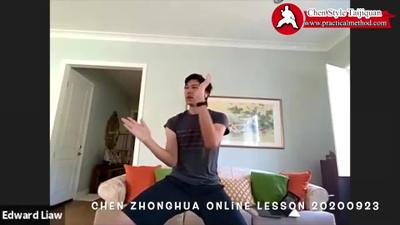
Chen Zhonghua’s Practical Method Online Lesson on Sept. 23, 2020. This lesson focused on the 3-count Cloud Hands.
Presenter: Chen Zhonghua Length: 62 min. In: English Year: 2020 Difficulty:1/5 At:Edmonton Chen Zhonghua Taiji Academy
Exercise 1
Open the kua to cause a horizontal rotation. Lock the top by using one hand to the hold the wrist on the other side. Stretch the fingers. Where the middle finger is pointing at changes as the rotation caused by the kua happens.
Open the right kua to turn left.
Open the left kua to turn right.
Don’t let the left knee point down when opening the left kua.
Read more
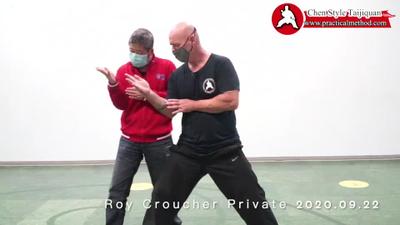
Master Chen Zhonghua’s corrections on Roy Croucher’s Six Sealing and Four Closing. It covers the basic function of the exercise and various subtle points. Presenter: Chen Zhonghua Length: 57 min. In: English Year: 2020 Difficulty:1/5 At:Edmonton Chen Zhonghua Taiji Academy
Read moreMaster Chen Zhonghua’s online lesson on Chen Style Taijiquan Practical Method on Sept. 22, 2020. This lesson focused on the double positive circle. Training steps of locking the arm onto the torso; rotate horizontally, rotate vertically; and rotate three-dimensionally.
Presenter: Chen Zhonghua Length: 65 min. In: English Year: 2020 Difficulty:1/5 At:Edmonton Chen Zhonghua Taiji Academy
We started with double positive circle.
We used a rubber cord to tie to elbow to the waist, so that the elbow does not move by itself.
Read more
Upshaw Practical Method Taijiquan Broadsword 1st recording 20200921

This is Roy Croucher’s second private lesson. This lesson focused on the mechanics of Fetch Water, one of the foundations exercises.
Presenter: Chen Zhonghua Length: 55 min. In: English Year: 2020 Difficulty:2/5 At:Edmonton Chen Zhonghua Taiji Academy
Practical Method requires that the elbow cannot be hyper-extended. It cannot be strange. In our special language/terminology, we open the elbow with a result that it becomes lively (活).
This exercise is designed to form a habit that the elbow is always slight bent.
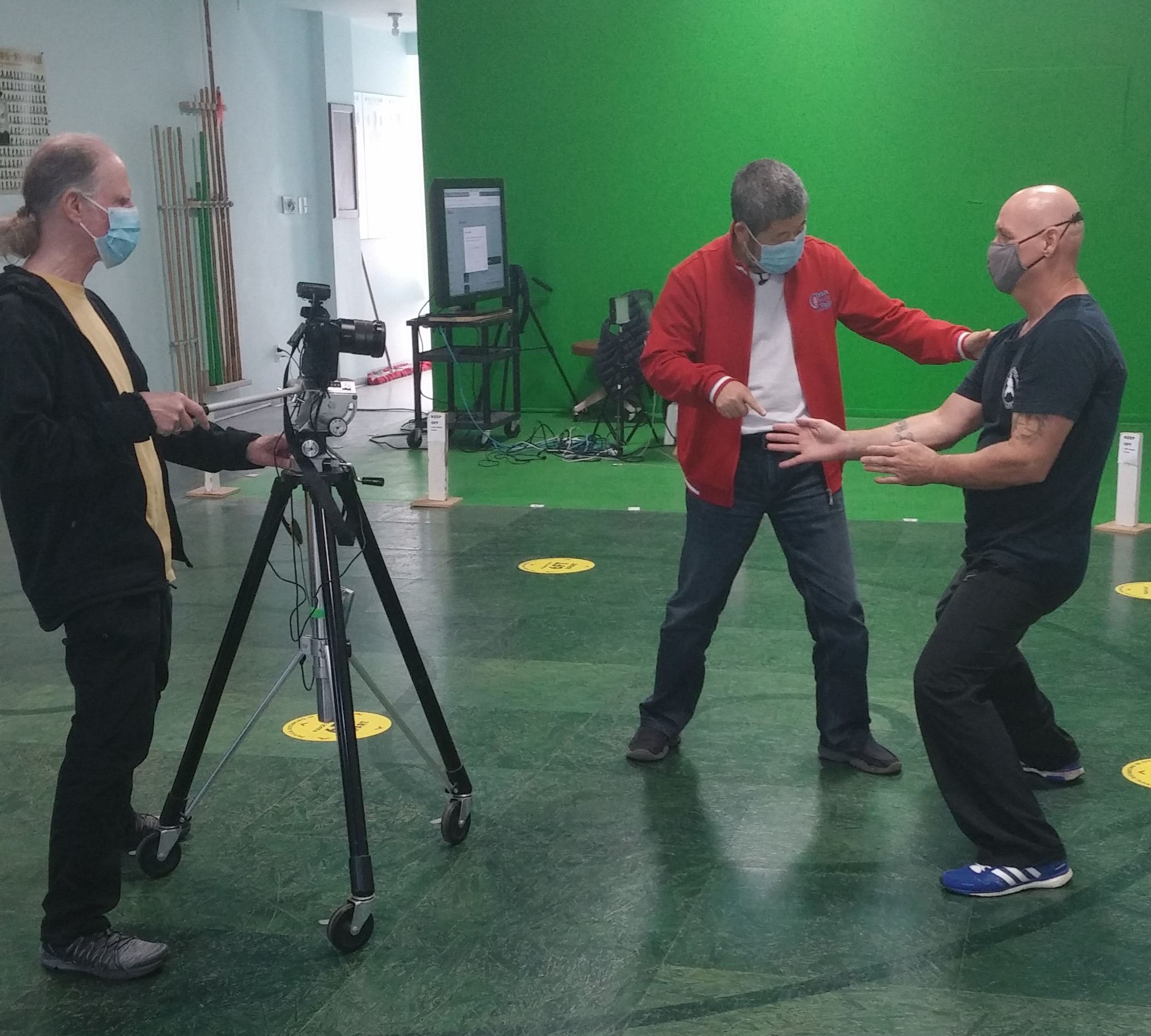
twisting towel
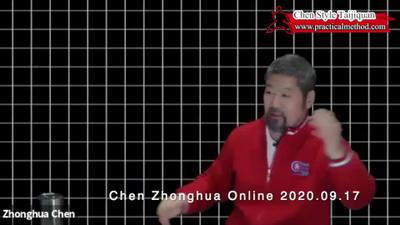
Chen Zhonghua’s online lesson on Chen Style Taijiquan Practical Method on Sept. 17, 2020.
Presenter: Chen Zhonghua Length: 58 min. In: English Year: 2020 Difficulty:2/5 At:Edmonton Chen Zhonghua Taiji Academy
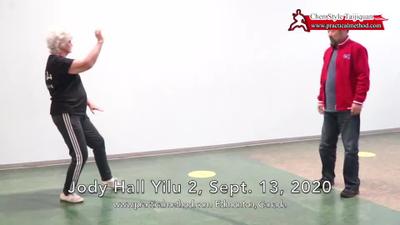
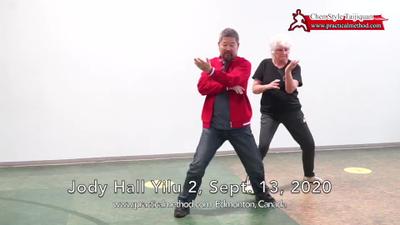
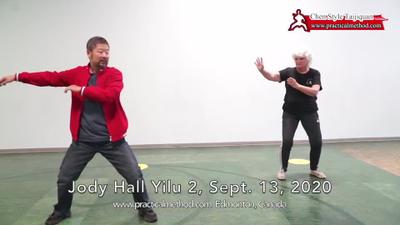
Master Chen Zhonghua’s Yilu correction for Jody Hall. This is part two. The first part covered the first 13 moves.
Presenter: Chen Zhonghua Length: 15 min. In: English Year: 2020 Difficulty:3/5 At:Edmonton Chen Zhonghua Taiji Academy
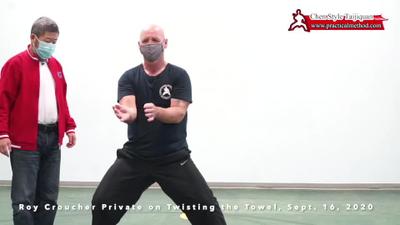
This is Roy Croucher’s first private lesson in this series. In this video, he is corrected on the foundational exercise of Twisting the Towel. Many important aspects of the Chen Style Taijiquan Practical Method are covered. A particular point in this video is how to stretch the vertical line in order to stabilize the kua. One of the kuas must be stable while the other does an opening move. Presenter: Chen Zhonghua Length: 54 min. In: English Year: 2020 Difficulty:1/5 At:Edmonton Chen Zhonghua Taiji Academy
Read more-two things I have been thinking about my practice in the past couple of days: 1. the new task of ‘resetting’ my body, given me by GM, is more profound than it seems, 2. the process of how you learn is as at least as important as what you learn
1.
-the task GM has given me may be the most difficult one I’ve ever been given
-not only does it encompass a complete re-working, re-tooling, re-creation of my entire physical self it implicitly tasks me to begin to practice PM all-day long, not jibengong all day long, but finding ways to subtly inject elements of training into every action
-my body awareness and sensitivity will have to go up more than a notch, a quantum leap would be more descriptive, and my ability to accept and work with my cognitive-emotional states will have to ratchet up a notch also
-the task is to ‘re-set’ my body so that it produces expanding Peng (redundant?) energy without any observable or perhaps measurable tension in any body tissues, esp. the contractile muscles, ligaments and tendons
-this is proving to be extremely challenging and is of course affected by my psycho-emotional states, try relaxing contractile tissues while in pain (emotional or physical)
2.
-in keeping with working on my assigned task I noticed that the class last night at the Edmonton studio was remarkable in a couple of ways
-firstly, we had a visitor, GM’s newest disciple Sooyeon Zachrias, who was a most delightful addition to our practice group
-secondly, I found myself fondly remembering my experiences at TigerClaw Gung Fu School in the ’70’s when I trained & and competed in kickboxing, we had a pretty informal competition class atmosphere and we regularly teased and joked with each other and the teachers/coaches
-our group last night was ‘playing’ with each other, there was joking, and teasing and relaxed informality
– we were all laughing out loud, but respectful, nothing out of line or intended to be anything but supportive
– Sooyeon Zachrias mentioned how she was enjoying the training experience with others as mostly she only attends workshops in MapleRidge, thank you Sooyeon for reminding me that the time I share with my brothers and sisters in this art gives me something different from the hrs and hrs I spend working on PM alone
-not saying every class has to be a stand up session or that no laughter means its not a good class, I am trying to say that the moments we share in class are precious
– we all have the physical pains of trying to grind away the rough parts of our joints and the psychological pain of removing from our souls anything that fails to make room for Peng
-hope this is an okay subject to post on PM website
-learning to live a breath at a time
Chen Zhonghua’s Sept. 15, 2020. Presenter: Chen Zhonghua Length: 63 min. In: English Year: 2020 Difficulty:2/5 At:Edmonton Chen Zhonghua Taiji Academy

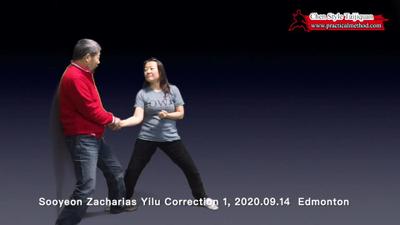
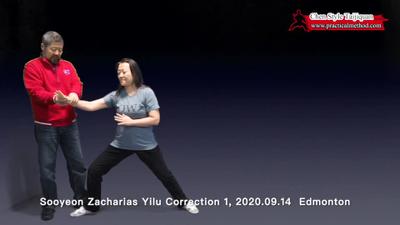
Sooyeon Zacharias Yilu corrections part 1.
Presenter: Chen Zhonghua Length: 16 min. In: English Year: 2020 Difficulty:3/5 At:Edmonton Chen Zhonghua Taiji Academy