Knowledge
View posts in sub-category:
Application Articles Body and Posture Class (Workshop) Notes Common Errors Glossary and terms Hunyuan Knowledge-Movement Explanations Learning Method Principle-Concept Principle-List Principle-Rule Principle-Technical Push Hands Quotations Routine Names Routines Videos Stories Student Evaluations (Private) Taiji Apparatus Taiji FAQ Taiji Sword Thoughts and Understanding Workshop and Class Notes
http://www.youtube.com/watch?v=opFoeoTV7ks&feature=youtu.be
[wowslider id=”38″]
Master Chen Zhonghua’s Phoenix Workshop
October 15 (Tuesday) to 18 (Friday)
Read more
 Clip from Daqingshan lesson on primary taiji move which comes from forming a line that has constant tension. Taiji movements are divided into primary movements and secondary movements. Primary movements are actions and secondary moves are the transitional moves that connect one action to another. Presenter: Chen Zhonghua Length: 4 min. In: English Year: 2013 Difficulty:3/5 At: Daqingshan
1. Beginning. 2. Two points stretching out. 3. How to go down. 4. How to shift center. 5. Don’t move the fulcrum. 6. Don’t move and yin yang separation. 7. Door hinge. 8. Internal movements. 9. Adherence. 10. Sinking. Presenter: Chen Zhonghua Length: 60 min. In: mostly Chinese with a bit of English Year: 2012 Difficulty:3/5 At:Singapore
In 2009 on Daqingshan, Master Chen Zhonghua instructed me to keep one point on my body stable and fixed during push hands practice. The location of the point was up to me; I could make it be the lower back, rear foot, etc. However, the most important thing was to maintain the integrity and stability of the chosen point. Read more
I just started training foundations with an interval training timer app on my Android device. It is a great way to allot a fixed amount of time per exercise and allow one to focus entirely on certain aspects of the body method, energy alignment, etc. Read more
 Master Chen teaches a rule in Taiji movements that requires all actions to start from the Dantian and then ends in the Dantian.
Presenter: Chen Zhonghua Length: 3 min. In: English Year: 2013 Difficulty:1/5 At:Daqingshan
Originally published in 2007
We are masters of tools and in return, tools also control us. Through years of teaching in North America, I have come to the conclusion that weapons and device training must be started at the beginning, not at the end. Read more
Private lesson for Jonathan Hormadaly, yilu correction, with demonstration of move application. Circle in push hand., internal circle.
Presenter: Chen Zhonghua Length: 81 min. In: English Year: 2012 Difficulty:4/5 At:Toronto, Canada

Facebook Event: https://www.facebook.com/groups/practical.method.toronto/permalink/513006922096561
Feb. 9, 2014:
Agenda:
6:30 am – 10 Yilus
8:00 am – Examine our negative circles
1. Hand-elbow yin yang split. 2. Everything moves except where touched. 3. How the 45º works. 4. Don’t move the shoulder. 5. Sequence of movements. 6. One focal point only. 7. How to penetrate with strength. 8. The line in body movements. 9. Cut corners: how to make a circle. Presenter: Chen Zhonghua Length: 57 min. In: English Year: 2013 Difficulty:3/5 At:Maple Ridge, B.C. Canada
Detailed Yilu corrections and talks on practical method principle. Part of a series of one hour private lessons, Master Chen covered different areas of taiji for each student as other private student are watching.
Presenter: Chen Zhonghua Length: 95 min. In: English Year: 2012 Difficulty:1/5 At:Phoenix, USA.
1. Chen Zhonghua demonstration: Yilu 3-13. 2. Practice. 3. Differential. 4. Energy transmission. 5. Connection spot. 6. Hollow chest. 7. Tipped Dang. 8. Error corrections. 9. 3-dimensional circle. 10. Taiji 3-Theory.
Presenter: Chen Zhonghua Length: 55 min. In: English Year: 2012 Difficulty:4/5 At:Toronto, Canada
of
Grandmaster Hong Junsheng
General Principles
o Peng
Peng has been one of the most talked about topics in Taijiquan. Hong defined Peng as having two meanings: one is the upward expanding action of ward-off and the other the overall combined expanding energy that permeates all moves of Taiji. It is the latter meaning of Peng that is most important to him. “Without Peng, there is no Taiji.” Read more
Since July 2011, Steve has been learning taiji from Master Chen in Toronto.
At a higher level when the inside of the body is stretched out, the outside frames (structure) of the body should start to close. This is in compliance with the principle of “the energy must be released but structure remain intact”.
Here are some simple explanations of the structure and energy movements of the knee. Read more
Yilu hands on corrections for 12 students at the 2012 September Toronto workshop. This is a good video to see common problems ranging from beginners to intermediate students. Length: 60 min. In: English Year: 2012 Difficulty:2/5
There are 5 stages of practice. We can also call them five stages of learning.
- 1. Choreography. This is the first stage. The student only learns to remember the choreography of the routines. Memory of the movements and names of the moves can be used as a method for learning.
- 2. Coordination. At this stage a sudent tries to put the movements into a logical coherent synthesis.
- 3. Clarity and Energy. The body must be able to clearly show what the practitioner is trying to accomplish.
- 4. Application. The student is applying the movements and techniques in his mind.
- 5. Flow. All movements must flow while keeping all of the above principles.
Note: This is not the 5 levels of gongfu in Taiji. This is just the chronological stages of learning.
Leaking out of energy is a general error among Taiji learners. It occurs in many places and happens quite often.
This is quite difficult to explain. Let me use an example and imagine the following scenario:. Read more
Master Chen went over in detail the concept of Revolution and Rotation, an important principle developed by GM Hong. Also demonstrating its application in push hand
Presenter: Chen Zhonghua Length: 48 min. In: English Year: 2012 Difficulty:3/5 At:Phoenix, AZ. USA
Xu (1)虚: Empty.
Shi (2) 实: Solid.
One is empty while the other one must be solid. Taijiquan is the art of Empty rooted in the Solid and vice versa.
Empty and Solid must be equal. Use the feet as an example. One cannot stand on one foot and then the other. One must be on both feet at all times. But one foot is used to work while the other is used to support.
This is the overall way of action in Taijiquan.
Taijiquan practice requires that the body must possess five bows in order to have power. There are different versions of what the five bows are. In the Chen Style Taijiquan Practical Method system the five bows are defined as:
- Hand to Hand.
- Foot to foot.
- Hand to foot (set one).
- Foot to hand (set two).
- Torso.
Dear Master Chen,
If I listened correctly you don’t move but rotate to change angles. I have a question about the positive circle. In the first half if you lead with the elbow it seems the angle in the elbow gets sharper. Is that a move or does that happen through rotation? As far as know a rotation isn’t considered a movement. Also what happens when you keep “pushing” the elbow in the line of the shoulder and hand to create power? It look likes the elbow is dropping away from the line which should make the structure weak. I can’t seem to unite these directions although I think I understand them separately.
Greetings,
Richard
To experience “two ceilings”, wedge your thigh under a picnic table, push upward against the table, then, you have the “waist ceiling.” If you don’t have the “waist ceiling,” you don’t have the “crown ceiling” either.
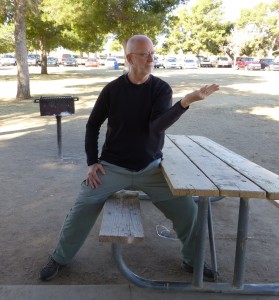
(In the photo: Marvin Glotfelty)
Yi Lu is one of two forms in the Chen style Taijiquan lineage of Chen Chanxin who condensed the postures of the 7 barehand forms of Chen Wanting into 2 forms; Yi Lu and Er Lu. Yi Lu is the training form of Chen style Taijiquan.
1. Rotation and movements. 2. Fetch water exercise. 3. Loose and tight. 3. Breathing. 4. Connected spiral. 5. How to touch. 6. Alignment and energy movement. 7. Chen Zhonghua demo of Yilu 13-21. 8. In with elbow. 9. Sinking involves a stretch. 10. Taiji movements are not normal. Read more
One of the most important tasks of Hunyuan Qigong practice is to “calm down the mind of the monkey and the intent of the horse.”
Read more
” … the problem is not speed, but timing. Rather than moving too slowly, most students of taijiquan will in fact move too soon. This point stresses the importance of push-hands training which develops the kind movement and timing necessary to be able to receive the energy of your opponent and then to send it back out like a spinning tire.” A quote from Master Chen