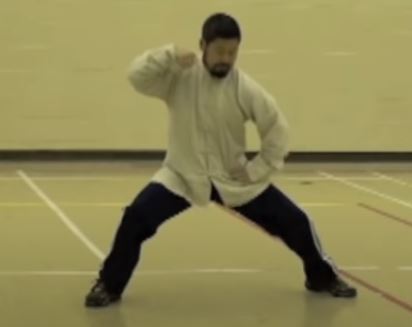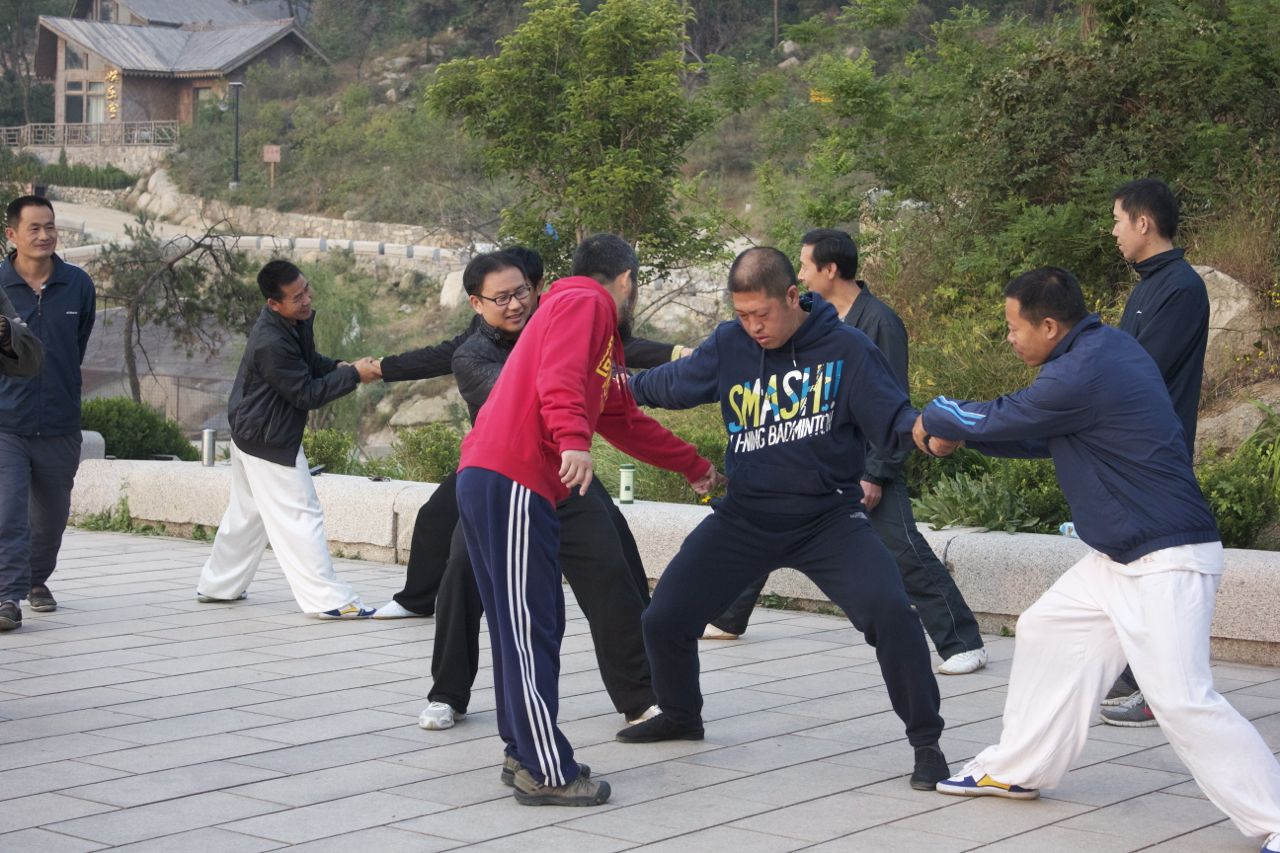
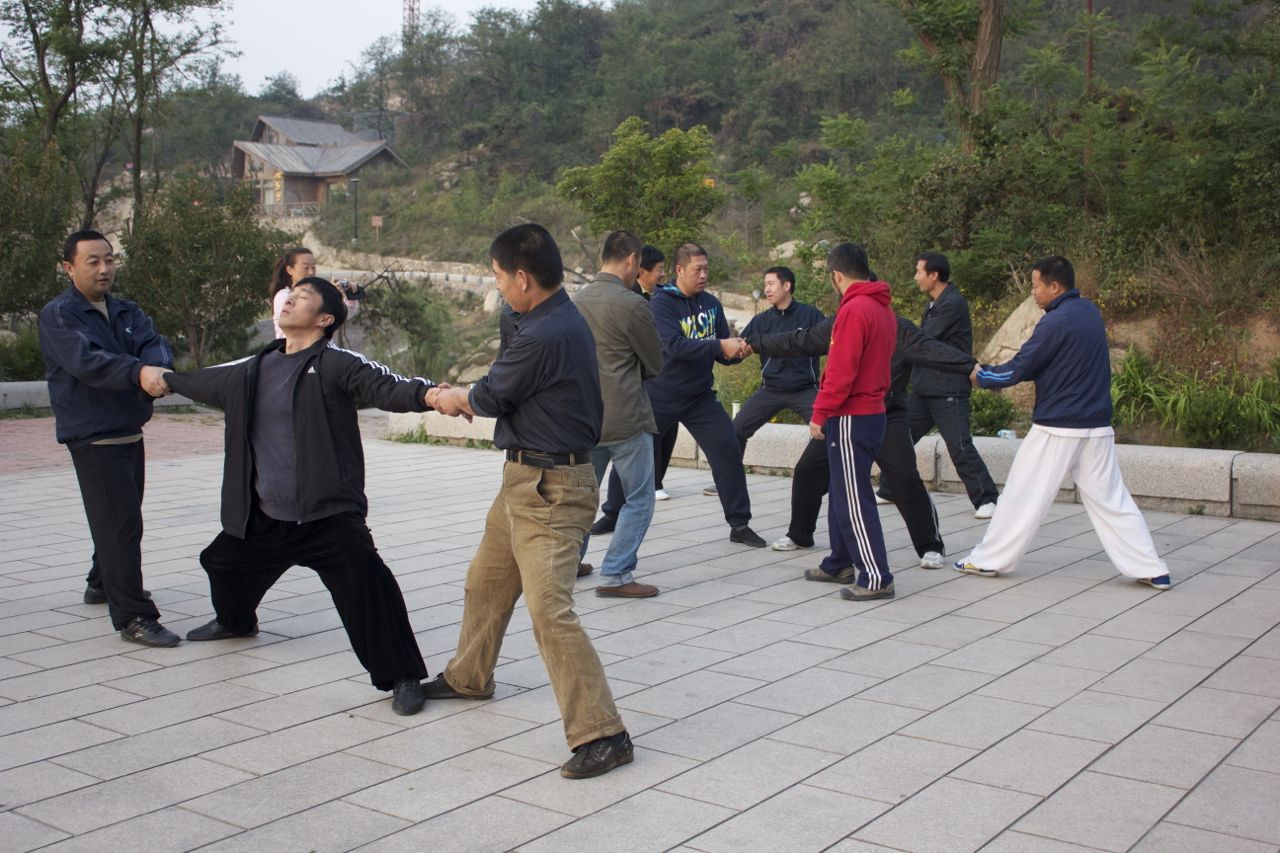
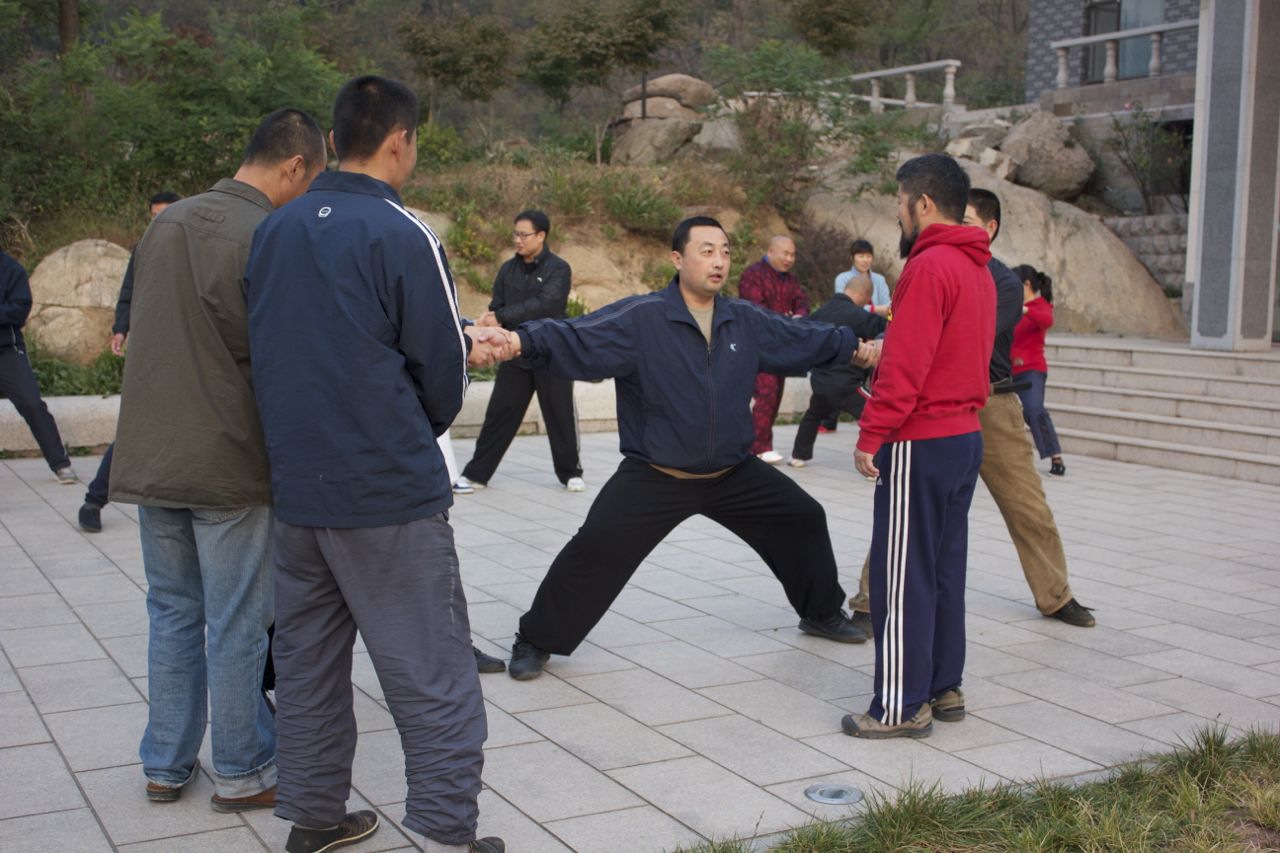
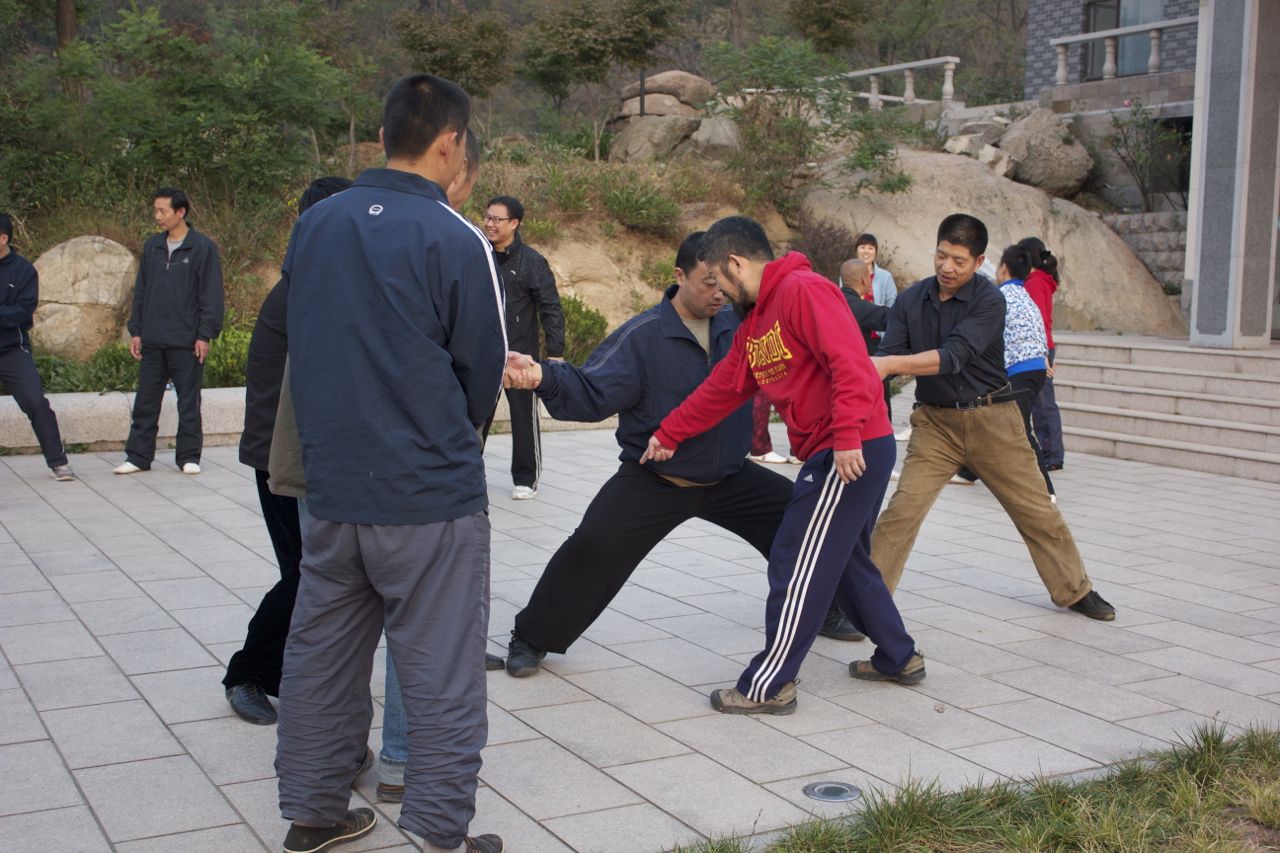
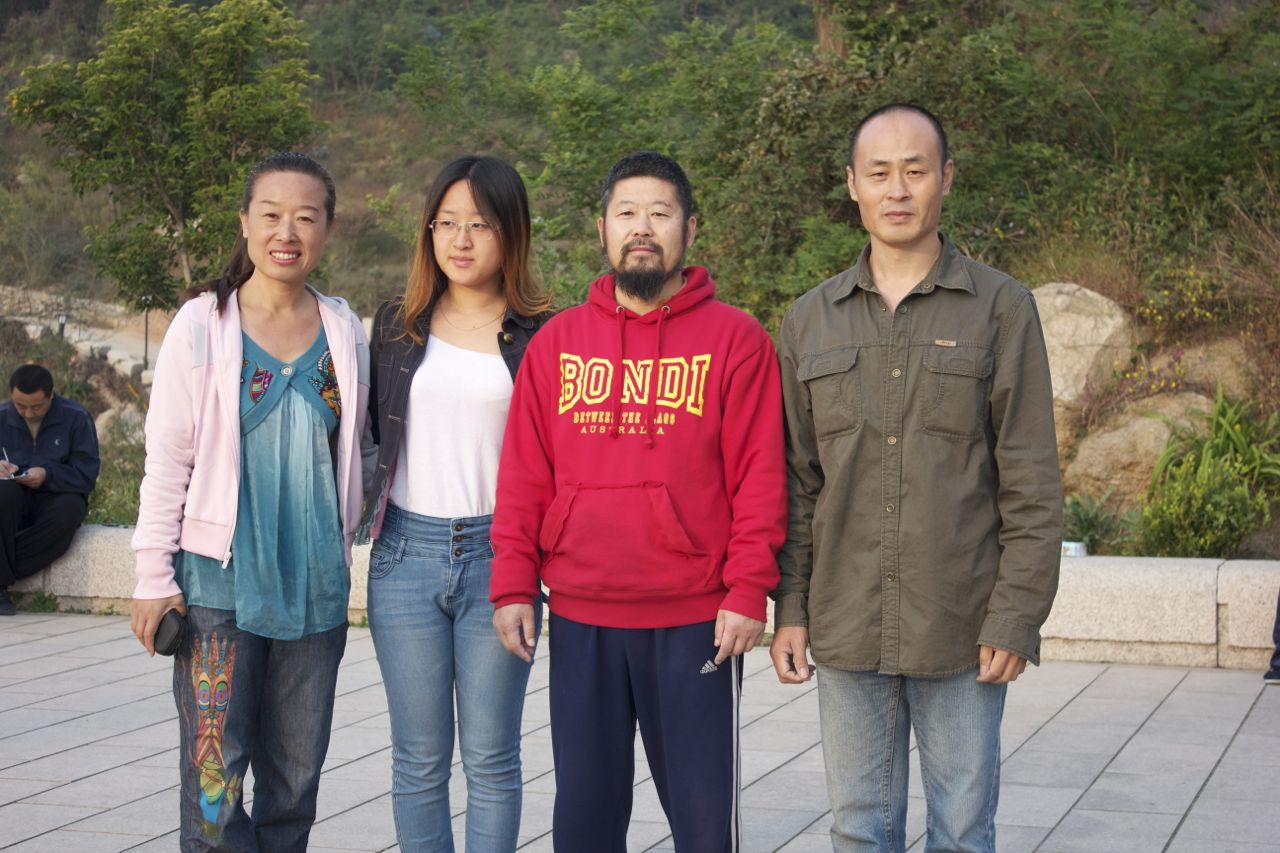

Master Chen taught the two main taiji energies: push and pull. Every push must be a pull. Showed and did an exercise on how to turn the body into a rotation spool to create power.
Knowledge
View posts in sub-category:
Application Articles Body and Posture Class (Workshop) Notes Common Errors Glossary and terms Hunyuan Knowledge-Movement Explanations Learning Method Principle-Concept Principle-List Principle-Rule Principle-Technical Push Hands Quotations Routine Names Routines Videos Stories Student Evaluations (Private) Taiji Apparatus Taiji FAQ Taiji Sword Thoughts and Understanding Workshop and Class Notes
Filmed by James Tam of Ottawa, Canada in July, 2012
Read more
 Ming’s post below captures most of the material Master Chen shared on the weekend. Here are a few things I wrote down or was told directly over the course of the weekend.
Main Theme: “Taiji movement must be Differentiated and Sequenced; in order to move like this, repetitive practice of Yi Lu is needed to habituate the body”, Read more
Rare footage of Grandmaster Hong Junsheng. Li Zongqing was one of his earlier disciple and assistant. This video came from a 1980s film. It was on an occasion that they demonstrated for the governor of Shandong Province in Jinan.
DAQINGSHAN SURVIVAL GUIDE V1.0
so a lot of people i’ve talked to have said they wanted a in depth guide on stuff they might need to bring to the mountain, now this guide is less important for people here for shorter stays so if you’re here for less than a month it wont be so important, but if your here for more than 2 months this list might make your stay much more enjoyable, so here’s my first revision of the daqingshan survival guide apologies in advance for the terrible grammar and spelling Read more
”if the move up and down are equal, the center becomes truly empty”—— “In ancient times the master would never let you feel it…..if you don’t feel it, you will never get it….once you feel it, it’s only a matter of time….”——–”they MUST equalize….”
Thanks to Bruce Schaub who typed in the quote from Ireland workshop video. Please check out Ireland 4 video (now on new video server) for demonstration on turning of the joint and other topics
http://practicalmethod.com/2010/05/ireland-workshop-2010-4-online-video-trailer/
“So when you feel you are doing it right, you are absolutely wrong; when you do it right, you don’t know it. There is 0 biofeedback, so the only thing left is to watch your own video and listen to the teacher’s instructions.” Master Zhonghua Chen
The Edmonton Full Time Training session will be held September 24 until December 21, 2012 so let me know soon if you will be attending. Edmonton, the Home of Grandmaster Chen Zhonghua, has a reputation as being able to give you an incredible amount of instruction for the time you are here.
We specialize in helping beginners or advanced practitioners to learn or correct Practical method Foundations, Silk Reeling, Theory, Applications, Yilu, Erlu, Chen Sword and Broadsword, Hunyuan Qigong and Hunyuan 24 form. Contact me at: allanbelsheim@shaw.ca and check for more
At DaQingShan, Master Chen was discussing push hand with someone, I was observing at the side, I could not resist and said “I have a method”. Master Chen, upon hearing, stood aside, the other person kept the same posture, I used his original posture, applied a effective technique. I held on to that person, as he was working with me, I could not let him fall.
Read more
This is my 603rd repetition of the form in 2012.
I started learning the Yilu form in October 2011 and only recently completed learning all 81 moves. This was probably the 5th-6th Yilu I have performed end-to-end without interruption. My moves in the 2nd half are still not very smooth and full of mistakes.
This place is called Austimer Beach, about 1.5 hour train south from Sydney. I was trying to catch the sun rising, but too bad it was blocked by the cloud that morning.
At the second annual Daqingshan Hong Junsheng International Taiji and Health Conference and Competition.
Steve lost to Wang Feng at the Second Daqingshan Hong Junsheng International Taijiquan Conference and Competition in May 2012.
架子
“架子”是“拳架”一词的更口语,更随意的说法。练太极的都把“架子”挂在嘴边上。练套路叫“走架”,叫“盘架子”。师傅对生徒练的套路里的错误加以纠正,以及为提高生的套路水平而加以指点,都叫“拨架子”,因为“拨”字,含有“拨正”和“点拨”的意思。 Read more
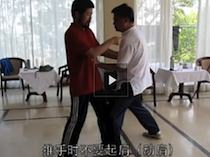
Sorry no trailer
Two videos by Chen Zhonghua. One with Michael Koh on Daqingshan in May 2011. When we push hands or making moves, one of the most common problems is that the whole body (parts other than the part used) are engaged. In this video, Master Chen Zhonghua shows Michael Koh how to push with his hands without engaging his shoulders. As you can see in the video, this is not easy to do. Presenter: Chen Zhonghua Length: 2 min. In: English Year: 2011 Difficulty:3/5 At:Edmonton, Alberta, Canada. The second video is made in Edmonton in Jan. 2012. It is 5:45 long and covers the rotation and movement requirements of the shoulder. How the shoulder can rotate 360 degree. The last topic is on Zhuan Guan.
I hope someone who knows Chinese and/or TaiChiQuan literature help me on this one. Read more
I can’t help but to be amazed by this young lad. Just look at his posture alignments. God! He is going to grow up to be an amazing TaiChiQuan master.
Master Chen,
I am starting to feel something new. It’s related to the post on the “Sweet Spot”. Is it possible to initiate movement or generate power from the elbows? I cannot differentiate the difference yet. Read more
http://www.youtube.com/watch?v=EEhJwLifhVI
check out Michael’s other Practical Method video from his youtube channel
I often heard a Taiji teacher saying to a physically strong student, “You are using force, you will need to first get rid of it, then what comes out afterwards will be Taiji energy.” What is Taiji energy? How is it used? Many people have their own opinions. However, most of them are very abstract, and difficult to grasp and understand. The more the students hear, the more confusing it comes. Isn’t that true? If the information provider is unclear himself, how can the listener understand? Read more
It was a beautiful morning in Phoenix, Arizona. Went to my Tai Chi class at 7:30am. Adam, Read more
 Eventually, the positioning of the feet and stances must also be taken into consideration and perfected. When the body is properly connected, the legs are naturally brought in and the knees pushed out as far as possible without compromising the structure of the rest of body. Read more
In terms of learning the Chen Style Taijiquan Practical Method system, the assumption is that unless you have a special method, you are not learning. You might disagree with this assumption and believe, like many others, that you are learning and making progress. Your beliefs and conclusions are based on criteria that are not taiji, therefore, they are not valid. Read more
Below are the students authorized by Master Chen to teach Practical Method
Read more
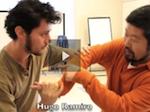
Demonstration, instruction and drills about the pulling energy of taijiquan. This is part of the Jan. 2012 Toronto workshop on Chen Style Taijiquan Practical Method. Related explanations about shoulder, elbow, kua, alignment, vertical axis are given in light of the pulling energy. Presenter: Chen Zhonghua Length: 39 min. In: English Year: 2011 Difficulty:2/5 At:Toronto, Canada