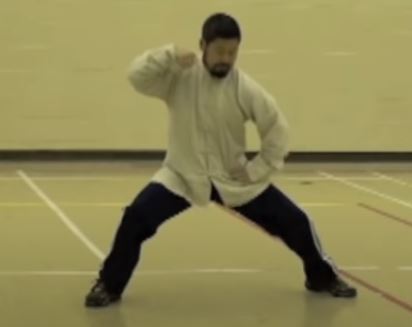
I was having a conversation over dinner with my Taiji brother Nicholas Fung about the frustrations of learning Taiji. He was wondering aloud about the method for learning. Read more
Knowledge
View posts in sub-category:
Application Articles Body and Posture Class (Workshop) Notes Common Errors Glossary and terms Hunyuan Knowledge-Movement Explanations Learning Method Principle-Concept Principle-List Principle-Rule Principle-Technical Push Hands Quotations Routine Names Routines Videos Stories Student Evaluations (Private) Taiji Apparatus Taiji FAQ Taiji Sword Thoughts and Understanding Workshop and Class Notes
[singlepic id=971 w=320 h=240 float=center]
Review and part two of the 12-form Hunyuan Qigong. Practice was conducted in front of Yulange Hotel in the clouds this morning at 5:30.
[nggallery id=45]
First three of the 12-form Hunyuan Qigong were taught this morning.
[singlepic id=969 w=320 h=240 float=center]
I was recently looking through some old notes and came across Master Chen Zhonghua’s “New Theory on the Eight Methods.” It is also known as the eight techniques. I thought this might be of interest due to the recent discussion of the Eight Methods mentioned in Rion’s notes from the Cannon Fist workshop. Read more
Below are my notes from all the remaining days of the seminar:
lower body = earth Read more
Notes:
-Talking about stretching to attain proper structure: Chemicals/toxins deposit in your ‘corners’. Eliminate all corners/creases and create the arch. No power. Structure! Read more
July 26, 27. Cannon Fist Workshop.
Thank you Master Chen and Allan for your time and excellent teaching so far. The first two days have been great! Read more
The relation between Taiji and the Taoist concept of time is a topic which Master Chen has emphasized as extremely important, Read more
http://www.youtube.com/watch?v=KOYo8Av60r4
http://www.youtube.com/watch?v=ClM7BUtlsgg
 Author: Sun Zhonghua, 19th generation master of Chen Style Taijiquan and second generation master of Hunyuan taiji. Read more
The main goal of Taiji is the transmission of power. But what does this mean? In technical terms it refers to the conversion of power from one form to another. Read more
July 11, 2010
Every move in Taiji is a downward move. This begs the question how many moves can you make before you are sitting on the floor? Master Chen says if you can make every move a downward move without going down then you have got it. The key is that downward is a rotation. This rotation is called sinking.
At lunch Master Chen compared learning Taiji to boiling water: The requirement for boiling water is 100 degrees, even if the water is 99 degrees it is still not boiling. From one perspective the water might as well still be cold because it is still not boiling; 99 degrees might as well be 1 degree. In reality 99 degrees is only 1 degree away from boiling while 1 degree is still 99 degrees away from boiling. Read more
Master Chen said there are many things he can’t do which would give the impression that he is not very flexible. But, he insists, his joints are round and smooth which means he can maneuver them freely. Maneuverability is favored over looseness. If you are not stiff, you have no power. If your joints are not round you have no maneuverability.
My first experience with Chenstyle Taijiquan Practical Method: A complete new understanding of some main principles
Hello, I’m Michael from Berlin, Germany and after being on Daqingshan Mountain for 12 days I’d like to share my first experiences with the Hong Style Taijiquan. Here at the Full-Time training I met Master Chen Zhonghua for the first time in person.
After about 7 years of practice in Chen style Taijiquan Read more
By: Chen Zhonghua陈中华. Language: English英文. Length: 19 minutes分钟. Year: 2008年
Audio problem only on trailer. Read more
When we learn the form we must copy what we see. This is not wrong. Form means to get from here to there. What’s wrong is how we get there, the way we do it. The form must look the same but the action must be exactly the opposite of what you would come up with on your own.
By: Chen Zhonghua陈中华. Length: 50 minutes分钟. Language: English英文. Year: 2004年
Shot during trip to Jinan China. There are several informative interviews at the end of the movie with Master Chen and his students.
Neutralizing is taking up the space before your opponent can and adding slightly more. I’m not sure, but maybe is the same as when Master says that there is one line with two sides to it: you follow the opponents line back and then step in on the same line.
孙中华老师继续教授。今天到24的一半。Half way through the 24 form by Master Sun Zhonghua today.
[nggallery id=18]
Practical Method Videos on YouTube
Note: I had trouble putting the same video wall in this blog itself.
While drawing the circle there must be no moving of the body. However, the body must not move. The arm must not be flimsy and must always be constantly pushing down. However, half the energy that goes down must go up. There is an invisible horizontal wall preventing the arm from going down to the ground. This is an abstract wall, and it’s placement is of your own decision and position. The head must be suspended by a string. The head pushes upwards, however, there is an invisible ceiling on top of your head preventing your head from going up. This gives you peng energy. Read more
Question, “What is it like to have no circles?”. The master answered, when you boil water, you will know that boiled water does not whistle. It whistles only when it is about to reach the boiling point. That’s because the water in the pot reached the same level of temperature.
The size of movement of each part of the body must match. For example the hand is capable of a much wider range of motion than the body, therefore the hand can only be allowed to move as much as the body does.

Thanks. Not a problem.
There are two ways of looking at this.
- For focused training you need to use the medium stance. Read more
Rion Swanson
Thank you again Master Chen and Allan for your time, energy, and patience this weekend at the seminar! It was excellent as always.
Below are a few brief notes. These are but a few key points and are as I remember so therefore may need correction! Read more
Today Master Chen reinforced a point of Push Hands with me. All the lessons that have been mentioned in class lately and our last weekend Seminar is to look for a line and Read more