Peter Wu i

by admin on 2009/10/18


via 56.com
via 56.com

Master Chen Zhonghua is one who knows his taiji, not one who is known for his reputation.

1. 混淆传承和名誉的问题

传承是练拳习武的首要问题,然而给这个问题一点思考的人极少。无论国内国外,崇拜师父是最突出的表现。 Read more

Originally written by: Ian Macrae

Maple Ridge Workshop July 25th and 26th, 2009

(A loose transcription of notes, not an organized article)

This month our workshop was in Pitt Meadows Heritage Hall. Our regular use of Thornhill Hall was preempted by the Disabled Games. What a nice big clean beautiful hall this was, notwithstanding that the A/C wasn’t working and it was almost too hot to do YiLu. Well, actually, it was too hot, so we didn’t work quite as hard as we usually do. Read more

“Forget your perfect offering/There are cracks in everything/That’s how the light gets in” -Leonard Cohen

Taiji fighting ability 9

by admin2 on 2009/05/14

Originally written by: Matej Velicky There are many stories about Chen Fake and Hong Junsheng and their fighting ability.

Read more

At a higher level, stretching moves are changed to arching moves. Arching is really a way of extension without stopping the energy flow.Arching is more stable than stretching. However, arching creates less distance than stretching.

Some examples:

  1. When moving the arm back towards your body, don’t allow your front knee to move backwards. This way, you can extend your foot hand arching length.
  2. When pushing the front arm out,  don’t allow your rear knee to move forward. This will make your rear foot-front arm stretch longer.

1. 出手不出肘;收肘不收手。 Read more

Zhan Zhuang Questions 18

by JVanko on 2008/09/01

Master Chen,

Greetings. I’m not sure if you’re interested in these things, but just in case, here are my experiences with Qigong since March 2008. Zhan Zhuang Experiences (wuji posture only) Read more

Bounce! i

by webmaster2 on 2008/08/30

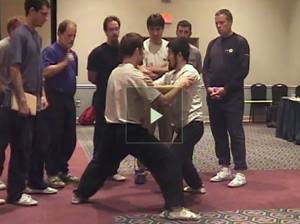
One of the characteristics of the Chen Style Taijiquan Practical Method System is the technique to bounce the opponent out. In this short video clip, Master Chen Zhonghua taught Nicholas Fung and Alex Nay to follow a simple procedure to start the bouncing sequence:

  1. Make sure that you make contact with your opponent.
  2. Always back off a bit so that you can feel you have absorbed your opponent’s power.
  3. Anchor you rear foot, or whichever foot is the farthest from your opponent. This is a two way lock. It cannot move sideways, or backwards.
  4. Lock your hand/hands onto your target. It is the same lock as your foot except the foot is locked onto the floor while the hand is locked onto your opponent.
  5. Make sure that you wiggle your hands a little bit so that they aim at your opponent’s center.
  6. Now move your waist. This move will create a tension that bounces your opponent out. This move is very much like the pull on the string of the bow as in using a bow and arrow.

Another way Master Chen teaches the students how to stick to your opponent. Master Chen believes that one of the most common errors in modern Taijiquan training is the use of other energies before “Squeezing” (press) energy is developed. The sequence of the primary four energies are:

Peng as a initial energy
Lu as a change of direction based on Peng
Ji as a step in (further energy) in addition to Lu, and
An as a result of the three previous energies.

Most people perform the four energies in an unrelated manner. They will not have progression in this way.

In the video clip below, Master Chen Zhonghua shows how two people are tied up with rubber cords to experience “snot” (sticking) energy. The aim is to make the lower body move and power up, while making the upper body to adapt and to adhere.

The knees are hinge joints, unlike ball joints. They only allow the thigh to move up and down. They cannot move horizontally.

Originally written by: John Brown

… I have been working with the bands, focusing on the instructions you have given me. Read more

Originally written by: Richard Johnson
I just spent  a long time posting my notes from the workshop.  They disappered into cyberspace when I tried to save them.  I’ll have to re-post later.

Do What You Claim 1

by Dave Dahms on 2008/08/05

Another observation I made is that pretty much everyone who has been doing taiji for sometime can tell you how taiji is supposed to be done and in most cases the things they say I don’t think are wrong but the problem I think is because everyone thinks that they are doing the concepts they talk about and that is why they are not doing them. They just think they are instead of looking at what is really going on and what is really going on is that they are not doing what they say they are doing. They are just fighting.

I think taiji should be as easy to learn as anything else because in other things you see the difference between you and an expert very easily. In taiji you see the difference between beginner and expert. In push hands so many people claim to be experts but they won’t push with you. If someone were to claim to be an expert hockey player and they can’t even skate everyone would know right away they are a fraud.

Basically Master Chen I have been thinking a lot and the more I think the more everything fits into my logic, and my logic is based off of what I see and to be true and in short the way I see it is almost everything is backwards.

Another thing is that everything not just taiji seems to be that you allow each thing to do its part and that is how something greater can be achieved.
I remember on the mountain you said the manager was worried about November and you told her that if she took care of today everything would take care of itself. It always seems that if you want something then you have do the opposite. Like if you want something to take no thought then you have to give it a lot of thinking first.

Master Chen this email is my thoughts on taiji and other things you have taught me and the reason I am sending this is because I think I am right and now that I think that I can only see how I am right so the true purpose of this email is to find out where I am wrong so any response will be apprieciated, and please hold nothing back.

First in practicing pushhands I realized what I do is nothing like the form or anything close to that. In fact what I do is  more like the opposite. The way I  saw this was if I stop in the middle of pushing with John or trying a move and then with him away I recreate the same feeling and intent I had when i was pushing him it is as if I don’t even know how to move. What happens is that my whole body is actually going upwards and even my heels the only things that are not going anywhere are my feet and the spot I was touching him.

This reminded me of how you say that it is about how fast your feet are. When I push my feet are as slow as possible. So in reality all my effort just comes back to me and my opponent does the same thing so it is who is stronger and we are both rediculously weak. I thought up an analagy.
A rocket ship needs a tremendous amount of force to move because what is pushes on moves so easily, pushing on air a rocket ship has to move enough air until the amount of air pushing it is so great that the rocket moves but a gun is much more effient because of the material and the structure. It is natures way that everything finds the easiest path. So the gun is made so that the easiest place the explosion has to go is through the barrel and the only thing in the way is the bullet. The air moves so easily that is why rocket has so much trouble moving. So I realized if you want to move then you need something that won’t budge and if you don’t want to move you need something to move.This concept seems to me as the same thing as laying the tracks. The form is a restriction and until it is no longer a restriction we can’t use it, and  the truth, is the way i see it is, that the form or proper way to move is actually freedom and that the way I move right now is the restriction. Horizontal movement versus vertical movement. The best way to move is a straight line because it transfers instantly. But we are not straight lines however Hong said seek the straight through the curve so it can be done.

When I asked Master Wang Haizhou of the Zhaobao Village what Bei Si Kou is, he said, You throw a silk (like a spider’s web) net on him. He will struggle until he cannot move any more. Then it is your time to do something.

At Master Sun Zhonghua’s apartment in Beijing, I summarized my teachings during the recent June 9, 2008 trip to China and the topic of restriction was on the top.
One of the ways of looking at our movements in Taijiquan is to divide movements into two types:
  1. Movements that causes the body to create an outer going force so that the body is made to move outwards.
  2. Movements that causes the body not to move so that the body can stay in a certain position.

These two types of movements form the proper physical structure for our taiji practice.

Most of the following relate to Tai Chi principles and form, but some are just general comments. All the comments below were either heard directly from Master Chen, or conveyed from another person who heard the lesson directly from him, or is based on my personal observation or experience. – Marvin Glotfelty Read more

What is an Effective Teacher?
by Jan Fisher

You hear a lot these days about the effective teacher. It is the subject of many books and countless journal articles. Television documentaries and radio talk shows bounce the topic around with great frequency.

The Washington Post has headlines on a regular basis proclaiming they have the secret to what makes an effective teacher. So does the Los Angeles Times. And, ASCD sells a set of video tapes entitled, “The Effective Teacher.” With the exception of the latter, none of these who write or talk about effective teachers are teachers. They had teachers, of course, in their own lives and, sometimes, they have children who have teachers. Some even have children who are teachers, but these are few and far between. Most do not have a relationship that close. But, hey, whoever said you had to know anything about a topic to talk about it? And, I had to admit it was a subject of some interest. I wanted to find out the answer—just what is an effective teacher anyway?

I carefully read and listened to all the above sources but an answer to the question was not forthcoming. Everyone had a different idea. Lots of attributes of effective teachers were discussed, but I never heard the same attribute mentioned more than once. There certainly was no agreement on this issue—at least 500 different qualities of effective teachers have been mentioned just in this last year! No one seems to actually know. I decided to approach teachers—real teachers—with the question. Guess what? They don’t know, either. They’d never thought about it, so they said. Well, neither had I, but I decided that maybe it was time. Seems to me, this topic needs to be nailed down. Just what is an effective teacher? What are their characteristics? I started a list. I have 14, so far. See what you think.


  1. The effective teacher is efficacious. She believes she has a direct impact on the students. What she does in terms of teaching has an effect in terms of student learning. The effective teacher definitely makes a difference—and she knows it!


  2. The effective teacher assumes responsibility for the learning and behavior of her students. She does not blame the school, the parents, the principal, or last year’s teacher. The effective teacher knows she has the power to effect change—now!


  3. The effective teacher believes that all students can learn. She teaches, always, with that in mind.


  4. The effective teacher makes decisions based on a sound knowledge/research base. Interventions and initiatives are always selected from research on best practices and they are applied with appropriate modifications based on knowledge of the students she teaches. The effective teacher is the decision-maker, but those decisions are informed by the professional knowledge base.


  5. The effective teacher demonstrates a deep understanding of both content and pedagogy.


  6. The effective teacher designs and implements coherent instruction that meets the needs of all students.


  7. The effective teacher assesses continually and uses the results of that assessment to inform instruction. The effective teacher knows, without a doubt, that data matters.


  8. The effective teacher is committed to the development of self-control and autonomy in her students. Her goal is to become obsolete in the lives of the kids she teaches!


  9. The effective teacher engages all students in learning. She makes learning relevant and meaningful.


  10. The effective teacher is reflective about her teaching and designs a systematic professional growth plan that is implemented on a continuous and ongoing basis.


  11. The effective teacher fulfills all professional responsibilities to students, to parents, to colleagues, to her administrators, to her school, and to her community. She makes significant and regular contributions to her district and to her profession.


  12. The effective teacher realizes she is not an independent contractor, but rather is a member of a learning organization and works always to move that organization ahead. The effective teacher assumes responsibility for the learning of all the students in her school, not just those in her classroom.


  13. The effective teacher is collaborative with all staff members and assumes the responsibility for the learning of every other teacher. An effective teacher knows she cannot be successful unless every teacher is successful.


  14. The effective teacher maintains balance between her professional and personal lives.

My list is not intended to be either exhaustive or conclusive. But, it is a beginning. Will it change? Absolutely. As I learn more about teaching, the list will need to be updated. I see it as a perpetual first draft. But, if I ever expect to be effective at this thing called teaching, I’d better start figuring out what the heck I am supposed to do!

The story of the eagle

Story Recommended by Brad Hindle

The eagle has the longest life-span of its’ species. Read more

Here is a clip that shows how to use the energy on the outside of your body to counter.

How to Arch the Lower Body Video


Jin Na Song Da i

by admin2 on 2008/04/24

When your opponent is tight, you rotate to get out; when he is loose, you hit directly. The video clip was made at a workshop at the De Glind in Holland in April 2008. Master Chen Zhonghua was assisted by Pavel Codl.

You should always use what is outside of contacting point, not inside of it.

Taiji uses a type of energy generated through spiral movements. This energy is constantly powered. Momentum is a great energy source that is abundant in everyday life. Many other martial art forms use this energy. Taiji does not.

Present at the class: Clinton Jurke, Allan Belsheim, Trevor Juuti, Alex Nay, Scott Hess, Camille Lipford and Blake Norman.

  1. When you make contacts with your opponent, you must assume that this occurs at the 9 o’clock position. Your opponent is climbing when pushing on you.
  2. You must also climb up his hill till you reach the top. In this case the top is 12 o’clock and it is the point.
  3. You must find a way to move beyond this point, causing a fall down from 12 o’clock to 3 and then to 6 o’clock.
  4. This must be done by holding the front contacting point in position and then stretch what is behind it. Usually this means the spine and the back.
  5. So when you are pushed, you make sure that your spine is locked and only move the front part of your body.
  6. When you push back, you lock the front part of your body and only push/extend the back/spine.

In this teaching animation model, Master Chen Zhonghua shows how the elbow interacts with the knee in a negative circle.

In relation to the viewer’s eyes, the elbow point moves more horizontally from left to right then the other point points. The two knee points move more in line with the eye vision’s depth. Essentially, you should try to understand that the three points don’t change relationships. Only the three dimensional perspectives cause the flat one planed photos to appear to have the changes.

In this animation model, I tried to show how the energy moves in a line of energy from front hand to the rear foot. 在这个幻影里,我演示前手到后脚的劲路方向

Positive Circle S-Curve energy path 正圈S曲线劲路
Negative Circle Knee Elbow Relation 反圈膝肘关系
Negative Circle Hand Energy Movement 反圈手的劲路
Negative Circle Lower Arc Energy Movement 反圈下拱形劲路

In this model, Master Chen Zhonghua shows the energy of the lower arch while in a negative circle.

In this model, Master Chen Zhonghua shows how the energy (as one dot) moves on the lower body arch during a negative circle execution.