Knowledge
View posts in sub-category:
Application Articles Body and Posture Class (Workshop) Notes Common Errors Glossary and terms Hunyuan Knowledge-Movement Explanations Learning Method Principle-Concept Principle-List Principle-Rule Principle-Technical Push Hands Quotations Routine Names Routines Videos Stories Student Evaluations (Private) Taiji Apparatus Taiji FAQ Taiji Sword Thoughts and Understanding Workshop and Class Notes
2007
2008
One of the terms we hear often in the Chen Style Taijiquan Practical Method system is “Rotation”. This term relates to silk reeling, spiral, circles, turning, etc. It is an inseparable part of the Chen Style Taijiquan Practical Method system.
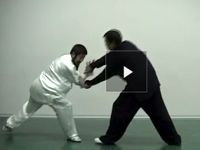
In dealing with this concept, one must keep in mind the following:
- There are no complete rotations with any part of the body.
- Every part of the body should have partial rotational movements.
- According to the number of parts of the body, the rotation is composed of mini rotational movement of each part. The total of all involved parts must add up to 360 degrees, a full circle.
- Rotation must involve a central axis.
Hong’s form of taiji has no ‘rehearsal movements’ or pre-movements, its just the useful stuff. Don’t load your taiji with rehearsal movements and unimportant movements.
“Don’t Move Your Hands!”
Contrary to what most believe, the hand in most cases move too much. Everybody wants to learn how to move the hand. In fact, they should learn how NOT to move it! Read more
Chen (2) Jian (1) Zhui (4) Zhou (2) 沉肩坠肘
Sink the shoulder and pull down the elbow.
The shoulder can only sink downwards towards the direction of the kua. It cannot move sideways. It cannot move upwards either.
The elbow must point downwards towards the direction of the Dantian. It cannot raise upwards.
Are you learning anything? I often mention at my workshops that I notice many old disciples of the Grandmaster who spent dozens of years with the Grandmaster without learning a thing.
Why do I say something so harsh? Look at the physical evidence. They continue to look like they are doing wushu, or whatever they used to do. They continue to use force in their push hands. They continue to use tricks in their applications. Their abilities are all external.
Are you one of the above?
One observation that I have consistently made is that most people follow the rules for about 4 months. They gain considerable ability and understanding during these four months. After that they mentally graduate. They won’t “hear” anything any more. The first four months were filled with real learning because they were totally new to the system. After the first four months, they continue to believe that they are learning but in reality, they don’t learn any more. If you tell them, they will have 1 million explanations. They confuse what they do with what learning is. They experiment and are on their own while in their mind they are trying out what they learned.
In real life, a person gets into this frame of mind at the age of about 11 to 13. That’s when you notice that they start believing in themselves. In learning Taiji, this is reduced to about 4 months. Once a person gets into that frame of mind, there is almost no return.
Another scenario is almost the opposite but has the same bad effect. People come to the system but will not learn. There could be a myriad of reasons but they are not learning. If these people can persist, one day they will learn. When that happens, their learning will be in leaps and bounds. That is because by this time, they will have a very good foundation for learning. Their understanding will be based on facts they know.
You need to re-examine your learning process.
Rotation with just enough pushing force. A good example of this type of energy or action is when screwing. The turning and the pushing that makes the screw go in is “grinding”. Otherwise there would be only turning, or pushing. This type of energy is highly stressed in the Chen Style Taijiquan Practical Method system.
In Chinese pinyin: Nian.
Sink down to grind out: It is a special term used in Chen Style Taijiquan. It was first used by Chen Xin in his “Illustrated Book of Chen Family Taijiquan.” Simply put, this is term that refers to the use of a vertical (upper and lower body) lever in taiji applications. Normally it refers to sinking the rear kua down while grinding the front hand out.
Chen Style Taijiquan Practical Method employs 5 dimensions in its actions. 5 dimensions will comprise a Chen Style Taijiquan Spiraled movement. The definition of a dimension is different from that of the scientific definition. The word dimension here is more like “plane” in English. The five dimensions are:
- Dot
- Line
- Surface
- Full
- Movement
Direction: It refers to the body part alignment direction and the force direction. It is an important part of the trinity of the Chen Style Taijiquan Practical Method system. The other two are timing and speed. Angle is used synonymously with direction.
The space between two points of action. The distance between two points is regarded as a space that can be manipulated in taiji actions.
Timing: The activity and force that is caused by the utilization or manipulation of time or lack of time.
Popping: One part of the body moving outside of the restricted area. Size and area restriction is a central key in Chen Style Taijiquan Practical Method system. Mostly common body part that pops is the shoulder.
The case of having two or multiple centers of gravity at the same time, causing the body to lose balance. It is an ill in Taijiquan. To avoid the state of Double Heavy, one needs to learn to separate yin from yang.
Extension: Stretching of a part or point to make it longer. The original point/position must be maintained.
peng jin:The movement away from the center in all directions. The center must be maintained to be considered an expansion.
- Sinking
- With the baihui point fixed, the movement downward of all or some other parts of the body.
- Any part of the body can be split into yin and yang. When one part is fixed and the other part goes away from the fixed part, it is also called sinking. Therefore, sinking does not have to have a downwards direction.
Momentum: inertia of force. In taijiquan practice, momentum force simply means movement that cannot be stopped.
Powering Up: To increase size, length or compression within a fixed area.
- Split: The action of two (or more) parts of the body moving away from each other. The key is that there must be a fixed spot (does not mean a real physical spot) in this action. This fixed point is also the center of the action.
- Hair is the tip of blood;
- Tongue is the tip of flesh;
- Teeth are the tips of bones;
- Nails are the tips of ligaments.
Internal harmonies:
Heart and Intent; Intent and qi: qi and force.
External harmonies:
Hand and foot; elbow and knee; shoulder and kua.
The Dao has no shape. Everybody lives it without knowing it.
大道无形。人在道中却不知。
strong will beat weak
Big will beat small
Technique will beat force
Gong will beat technique
Qi will beat gong
Intent will beat Qi
Longer will in the end beat the shorter. Length can be equated to strength.
Mind-intent is one of the most important ideas in Chen Style Taijiquan learning and practice. It is also one of the most confusing concepts. Let’s take a look at this concept from a simple point of view to facilitate learning.
- The learning of Taijiquan requires that the student have correct mind-intent because Taiji is an internal martial art.
- Mind-intent is to know what you are doing.
- There are many levels of “to know what you are doing”.
- The first level is to simply copy the choreography correctly. In this sense, to know the choreography is to know the meaning. Nothing else should be involved. At this stage avoid this question: What is this move for? Instead ask, “How did you do that?” “Show me how?”
- The second level is to know what you are doing in terms of energy circulation in your own body.
- The third level is to know what you are doing in terms of how your body interacts with your opponent’s body.
- The fourth level is to know what you are doing in terms of how to always make your body the lever and your opponent’s body the load (as in a leverage).
- The fifth level is to accomplish the above naturally. This means that the above scenario will be the case no matter what.
- Mind-intent is not what you think that it should be. It is what the situation requires.
- Mind-intent is not a skill. It is not something you can learn. It is a result. It is like saying that when you walk, your mind is directing it. Therefore, the real mind-intent in walking cannot be felt or known. In most cases, when someone is conscious of an action, it usually mean there is a problem with that action. In this sense, we say, “The real intent is when there is no intent.”
- It is nice to know about this concept but if you focus on it, you are guaranteed to be lost.
Good deeds leave no traces behind; Good advice contains no blame;and Righteous calculations come without thought. Read more
—Hong Junsheng
Many people regard Taijiquan as a slow, gentle and soft art. The orginal principle, however, points to a different and more reasonable direction.
“The two hands are just two doors. The fight is done by the feet”—martial adage.
“The hand is there but not the foot. The fajin is not clever. When the hand is there, the foot is there also, the fajin is clever. When the foot is there before the hand, the fajin is beyond wonder.”—martial adage.
“The hands will take 3 years to train. The feet ten years”—Xiaowushou adage.
Xian (1) Ru (4) Wei (2) Zhu (3) 先入为主
Xian: first, early, before
Ru: enter
Wei: become, be
Zhu: host, master
“One who enters first is the host”. The second part of this idiom is “He who enters later is the guest.” This is a special type of idiom in Chinese. It is called “Xie Hou Yu”. In using it, the speaker leaves out the conclusion. The listener has to fill the gap. This is a clever play of language, however, it also causes confusion or problems when the listener does not have the necessary knowledge to complete the whole idea.
When Richard Nixon went to Beijing to pay an official visit to Chairman Mao in 1972, Mao started the conversation by saying that he was an old monk holding a broken umbrela. The unspoken conclusion of the idiom is “No hair, no sky.” The meaning of the unspoken part is, “For me, I am above all laws, even God.” Nixon’s interpreter did not know this particular idiom. He made a mistake by interpreting the Chairman’s idiom into “I am humbled to meet you.” This small error in interpretation made history.
Other examples of Xie Hou Yu.
- Hit the dog with meatball buns. (You won’t get it back).
- Clay Buddha crossing the river. (You cannot even protect yourself!).
- Bamboo basket fetching water. (You will get nothing).
Let’s go to the second part of this lesson: the relevancy of this idiom to Taiji.
In learning, whatever is introduced to you first becomes the standard for your subsequent learning. This is a nasty and stubborn problem for everyone. The proper learning process should/must involve learning new things and eliminating previous mistakes. This is the ideal situation but in reality, it does not work like that. Xie Ru Wei Zhu is the dominant method of learning. It is the default learning mode. This mode actually overrides the ideal scenario of learning and the elimination of mistakes. Fist of all, when the wrong thing is set as the standard, you won’t learn anything correctly. Secondly, you won’t have the ability to find out the mistakes to eliminate them.
Now you realize that whether you are right or wrong is largely a toss up.
What do we do from here? How can we get rid of this pesty Xian Ru Wei Zhu?
Grandmaster Hong Junsheng offered a few advice:
- Follow the real transmission.
- Do not trust/believe yourself.
- Subject everything to simply tests.
Transmission has to be directly from one person to another. Simple and straight forward. It cannot be that there are one million justifications but no transmission. What should we look for in a transmission? 1. Did the two people in question meet? How long were they together? Were there others present? Is the choreography identical? Are there others in the class who also have identical choreography?
Taijiquan is a physical science. It is not a belief system. Do not trust yourself. Use physical measurements and objective standards. Do not trust your instinct. Do not go with the flow.
Use simple tests. Do not devise complicated tests that involve too many parameters. Many of the parameters are falsely established. Many of the “Taiji Principles” in classics are simply erroneous. For example, the story of Chen Fake’s learning grew from 10 yilus a day to 20 a day, then 40 a day and eventually 100 times a day. Some even claimed that he did Yilu and Cannon Fist a hundred times a day! People quoted these unfounded claims exactly the same way gossip is spread in tabloid papers! I asked Todd Elihu, John Dahms, Dave Dahms and others to complete 100 yilus in a day. They started at 4:30 in the morning and went till past 9:30 at night. They had prepared food ahead of time to save time and did not take lengthy breaks. They were able to do 100, 104 and 110 respectively.
Just imagine that. It is certain that Chen Fake did not practice from 4:30 in the morning till 9:30 at night each day for many years!
LET GO of the precepts, principles, habits, ideals, beliefs and techiques you hold to be dear! Embrace the simple practical method. You will see yourself improve quantumly.
- 1. Choreography.
- 2. Coordination.
- 3. Clarity and Energy.
- 4. Application.
- 5. Flow.
Notice that most people follow this:
- 1. Choreography.
- 2. Flow.
- 3. Clarity and Energy.
- 4. Coordination.
- 5. Application.
Slight change in order but big difference in the end.