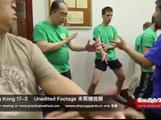
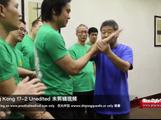
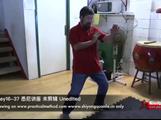
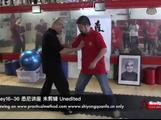
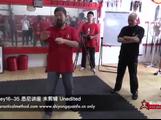
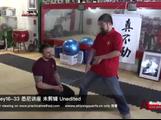
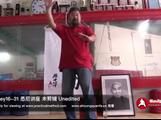
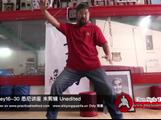
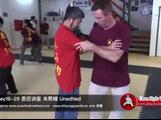
We continued the topic about the triangle in today’s class. To apply the triangle during push hand or Yilu we need to realize the following keys:
How many triangles are needed
The more the better as long as it can contribute the indirect force to the final result.
My understanding is we need at least two: the first one is formed in upper body. It involves contact points. The triangle can be two hands + one shoulder or one hand + elbow + shoulder or one hand + two shoulders; the second one is formed in lower body. It can be one foot + kua + shoulder or two feet + kua. This perfectly explains the theory of “rooted in the feet, initiated from the legs, controlled by the waist, ended in the fingers”(其根在脚,发于腿,主宰于腰,形于手指).
Apply one triangle on top of another
Keep this in mind: fix one and then apply next. This is required by the rule of “Don’t move”.
Build a solid structure
A solid structure will be like a rod or chair. Opponent’s power will be directed to ground and bounced back to them easily.
The solid structure will also support forming triangles.
We always look for opponent’s weak point in their structure, so we can apply our triangles accordingly.
Twisting towel – Ning maogin
Straight torso – spine stretched – legs apart –bend knees a bit just to make upside down U shape … Imagine there is a horizontal bar just below navel area, stretched forward and vertical rod from head to ground
Fingers always stretched and slightly open, except the thumb, thumb touching forefinger. Arms at navel level, stretch forward tucking elbow towards the center of your body- keeping wrist locked (wrist doesn’t movie) elbow straight – shoulders locked (moving only within its socket)
At the moment Master Chen is giving the 21th Practical Method Seminar on Daqinshan. More then 80 peoples are participating and there are both advanced (beneath them many disciples) and beginners.
This is a book on Hunyuan Qigong and Hunyuan Taiji by Master Chen Zhonghua. It is an essential book for anyone practicing Qigong.
Its contents are mainly based on the Hunyuan Qigong of Grandmaster Feng Zhiqiang and the personal experiences and explorations of Master Chen Zhonghua.
Position of elbow in positive circle: After warming up with what we learned the last 2 weeks, we reviewed the line that the elbow follows in first move of Positive Circle. It should follow a straight line as if it’s in a track. Fingers should still point at same spot. We tried looking at the line the forearm was making in mirror.
To finish positive circle after turning at waist, lead with hand as if forearm is in a tube and sliding out sequentially. Don’t let forearm deviate outwards as it wants to.
Today we covered 5 exercises. Here are some corrections Kelvin Ho gave me and reminders in class as I understood at the time.
1)Twisting the Towel -Don’t move arms with arms but move arms and hands from same side foot. Make sure pelvis doesn’t move. Remember to keep hands stretched out and to stretch through whole arm. Keep on the centre line. Read more
Another exciting two hours today in Richmond Hill class. Two notes to share with audients:
1. Amazing triangle
Actually using triangle to apply indirect power is not a new topic, but today our practice really impressed me. I started to understand how important it is and how to apply it to all forms.
How to form a triangle: hold two hands together as point A and two elbows are the other two points (point B and point C). Partner tries to hold the two elbows tightly using his two hands.
Practice one: push two elbows out against partner’s two hands. It is very hard. Read more
One of my corrections from Sifu during a private lesson in 2015 was on separation of hand from my head. For instance, when out with hand in Single Whip, as I placed emphasis on the stretches when my hand went out, my head would follow…this would occur at varying degrees, yet that isn’t relevant because any deviation of the head changes everything as I will get to soon.
**Due to my computer crashing these notes have been recompiled using my original written notes, which are somewhat incomplete. As such there are some blank spaces, which I’ve indicated with an asterisk. I would very much appreciate anyone filling in those blanks, as I don’t feel confident enough to do so myself.
Taking notes at workshops is a useful tool for making progress, and going over them as soon as possible (at the end of the day and after the workshop) helps to internalize the most salient points. Furthermore, sharing notes, as well as potentially helping other students in their practice, can also engender a need for the note taker to test the accuracy of their personal understanding of Master Chen’s teaching. A testing strategy that I have recently adopted is to imagine that I have to explain my understanding to other students through practical demonstration. Read more
Hand starts and 45 degrees and ends at 45 degrees, s the elbow comes to centerline. The energy must come from the foot to the hand. This Is much more difficult then it seems. The tendency for me was to bend the wrist independent from the arm and to move the arm out with no regard for the line. I found it very helpful to stand on a tiled floor which allowed me to better concentrate on the line. By doing this I found that the line allowed me to better keep arm on the line and my wrist better alignment with the rest of the arm.
start in front bow stance , back arm bent palm up front arm bent also palm up, this creates a line, bring hip and shoulder to hand line, be sure hip is up and out, shoulder is down and out, front elbow twists in as action performed. Back also straitens and ass is not out. Do not move wrist independently. I found that I could better concentrate and get more consistent results by starting with the front elbow touching my side. Taking pictures of yourself is also good idea because you see what you do wrong I have started to practise in the mirror so I can see and correct things like raising my back shoulder
IN fetching water, you must be in front bow stance. back arm bent palm up front arm down front kwa hand open, First internally connect front hip to back shoulder around and down to back hip somewhat like suspenders. This little effort to start really helps. Then open front hip moving it to the line. As that happens notice front shoulder goes down twist in the front elbow.
We had the honor to spend the last days together with Master Chen Zhonghua and a small group of other dedicated students. Chinese New Year, people also call it “The Spring Festival”, is the most important Chinese festival. Usually people spend it with the closest members of their families. But as our Masters family is Canadian we had the great opportunity to be together with him for this special day. Read more
Ensure the whole body acts as one entity , and every part is connected and supporting each other. This is so called 整劲.
Apply two major triangles:
Triangle one: left hand, right hand and front kua. Bring front kua into the line connecting two hands.
Triangle two: left hand, right hand and front shoulder. Two actions are involved in order to bring front shoulder into the line connecting two hands: a) Sink the shoulder; b)bring front elbow towards body center line(vertical). This action will typically leads to drilling effect (顺缠).
turn left foot to left 45 degree, align left knee with left foot
form a rod on left side of the body: maintain the left leg position by pushing knee backward and pushing kua forward. This will ensure the rod is very stable
move weight to, and keep weight on left heel
bring right elbow to front right
bring right foot to front. The body is turned around the rod formed. This is why forming the rod strong and stable is very important. This rod appears in many other Yilu forms.
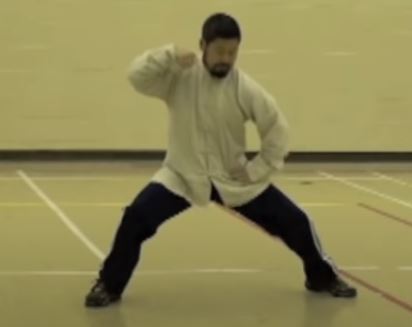
Legs apart – toes aligned with the other foot heel – foot open 45% outward and the other feet, toes close inward a bit – leaning closer to the front foot – Knee 90% measured at the ankle
Eyes
Choose a focus point and keep your eyes pinned to the focus point always
Upper body and movement
Shoulder and wrist locked- fingers stretched – index finger pointing towards your focus point and not above your eyebrow – start with palm down pointing towards the ground- bring elbow to right ribcage from waist twist all the way inside without losing your focus point.
Ken Lang joined the class for the first time. He started learning about twisting the towel. He has been doing taiji for 10 years, and went to study at Chen Village for 6 weeks. His initial impression was that the Practical Method elbow-in was similar to what he learned in Chen Village. His teacher there was Master Chen Zhaosen.
We reviewed twisting the towel, and how the hand is to be connected to the foot, and how to push the foot against the ground to squeeze out the hand.
We did an exercise with one person pushing the other person’s hand up the arm, and how to prevent the shoulder being popped up, and how to stretch through the back to the rear foot to find the connection.
We practiced taking out the space.
I told Bruce during push hands, at this point, make it a focus to simply maintain the desired posture regardless of what the opponents does to him.
After the 2-days Hong Kong Chen style Taiji practical method workshop held on 17&18 Dec, I joined the regular foundation Sunday class. Starting from my 1st day training, I learned the importance of the kua opening. When doing twist-towel or fetch water foundation, by opening the Kua, power can be transferred from the foot (ground) to the hand. Read more
Kelvin Ho gave us feedback on the first 7 moves of Yilu today. some examples to remember
Buddha’s warrior attendant pounds the mortar – in first move both arms move from the elbow. The right arm is a negative circle. Elbow is down and palm faces floor when you stretch out after grind out. To lift foot twist right elbow even more to connect and lift foot.
Block touching coat. – in step out adjust weight to front foot before arm moves and positive circle starts
Single whip – hands start at 45 degrees and end at 45 degrees as the elbow comes to centerline and fingers and forearm follow the same strait line rubbing against an imaginary vertical finger. The end of single whip the left hand out is a positive circle.
Brush knee – the left open hand drops down crossing knee. The end of brush knee when both arms are extended squeeze in on chest and down back as to not cause a rise in the chest. I found this very significant feedback because this is true in so many of the moves. It also seemed to have an impact on my next move to keep my back steady in initial closing.
Today I realized how significant independent practice is in this practical method. Your body needs time to adjust to perform proper alignment and stretches. If your elbow has limited mobility or you cannot convert the squeeze in the chest to the back and downward, you need practise before you can move forward with more constructive feedback.
Today I realised, why I like (our) Taiji that much. We had class (Patrick, John and me), Chén Xù was teaching. He showed us twisting the towel. Push the left foot and then don`t move (one point on the right side of the body), push the right foot, don`t move (one point on the left side of the body). This is the same principle Chen Laoshi explained in this video . When I heard Chén Xù`s explanation, I thought, that this is so illogical. Because, if you lock the right side and turn the left, and then lock the left side – there where you are – and turn the right, in the end you are moving forward. Although I saw Chén Xù doing it, believing his explanation, my mind said: How??? That`s not logical.
Just for joking I asked him about my worries and he said, don`t care about it!
This for me is the challenge and attraction. I always loved maths but practical method is more complicate! It seems to be so logical and scientific, but then very often, for me it makes no sense at all 🙂
Lesson on the parts of Practical Method System.
Gong Fa (develop internal energy) how to move
Quan Fa (choreography) yilu, erlu,
Yong Fa (usage) push hand, loose hand Presenter: Chen Zhonghua Length: 62 min. In: English Year: 2016 Difficulty:1/5
Detailed instruction on Qigong Breathing, how to coordinate with body expansion and contraction Presenter: Chen Zhonghua Length: 62 min. In: English Year: 2016 Difficulty:1/5
Instructor Kelvin Ho worked through a number of items in today’s class today with me and Bruce Robinson.
All Movement – keep elbows pointed to the ground, open hand position and stretch through to fingers
Buddha’s warrior attendant pounds the mortar – start with right hand against chest as you turn hand releases from chest, front hand does not retreat. after ground out completes keep elbow pointing down as you stretch to fingers at end of stretch right elbow in.
White crane spread it’s wings – As part of stepping back adjust your back so that it is solid before moving the left leg back and raising and stretching the arms from the back outward to the finger tips. Easier said than done the idea of fixing the back against an imagery wall so that it does not move is very difficult. However by working with Kelvin today I can see what I am working toward.
Master Chen Zhonghua’s first workshops in Iowa were in 2007 and 2008, hosted by John Brown. In the summer of 2009 I organized the first Midwest Practical Method gathering, along with Tim and Levi, in the Northeast Iowa area, which was led by Tim Duehring. The group met periodically throughout the year for several years. Tim move to China to work for Master Chen, which Levi Sowers then led our gatherings. Several of our group members became disciples of Master Chen Zhonghua, which initially, Tim was the only one. The Midwest disciples, in chronological order, include: Levi Sower, John Upshaw, Erwin Ramthun, Jeff Clevenger and Christopher Dusek.
Levi Sowers and I have organized 3 Midwest Chen Style Taijiquan Practical Method Workshops that was taught by Master Chen. These workshops occurred in October of 2013, September of 2015 and July of 2016. We have organized the first North American Practical Method Training Camp that will be led by Master Chen this coming July.