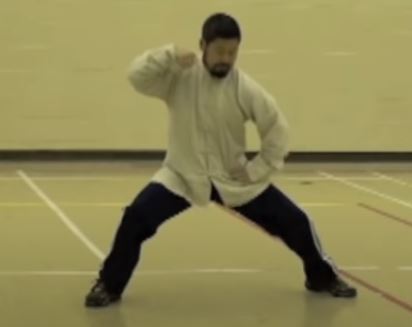
1. “To occupy strategic position you must fight for the meridian”. Read more
Knowledge
View posts in sub-category:
Application Articles Body and Posture Class (Workshop) Notes Common Errors Glossary and terms Hunyuan Knowledge-Movement Explanations Learning Method Principle-Concept Principle-List Principle-Rule Principle-Technical Push Hands Quotations Routine Names Routines Videos Stories Student Evaluations (Private) Taiji Apparatus Taiji FAQ Taiji Sword Thoughts and Understanding Workshop and Class Notes
When issuing power, the shoulder must stay stable, not popping up or moving, in order to transmit power from hand to foot, or vice versa.
The hand is the most used part of the body. It is also the focus of taijiquan activities. This video clips shows how the power of the entire body can be focused onto the hands and even fingers to fight again an opponent.
Pulling energy is also called “Pull back”, or “Roll Back”. In general it is an energy pulling the opponent towards yourself. The key is that your pulling power must originate from your own dantian. It cannot originate from your hand. Here is a video clip to illustrate this point.
Being able to “stack the joints” is an important skill in Practical Method. It means not only that all joints have to be aligned to be able to receive the oncoming force, it also means that they have to react in sequence.
Nothing is as good as personal instruction. This is close to it.
Presenter: Chen Zhonghua Length: 76 min. In: English Year: 2011 Difficulty:2/5 At:Germany
The energy on the body must sometimes be connected and other times disconnected. Here is a video example of how the energy can be connected.
The body must be trained to have multiple axis and they must be in multiple dimensions. One of them is the VERTICAL AXIS. Vertical axis acts exactly the same way as a door hinge. Read more
 It is a fact that most modern people, especially westerners living in urbanized areas, are not as physically active as they once were. As society becomes more dependent on machines and electric tools to do the physical labour once done manually, the bodies of modern men seem to be changing accordingly. Read more
When I first started taiji training with my teacher Kee Hong, he would always say: if you want power, you have to sink your weight. In fact, I would observe his center of gravity sink whenever someone pushed him. I would also feel his push getting “under me” whenever I pushed on him.
Q: i am wondering, what should i do in order to make sure all my learning is correct. Any advise ?? 2
I am wondering, is it just me or everybody feel the same that practical method, quite challanging in learning…..
Wayne started learning the yilu in Oct 2011.
In my experience, it is a common problem for taiji beginners to feel strain in the knee because the rules of Taijiquan say we should “rotate our hips”. When the kua (the technical term for the hip area) is not open enough, the knees tend to overcompensate and end up rotating. But the knees can only bend and unbend, they aren’t meant to rotate, so when they rotate, it leads to injury. Read more
Over the past few months I have noticed something becoming more and more prominent. On elbow in, I hit this “sweet spot” where it feels like everything is locked up to it’s maximum – very stiff almost bone on bone feeling in between the joints, yet muscles are softish. So much so that the tip of my fingers vibrate as if from reverberation. I don’t get this feeling from any other movement, so I’m not sure if this normal?
Recently, I notice when I rotate the rear kua in a certain way to bring the knee up, a stick seems to be created between the rear kua and the rear ankle. Note that the leg itself is actually not straight, it really is just like the half horse stance with the rear side longer than the front side. It feels like this stick can support me with the proper alignment against an incoming force.
Anyone who has done some form of Taiji for a while has invariably come to know the importance of sinking the shoulders. Master Chen Zhonghua takes it a step further, however, by instructing students to “feed the shoulder to the dog!”
Taiji is supposed to be about relaxation. If that is the case, why is there such a heavy emphasis on low stances in Chen style? Doesn’t that contradict the requirement for relaxation?
Eventually, higher level students of Taijiquan come realize that the power produced in practice should never be produced by the muscles. But if it isn’t produced in the muscles, where does the incredible strength, flexibility and speed of the great masters come from? I believe this question can be answered by understanding the amazing system of tendons and ligaments which connects the muscular and skeletal structures. Although many people like to believe that “qi”
The elbow leads back to the body, the hand leads away from the body
“People work very hard for a long time to acheive the wrong things.” -Chen Zhonghua
The Master once said, “Everybody in the world uses momentum-based movement, therefore we do not. Taiji involves ‘contained spiral force’ that generates momentum on something external to oneself.”
When you fix your eyes on the target, you can truly rotate your body. Otherwise, you are just tossing!
A good video to compare with the Victoria 2009 yilu (the one in the left sidebar). Please comment your observation of the differences.
There must be a proportional dispensation of movement, or in other words, one body part should not be outdoing the others.
Open for discussion. Consider:
- Theory:
- What is right and what is wrong.
- What is possible
- Reality:
- What you can achieve.
- What a human can achieve.
I’m still at the “slow” phase.
Edwin started learning the yilu in Oct 2011.
It seems to me that most people are not aware of the spiraling that should occur throughout the body while doing Taijiquan. Even though most people must have seen the ancient diagrams of a body coiled in lines representing the spiraling paths of the silk reeling energy (chansijin) characteristic of Chen style Taijiquan, very few people seem to be able to explain or even understand what this principle actually is. Obviously, it is not only important to know how to create spiraling throughout the body, but also to understand why spiraling and the unique energy it creates is so important to the art.
The only difference between the master and student is that the student learns publicly and the master learns privately.
Hello everybody,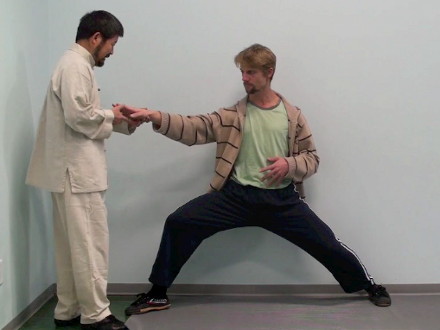
I came all the way from Berlin to Edmonton these days to spend some time with Master Chen Zhonghua to train.
I need to say that I’m very happy to have the opportunity to do this. It is very beneficial.
So to me the main benefit is to have so much Read more
John Brown’s article Rotation: Approaching the impossible with the Practical Method was published by Kung Fu and Tai Chi Magazine in the Feb. 2012 issue. Here is a preview in jpg form. To read the entire article please purchase the magazine directly at www.kungfumagazine.com. Read more