Presenter: Kelvin Ho Length: 52 min. In: English Year: 2020 Difficulty:3/5
Presenter: Kelvin Ho Length: 52 min. In: English Year: 2020 Difficulty:3/5

John Upshaw and I met because of Practical Method. He lives in Iowa, USA, and I live in Toronto, Canada. We started to get to know each other through Facebook posts and chats. We first met in person in New Jersey Camp in June 2012. Despite living far apart, we started to train together in early morning on weekends using video conferencing, such as Google Hangout and Skype. We learned straight sword, erlu, and recently broadsword together. Last night, I stumbled some upon notes I made back in 2013/2014 for the online practice sessions. Upon reviewing the notes, what we have been practicing remains the same over the years. To name a few, the instructions include:
We improve over time in terms of detail and quality of the movements, but we will never be perfect. and the training just keeps going. Such notes allowed me to re-live some of the wonderful memories, and thanks to shifu to keep reminding us to make notes.

When I first heard about the online class meetings with Shifu I was excited because with Covid-19 it felt like we had lost touch, or at least the ability to get to him. Even still, at the back of my mind I had some reservation about how effective these “zoom meetings” would be? After all Shifu teaches us by touch so how was that going to work online! True, there would be the enjoyable stories – but still the workshops packed in so much…. Read more
Hi, on Tues 27 Oct 7:30AM Foundation class, Master Chen shared that when he studied with Grandmaster Feng (I am assuming its Xin Yi Hun Yuan Taiji Quan) he mentioned Grandmaster Feng’s style of instruction was to walk around and execute a single movement (randomly) and not in a continuous manner. Master Chen went on to explain that the continuous execution of Taiji styles has diluted the original essence of each individual movement as the practitioner transits between each movement. While performing it may look impressive, but these transitions between movements don’t help in mastering the power of each individual movement.
All the videos I’ve seen of Master Feng (and his daughters) executing Hunyuan are in continuous mode, so it was refreshing to hear from Master Chen about this perspective. I sincerely hope that Master Chen could share more of his learning experience from Master Feng (and Master Chen Fa Ke as well) so that we can appreciate the differences.
Separation of Yin and Yang
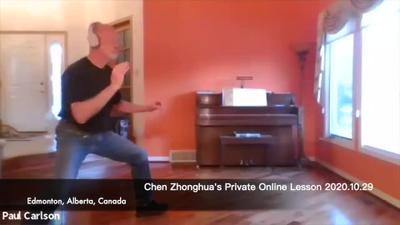
Master Chen Zhhonghua’s online lesson on Chen Style Taijiquan Practical Method on Oct. 29th, 2020.
Presenter: Chen Zhonghua Length: 63 min. In: English Year: 2020 Difficulty:3/5 At:Edmonton Chen Zhonghua Academy
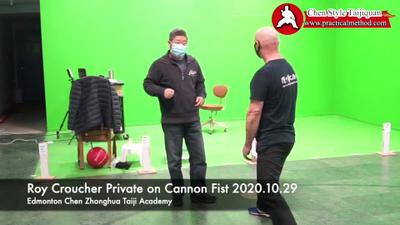
Roy Croucher Private Cannon Fist 20201029. Presenter: Chen Zhonghua Length: 54 min. In: English Year: 2020 Difficulty:2/5 At:Edmonton Chen Zhonghua Academy
Read more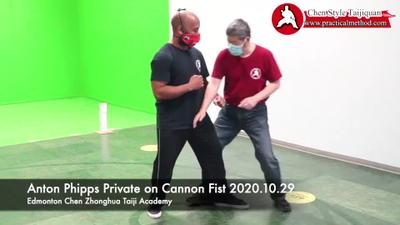
Master Chen Zhonghua’s private lesson for Anton Phipps on Cannon Fist. Presenter: Chen Zhonghua Length: 28 min. In: English Year: 2020 Difficulty:2/5 At:Edmonton Chen Zhonghua Academy
Read moreCross hand
First only open the hands without any other movements. Then push the shoulders to open/propel the arms. Read more
Going Over – We focus on this concept in several moves today.
Flash the back
Recorded Oct 28, 2020 in Panama. Started PM mid Sept 2020
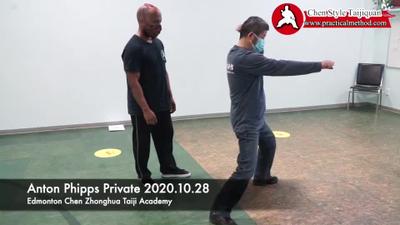
Chen Zhonghua’s private lesson for Anton Phipps. Presenter: Chen Zhonghua Length: 44 min. In: English Year: 2020 Difficulty:3/5 At:Edmonton Chen Zhonghua Academy
Read more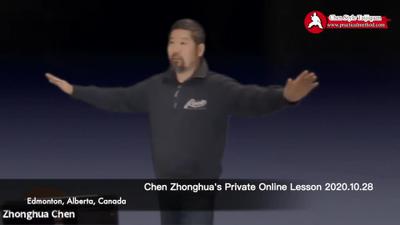
Chen Zhonghua’s online lesson on Chen Style Taijiquan Practical Method on Oct. 28, 2020. Presenter: Chen Zhonghua Length: 62 min. In: English Year: 2020 Difficulty:1/5 At:Edmonton Chen Zhonghua Academy
Read more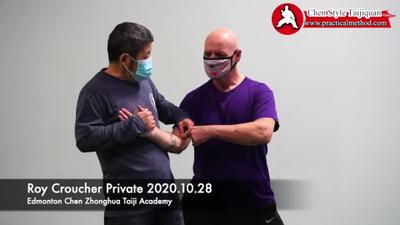
Chen Zhonghua’s private lesson for Roy Croucher on Oct. 28, 2020. Presenter: Chen Zhonghua Length: 54 min. In: English Year: 2020 Difficulty:2/5 At:Edmonton Chen Zhonghua Academy
Read moreMaster Chen is showing us something that we cannot do. So, if we fake it, we are not learning. It is something we cannot do. The learning is to show us our deficiencies not our efficiencies.
It is very important that we never become comfortable. We must be in that position that we are uncomfortable, and stay in that position. We need to stay in that state of uncomfortable without changing our structure. This will allow our us to re calibrate.
In yilu, we must do it one move at a time until we reach our fullest extent and then reset. Master Chen is trying to bring back the original idea, not continuous. Train each move separately.
The stretch from knee to kua the thigh lengthens. We need to go into the uncomfortable position that we are about to fall down or we do fall down.
We need a clear net gain without changing shape. This net gain can only be created with the stretch and no rotation. This needs to be applied in push hands and in practice. To train this you cannot have wobbly moves. If the opponent creates a net gain during push hands and you don’t that goes into you and you lose. Net gain equals net distance.
Correction on my form Need to have 3 solids There is a line at the shoulder level between the front hand and rear shoulder (first 2 solids) I need to stretch the kua down to create the 3rd solid. Read more
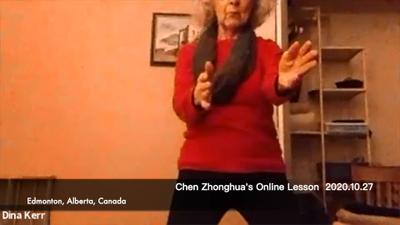
Master Chen Zhonghua’s Online Lesson on Practical Method on Oct. 27, 2020.
Presenter: Chen Zhonghua Length: 61 min. In: English Year: 2020 Difficulty:1/5 At:Edmonton Chen Zhonghua Academy
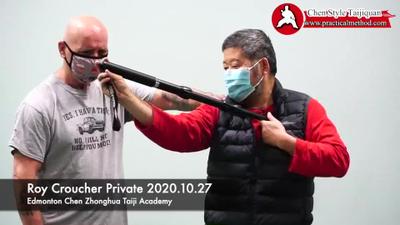
Master Chen Zhonghua’s Private Lesson with Roy Croucher on Oct. 27, 2020. Presenter: Chen Zhonghua Length: 53 min. In: English Year: 2020 Difficulty:3/5 At:Edmonton Chen Zhonghua Academy
Read moreMaster Chen Zhonghua’s private lesson for Anton Phipps on Oct. 27, 2020.Presenter: Chen Zhonghua Length: 45 min. In: English Year: 2020 Difficulty:2/5 At:Edmonton Chen Zhonghua Taiji Academy
Read moreLearning Taiji is like climbing the stairs. The teacher has to grind hard on you until you see the first step and put your foot on it. Whatever is correct has to be driven into you. Read more
Correction on my form
Today we worked on isolating a movement and twisting the towel. During previous training sessions we did it to feel the trajectory and range. Now we do it with a restriction. The restriction that we did it with was not to move the knee. The main action we were training was twisting the towel with a stretch, not a rotation. Read more
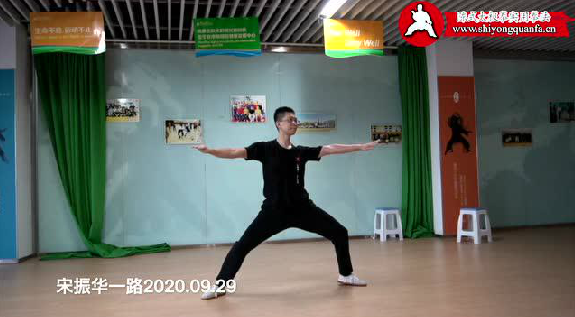
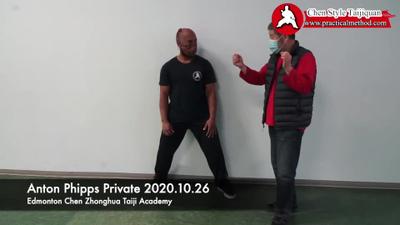
Master Chen Zhonghua’s private lesson for Anton Phipps on Oct. 26, 2020. This lesson focused on the finding of the two points that forms the line. Presenter: Chen Zhonghua Length: 54 min. In: English Year: 2020 Difficulty:1/5 At:Edmonton Chen Zhonghua Taiji Academy 埃德蒙顿陈中华太极馆
Read more
Using “Twisting the Towel” exercise as a training tool for this lesson, Master Chen Zhonghua taught the method of “keeping one” while moving. This method trains the ability to create a dot in Taiji movements.
Presenter: Chen Zhonghua Length: 63 min. In: English Year: 2020 Difficulty:3/5 At:Edmonton Chen Zhonghua Taiji Academy
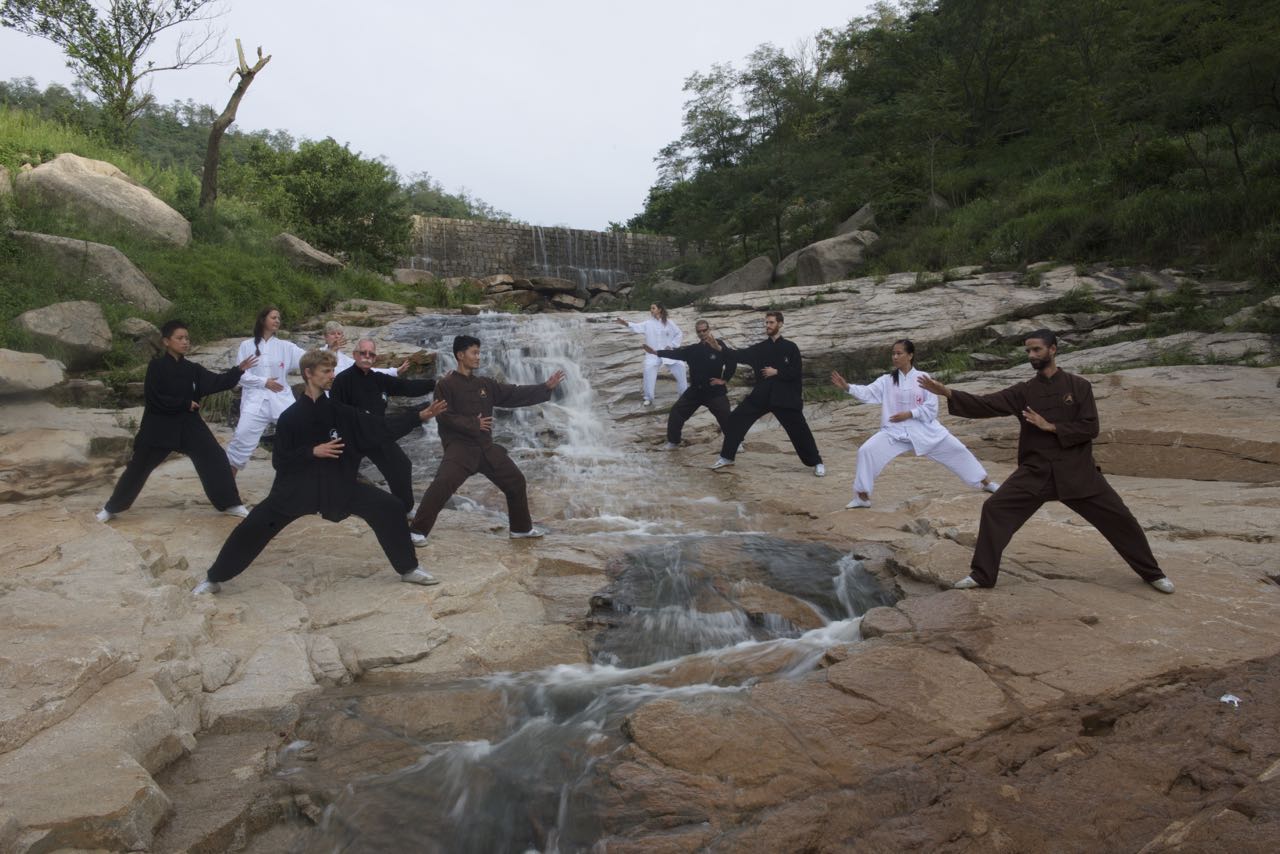
Student Photos of The Dragon’s Abyss on Daqingshan in 2016. Read more
I recorded my illu about 10 days ago and put it here with the hope to get some corrections. Read more
Presenter: Kelvin Ho Length: 69 min. In: English Year: 2020 Difficulty: 3/5 At: Toronto and Iowa
Read moreConservation of Energy
Master Chen used this term in one of his lectures. Here is my understanding:
In an ideal closed 2 energy system, Conservation of Energy means the total energy is the same while the magnitude of kinetic energy and potential energy can vary.
Mathematically, total energy = kinetic energy + potential energy.
Read more
Not Moving is one of the most important concepts in Practical Method. There are 3 types of Not Moving.
Absolutely Not Moving
Relatively Not Moving
Restrictively Not Moving
On October 20th, 2020, during an online class Master Chen Zhonghua shared and demonstrated an important action of the knee that has not been disclosed before. Prior to discussing the important action, I shall discuss some important functional and structural aspects of the knee as a means of providing a context to help the reader conceptualize how this recently disclosed information is applied in practice and applications.
We do our form in a low stance to train gong. When we use it, we don’t go so low, because it is not agile enough.
Movements need to be big and long.
The kuas need to be just a bit higher than the knees. Read more
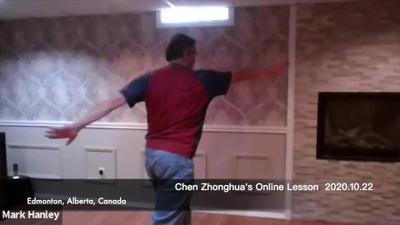
Chen Zhonghua’s Online Lesson on Oct. 22, 2020. This is a session on Yilu corrections.
Presenter: Chen Zhonghua Length: 67 min. In: English Year: 2020 Difficulty:2/5 At:Edmonton Chen Zhonghua Taiji Academy