Knowledge
View posts in sub-category:
Application Articles Body and Posture Class (Workshop) Notes Common Errors Glossary and terms Hunyuan Knowledge-Movement Explanations Learning Method Principle-Concept Principle-List Principle-Rule Principle-Technical Push Hands Quotations Routine Names Routines Videos Stories Student Evaluations (Private) Taiji Apparatus Taiji FAQ Taiji Sword Thoughts and Understanding Workshop and Class Notes
Instructor: Kelvin Ho
Topics:
- Footwork
– Shoveling out with Front Heel, Land the Front Foot, Pull up the Rear Foot
– Jumping across to cover distance - Aiming
– Aligning Front Hand with the Rear Foot
Maxime Fréchet·Wednesday, June 8, 2016

Author: Maxime Fréchet
Here is a little review of the workshop with Master Chen Zhonghua. I’m not in a position to explain anything so I’m just going to share my feelings and experience.
Great experience! Zhonghua Chen is a kind and humble person. He often shares but not too much either. His approach goes straight to the point. He makes you understand principles and concepts with clear words and demonstrations. There is always a bit of Dao in everything, which I really appreciate, it keeps your mind open. Great bunch of people from different countries, good atmosphere and workshop in English.
Questions students prepared for the June 2016 Chen Zhonghua Berlin Workshop.
Athanasios Alexatos
Master Chen can you show us and tell us a few things about the 8 energys in practical method ?
Master Chen Zhonghua has demonstrated numerous times of having a fixed point (dot) for rotation in his action. Recently, I start to understand the pair of contacting points which can be used to create a stick/lever. I have been able to rotate an opponent using a dot in the middle of the stick. Today, I realize this dot can, in fact, be in space, and not necessarily in the opponent’s body. It depends on how I contact the opponent, e.g. which body parts I use to create the stick. This kind of rotation is vertical, and can take the bottom support out from the opponent.
Notes:
• Taiji works in 3’s, and power, structure, and aim all have to be independent. Read more
A 4 videos series explaining the concept of using joint power to generate force.
Using joint power is different then muscle power because using joints keep the body in place. Muscle power often rely on momentum which can be manipulated by opponent.
In addition joint power is additive, so the more the body is open, the greater the output.
 “Centered Move 1” “Centered Move 1” |
 “Centered Move 2” “Centered Move 2” |
 “Centered Move 3” “Centered Move 3” |
 “Centered Move 4” “Centered Move 4” |
23. Brush the Knee Obliquely (Lou Xi Ao Bu)
24. Flash the Back (Shan Tong Bei )
Master Chen told me that I need to maintain axis in the arm hitting moves in the transition between 23 and 24. Observant viewer of this video might notice another detail in the transition
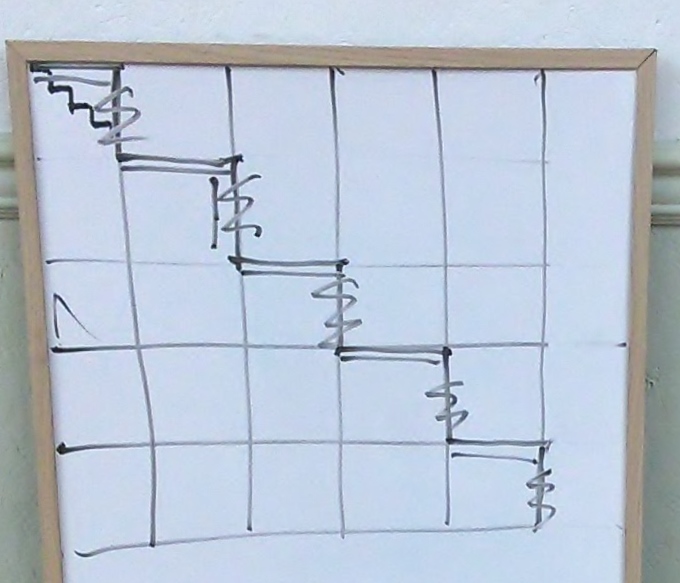 During last Vancouver workshop Master Chen explained that there needs to be adjustment between stretch. Stretching alone normally doesn’t have correct aim, and adjusting the body after a stretch allow the subsequent stretching to be deeper.
The picture depict that the aim is in a diagonal, but stretch only go to horizontal, so adjustment rotate the body so the stretch will go toward the goal.
Subsequent stretches are done with different body parts starting from contact point to the feet.
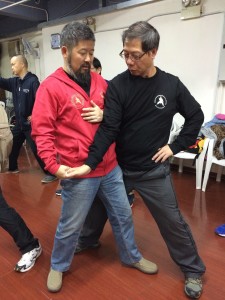 |
As the Christmas season approached, Hong Kong shimmered under dazzling festive lights, setting the perfect backdrop for a year ending workshop led by K.T. Lin and Nicholas Fung (馮嘉傑) from the Hong Kong Chen Style Taiji Practical Method (香港陳式太極實用拳法). On a pleasantly mild weekend, more than thirty dedicated practitioners from Hong Kong, Mainland China, the United States, and Canada gathered to train with Master Chen Zhonghua.
A special appreciation goes to Tim Duering and Hán Ruì (韩瑞), who traveled from Daqingshan to support the workshop. Over two transformative days, Master Chen guided participants through the core principles of the Practical Method, including foundational techniques, movement dynamics, and Yilu. Beyond the fundamentals, he also explored the deeper theory of Chen Taijiquan, offering hands-on applications and insights into the intricacies of push-hands training. |
Daqingshan instructor Ling Zili recorded by John Ho.
Good reference for those learning Practical Method Sword routine

Negative circle is likely the second thing one learns in Practical Method. The following are some starter instructions for a right-side negative circle:
- The right side is considered the front side, and the left side is consider the rear side.
- Find a line that is parallel to your chest on the ground.
- Put your right foot at 45 degrees to the line with the heel touch the line.
- Put your left foot at 90 degrees to the line with the toes touch the line.
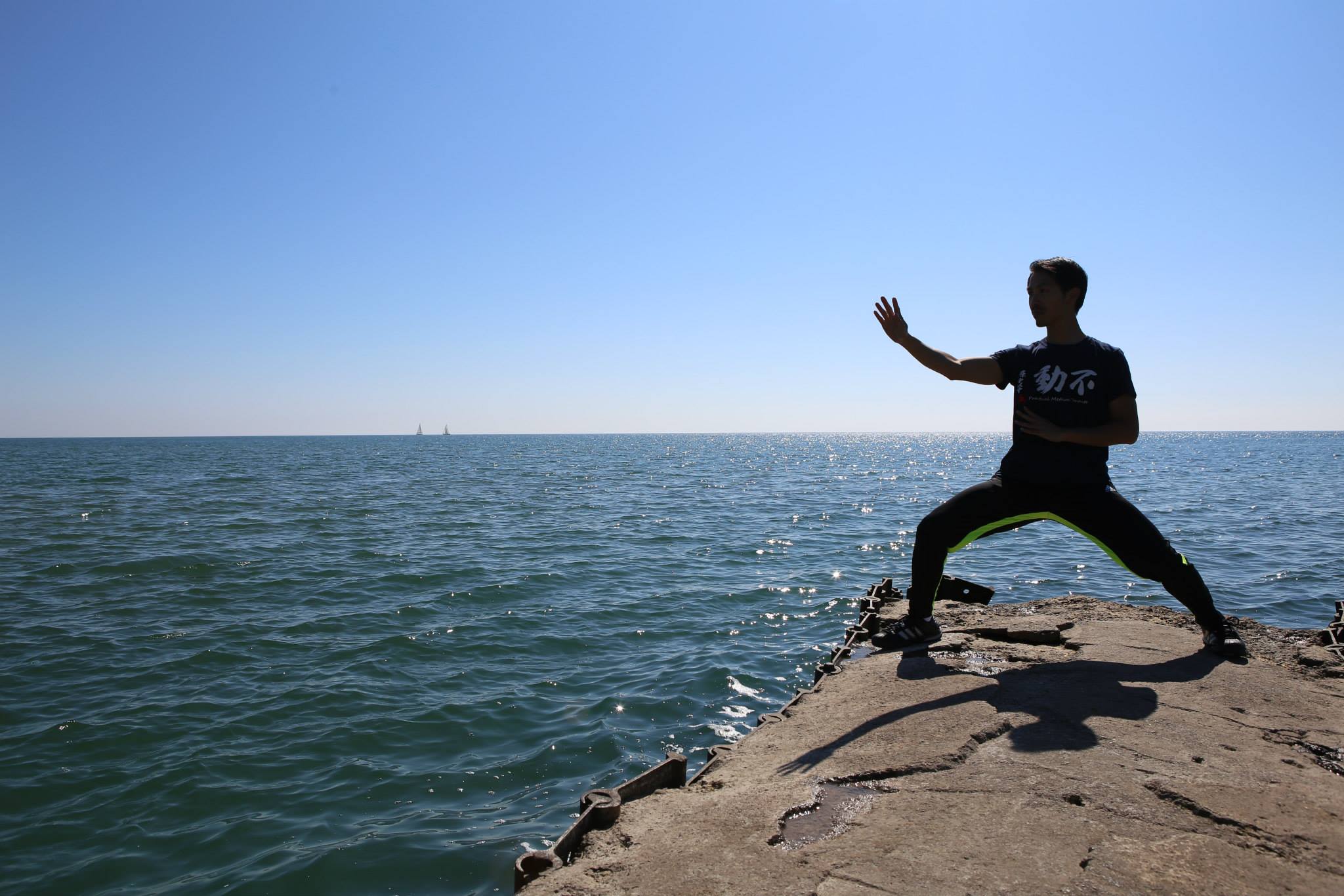
Positive circle is likely the first thing one learns in Practical Method. The following are some starter instructions for a right-side positive circle:
- The right side is considered the front side, and the left side is consider the rear side.
- Find a line that is parallel to your chest on the ground.
- Put your right foot at 45 degrees to the line with the heel touch the line.
- Put your left foot at 90 degrees to the line with the toes touch the line.
I have a question regarding the training speed of Yilu. I remember Chen Laoshi saying, that doing two slow and one fast Yilu (and then again two slow, one fast) would be good. But I am not sure about the context anymore. Here on Daqinshan the „group“ prefer to do fast Yilus (like 4:30 minutes), instead of slow ones (like 8 minutes).
What I would like to know is, if there is a certain method to train Yilu (like two slow – one fast) or if the speed is just depending on the circumstances (learning level, day`s form and so on).
Thank you!
Please comment on what this video is showing.

When I first studied practical method in Nov. 2009, there were a few things that made a long lasting impression. They were:
- In with elbow no hand, out with hand no elbow.
- Don’t move
- Yilu, which is made up of only positive and negative circles.
Many beginners including myself usually ask the following questions:
- How did you (Master Chen) know to do that?
- How can I not move?
- What can I do that myself?
- How do I train that?
Video on the difference of Rotation and Revolution movement in Practical Method system.
Already some time ago now I had an interesting discussion with another person from Germany. There was one aspect showing up, which in principle could be very interessting for all of us who want to learn Taiji.
Here and there Master Chen did point out that in Taijiquan (or at least our style of Taijiquan ..) there is nothing which is related to anything we know from normal life, to the contrary, in general things are totally opposite. Right? Read more
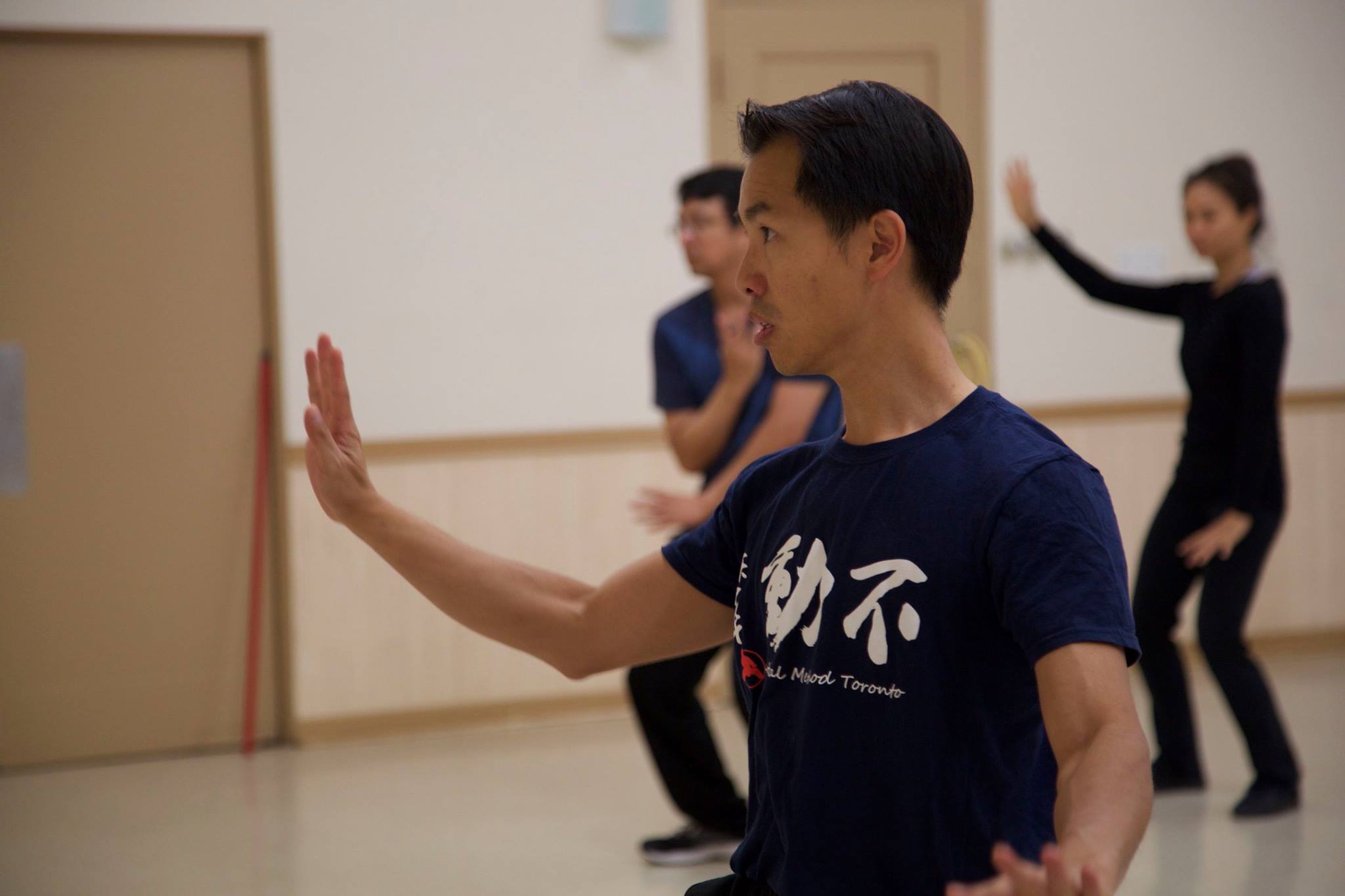
We had 19 people attending the Toronto workshop this time. 5 of them were first timers. We started off with Master Chen talking about the positive circle, and continuously focusing on its various aspects.
Here are my notes:
- Only move your foot forward towards the opponent, everything else does not go towards the opponent. Read more
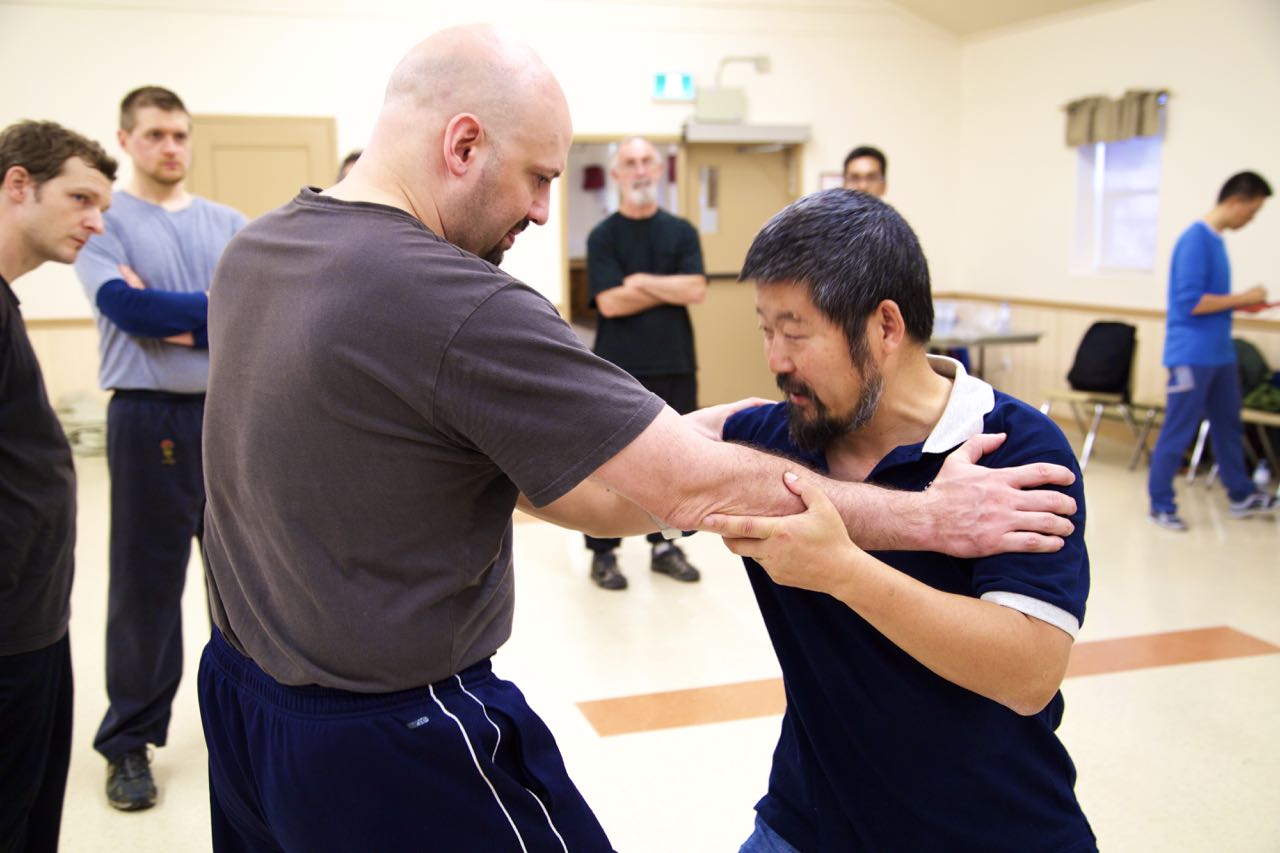 I just returned from a 3 day workshop in Toronto. I would like to thank Master Chen and all of the other participants for providing me with this learning experience. All of these notes are mental ones and I will make sure that I take down physical notes on subsequent trips. All errors and omissions are my own. I would like to thank Kelvin for calling me out on my note taking or lack thereof. I totally forgot how to be a good student. I believe that it is important to take notes as a) they will help you to remember what you have learned and b) some of the instructions are personal points of guidance that might apply only to you and as such will not appear in anybody else’s notes.
 My name is Susanna, I am a Toronto student of Master Chen Zhonghua. I started studying Practical Method in the fall of 2012. At that time, my first daughter was just 9 months old. I brought her to the workshop and carried her around as I learned from Master Chen for the first time.
I learned the first 13 movements at that seminar and practiced them a couple times a week. Since the fall of 2013, however, I started practicing the first 13 movements everyday, without fail, 5 repetitions per day. It would take about 20 minutes to do. I continue to practice like this today. Read more
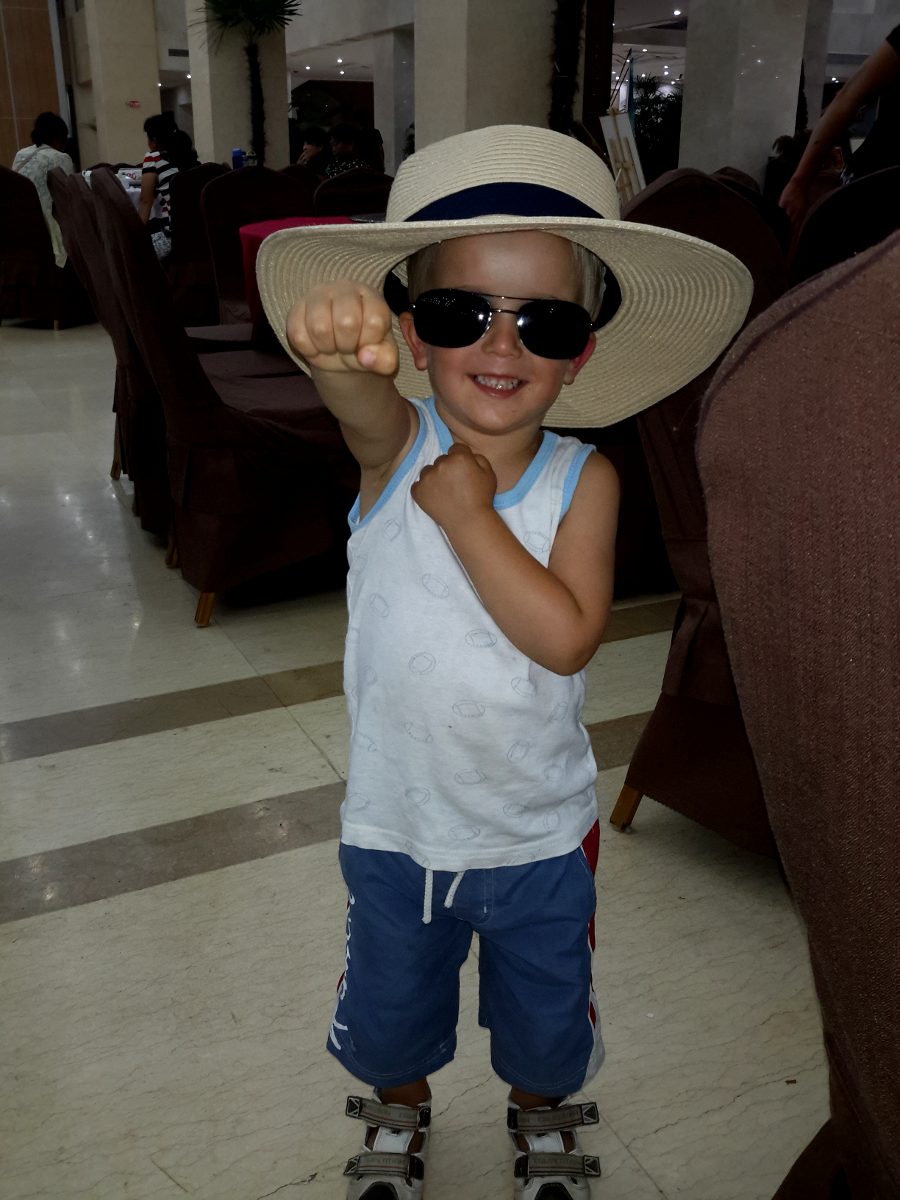 To all parents hesiting if to go with their baby or infant to DQS, we collected some informations and impressions.
At the moment we, that is me with my husband Michael and 2 1/2 year old boy Lukas, are on Daqingshan, Shandong Province in China for Taiji Fulltime Training.
The three of us have been here together already last year, so here are our experiences with our little boy on the mountain.
Read more
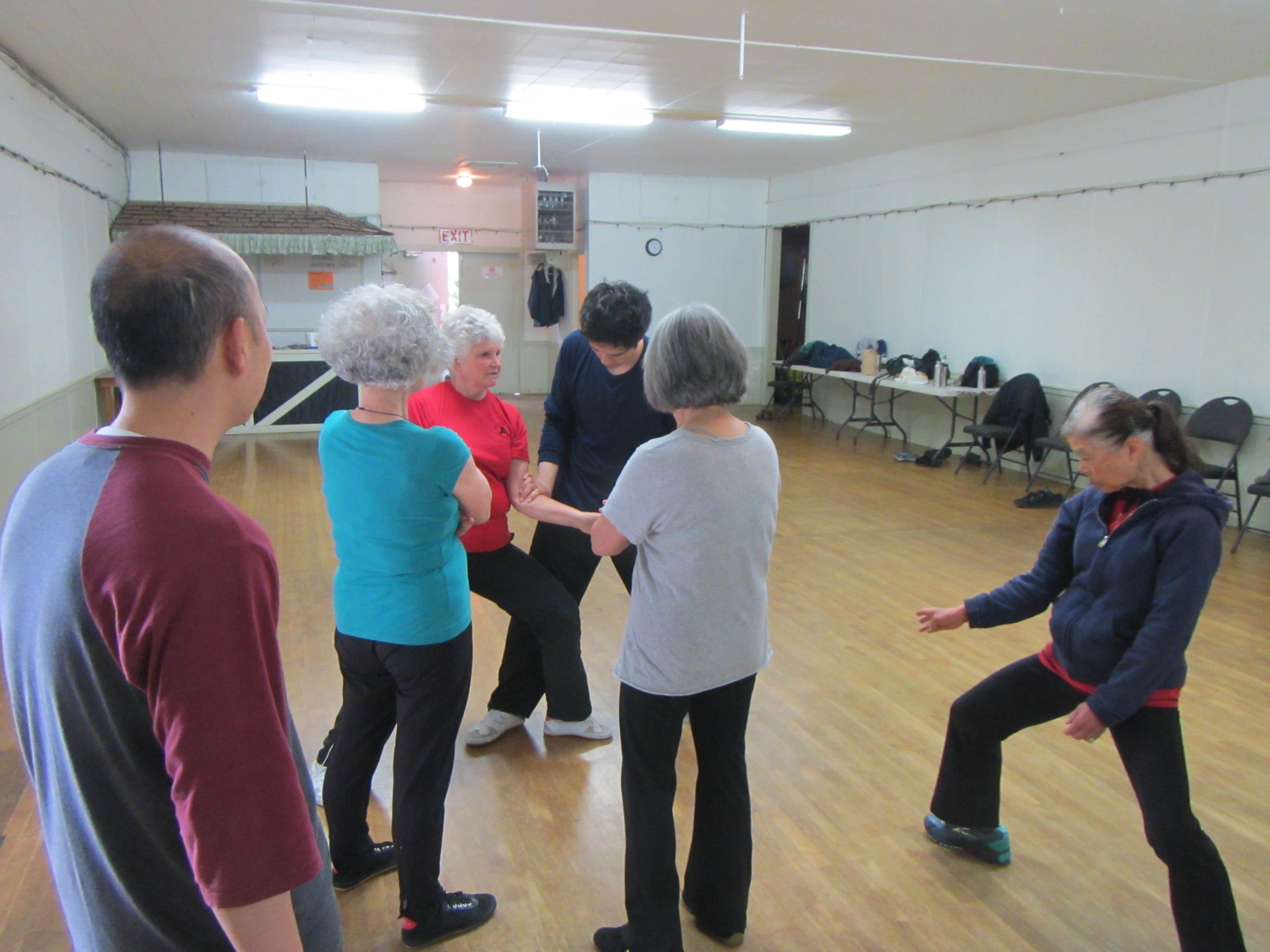
There must be three stick in the body.
- Vertical stick is from the Baihui on the top of the head to Huiyin at the bottom of the torso.
This stick is absolute. There are no “ranges” allowed. - Horizontal stick is the arm.
This stick has a range. it can move within the range of eyebrow and the kua. - 45 degree stick is from rear foot to the front hand.
This stick has a range from front hand to the floor.
Kewei Sun has started learning Practical Method since May 23, 2015.
Read more
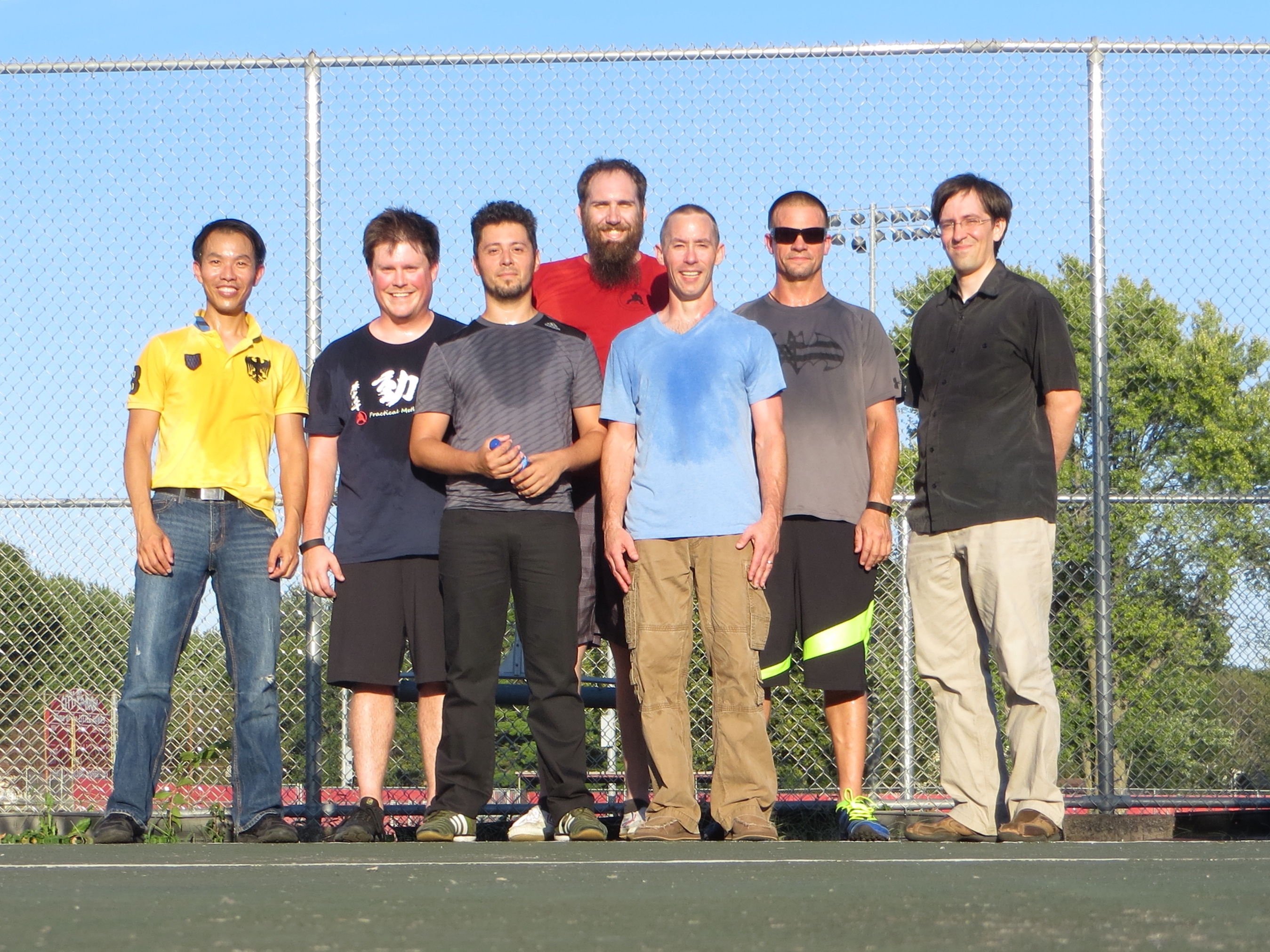
I attended the Practical Method Iowa Workshop 2015. Officially, the workshop was on Sep 12-13, 2015. I spent a total of 6 days there from Sep 10-15, 2015. It was the best workshop I had ever attended. We had a lot of dedicated Practical Method people there. Thanks to Levi and Christina who let a number of us stay at their place the whole time, and gave us the opportunity to immerse in taiji with Master Chen Zhonghua. Thanks to Levi and John for taking care and arranging food, as well as driving us around. We woke up early at 4:20 am to start doing yilus before breakfast, and we often pushed hands till 10:30 pm at night. It was just wonderful being around my taiji brothers.
The following are the notes I took:
Day 1
– Keeping the back straight at all times
– Always have an aim at the centre, every movement should result back to the centre (don’t deviate from it)
– Keep the movement small, otherwise it is wasteful, and there won’t be any left.
-Separation: When the hands have power, move in the waist. Have power in the waist, the hands can become free. Nudge in bit by bit.
Read more