Knowledge
View posts in sub-category:
Application Articles Body and Posture Class (Workshop) Notes Common Errors Glossary and terms Hunyuan Knowledge-Movement Explanations Learning Method Principle-Concept Principle-List Principle-Rule Principle-Technical Push Hands Quotations Routine Names Routines Videos Stories Student Evaluations (Private) Taiji Apparatus Taiji FAQ Taiji Sword Thoughts and Understanding Workshop and Class Notes
At the evening class tonight, I taught the use of a white waxwood staff exercise for shoulder and elbow rotational control. Please see the video here.
- displace, displacement: to move physically out of position <a floating object displaces water> Read more
Feng Zhiqiang Grandmaster Feng Zhiqiang pushing hands with Wang Fengming in Japan in the 1990s.
This interview we conducted with Chen Zhonghua, is the prepublication version of an article which appeared in the Fall of 2005 issue of TaiChi Magazine. It is offered here as a source for future discussion and feedback, for interests of the readers. Read more
Getting to the workshop location and depart for the airport are the responsibility of the participants.
Some organizers arrange airport pick-ups while others do not. Check the workshop detailed information page for further information or you can contact the workshop organizer for details.
There are no restrictions for meals at workshops. Typically some participants will go for a quick lunch as a group. Whenever Master Chen is present, students are expected to chip in a dollar or two to cover his meal.
There is normally a Saturday evening dinner. This is a more formal dinner. Students also contribute to Master Chen’s dinner expense. It is expected that nothing fancy or costly will be ordered.
- No video taping except by permission from the host. Read more
Participants are not allowed to make any promotions at the workshops. Anything of this nature must go through the host.
I do not have a local instructor. Can I really learn the Chen Style Taijiquan Practical Method system based on workshops alone?
So you want to attend one of Master Chen Zhonghua’s workshops! Here is a checklist to help you gain maximum bang for your buck! Read more
I will offer a list of things you need to look after before you attend a workshop to learn Taiji. Read more
Do you know the visa situation in China? I am going to stay in China for 3 months and possibly a year, but I’ve heard China stopped issuing 60 and 90 day visas. Do you know how difficult it is to get a 6 month visa? I am going to get mine in Hong Kong, hoping it might be easiest to get a visa there. Read more
Will I have any problems staying on Daqingshan as a vegetarian? Read more
Most definitely! Daqingshan Mountain Resort can accommodate your friends while you are at your studies. We can also look after them with tours and other activities. They can are able to dine with your Taiji group or have a private dining facility.
What is neutralization in Taiji?
We hear the cliche often: “when the opponent uses yang, we use yin.” In other words, when the opponent is strong, we must be weak, or yield. Nothing wrong with that. The logic is sound. It has been accepted by students, masters and grandmasters for ages. Read more
To adjust to or keep in proper measure or proportion, e.g. to modulate your force appropriately. Similar concepts include proportional movements, adjust while moving, etc.
This is a clip of single movement repetition practice led by Grandmaster Feng Zhiqiang. Clip provided by Master Zhang Jiping through youtube.
2008陈式洪派培训班—李老师讲解正反旋圈要点
What does it mean by not moving the hand?
Here is my understanding:
If I would like change the location of the hand relative to my body, e.g. the current location of the right hand is at the level of my belly button, and the destination is at my eye level in front of the right shoulder, how can I achieve that without moving the hand?
- Don’t move the hand, but I can move any other part of the body to achieve the same result.
- Keep the hand at the same coordinates in this three-dimensional space, and sink my body down, which in turn causes my elbow to go from above the hand to below the hand. Then perform the 2nd half of the positive circle.
Thanks to those who posted the quoted videos on youtube.
Tossing, or body swaying, is one of the ills of taijiquan practice. Tossing is something that people naturally do. It is not a trained characteristic of taijiquan. It has the “benefit” of looking good when done in taiji routine practices.
Today, most people take pride in “tossing”. Read more
This is actually a photo-camera recording of an impromptu session with Jay Smith during a session break at a workshop in Maple Ridge in 2008.
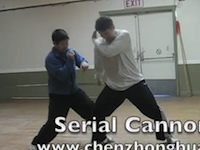
After they finished the foundations with the last move being the mobile version of “Wild Horse Parts Its Mane”, I gathered the classes and showed students a few tips: Read more
“Withdraw is to issue” is an important concept in Chen Style Taijiquan Practical Method. It is also a measurement of level of skill in this style. Here Master Chen explains a technical aspect of this skill. Read more
Use this to try to learn how to pull with elbow, not hand.
This demonstration of Yilu by Todd Elihu is the result of close to 10 years of hard work. This can be viewed as a good example of what Master Chen Zhonghua teaches.
This is a yilu demonstrated by Master Chen Zhonghua at the annual Taiji Traditions Camp in Victoria, B.C. Canada on Oct. 26, 2009. The demonstration was intended to suit the students at the camp in their learning.
Here is a video on how to maintain your own center while pushing hands and doing the form.
This seminar was attended by three visitors/new students. Nicholas Fung, an old student of mine, is visiting from Hong Kong. Wilkin Ng is from Vancouver and he has joined us. Gino Nasato is from Victoria. He has been an active participant in my Victoria workshops and in local classes there. He is visiting this weekend also.
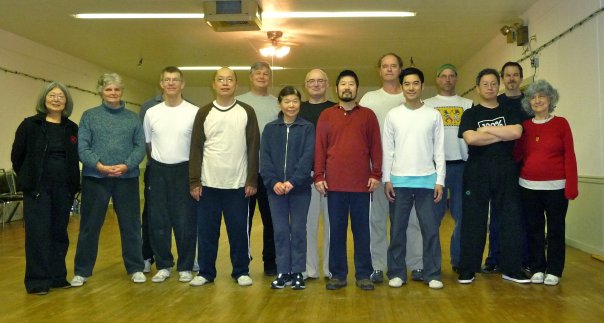
The main subject this weekend is on how to keep three different lines while pushing hands. This is a very difficult act to perform. I explained and experimented for students the example of how to aim at something or some place. In our push hands or applications, we often don’t push towards where we ACTUALLY intend to push!. This is a question of the mind intent not harmonized with the energy alignment. This question touches upon our basic natural disposition. It is very important for you NOT to believe that you don’t have this problem!
I have been giving this group of people seminars here for the seventh year. We started in Vancouver and moved to Fort Langley and finally settled in Maple Ridge. Currently we have three students from Seattle, one from Denver, CO who joins us occasionally, several from Victoria, and one from Nanaimo. Some have to drive more than three hours to get here; others have to take the ferry for over 5 hours. I fly here from Edmonton early in the morning. All this for Chen Style Taijiquan Practical Method!
2010-1-2
1、(腰胯)拉直后,无腰、无跨,此时可以保持腰不断劲。(沉肩、坠纣、头顶、双腿与丹田形成中轴——中正?)。 Read more
As every time I receive instructions from my Shifu, Chen Zhonghua, I understand more that what he has always talked about is one principle that is applied in countless ways. Read more