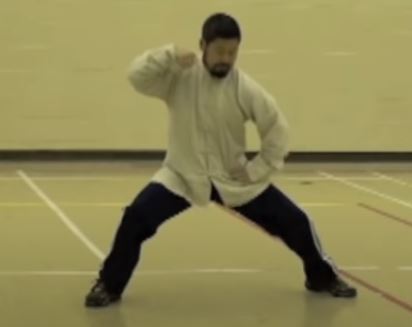
The subject of the lesson was corrections of yilu. Four students performed parts of yilu and received corrections.
Read more
Chinese Class
Our movements must have a horizontal one and a vertical one intersecting/interacting at the same time.
Three parallel planes
- Top plane at the shoulder (including extending the arms)
- Middle plane at the waist
- Bottom plane at the knees
The integrity of each plane must be maintained. There is a vertical rod that goes through the middle to connect all three planes to fix them in a particular way, but yet they are free to move any other way. Each plane is like a trampoline. This is how we convert opponent’s incoming kinetic energy into potential energy stored in the trampoline, and eventually back to kinetic energy aimed at the opponent. You can also lock any of the planes, and move a different one to create a vertical stretch. With these 3 planes, you can create a lot of variations and configurations.
Read more
Gerry
Cloud hands
- Need to rotate torso to give the appearance of the hands moving.
Getting stuck
- Issue is that you were able to “do” things since the beginning. Able to mix instructions with something you were already able to do.
- Need to be stuck unable to do it, so that it forces you to do something totally new. Never went through a time where you couldn’t do it. If there is no difficulty why would there be change?
Knowing
- Daoist idea, Humans made correctly but the abilities we have deter us from learning.
- Gained the ability to make things up in our heads.
- Everything Master Chen learned are afterthoughts / accidental.
- Don’t know when you get it, and when you think you get it, you don’t.
- A dog is just what it is, but we make up this view of what they should look like.
- Whatever it is, you don’t know it. And whatever you know it isn’t what it is.
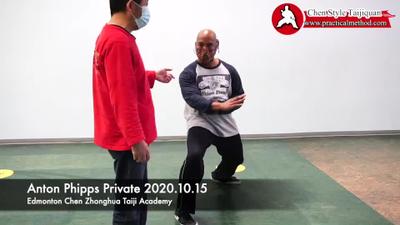
This is the section 3 of the Yilu corrections for Anton Phipps by Master Chen Zhonghua.
Presenter: Chen Zhonghua Length: 38 min. In: English Year: 2020 Difficulty:3/5 At:Edmonton Chen Zhonghua Taiji Academy 埃德蒙顿陈中华太极馆
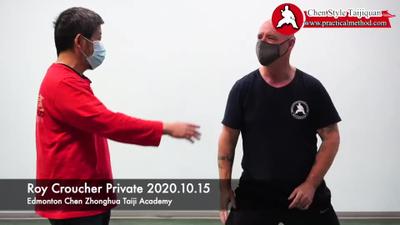
Master Chen Zhonghua’s online lesson on Chen Style Taijiquan Practical Method on Oct. 15, 2020.
Presenter: Chen Zhonghua Length: 77 min. In: English Year: 2020 Difficulty:2/5 At:Edmonton Chen Zhonghua Taiji Academy 埃德蒙顿陈中华太极馆
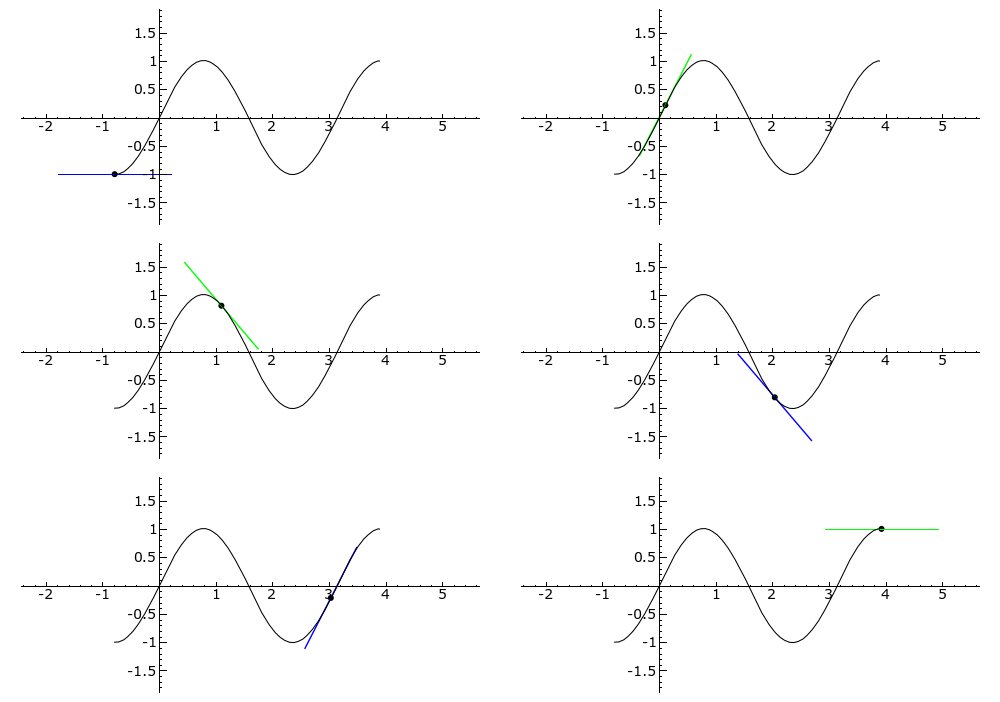
Inflection points in differential geometry are the points of the curve where the curvature changes its sign. In the illustration below, it is when the tangent turns red or when the curve intersects with the X axis in this case.
Whatever it is that you know, the truth is not like that. Whatever you don’t realize, accidentally it is the correct thing.
Read more
Presenter: Kelvin Ho Length: 17 min. In: English Year: 2020 Difficulty:3/5 At: Toronto and Iowa
Going over
- Going over the shoulder: have to go around the shoulder.
- Like the gear shifter, has to actually change gear.
- One movement that continues to the other side (normal).
- Go halfway and change to the other side to go down (switching).
- (腰裆转换 Yao dang zhuan huan). Waist and dang (half circle, horseshoe) switching. That half circle has to be locked – the shape locks.
Positive Circle
- Focus on the use of front kua in Positive Circle to increase the size of the circle.
- When going down, step the rear foot backward.
- When coming up, step the rear foot forward.
- Do the same on both sides.
Chen Zhonghua’s Online Lesson on 20201014. Presenter: Chen Zhonghua Length: 85 min. In: English Year: 2020 Difficulty:3/5 At:Edmonton Chen Zhonghua Taiji Academy 埃德蒙顿陈中华太极馆
Read more“Rotation is changing direction without changing direction”
What kind of confusing statement is that?
Learning taijiquan is a feat in resolving conflicts.
Read more
Foundations on line notes ~ October 13th 2020 by John Upshaw
Kelvin Ho lead us through a positive circle stepping back drill. With our front hand out, we would step back with a rear foot causing us to go lower, we rotated/shifted from our front kua to our rear kua, rotating the elbow in on the same line with hand staying fixed on that same line…like a spear, tip pointed at the opponent. By using my kuas in this manner, my range increased.
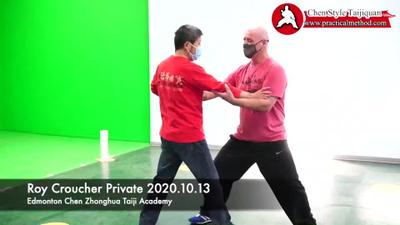
Master Chen Zhonghua’s Private lesson for Roy Croucher on Oct. 13, 2020. Presenter: Chen Zhonghua Length: 47 min. In: English Year: 2020 Difficulty:1/5 At:Edmonton Chen Zhonghua Taiji Academy 埃德蒙顿陈中华太极馆
Read moreMaster Chen Zhon ghua’s Oct. 13, 2020 private lesson for Anton Phipps. This lesson used the applications of the first 13 moves of the Practical Method to illustrate how the moves are to be done.
Presenter: Chen Zhonghua Length: 58 min. In: English Year: 2020 Difficulty:3/5 At:Edmonton Chen Zhonghua Taiji Academy 埃德蒙顿陈中华太极馆
Master Chen Zhonghua’s online lesson on 2020.10.13. This lesson is on foundations. Master Chen taught how to focus on the kua while doing the positive circle. Presenter: Chen Zhonghua Length: 63 min. In: English Year: 2020 Difficulty:1/5 At:Edmonton Chen Zhonghua Taiji Academy 埃德蒙顿陈中华太极馆
Read moreToday’s class on Foundations was held on Canadian Thanksgiving.
The subject of the lesson was foundations/positive circle.
Master Chen provided some history of China and the development of taijiquan. He also related a story about how the Practical Method foundations were developed. Read more
Master Chen Zhonghua started with a story about the history of China and Chen Style Taijiquan. Before the first Qin emperor defeated 6 other kings and united China, there was the period of Spring and Autumn 春秋 (which has nothing to do with the two seasons). Back then, there were 800 states, each had their own cultures, and they all flourished. Today, there are different levels of governments in China: Federal, Provincial, and County. The Chinese government wanted to get rid of the county level government, but they couldn’t done. Each county turned out to map back to the old states. The Chinese government had full election for village officials, but there are large families at the county levels, with full election, these large families will gain control at the county level goverments. These families managed to get around the one-child policy themselves.
Read more
Master Chen Zhonghua’s online lesson on Chen Style Taijiquan Practical Method on Oct. 12, 2020. This lesson was on how to use large moves of the kua to create a positive circle. Presenter: Chen Zhonghua Length: 48 min. In: English Year: 2020 Difficulty:1/5 At:Edmonton Chen Zhonghua Taiji Academy
Read more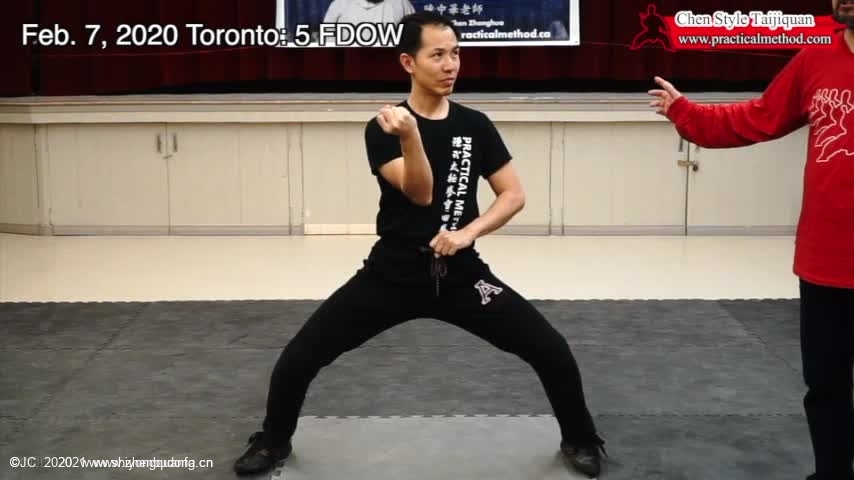
Master Chen Zhonghua’s Toronto Workshop March 2020-5
Presenter: Chen Zhonghua Length: 9 min. In: English Year: 2020 Difficulty:4/5 At: Toronto, Canada
Master Chen Zhonghua explans the Practical Method signature move: Fist Drape Over Body. This move requies coordination of the entire body. Master Chen gave Kelvin Ho a lot of detailed corrections.
Presenter: Kelvin Ho Length: 25 min. In: English Year: 2020 Difficulty:3/5 At: Toronto and Iowa
Read more
Once again Master Chen found it necessary to tell us how to learn. Many of us were practicing as he was teaching. And of course, I was one of them. He was giving each of us a private lesson and we should have been listening intently. At that point, practicing was just a distraction. Yes, practicing is totally necessary, but not when the teacher is telling us the important things that other teachers would call secrets and probably wouldn’t even teach. If we’re at all smart, we’ll take advantage of the wonderful opportunity Master Chen is providing. Read more
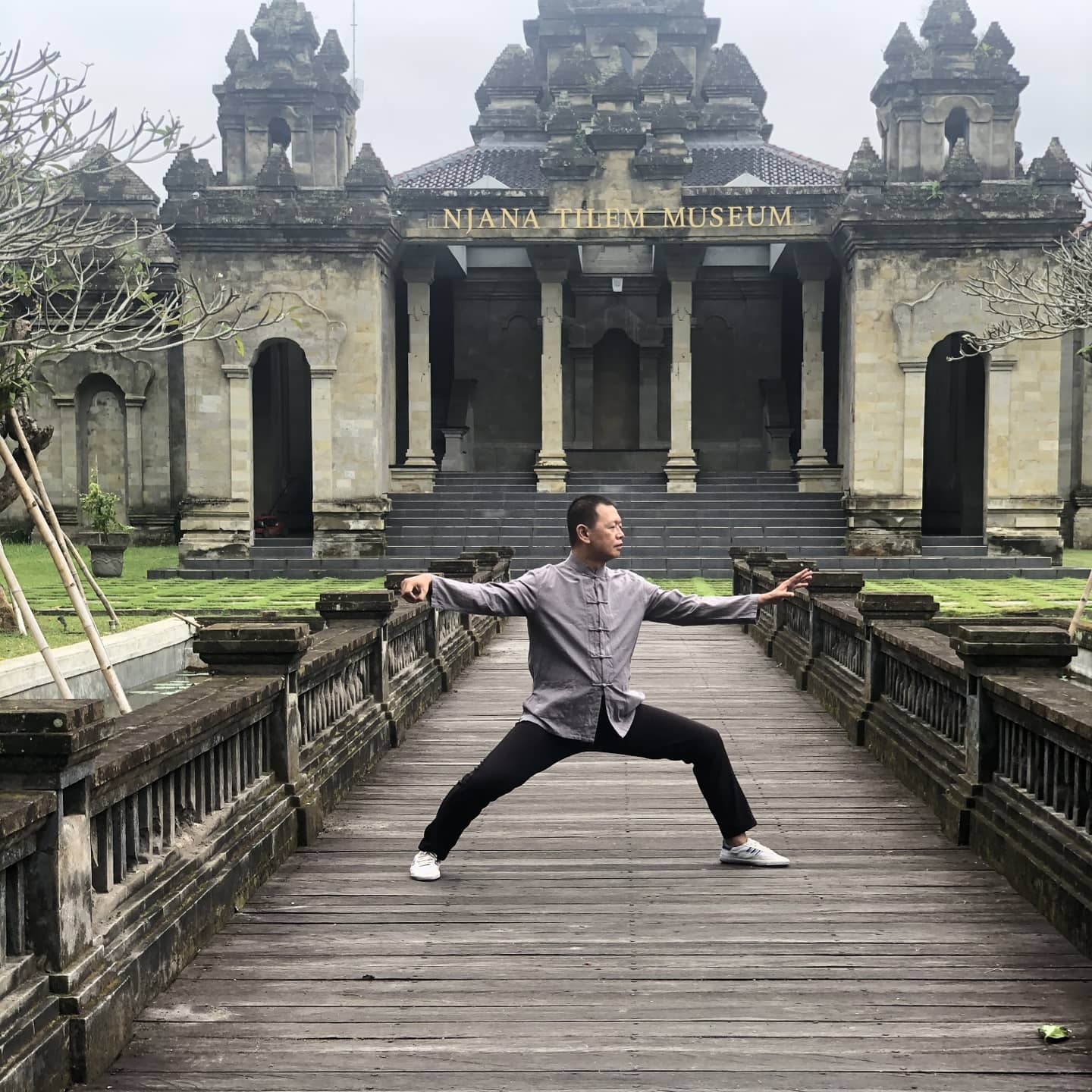
During this time of the pandemic, I had a very valuable opportunity to attend Shifu Chen Zhonghua’s online class. By listening, seeing and following the instructions given in the class I began to understand the principles of the Taiji practical method and apply them to yilu and push hands. All this time I thought that I understood and could do yilu well, but what I understood was wrong. Read more
I named this the Yilu Project because I have taken some steps to “clean up my yilu”, and this is my baseline for measuring progress or the lack thereof. I have been attending weekly online classes with Master Chen Zhonghua. Having access to consistent corrections on my yilu and foundations is a “once in a lifetime opportunity”! Additionally, I have been getting feedback from my Taiji brother Kelvin, who has a very good eye for details. Feel free to point out mistakes.
Respectfully,
John
…learning about adaptation vs. action…screwdrivers only engage one way…
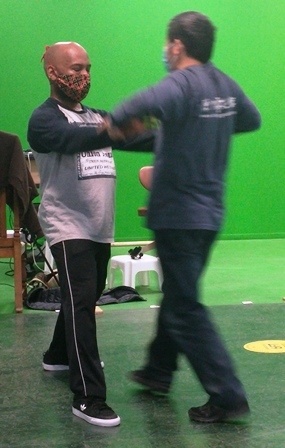
There were many corrections and a number of important conceptual points on how to learn.
-We have 2 general types of movements
Action movements are what the particular form is about in order to execute a particular application on an opponent. Must be accurate.
Adjustment movements are to position body parts to be in place to execute the action movement. Accuracy in getting there is less important.
We must know the difference. We tend to not know or show the difference.
-Master Chen repeated the instruction, as he has many, many times, to listen and watch as he explains. Do not attempt to copy while he is explaining. We miss much of the instruction while we attempt to copy. I have heard this so many times, yet I was copying while he spoke in the class this morning.
-Not one move in PM Taiji is like any other in life or sports. We must see that the moves are unique to PM Taiji. MC does not move like an average person, but the average person, as in we his students, THINK we move like MC. He has said to me specifically in other zoom classes that I make a good copy of the moves, but he can see that I do not really do the essence of the moves. We tend to compare to other movements and other sports, but PM is different from those moves. I must say that I make many of these comparisons. I would say my whole education has been based on building on comparisons and it is a very difficult thing for me to not compare PM to other human activities. I can see now that recalibration must happen without these comparisons.
Action vs adaptation
- Only worry about that particular action. We don’t care much about the adaptation. Once the screwdriver fits with the screw, there is only one thing you can do. You can get away with whatever for the adaptation, but the action must be what it is to have power. Must identify that action.
The actions need to be precise/ accurate. There is only one way to do it right. The adaptation you can get away with it. Read more