-
When the elbow comes in, the finger must aim onto person. Actually, every move must aim onto person.
- When locked at one or two points, utilize another set of points beyond the initial set of points to go over/break out.
- Isolation exercise #1: partner holds your arm at the wrist and shoulder. You squeeze the muscles on the body-side of the where he has his hand on your shoulder, then extend the fingers. Each move must be independent from one another. Switch back and forth. Read more
Knowledge : Workshop and Class Notes
Six sealing four closing: Must be like inside a round cylinder. Muscle must rotate around bone. Don’t move. Hand must be like inside tube and body must adjust to be aimed correctly. Hand out, elbow in can only be done if front lat goes down to the rear arch and front kua rotates to curve up to connect to the rear shoulder. Pull elbow back to be in alignment. Step in a little bit with just the lower body to fill space. Don’t push. If one part is off it throws the entire body out of alignment.- 18 posts in the body… they cannot collapse into each other. Read more
Align backward , never fight forward… feet are too close together, arms are as well. Shoulder needs to stay in the kua.
Full front kua in the line, align the arm . Then open the rear kua… the front kua,is always the filler, the rear kua is always the stretcher…
The end of every move must be totally straight. ” stay on the line”
Day two.
Workshop Practical Method Chen Style Taichi Quan push hands by Grandmaster Joseph Chen Zhonghua
De Glind 26-27april 2014, Netherlands
These notes are partly chronological and based on how I percieved them. I kept as close as I could to Master Chen’s exact words.
Day one
The workshop started with an introduction. Underlying the art of Practical Method Taiji Chen Style are thirteen dimensions. These thirteen dimensions are divided in two levels. Eight dimensions are related to the air; five are related to the floor.
Most Important: Nobody can see, what Chen Laoshi is doing (except Chen Xu), when he is throwing a stone in the water and waves are appearing, everyone is asking, how to make such waves (form of the waves, etc.), but he just throws the stone- first 13 moves: shovel out, waist cannot go forward, has to be zero, only can go down, to push out
- shovel out means to bypass
- your opponent is strong in different dimensions, you always wrapping around him
- all forward moves you have to lock yourself down
- movements must be led by the piece were I and you don`t touch, move as one piece, like one wall going at you, which part is leading is very different
- Read more
Maxime Fréchet·Wednesday, June 8, 2016
Here is a little review of the workshop with Master Chen Zhonghua. I’m not in a position to explain anything so I’m just going to share my feelings and experience.
Great experience! Zhonghua Chen is a kind and humble person. He often shares but not too much either. His approach goes straight to the point. He makes you understand principles and concepts with clear words and demonstrations. There is always a bit of Dao in everything, which I really appreciate, it keeps your mind open. Great bunch of people from different countries, good atmosphere and workshop in English.

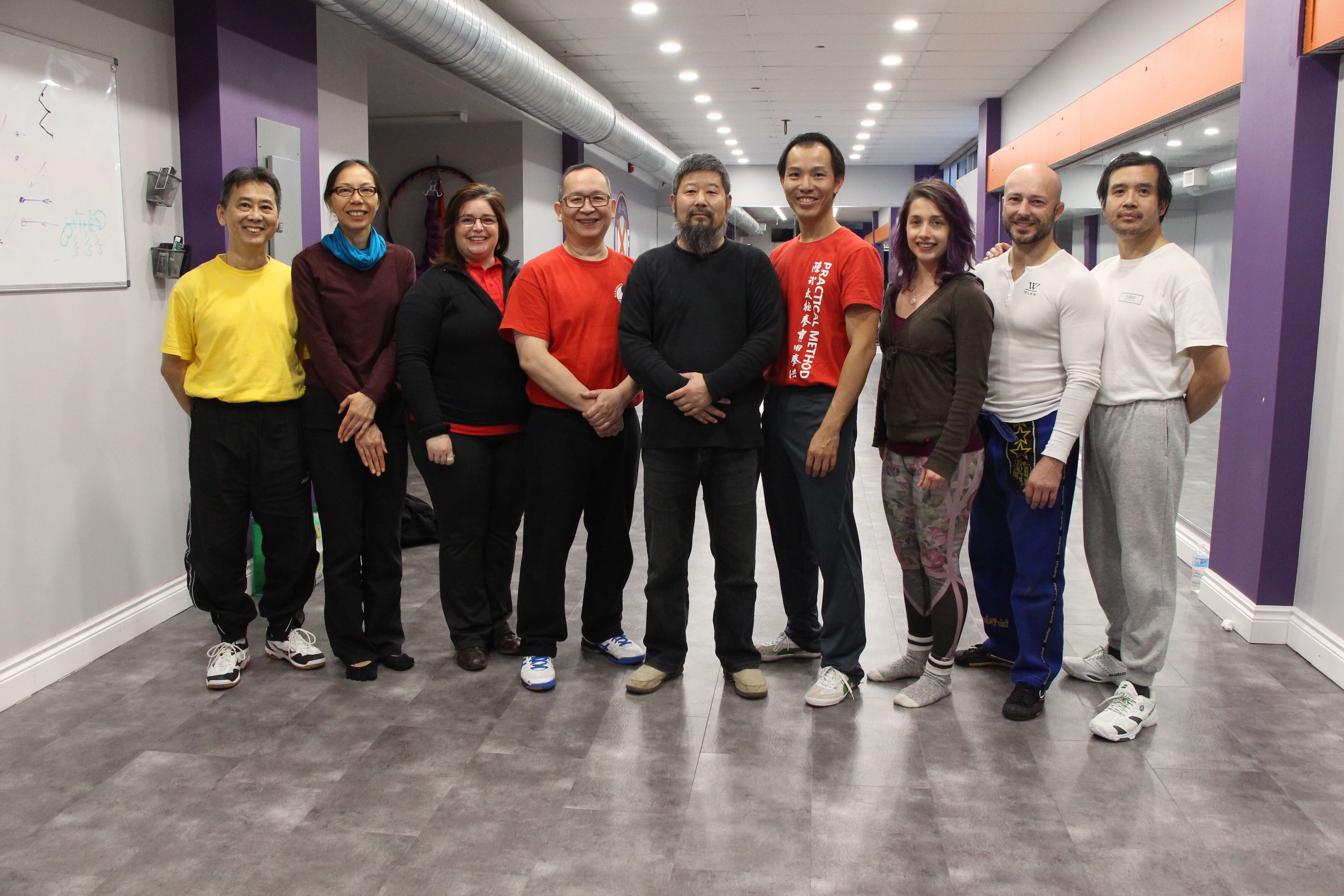
We had 19 people attending the Toronto workshop this time. 5 of them were first timers. We started off with Master Chen talking about the positive circle, and continuously focusing on its various aspects.
Here are my notes:
- Only move your foot forward towards the opponent, everything else does not go towards the opponent. Read more
I just returned from a 3 day workshop in Toronto. I would like to thank Master Chen and all of the other participants for providing me with this learning experience. All of these notes are mental ones and I will make sure that I take down physical notes on subsequent trips. All errors and omissions are my own. I would like to thank Kelvin for calling me out on my note taking or lack thereof. I totally forgot how to be a good student. I believe that it is important to take notes as a) they will help you to remember what you have learned and b) some of the instructions are personal points of guidance that might apply only to you and as such will not appear in anybody else’s notes.
I attended the Practical Method Iowa Workshop 2015. Officially, the workshop was on Sep 12-13, 2015. I spent a total of 6 days there from Sep 10-15, 2015. It was the best workshop I had ever attended. We had a lot of dedicated Practical Method people there. Thanks to Levi and Christina who let a number of us stay at their place the whole time, and gave us the opportunity to immerse in taiji with Master Chen Zhonghua. Thanks to Levi and John for taking care and arranging food, as well as driving us around. We woke up early at 4:20 am to start doing yilus before breakfast, and we often pushed hands till 10:30 pm at night. It was just wonderful being around my taiji brothers.
The following are the notes I took:
Day 1
– Keeping the back straight at all times
– Always have an aim at the centre, every movement should result back to the centre (don’t deviate from it)
– Keep the movement small, otherwise it is wasteful, and there won’t be any left.
-Separation: When the hands have power, move in the waist. Have power in the waist, the hands can become free. Nudge in bit by bit.
Read more
The Vancouver workshop was taught by Steve Chan and Bill Vanderhall. Driving in from Calgary, I was able to get some good training in and meet up with the Vancouver practical method group again. Read more
Shifu Chen Zhonghua often emphasizes how to learn Taijiquan. This web site has a great article called 6 Methods of Learning Tai Chi. (Read this if you have not already.) It expands and elaborates on Grandmaster Hong’s “Look, Listen, and Ask” practice method.
In motor control research, I found the neurological basis for this method of learning. There are neurological mechanisms called mirror neurons. The basic premise is when we see a person do something, mirror neurons fire off in our brain attempting to duplicate the pattern in our nervous system required to copy the movement. At first, it is an imperfect copy because it follows old neurological pathways. With repeated viewing of the action, our brains and nervous system do a really good job of creating new neurological pathways to accurately copy the movement. Read more
June 20, 2014 (?)
I’m not entirely sure if the date for these notes is correct. I believe they were from an evening class, but they may have been from a workshop. I should have posted these right away, but better late than never I suppose. Read more
After two and half month passed since my first trip to Irvine, I went back on January 31. This time, Edward came to join the group. We worked briefly on foundations. Mostly, I focused on teaching Yilu.
Foundations are important. Yilu is the core. The more students know about Yilu, the more fun they can have while practicing alone. I was able to finish the first 30 forms to “Upper Cloud Hands” and “High Pat on Horse” in the morning. (We did the first 13 moves in last workshop.) Read more
On the invitation of Mr. Lai Qingwen, two instructors from Daqingshan, Chen Xu and Li Xiaohui, went to Yishui, Shandong province to teach Chen Style Taijiquan Practical Method as taught by Master Chen Zhonghua. They will be in Yishui from January 30, to February 3, 2015. Read more
Notes from Toronto workshop:
-Make the dot longer to control where they fall. Must add 3rd dimension. Curved line automatically works in 3 dimensions.
-Change of position allows the length to be changed. Do not change the angle. Read more
These are some of the photos at the Toronto Workshop on Jan. 15, 2015. Worked on Foundations, Yilu, and applications. Push Hands techniques are mainly based on scissors power: two lines crossing with a fixed spot on them.
Today was the first day of the workshop in Sydney. After some adminstrative issues and handing out the t-shirts, Master Chen took control and started in quick sucession of static 3 count elbow in, turn waist, hand out. Soon this developed in stepping positive circles, and before everyone recovered the class was already twisting (wringing) the towel. We also explored the three way split, the effect of the resultant power (usually the other person on the ground).
We then continued with an extensive series of applications related to the movements of ‘Buddha’s Warrior’, and Master Chen demonstrated various variations to the applications with the foot kicking in the knee, the foot sliding behind the leg, the foot sliding behind the leg and kick the opponents leg from under them, the split of the kua at the front for higher moves and the back kua for lower hand moves, how the three way split applies to this, and much, much more. Read more
Master Chen told students to be clear in yilu, either arm or body move, not both.
![]() |
Rachel, Daniel, and James did an excellent job organizing an Open House and Workshop for the Weekend of April 05-06, 2014. On a beautiful spring morning, more than 50 people gathered to learn about the Chen Style Practical Method and to meet one of its distinguished proponents, Master Joseph Chen Zhonghua. |
On Sunday, Master Chen demonstrated how to set up multiple lines on an opponent’s body when pushing hands. The goal was to set up enough lines that the opponent finally felt like they had to jump out to escape, or they were bounced, or squeezed out. Read more
[wowslider id=”42″]
After almost two weeks since attending the Sydney Practical Method workshop. I cannot retain all the information I heard in my head. It’s just going to give me a headache. I’m going to empty out all of my thoughts and experiences on what I remember from the Workshop, not to be excited on how many comments I’ll get but for my benefit to continue training unimpeded, because if I don’t, then my energy will be wasted in thinking rather than practicing. Read more
Michael Calandra will be teaching a workshop on Practical Method in London on the 21-22 of November. Anyone interested can contact Asad Habib via facebook , or email Michael Calandra at oikddojo@aol.com.
http://www.seishinkanonline.com/
[wowslider id=”32″]

The following are my raw notes from the workshop:
- Create the arch in different segments of the body from hand to foot
- Don’t move the hand, stretch the elbow from the hand.
- Always aim at the largest part of the body since we shoot all over the place, and it’s useless. For now, the torso, later the spine, even later something smaller. Read more
Bruce Schaub Push Hands Learning with Chen Zhonghua 2013 in Toronto, Canada.
[wowslider id=”28″]
Name: Don’t Move The Original

The front graphic features Master Chen’s own calligraphy of 不動 meaning “Don’t Move”.
Read more
We are pleased to announce the return of Master Chen Zhonghua to the Upper Midwest, specifically Iowa, for a weekend workshop. We will cover foundations, form corrections, applications and push hands. These workshops are for everyone interested in learning taijiquan. No experience is necessary, just a willingness to learn. Hope to see you there.
Iowa Pratical Method Poster 2013.ai
[wowslider id=”38″]
Master Chen Zhonghua’s Phoenix Workshop
October 15 (Tuesday) to 18 (Friday)
Read more
Facebook Event: https://www.facebook.com/groups/practical.method.toronto/permalink/513006922096561
Feb. 9, 2014:
Agenda:
6:30 am – 10 Yilus
8:00 am – Examine our negative circles
| Chen Style Taijiquan Practical Method Toronto |
I am very impressed with Steve’s demos, he is able to explain his actions exactly like Master Chen with no deviation. It’s like deja-vu. I have heard the same explanations from Master Chen in a different place at a different time. I can learn so much from him.
Ming’s post below captures most of the material Master Chen shared on the weekend. Here are a few things I wrote down or was told directly over the course of the weekend.
Main Theme: “Taiji movement must be Differentiated and Sequenced; in order to move like this, repetitive practice of Yi Lu is needed to habituate the body”, Read more