Knowledge : Workshop and Class Notes

Master Chen is showing us something that we cannot do. So, if we fake it, we are not learning. It is something we cannot do. The learning is to show us our deficiencies not our efficiencies.
It is very important that we never become comfortable. We must be in that position that we are uncomfortable, and stay in that position. We need to stay in that state of uncomfortable without changing our structure. This will allow our us to re calibrate.
In yilu, we must do it one move at a time until we reach our fullest extent and then reset. Master Chen is trying to bring back the original idea, not continuous. Train each move separately.

The stretch from knee to kua the thigh lengthens. We need to go into the uncomfortable position that we are about to fall down or we do fall down.
We need a clear net gain without changing shape. This net gain can only be created with the stretch and no rotation. This needs to be applied in push hands and in practice. To train this you cannot have wobbly moves. If the opponent creates a net gain during push hands and you don’t that goes into you and you lose. Net gain equals net distance.


Correction on my form  Need to have 3 solids There is a line at the shoulder level between the front hand and rear shoulder (first 2 solids) I need to stretch the kua down to create the 3rd solid. Read more

Learning Taiji is like climbing the stairs. The teacher has to grind hard on you until you see the first step and put your foot on it. Whatever is correct has to be driven into you. Read more

Correction on my form

  • Need to have 3 solids
    • There is a line at the shoulder level between the front hand and rear shoulder (first 2 solids)
    • I need to stretch the kua down to create the 3rd solid.
    • The first 2 solids form the horizontal bar of a T-bar, while the kua stretching down creates the rod of the T-bar.
    • Master Chen Zhonghua demonstrated six sealing four closing with that rod not moving. Without this part, I will not be able to rotate. With it, things start to become 3-dimensional. It was really like that there was an auger in him.
    • This may seem like a contradiction while we need to push the front kua up, we also need to stretch it down to create a solid. Read more

Today we worked on isolating a movement and twisting the towel. During previous training sessions we did it to feel the trajectory and range. Now we do it with a restriction. The restriction that we did it with was not to move the knee. The main action we were training was twisting the towel with a stretch, not a rotation. Read more

Chinese Class

We do our form in a low stance to train gong. When we use it, we don’t go so low, because it is not agile enough.

Movements need to be big and long.

The kuas need to be just a bit higher than the knees. Read more

High Pad on Horse

  • Rub the torso
  • Only rotate the two shoulders and two kuas

Read more

Chinese Class

Negative Circle

  • In-with-elbow, Zhuan Guan, Out-with-hand
  • We have get the proper ideal image in our mind, even though we can’t do it properly at this point.
  • We must be expressive in our movement during training, so the teacher/instructor can see your intent.

Rotation is when there is movement without displacement.
Read more

Remember to lock one body part to do stretching.   Find one thing and do it right.  Once you have the method, you can repeat it until it exhausts you. Read more

莒县实用拳法讲座20201016-25th Juxian Practical Method Seminar from Oct. 17th to 18th, 2020.

Instructor: Chen Xu.
Wang Kai, Qiu Yingdong. Read more

Chinese Class

Our movements must have a horizontal one and a vertical one intersecting/interacting at the same time.

Three parallel planes

  1. Top plane at the shoulder (including extending the arms)
  2. Middle plane at the waist
  3. Bottom plane at the knees

The integrity of each plane must be maintained. There is a vertical rod that goes through the middle to connect all three planes to fix them in a particular way, but yet they are free to move any other way. Each plane is like a trampoline. This is how we convert opponent’s incoming kinetic energy into potential energy stored in the trampoline, and eventually back to kinetic energy aimed at the opponent. You can also lock any of the planes, and move a different one to create a vertical stretch. With these 3 planes, you can create a lot of variations and configurations.
Read more

Whatever it is that you know, the truth is not like that. Whatever you don’t realize, accidentally it is the correct thing.
Read more

Positive Circle

  • Focus on the use of front kua in Positive Circle to increase the size of the circle.
  • When going down, step the rear foot backward.
  • When coming up, step the rear foot forward.
  • Do the same on both sides.

Read more

Foundations on line notes ~ October 13th 2020 by John Upshaw


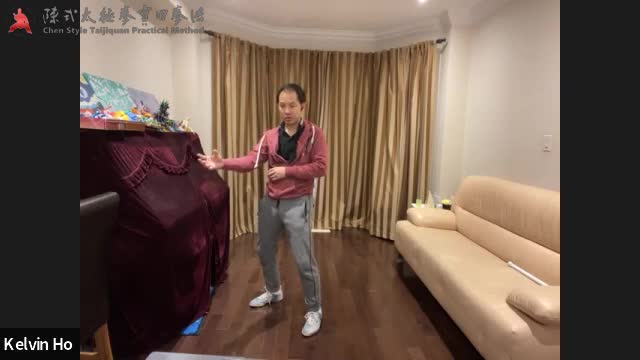
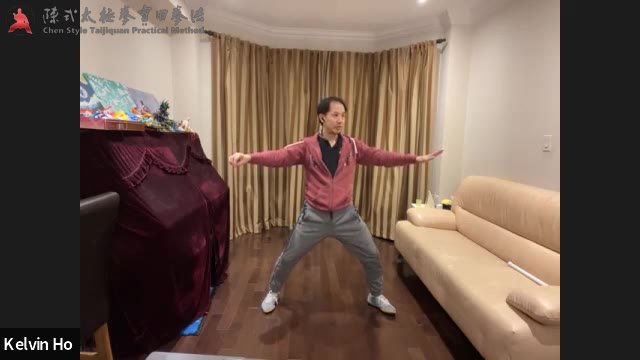
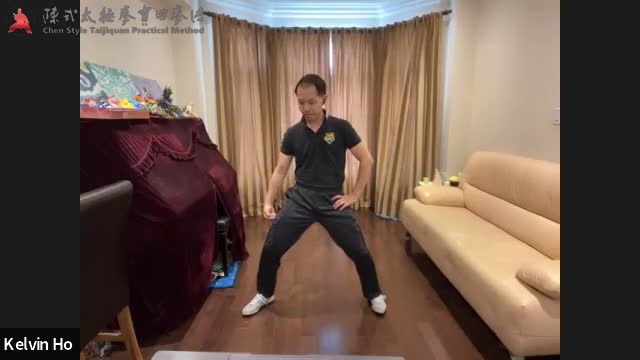
Kelvin Ho lead us through a positive circle stepping back drill.  With our front hand out, we would step back with a rear foot causing us to go lower, we rotated/shifted from our front kua to our rear kua, rotating the elbow in on the same line with hand staying fixed on that same line…like a spear, tip pointed at the opponent.  By using my kuas in this manner, my range increased.

  Read more

  • The learning ratio is strange. Many years of hard work (5 till 10 years) without results. But once you understand the rotation, within 3 months every move of the Yilu starts to make sense

Read more

The subject of the lesson was foundations/positive circle.

Master Chen provided some history of China and the development of taijiquan. He also related a story about how the Practical Method foundations were developed. Read more

Master Chen Zhonghua started with a story about the history of China and Chen Style Taijiquan. Before the first Qin emperor defeated 6 other kings and united China, there was the period of Spring and Autumn 春秋 (which has nothing to do with the two seasons). Back then, there were 800 states, each had their own cultures, and they all flourished. Today, there are different levels of governments in China: Federal, Provincial, and County. The Chinese government wanted to get rid of the county level government, but they couldn’t done. Each county turned out to map back to the old states. The Chinese government had full election for village officials, but there are large families at the county levels, with full election, these large families will gain control at the county level goverments. These families managed to get around the one-child policy themselves.
Read more

In our system, the kua is the dan tien, when both kuas are open, the dan tien is ‘full’

One your body learns rotation, all moves in Yilu make sense.  Without rotation, no Yilu moves make sense.  All the movements will be ‘fake’, ‘made up’, because there is no rotation. Read more

Once again Master Chen found it necessary to tell us how to learn. Many of us were practicing as he was teaching. And of course, I was one of them. He was giving each of us a private lesson and we should have been listening intently. At that point, practicing was just a distraction. Yes, practicing is totally necessary, but not when the teacher is telling us the important things that other teachers would call secrets and probably wouldn’t even teach. If we’re at all smart, we’ll take advantage of the wonderful opportunity Master Chen is providing. Read more

The subject of the lesson was corrections of yilu. Four students performed parts of yilu and received corrections. Read more

Chinese Class

What does it mean to get something into the body?  You are able to do it without thinking about it, e.g. when you can complete a yilu talking to someone, this means the yilu movements become automatic, while your attention is in talking to that person.
Read more

The following people received Yilu correction from Master Chen Zhonghua:

  1. Josh Landau
  2. Frederick Wong
  3. Jack Scott
  4. Mark Hanley
  5. Kevin Chen
  6. Sven Gusowski
  7. Kerstin Frotscher-Kummle

Read more

Today, shifu emphasized on how to learn. The first thing about learning is to listen to instructions and then to copy. Some people tried to copy without listening to the full instructions, and that won’t be a success copy either.

To copy, it’s to do everything exactly the same by definition.
Read more

[singlepic id=4 w=320 h=240 float=none]

The subject of the lesson continued working on six sealing four closing.

Master Chen said that people can train for many years but never make the change that will help them improve. They keep doing the same thing that they always have done. We often say old bottle with new wine but in China it is turned around, old wine in new bottle.
Read more

October 6th 2020 foundations On-line Class

Today we worked on staying on the line, which exists between the front shoulder and the front hand, and beyond with the same trajectory . The elbow pushes into that line, Which is activating the elbow, thus forcing the handout. The elbow withdraws in a way that integrity of the line between the shoulder and the hand remains intact.

Read more

[singlepic id=3695 w=320 h=240 float=none]

Today Master Chen provides instructions and corrections on Six Sealing Four Closing.

– The shoulder has to totally disappear.

– The move is a rotation from the central vertical rod.

– Only rotate from the shoulder. The hand, elbow and shoulder is one piece.

Read more

Master Chen started today’s class with a story and a method people used to remember things precisely.

The story was about how the Secretary was corrected by an old person on the details of an event. The Secretary referred his speech to a document. However, it turned out that the document was incorrect, and the audio recording had the truth as pointed out by the old person. In today’s society, we rely on a lot of documents instead of trying to remember things in our heads. If the documents were actually recorded in correctly, we would have the facts incorrect.
Read more

Chinese Class

Master Chen Zhonghua introduced Wild Horse Parts Its Mane as a foundation exercise. If space is available, we can do it as a line drill.
Read more

We started with the various foundations. Master Chen Zhonghua mentioned that we must be able to copy the external shape first, e.g. he must be able to recognize which foundation we were attempting to do.  If we were doing the yilu, others must recognize that we were doing a Chen Style Yilu, and then a Practical Method Yilu.
Read more

dsc02238

…during the Sept 23 Zoom class GM got that gleam in his eye, we’ve all come to know, “Little sparrow wags its tail…” and he went on to share a story about developing the skill of intention and about the skill of not telegraphing intent through micro-level somatic signals…

Read more

Several students’ yilu were corrected today:
Sooyeon,Carlotta,Raymond,Karen,Gerry

Read more

“Make it real” Series

Exercise 1

Open the kua to cause a horizontal rotation. Lock the top by using one hand to the hold the wrist on the other side. Stretch the fingers. Where the middle finger is pointing at changes as the rotation caused by the kua happens.

Open the right kua to turn left.

Open the left kua to turn right.

Don’t let the left knee point down when opening the left kua.
Read more

We started with double positive circle.

We used a rubber cord to tie to elbow to the waist, so that the elbow does not move by itself.
Read more

Today, Master Chen provided partial Yilu corrections for the following students: Read more

Today, Master Chen corrected the following students’ partial yilu:

  1. Karen Mattox
  2. Gerry Gebhart
  3. Albert Chung

Single Whip

Master Chen used the foot shovelling out in single whip as an example to talk about the concept of using a stick to pry open something. We shove the stick into a crack, then the front end of the stick cannot move anymore and stays in the same place. We can then make the crack bigger by prying with the stick. The key is that the one of the stick is not moving. As we pry, we may meet resistence, we can add a longitudinal rotation as we pry, it will allow the stick to go over the resistence. Regarding the single whip, we want to make sure that the toes do not point up as we shovel so that we can apply the longitudinal rotation on the entire left leg. As we shovel the left foot, the weight must stay on the right foot. As we shift over to half horse stance, the longitudinal rotation on the left leg occurs at the same time. Read more

Six Sealing Four Closing 六封四闭

Grandmaster Hong Junsheng studied the names of each move.  He looked into the origin of these names, and how the pronounciation might have changed when the information was passed down based on the dialect of the region.  The dialects in China can be so different that people from one region might not understand people from another region at all.
Read more

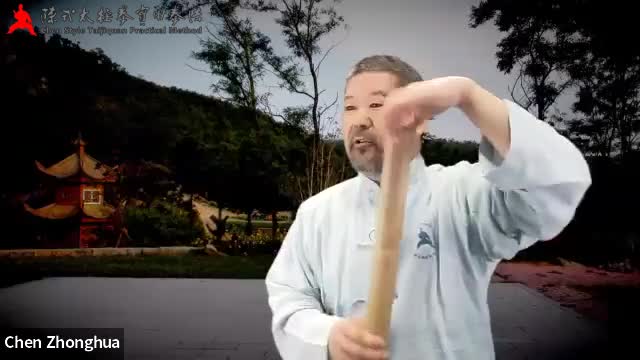
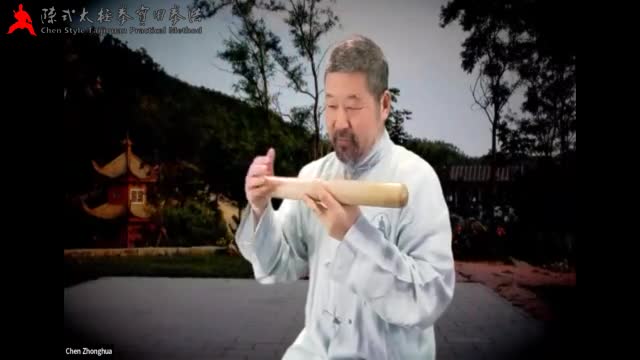
Master Chen demonstrated the foundation exercise Moving-Step Shake the pole, which is the positive and negative circle. He held a real pole to begin with to show the idea behind the foundation exercise. He locked his fron hand, which was holding the pole as a pivot. The rear hand moved the pole. Read more

Master Chen corrected a few people’s partial yilu today. Each person should remember himself/herself the stopping point, and so it can be continued from that point in future lessons when it is that person’s turn for correction again.

To stretch, we need to so find anchors on the two ends.

Empty means solid, it means power.

We need to find a line in ourselves. Master Chen showed Tinh Thai a version of fetch water that line up her rear elbow with the front hand. We need to make sure that the front shoulder is not in the way.

If we want to have grip in the hands, we need to have grip in the teeth and in the toes.

Six Sealing Four Closing
  1. Hands don’t move. Create a line between the front hand and rear foot. Read more