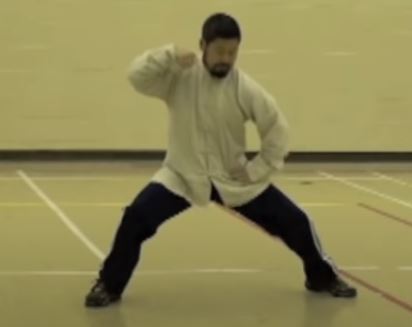
This is a clip of single movement repetition practice led by Grandmaster Feng Zhiqiang. Clip provided by Master Zhang Jiping through youtube.
2008陈式洪派培训班—李老师讲解正反旋圈要点
“This is the fourth workshop on Chen Style Taijiquan Practical Method of Hong Junsheng. ”
From Chen Zhonghua’s Feb. 2010 Toronto Workshop, posted by Zhonghua Chen on 2/22/2010 (5 items)

- Saturday group photo.


- Steven Chan leading the Yilu practice.


- Sunday group photo.


- Yilu routines. Charlie Gordon is at the front.


- Nick Mann and Alyssa Burrows in front of this photo.

Generated by Facebook Photo Fetcher
“Main theme was the first 21 moves of Yilu. Steve Chan from Ottawa came to assist. More info: http://practicalmethod.wordpress.com/2010/03/01/montreal-workshop-done-thank-you-2/”
[nggallery id=138]
That should be enough to work on and think about!
President and head instructor of Hunyuantaiji Academy
19th generation master of Chen Style Taijiquan under grandmaster Hong Junsheng.
2nd generation master of Hunyuantaiji under grandmaster Feng Zhiqiang.
Honorary instructor of grandmaster Feng Zhiqiang’s Beijing Zhiqiang Wuguan.
International Standard Bearer of the Chen Style Taijiquan Practical Method System. Read more
Wednesday, May 6, 2009 Chen Style Taijiquan Practical Method Workshop, Master Chen Zhonghua in Prague 11-12 April 2009
- Price: US$2,500.00 (one time limited offer) Includes all meals, lodging and instruction
- Arrivals Students should arrive in Beijing, Shanghai or Qingdao. If you require assistance, please call 13563348478 (Mandarin Chinese), 15954020070 (English), or email: mailto:
fulltime@chenzhonghua.com
-
Travel from these locations to the mountain is your own responsibility but the Daqingshan staff would assist you anyway they can. - Pick up and drop off at the cost of the students at the following locations:
- Weifang or Qingdao. Qingdao cost: ~US$80 both ways. Weifang cost ~US$70.00 both ways.
- Registered Students for 2010: 15 as of March, 2010. To reigster:
What does it mean by not moving the hand?
Here is my understanding:
If I would like change the location of the hand relative to my body, e.g. the current location of the right hand is at the level of my belly button, and the destination is at my eye level in front of the right shoulder, how can I achieve that without moving the hand?
- Don’t move the hand, but I can move any other part of the body to achieve the same result.
- Keep the hand at the same coordinates in this three-dimensional space, and sink my body down, which in turn causes my elbow to go from above the hand to below the hand. Then perform the 2nd half of the positive circle.
Thanks to those who posted the quoted videos on youtube.
Tossing, or body swaying, is one of the ills of taijiquan practice. Tossing is something that people naturally do. It is not a trained characteristic of taijiquan. It has the “benefit” of looking good when done in taiji routine practices.
Today, most people take pride in “tossing”. Read more
Some of my disciples such as James Chan and Nicholas Fung studied from Master Xu Gongwei.
This is actually a photo-camera recording of an impromptu session with Jay Smith during a session break at a workshop in Maple Ridge in 2008.
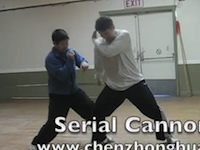
After they finished the foundations with the last move being the mobile version of “Wild Horse Parts Its Mane”, I gathered the classes and showed students a few tips: Read more
This is a class taught by Allan Belsheim in Edmonton in 2009.
Joseph
3-week package:
August 6, 2010: arrival in Beijing. Read more
Charlie Gordon and Alyssa Burrows came to join us today. Now it’s like a mini-Daqingshan reunion. Steve, Charlie and Nick are DQS graduates. Read more
We had 14 people at the workshop this time. Peter almost couldn’t make it. He went to Mexico on an emergency call on Thursday and was supposed to come back on Friday but go stuck in Houston. By lunch this morning, he made. What dedication! People came from Barrie and Brampton, Ontario. For the people in this province, this is not very far but still, To view an hour driving as nothing is indication of very serious commitment. Read more
The flight to Toronto today was plagued with problems. First there was the delay in departure. Then my video entertainment system did not work. Read more
Sitting in the airport again. The flight is delayed by an hour. Why are the delays on such a nice warm day in Edmonton? Anyway, time to sit and take a breath! Catching up on emails. Read more
“Withdraw is to issue” is an important concept in Chen Style Taijiquan Practical Method. It is also a measurement of level of skill in this style. Here Master Chen explains a technical aspect of this skill. Read more
Use this to try to learn how to pull with elbow, not hand.
Steven Chan at the Canadian National Championships after three months on Daqingshan.
This demonstration of Yilu by Todd Elihu is the result of close to 10 years of hard work. This can be viewed as a good example of what Master Chen Zhonghua teaches.
This is a yilu demonstrated by Master Chen Zhonghua at the annual Taiji Traditions Camp in Victoria, B.C. Canada on Oct. 26, 2009. The demonstration was intended to suit the students at the camp in their learning.
Here is a video on how to maintain your own center while pushing hands and doing the form.
This seminar was attended by three visitors/new students. Nicholas Fung, an old student of mine, is visiting from Hong Kong. Wilkin Ng is from Vancouver and he has joined us. Gino Nasato is from Victoria. He has been an active participant in my Victoria workshops and in local classes there. He is visiting this weekend also.
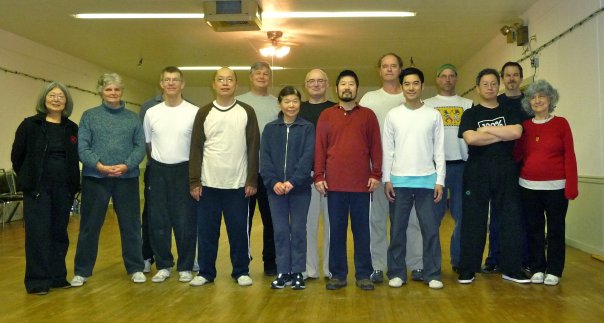
The main subject this weekend is on how to keep three different lines while pushing hands. This is a very difficult act to perform. I explained and experimented for students the example of how to aim at something or some place. In our push hands or applications, we often don’t push towards where we ACTUALLY intend to push!. This is a question of the mind intent not harmonized with the energy alignment. This question touches upon our basic natural disposition. It is very important for you NOT to believe that you don’t have this problem!
I have been giving this group of people seminars here for the seventh year. We started in Vancouver and moved to Fort Langley and finally settled in Maple Ridge. Currently we have three students from Seattle, one from Denver, CO who joins us occasionally, several from Victoria, and one from Nanaimo. Some have to drive more than three hours to get here; others have to take the ferry for over 5 hours. I fly here from Edmonton early in the morning. All this for Chen Style Taijiquan Practical Method!
by: Bill Vanderhall
Well, to start with, the first time we met Master Chen Zhonghua ( we know him as Joseph Chen ) was at a Martial Arts Tournament in Vancouver, about eight years ago, 2001. My friends and I help out with judging the Taiji section, so we had seen quite a lot of good and poor Taiji. At the end of the tournament, Joseph gave us a demonstration of his Chen Taiji and blew us away. Read more
I attended a morning session of the conference at the Yinjian Hotel. The only thing I can remember from the lecture is that we are not born with cancer, we get it.
Went shopping for clothes after the session. Beijing is too cold and I had to buy some clothes. Supper with Sun Zhonghua. He took me to a Shanxi restaurant. He is from Shanxi. Had 4 dishes that I cannot remember the names of. It cost 44 yuan. Very cheap indeed!
Back to the hotel after dinner and burned 14 DVDs for him.
Originally written by: Helen Kita
This is the third year I have taken Master Chen’s workshops. I have enjoyed his teachings and have learned many skills and know I am on a long journey to understand the principles of tai chi. Read more
2010-1-2
1、(腰胯)拉直后,无腰、无跨,此时可以保持腰不断劲。(沉肩、坠纣、头顶、双腿与丹田形成中轴——中正?)。 Read more
Originally written by: Dina Kerr
After 7 years of Maple Ridge workshops once a month, it never gets old. Each workshop is new and exciting. Its like meeting my family, brothers and sisters that I haven not seen for a while. There is joking and laughter intermingled with pushing and shoving, then in comes Daddy Chen, we must behave now. Read more
As every time I receive instructions from my Shifu, Chen Zhonghua, I understand more that what he has always talked about is one principle that is applied in countless ways. Read more