One of the most difficult things to do in the CTS system is to keep the elbows in. Master says “the elbow must be no more than 3 inches from the ribcage.”
While we cannot take these words literally, it does remind us just how important it is to keep the elbows in. While the hand moves outwards, the elbow must always have the orientation of moving towards the center, or the Dantian.

Here, Master Chen Zhonghua uses rubber cords to ties the students down at the elbow so that they will always keep their elbows in.

One of the more remarkable things about studying taijiquan is how learning a new concept changes your whole approach to how one practices the form. Read more

Introduction

Feng Zhiqiang is the ultimate example of Taiji. He is a paradox and a harmonized contradiction. He is the most common retired old man and yet the most feared legendary master. He is our only link (as of 2001) to the time of fists and swords, of legends and heroes, and of dedication and bitter struggle to survive. Read more

This is a photo slide show of master Chen in 2007 on Daqingshan. At the end of the show, master Chen shows the concept of “dots, not surface” with a video clip.

In this video, master Chen Zhonghua shows the positive circle and negative circle using a rubber cord. This exercise is very effective in getting the pulling energy and the pushing energy to move along the correct line.

 from http://practicalmethod.com/?p=18680


youtube version

Dear Master Chen
(please forward to master Chen)
My name is David Fadjar, and I appreciate very much your effort to translate GM Hong’s book. I have a question about Bow stance as described by GM Hong’s book (page 10) Read more


As for training, we are doing the things you showed us and I feel as though we are starting to

Read more

… Next is rotation and spirals. In any of the stances of the circles the weight on the feet is mostly caused by the torso and if your torso moves the weight will change. Therefore if your torso is truly rotating then the centre is not moving and you don’t shift so the weight should remain the same. And if your weight never changes and you are pushing hands, the opponent’s moves must be having no effect.

Also a rotation keeps the centre intact and a true centre is just a straight line but rotation is not enough you need another direction and that movement is downward. This creates a spiral. All the spiral does is move everything in such a way so that the straight line in the centre moves and remains a straight line.

Using the torso as an example. If your torso were to be rotating and moving downward or spiraling then any force that hits it will only be moving with it. This is because when a force comes in contact with a rotation the rotation is always moving 90 degrees to that force and in physics I learned that every force is made up of component forces. These components are just forces in different directions that when you add them up they are really only in one direction.

However there is no 90 degree component in any force. And the downward movement we do is also 90 degrees so if you move down as much as you rotate then the result is you are moving at a 45 degree angle with depth to the push. And there is so much talk about 45 degrees in Practical Method taiji. So if all body parts moved this way then they would all actually moving in straight lines.

Master Chen this email is my thoughts on taiji and other things you have taught me and Read more

Another thing is that everything not just taiji seems to be that you allow each thing to do its part and that is how something greater can be achieved. Read more

Another obsevation I made is that pretty much everyone who has been doing taiji for Read more

In this video, Chen Zhonghua and Gord Muir showed how a structure can bring out power in Chen Style Taijiquan Practical Method.
Read more

Fantastic photo slide show of Daqingshan in 2006! Read more

By:   Chen Zhonghua.      Length: 34:50 minutes.      Language: English.   Year: 2004
This video covers the content of dynamic foundations in the form of moving step and how they are applied in push hands and in the practice routines.

Advanced Foundations Online Video
Access is keyed to your user account. You need to be logged in to buy access.
Please register or log in.


Xu Guicheng i

by Practical Method on 2007/03/14

Master Xu Guicheng started his martial arts career at the age of 6 and a half in 1930 with Jinan master Li Kuixiang. After 8 years of hard training,

Read more

Hong Junsheng’s International Standard Bearer master Chen Zhonghua and Standard Bearer Master Li Enjiu are planning a series of celebrations in North American in 2007 to mark the 100 birthday of Grandmaster Hong Junsheng. Read more

You can generate power by pivoting on your foot. Here is a clip from master Chen Zhonghua’s 2005 Taiji Tradition Camp in Victoria, BC, Canada.
[youtube=http://www.youtube.com/watch?v=DlFW7GjBri4]

Go here for more on this topic:
http://wujimon.com/2007/what-does-a-camera-tripod-have-to-do-with-taiji/
http://hunyuantaiji.livejournal.com/

Note: if you get this post from your bookmark, it is because we have change the website server so there is no chinese content anymore, please update your bookmark to http://practicalmethod.com or create a new one after clicking the home button

In the summer of 2004, Chen Zhonghua took a group of students to visit the Black Tiger Springs Park, where he received his Taijiquan training from Grandmaster Hong Junsheng. This is a brief video clip Read more

Everyone knows how dedicated master Chen Zhonghua is about his teaching. All his students all have stories to tell about being thrown into the bed in hotel rooms late at night or in his basement. When it comes to Chen Style Taijiquan, master Chen Zhonghua Read more

Some Yilu and Cannon Fist moves on the Great Wall in 2004. The video was filmed in the early morning in July.

陈中华老师2004年7月一天早5点在长城。一路和炮捶部分动作。


One of the aims of Chen Style Taijiquan training is to achieve the ability of penetrating power. Read more

These are clips of Chen Zhonghua in 2005 and 2006 demonstrating Cannon Fist and Yilu in Victoria, Push Hands and Fajin in Athens, GA, USA Read more

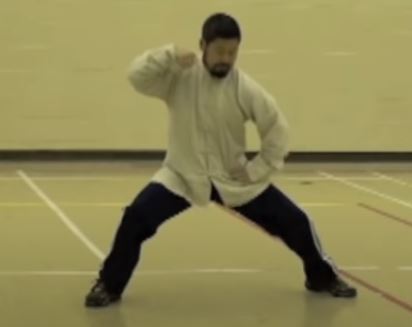
These are some practice shots of Chen Zhonghua during his 2003 full time training course. Watch out for the following:
Whole body integrity, flow, power does not exceed limits, stops at the right place without over extension, center line always erect and upright, center line does not sway when changing direction of movements.

Half-step is not unique to Xing Yi. It is an integral part of Chen Style Taijiquan Practical Method footwork. It serves to integrate techniques so that power is allowed to come out. Most of the “Single Whip” moves start with the previous move stepping in a half-step manner into it.

In this brief video, you can see how “Single Whip” is used in many ways. Mainly it is the interaction betwwen the forearm and the thigh on the same side. Read more

After “Punch to the Ground”, you turn to the right and then double kick. This is the transition to the double kick. The first turn to the right is a right elbow strike. In this case, the previous move of “Punch to the ground” actually dodges the opponent’s punch or kick to the head. You then strike your opponent’s ribs with the elbow.

After “Whirl Arms on Both Sides”, you step forward with right foot (turn to the right) and use both hands to push your opponent out. In this video, the move is done in a more straight forward matter which is more applicable in real situations (it is not possible to engage your opponent on the side as directed in the form).

After the right arm goes out to the right with the hand as a hook, the body turns left to drive the right arm to make a strong negative circle (power). In this video, in order to get into position, the master had to compromise his central equilibrium first. Best done without this loss.
[youtube=http://www.youtube.com/watch?v=nYLblJ73ECU]

Right arm positive circle while the waist turns left to set up. When executing, the waist turns right and then to the right again (two beats) while the right arm is doing one beat with elbow moving to the right in a negative (bottom portion) circle. In this video, the elbow was not physically used but the actions are exactly the same.

[youtube=http://www.youtube.com/watch?v=R8E8GyjHdJo]

This is the second last Single Whip in the Yilu routine. It is different from other Single Whip moves. Before, stepping to the left, the right hand does a deep positive circle and goes way down before coming to the finished position. Hong changed it to this way through his personal experiences. Here is how it is applied. Notice that the left leg did not step forward as required in the form. Read more

You don’t know Taiji

After seven years of studying Yang-style, I thought that I knew Taijiquan – very well. At 6’2” and 200lbs, push-hands came easy. The Yang philosophy of relax and turn fit well with my hippie thinking. But with forms named “Cannon-fist”, Chen-style raised my curiosity. How could this be Taiji?

Read more

On June 19, 2004, Chen Zhonghua was elected among Hong’s major disciples as Chen Style Taijiquan Practical Method International Standard Bearer. This election was Read more

This is a video project that students made in 1999-2006. Read more

These are some Chen Style Taijiquan Practical Method push hands and applications demonstrated by master Chen Zhonghua and Sensei Michael Calandra. Michael Calandra is an outstanding NY city Read more

This is the text for the 2004 China Trip narration: A Great Wall Read more

Jim Peters is from Regina, SK. Canada. He is a student of Ronnie Yee. Jim was the strongest fire fighter in Regina. He studies Aikiko and other martial arts before. This is what he has to say about Chen Style Taijiquan Practical Method and his 2004 trip to China
[youtube=http://www.youtube.com/watch?v=LHdYJ5gb2Bw]

In a recent class, I was fortunate to get some lower-body corrections from my peers and Shifu on the circles. These corrections and instruction have made a huge difference in kua movement and solidifying connection from toe to finger. Would like to share these learnings for discussion.

Read more