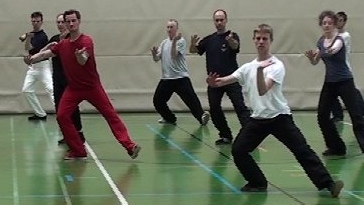
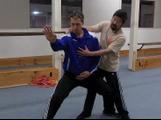
One part of the body always likes to follow the direction of movements of other parts of the body. This will cause tossing and collapsing. If you observe people practice Taijiquan, you will notice that this is a very prevalent problem.
When one’s own body parts follow each other, there will be no possibility for rotation in the body.
The cloud-like moves usually are the result of the mistake. It is something to be circumvented, not something to be desired.
Also known as KT, KT Lin. Male. Born in 1953. Now live in Hong Kong.
Studies Wu Style Taijiquan briefly from Grandmaster Ma Changxun in early 1980s.
Started to learn Practical Method from Master Chen Zhonghua since October 2009 and became an indoor disciple of Master Chen in May 2011.
Visited Daqingshan once a year since 2009. Wrote LEARNING PRACTICAL METHOD ON DAQINGSHAN (1), (2) and (3) to record his experience in learning Practical Method.
Adding one power is a technique to transmit power. It is broken to two steps, first to bite or catch opponent, second action is to add power to finish it. Introduction, Explanations, Key Points, Applications, Student Practices
Presenter: Chen Zhonghua Length: 42 min. In: English Year: 2010 Difficulty:3/5 At:Edmonton
If I listened correctly you don’t move but rotate to change angles. I have a question about the positive circle. In the first half if you lead with the elbow it seems the angle in the elbow gets sharper. Is that a move or does that happen through rotation? As far as know a rotation isn’t considered a movement. Also what happens when you keep “pushing” the elbow in the line of the shoulder and hand to create power? It look likes the elbow is dropping away from the line which should make the structure weak. I can’t seem to unite these directions although I think I understand them separately.
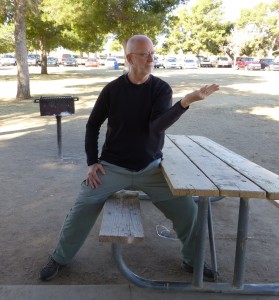
To experience “two ceilings”, wedge your thigh under a picnic table, push upward against the table, then, you have the “waist ceiling.” If you don’t have the “waist ceiling,” you don’t have the “crown ceiling” either.
Yi Lu is one of two forms in the Chen style Taijiquan lineage of Chen Chanxin who condensed the postures of the 7 barehand forms of Chen Wanting into 2 forms; Yi Lu and Er Lu. Yi Lu is the training form of Chen style Taijiquan.
1. Rotation and movements. 2. Fetch water exercise. 3. Loose and tight. 3. Breathing. 4. Connected spiral. 5. How to touch. 6. Alignment and energy movement. 7. Chen Zhonghua demo of Yilu 13-21. 8. In with elbow. 9. Sinking involves a stretch. 10. Taiji movements are not normal. Read more
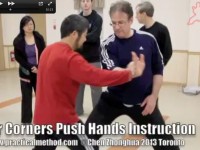
In this ten-minute mini video, Master Chen Zhonghua taught the essentials of the basic single hand push hand pattern: four corners push hand drills. Important push hands principles were given and the drill was designed to bring out the principles of using power in the practitioner’s body. Presenter: Chen Zhonghua Length: 10 min. In: English Year: 2013 Difficulty:2/5 At:Toronto, Canada
” … the problem is not speed, but timing. Rather than moving too slowly, most students of taijiquan will in fact move too soon. This point stresses the importance of push-hands training which develops the kind movement and timing necessary to be able to receive the energy of your opponent and then to send it back out like a spinning tire.” A quote from Master Chen
1. Moving without movements. 2. Add one. 3. Full movements. 4. Stretches of the legs. 5. Revolution with rotation. 6. Hand and foot connection in circles. 7. foundations exercises. 8. Dot coming out. Presenter: Chen Zhonghua Length: 44 min. In: English Year: 2012 Difficulty:4/5 At: Toronto, Canada
When doing the bare-hand form and pushing hands with an opponent, one must keep the power constant. This is one of the characteristics of Chen Style Taijiquan Practical Method. By keeping to this principle, one will gradually gain more internal abilities.
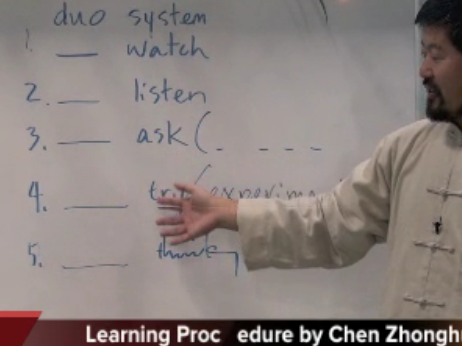
Part of a series of one hour private lessons, Master Chen covered different areas of taiji for each student as other private student are watching. Content: Learning process, detailed correction and explanation of circle foundation, twist towel, fetch water, flash the back foundation, applications, yilu corrections. Presenter: Chen Zhonghua Length: 94 min. In: English Year: 2012 Difficulty:2/5 At:Phoenix, USA. Other Arizona videos: Bruce Private Lesson
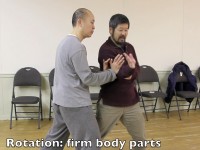
The key to taiji movements is first of all ROTATION. But how can we rotate when we have two feet, two legs, etc.? In this video, Master Chen Zhonghua shows one aspect of rotational movement requirements: the body must be firm to form a structure conducive to a rotation. Presenter: Chen Zhonghua Length: 12 min. In: English Year: 2013 Difficulty:4/5 At:Maple Ridge, B.C. Canada
Taiji Sword is one of the most important weapons of the Chen Style Taijiquan system. The use of the sword is the same as the way energy is manipulated in the barehand form. We talk about two aspects in this lesson.
Hi there Master Chen, these past days i’ve had the same question everyday, been trying to find an answer, looked over the old videos, but didnt really help. Read more
Yilu correction of Sandy Deur, Linlin Choy, Bing Sum Lau, Allan Haddad. Presenter: Chen Zhonghua Length: 55 min. In: English Year: 2012 Difficulty:1/5 At: Toronto
Michael Winkler will hold a workshop on Feb 02. / 03. in Berlin. It is hosted by the university and it is very affordable. Price for non-students € 40,-.
More information and booking … here.(German language)

 Presenter: Chen Zhonghua Length: 7 min. In: English Year: 2010 Difficulty:1/5 At:Edmonton
 When doing the bare-hand form and pushing hands with an opponent, one must keep the power constant. This is one of the characteristics of Chen Style Taijiquan Practical Method. By keeping to this principle, one will gradually gain more internal abilities.

 The key to taiji movements is first of all