Inside and outside, Lock and expansion, Circle: moving and unmoving part, sequence. Stretches in yilu. Sticking in push hand. Hand requirement in push hand. Presenter: Chen Zhonghua Length: 57 min. In: English Year: 2012 Difficulty:2/5 At:Toronto
Read more
Master Chen Zhonghua accepted three more new disciples today in Toronto, Canada!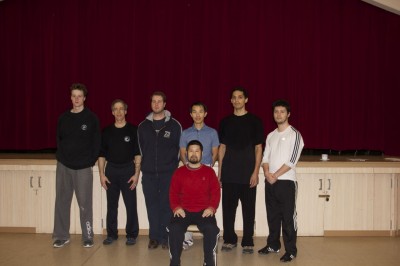
Read more
 Content of Classes:
- Fundamentals of Chen Taiji Practical Method
- First Form (Yilu)
- Push-Hands
Classes Starting January 22, 2013
(Join at any time)
Read more
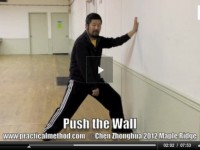 How to push the wall to create an arch in the body. This is a special exercise in the Chen Style Taijiquan Practical Method system. It is part of the construction of the new body structure to create an alignment of energy in the body. Presenter: Chen Zhonghua Length: 8 min. In: English Year: 2012 Difficulty:1/5 At:Maple Ridge, B.C. Canada
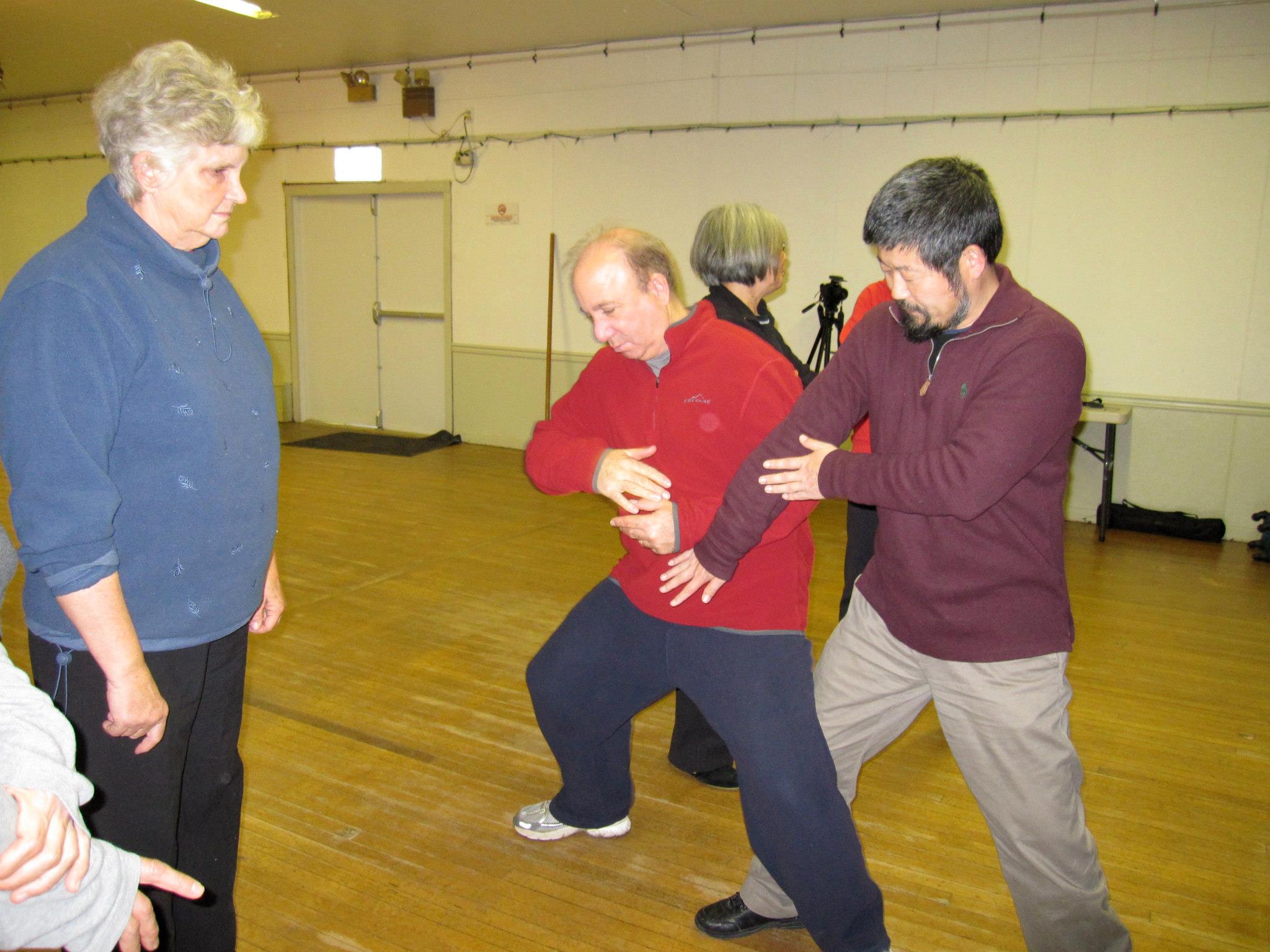
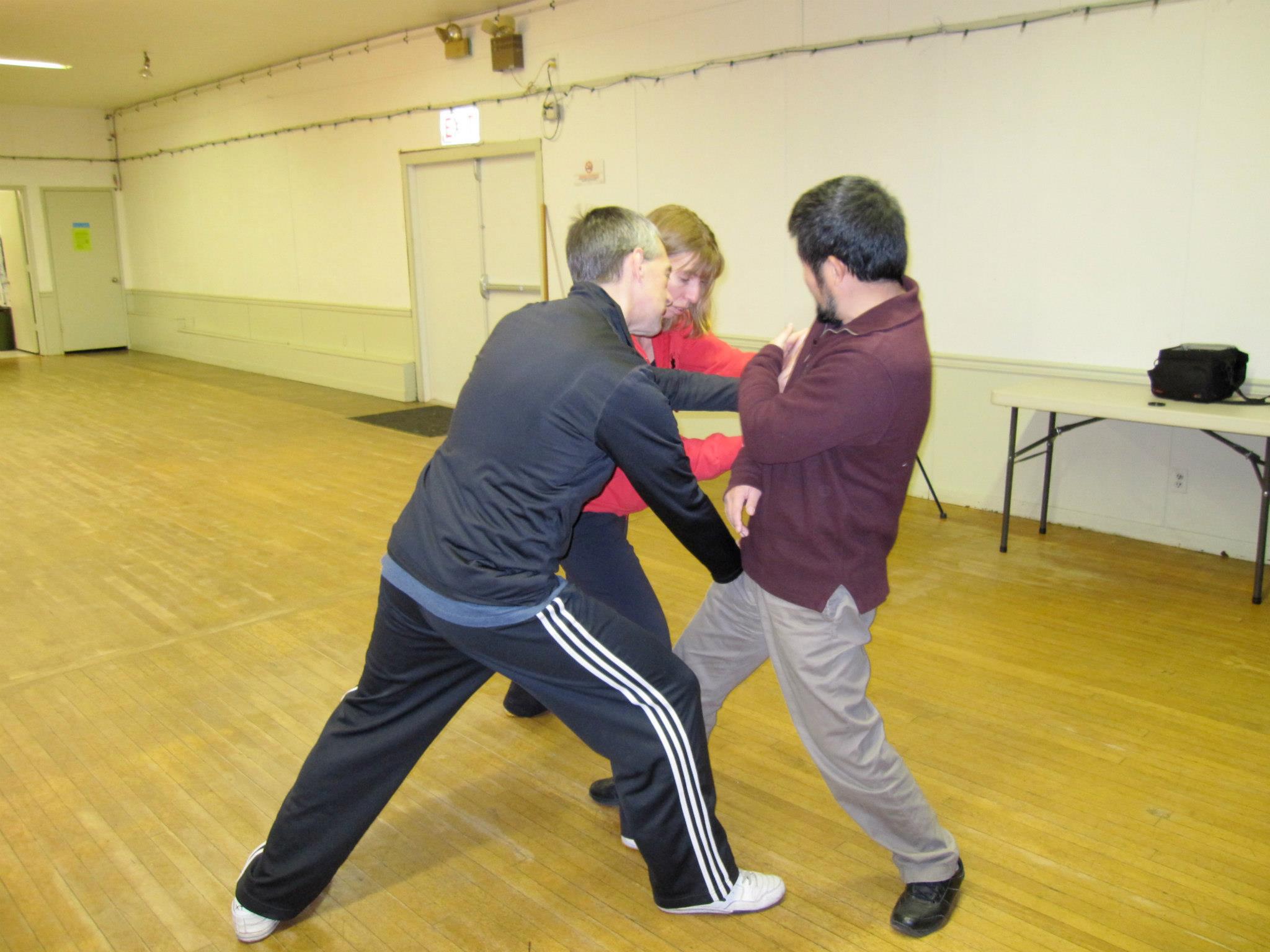
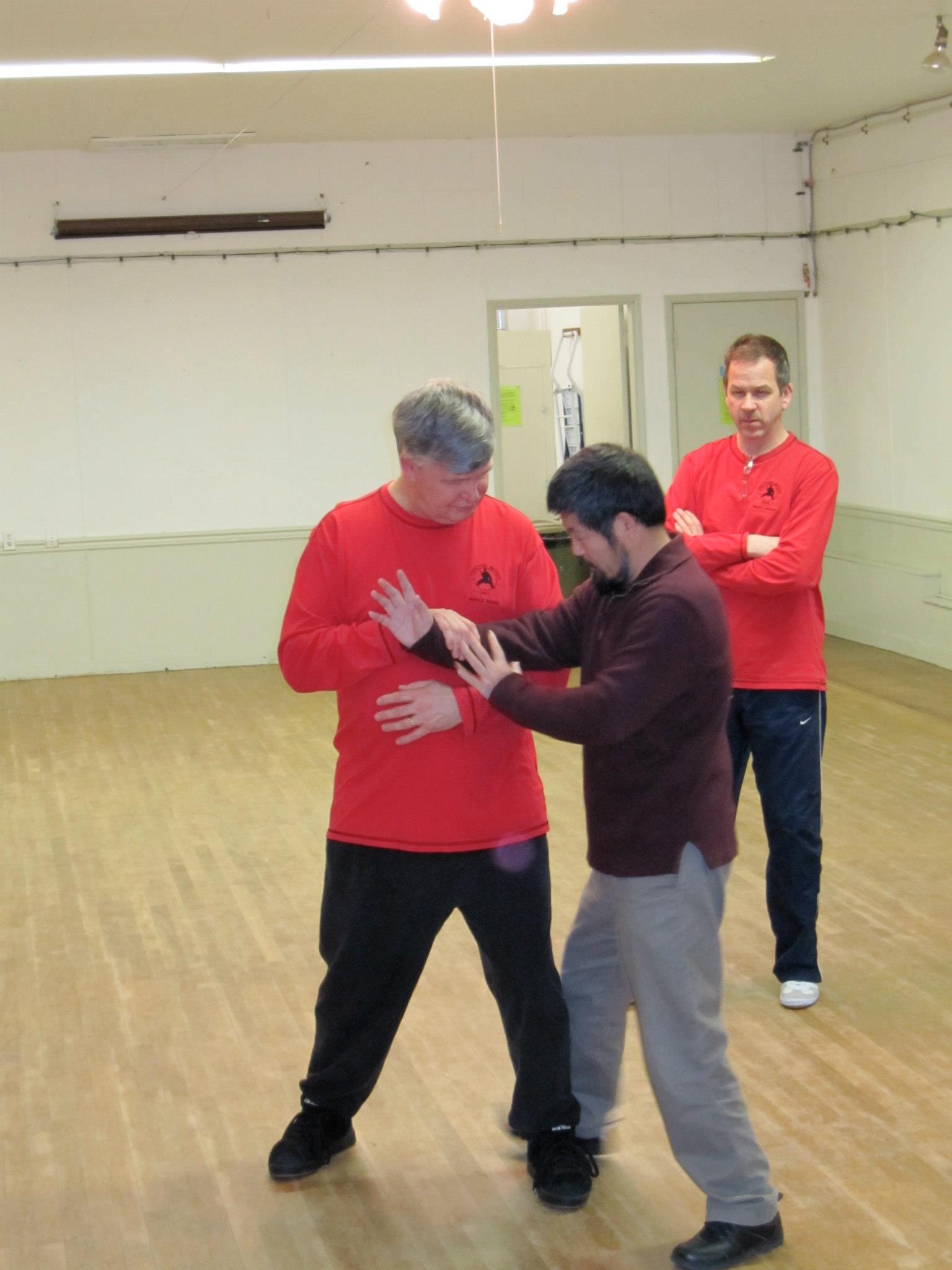
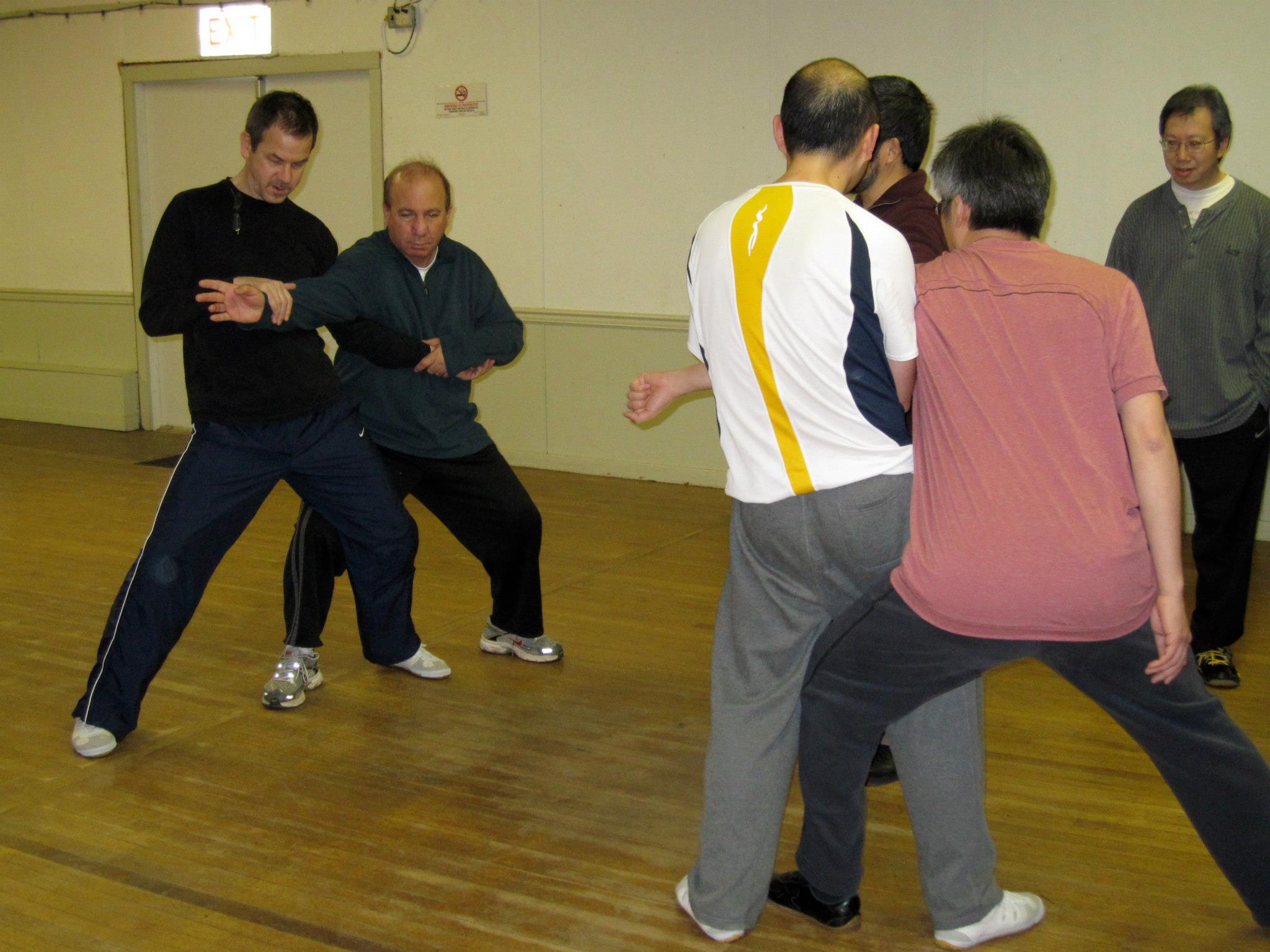
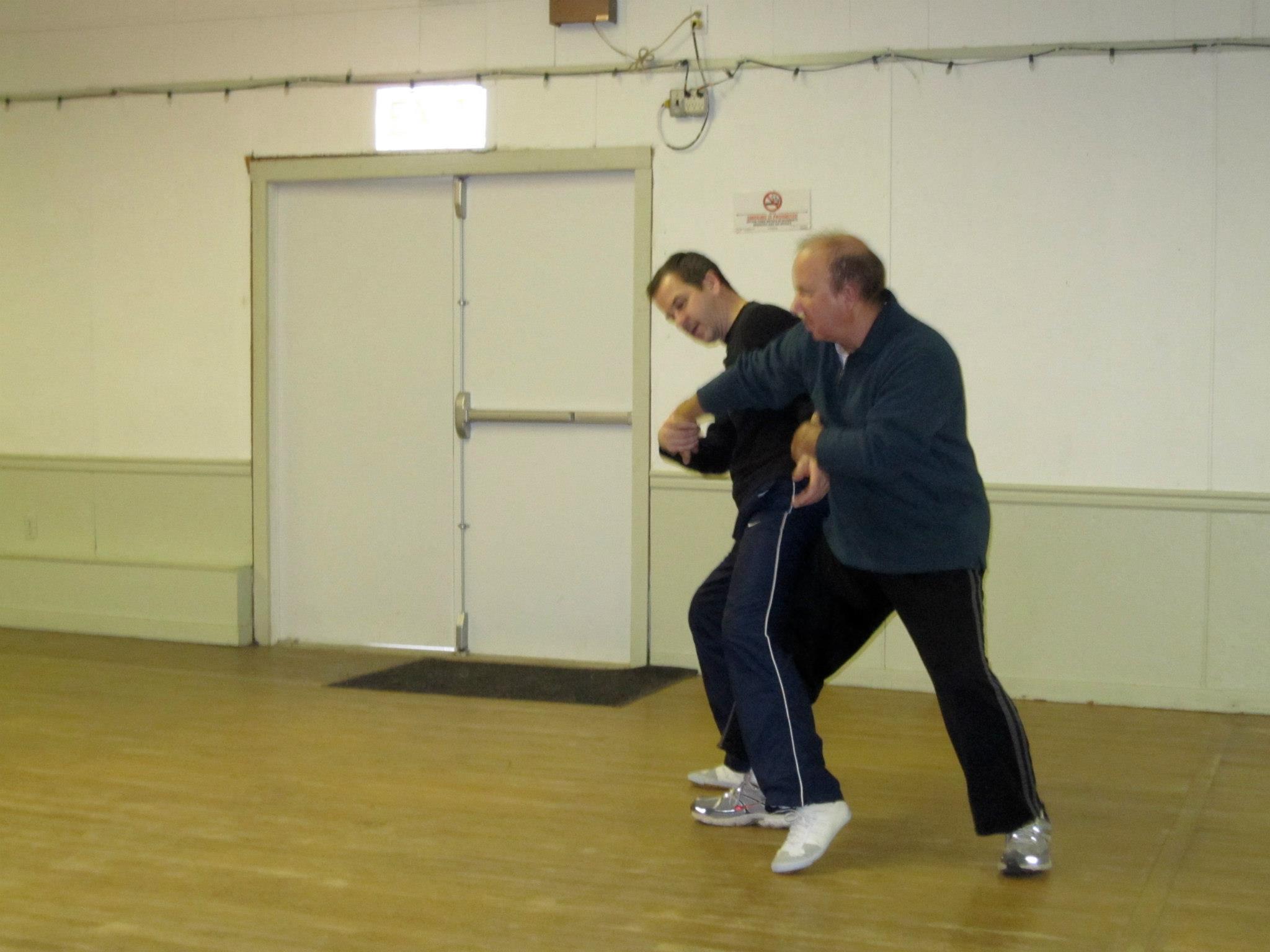
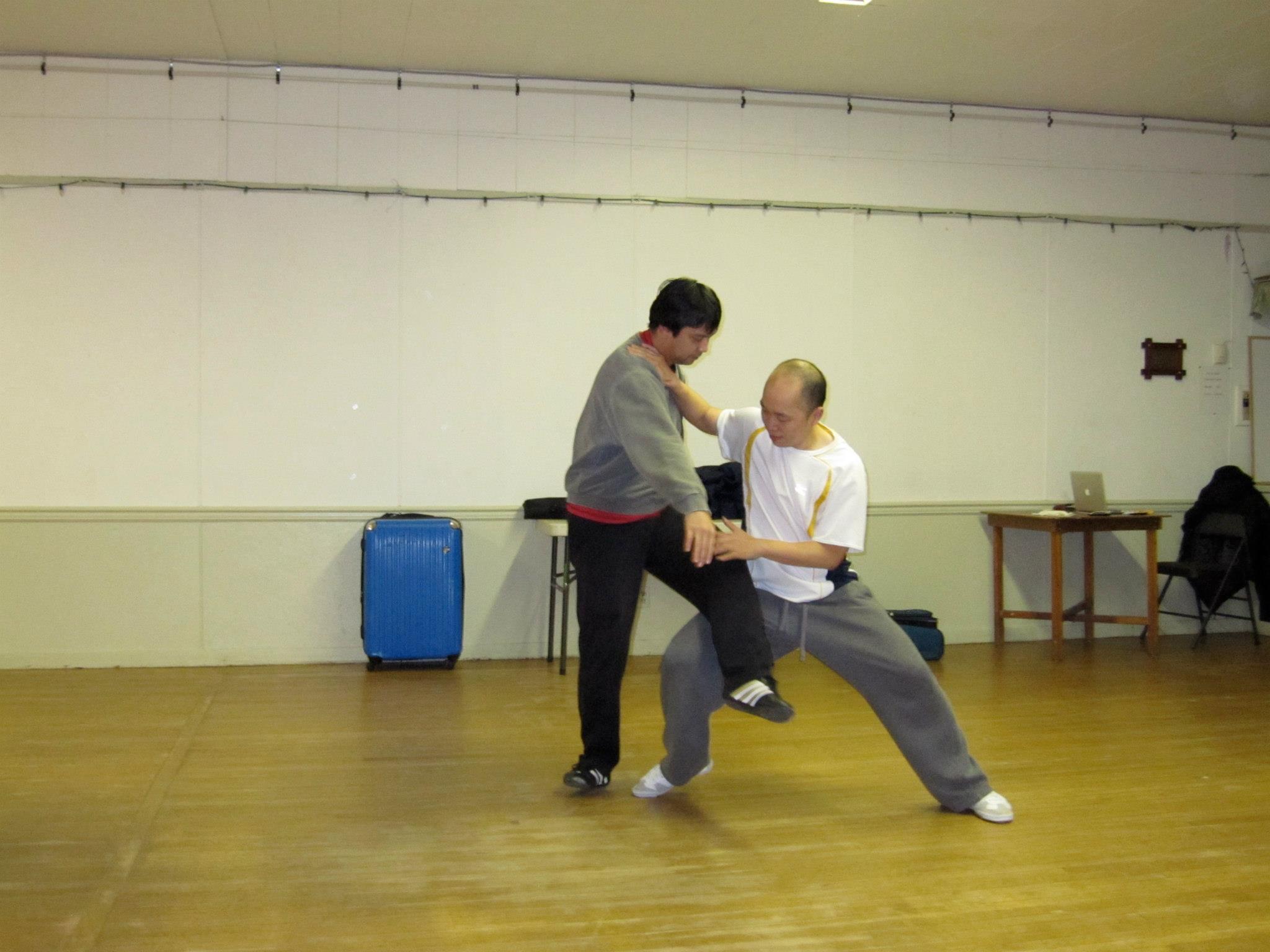
Master Chen went over in detail exercises for establishing an axis in push hand and in Yilu. The second requirement is to keep the axis not moving, only then rotation can happen. The arm moves because of axis rotation, opponent will feel power but there is no power on the arm. Photos by Jay Smith.
We are happy to have Carmen Farruggia of Sacremento, CA, USA join us again for this workshop.
The outsider see the fanfare. The insider see the secrets.
The fist of xingyi, feet of bagua and waist of taiji.
The punches of xingyi, the footwork of bagua and the yaodang (waist and crotch) of taiji.
Xingyi looks at the hands; bagua looks at the walk; and taiji is the gong of waist and crotch.
The hidden energy alignment in the form “Six Sealing and Four Closing”.
Hong Junsheng Taijiquan Philosophy – As I See it
By Zhang Yanhai 张延海 (Translated from http://chenzhonghua.cn)
Mr. Hong Junsheng (1907-1996) of Yu County, Henan Province was an indoor Taijiquan disciple of Mr. Chen Fake for 15 years and as the result has received true transmission of the art. After many years of inheriting the tradition and developing it, Mr. Hong has brought the essence of Taijiquan to a scientific and philosophical level and provided a systematic analysis of the inherent laws of Taijiquan; and at the same time able to demonstrate them visually in front of everyone. He is the first to propose the use of the mechanical concept of “neutral equilibrium” in Taiji. He has his own unique perspective on “rotation” and “silk reeling”.
Read more
Originally written by: Xavier E. Santiago-Albizu Feb 1 2008
After reading Master Chen´s “Relaxation and Rotation” comment, I have the following question. When doing push hands would trying to apply concepts such as “neutralizing, listening, and adhering” still be getting into the opponents dimension? Read more
This exercise has nothing to do with the demonstration by some masters being pushed by a line of people, mostly more than ten, to demonstrate how strong and rooted they are. This is an exercise Master Chen Zhonghua used at a workshop in Victoria, B.C. Canada in 2006 to train the pusher to get used to the experience of pushing into something very strong but is human. An exercise before this one is to push the wall, which provides static resistance. The pusher has to deal with: Read more
This is a part translation of a section from Lin Ketong’s Chinese Blog. Any errors, omission and mistakes are from the mistranslation. Read more
We must avoid even thinking about these words or concepts:
strong, weak, fast, slow, stiff, hard, soft, locked, smooth, round, circle.
Read more
1. Core Taiji movement. 2. Shoulder. 3. Central Equilibrium. 4. One-Third
theory. 5. Movement without moving. 6. Knee. 7. Ankle.
Second video added 1.Tile Hand 2.Wrist 3. Head – Inside and Outside, Rotation and Catch. Presenter: Chen Zhonghua Length: 25 min + 17 min. In: English Year: 2012 Difficulty:4/5 At:Maple Ridge, B.C. Canada
 Presenter: Chen Zhonghua Length: 16 min. In: English Year: 2012 Difficulty:1/5 At:Daqingshan, China
Presenter: Chen Zhonghua Length: 46 min. In: Chinese Year: 2012 Difficulty:3/5 At:Singapore
Key words:
- 【硬而不僵】: Ying er bu jiang. Hard but not stiff. This is a concept in Chen Style Taijiquan Practical Method.
- 松而不懈: Song er bu xie. Soft but not collapsed. This is a commonly used taiji phrase and concept. Read more
Buddha Warrior Application. Timing of contact. Angles, timing and pressure of action. No surface for your opponent,. Dot, line, sphere, rotation.
Presenter: Chen Zhonghua Length: 50 min. In: English Year: 2012 Difficulty:2/5 At:Toronto
Presenter: Chen Zhonghua Length: 54 min. In: Chinese Year: 2012 Difficulty:1/5 At:Toronto
This is the Practical Method. By Flávio Prado de Aquino
It took me a bit to write about the seminar that took place in Brazil in early December, had to go through a deeper review process. Also, these days that followed the workshop with Master Chen, relive and tried to apply what I had been transmitted. It’s a lot to work on.
Read more
5 Levels of comprehension:
Enlightenment
Personal experience
Numbers
Images
Words
 When I asked about the concept of “needle wrapped in cotton”, the master countered with a question, “Do you fight with cotton or with needle? I answered that I would use needle instead of cotton. “In that case, why did you ask me, then?” the master said. “Cotton” is just a decoy to “cheat” the enemy is off his guard, make him think you are not strong. When you use your power to get him, he does not have the time to react. The bottom line is that we train power “jin”. Without power there is no basis for anything in martial art. Read more
Hunyuantaiji Academy, 5222-86 street, Edmonton will be having our New Year’s Open House on Saturday January 12 and Sunday January 13 from 10 am until 1 pm. Join a Free lesson and find out what our Academy can do for you to help you become fit, healthy and able to develop both brain and body as lifelong learning. Read more
This was supposed to be a video from the Staff on Daqingshan, but I got called back to the USA before we could record it, so you will have to put up with my solo version. Read more
O Mestre Chen Zhonghua deu um seminário no Brasil em Guaratinguetá, SP em Novembro de 2012. Ele solicitou a mim que postasse minhas anotações, então aqui estão elas. Eu estou postando uma versão resumida agora, e postarei mais detalhes com o tempo.
O Seminário foi incrível, nossos professores e alunos tiveram a sorte de não só receberem aulas de taiji, mas também lições de vida.
Read more
Originally written by: Blake Caldwell Feb 2008
Squares Triangles Rectangles Cylinders Circles. All of these are used in Taiji? Squares, rectangles, and triangles are all used in foundation and strength, circles and cylinders in movement, redirection.
By using mind intent we move the lengths of angles to make the angles center obscure and to increase the strength of the angle in relation to our movement and opponent (i.e. leverage)
Originally written by: Allan Belsheim Nov 2007
When Master Chen Zhonghua shows us how to do the Chen form, he assures us that the hands are NOT moving. To look at him, everything is moving, including the hand. When we copy his moves, we are told that we are moving our hands and on top of that, we are tossing our bodies. The less we seem to move the more we are told that we are moving. Read more
A: No, we see GM Hong still had a very high skill when he was old. Taiji skill is just like riding a bike, or swimming, you will never lose it once you master it. Internal strength is not based on muscle, but rotational joint dexterity for precise manipulation of power.
Just exactly how the kua works? In this mini lesson, master Chen Zhonghua gives details of the mechanics of the kua opening action. Presenter: Chen Zhonghua Length: 17 min. In: English Year: 2012 Difficulty:2/5 At: Maple Ridge, B.C
Read more
Presenter: Chen Zhonghua Length: 12 min. In: English Year: 2012 Difficulty:1/5 At:Singapore
Read more
A: Other Chen style is for form competition and has been modified so it is easier to learn. Martial art form is more precise and is harder to learn.