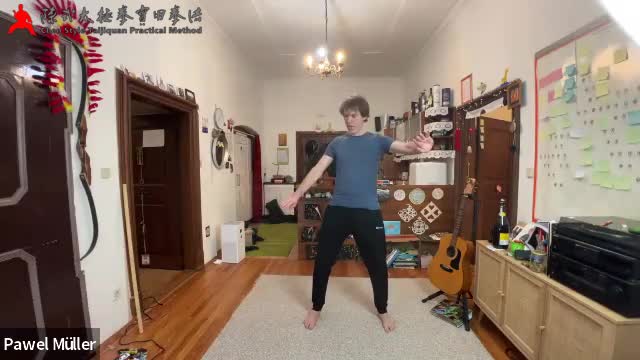
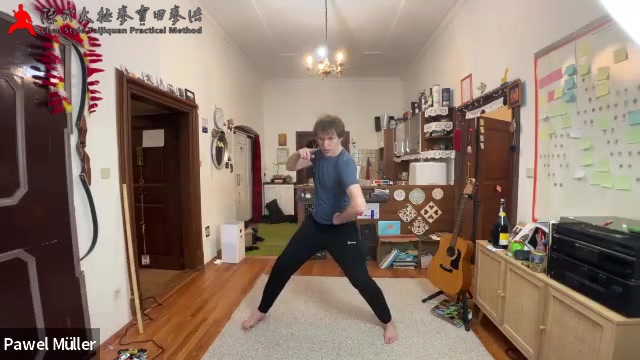
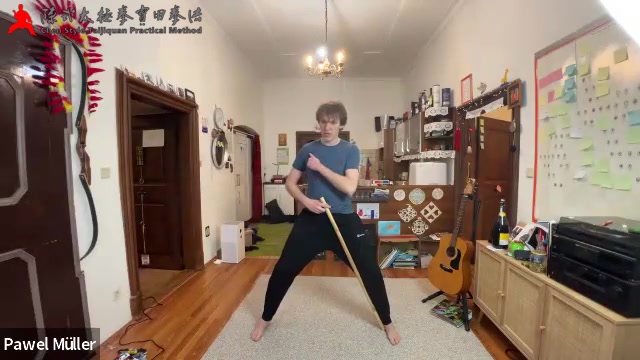
Presenter: Chen Zhonghua Length: 56 mins Difficulty: 3/5 Language: English  
Year: 2025 Location: Edmonton, Canada


View posts in sub-category:
Application Articles Body and Posture Class (Workshop) Notes Common Errors Glossary and terms Hunyuan Knowledge-Movement Explanations Learning Method Principle-Concept Principle-List Principle-Rule Principle-Technical Push Hands Quotations Routine Names Routines Videos Stories Student Evaluations (Private) Taiji Apparatus Taiji FAQ Taiji Sword Thoughts and Understanding Workshop and Class Notes


by Shopmaster on 2025/11/07


by Shopmaster on 2025/11/06


by Shopmaster on 2025/11/06


by Shopmaster on 2025/11/05


by Shopmaster on 2025/11/05


by Shopmaster on 2025/11/04


by Shopmaster on 2025/11/04


by Shopmaster on 2025/11/04


by Ming on 2025/11/03
![]() |
What is the true essence of Taijiquan? Master Chen answers this question not with a complex explanation, but by simplifying the Eight Methods (八法 Bā Fǎ)—the foundational building blocks of the art. While historical figures from Wang Zongyue to Yang Chengfu contributed vital interpretations, sometimes viewing the methods as specific techniques or esoteric energies, Master Chen follows his teacher, Master Hóng Jūnsheng, in revealing their deeper intent. He insists that the Bā Fǎ are not reactive postures but dynamic principles (原理)—universal concepts that govern the body’s structure, alignment, and energy flow in every moment. |
| This essay will illuminate how Master Chen’s direct, practical approach, taught in his 2014 Toronto Workshop and backed by the wisdom of Master Hong’s writings and the Taiji Classics, strips away centuries of technical formalism to reveal the clear, direct application of the Practical Method. | |
| (This article is based on the Eight Techniques mini-lesson filmed in 2014, Toronto, Canada.) |
|
by Shopmaster on 2025/10/31


by Shopmaster on 2025/10/31


by Shopmaster on 2025/10/30


by Shopmaster on 2025/10/30


by Shopmaster on 2025/10/29


by Shopmaster on 2025/10/29


by Shopmaster on 2025/10/29


by Shopmaster on 2025/10/28


by Shopmaster on 2025/10/28


by Shopmaster on 2025/10/28


by Shopmaster on 2025/10/24


by Shopmaster on 2025/10/23


by Shopmaster on 2025/10/23

by Shopmaster on 2025/10/22


by Shopmaster on 2025/10/22


by Shopmaster on 2025/10/22


by Shopmaster on 2025/10/21


by Ming on 2025/10/20
![]() |
Master Chen’s teachings on Taiji center on the sophisticated use of pivots and levers within the body, a concept he refers to as “switching” rather than moving. The core principle is akin to a train operator skillfully changing tracks to redirect a train’s power and speed without altering its own engine. Instead of a gross shift in the body’s center of gravity, which Master Chen views as inefficient, the practitioner learns to utilize three vertical lines—one central and two on either side of the torso—as internal fulcrums for a human lever. |
| This allows them to switch the pivot point to gain a mechanical advantage, either prioritizing speed and range (like placing a lever’s pivot closer to the force) or power and stability (by moving the pivot closer to the load). By mastering this internal leveraging system, one can maintain a stable, unmoving core while seamlessly applying force and changing direction, much like a train maintaining its steady momentum while being redirected by the track switch to a new destination. | |
| (This is an edited transcript of a mini lesson Switching in the Positive Circle filmed in 2014, Berlin, Germany.) |
|
by Shopmaster on 2025/10/17


by Shopmaster on 2025/10/17


by Shopmaster on 2025/10/16


by Shopmaster on 2025/10/15


by Shopmaster on 2025/10/15