What are the Three Pans of Taiji?
- Upper Pan: Shoulders and Head section.
- Shoulders down and Kua above.
- Below the Kua.
What are the Three Pans of Taiji?
Originally written by: Chen Zhonghua and Ian Macrae
Based on Ian Macrae’s
Notes from the April 12th & 13th, 2008,
Workshop at Thornhill Hall, Maple Ridge Read more
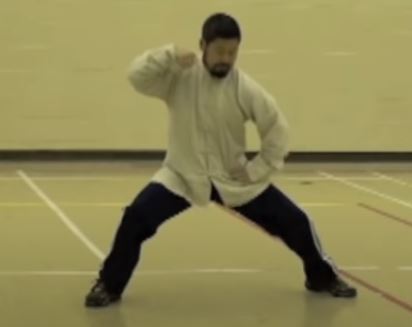
This photo graph is designed to deal with knee problems in training.

In order to avoid injuries, the most important thing to avoid is the knee pushing outward away from the body, as illustrated in the picture above: the yellow dot cannot move towards the blue line. The blue line is an imagined wall that the knee cannot push against.
The following youtube clip shows the actions of the rear knee.
Lian : 炼
Taijiquan as self defense can be ruthless and lethal. The fighting method of Taijiquan is called Zhan Shou (Cut Hand). Read more
Main Points: Read more
The Victoria Workshop was held from March 29th to 30th. It was sponsored by Gord Muir and was held at Ted Truscott’s Karate Dojo in Langford, Victoria. Read more
Another excellent workshop! We concentrated on the”Martial” & striking aspects of Chen Taiji. Master Chen worked us very hard on Saturday, a GREAT workout.
Thanks to Master Chen, Brother Gord & Sister Barb and their Victoria school sibblings  had a great time.
Regards,
Jay
The topics will include:
Originally written by: Zhang Zhaoping
On the chapter on Taijiquan being agile and connected, Zhang Zhaoping quoted Zheng Manqing as saying that it is like “Swimming on land.” -Zhang Zhaoping. On Taijiquan. p. 25. Grandmaster Feng Zhiqiang said taijiquan is like “Swimming in the air.” -Chen Zhonghua
Originally written by: Zhang Zhaoping “Internal skill” is achieved within slow actions. “Effective result” must be enhanced in slow training. -Zhang Zhaoping. On Taijiquan. p. 23.
“Why do we require that the eyes follow the index finger? I.E. wherever the index finger goes, the eyes go. Simply put, this is the nurturing of the heart. -Zhang Zhaoping, On Taijiquan. p. 20.
“Zhogn Ding, to put it simply, is the placement of the center of gravity. It is also the kungfu of Sinking the Qi to the Dantian. This placement of the center of gravity of the Dantian, is eternally not easy. It is not gain or lost at an instant.”
-Liu Xiheng. On Taijiquan. p. 17.
“Center of gravity is the Zhong Ding of Taijiquan” -Zheng Manqing, On Taijiquan. p. 17.
Yang Chengpu said, “When dealing with an opponent, there are only two possible outcomes: win or lose”. -On Taijiquan p. 15.
“One mother gives birth to nine children. The nine children have nine different hearts”
p. 187, On Taijiquan; Lun Taijiquan, by Zhang Zhaoping and Du Feihu
Comments:
This quote was used in this book to reinforce the commonly held idea that “the outer appearances or forms can change but not the principles behind them”.
In my opinion based on learning and teaching experience, this is neither right nor wrong. This is irrelevant! This is irrelevant because it is not the job of persons living to talk about the separation of physical appearance and principles behind them. That job is better left to the “immortals” who can live long enough to reach that level. Normal humans (like us) have no part of that idealistic degree of competence.
As to the meaning of the direct quote above, if the nine children do not resemble in appearance neither their father nor their mother, a DNA test is required to find out the REAL reason behind that!
This year’s Hunyuan World Seminars event was relatively smaller than previous years. The highlight of the 4-day event is the special lectures on Qigong and Yiquan by Master Kenneth Cohen.
Participants to this event were quite diversified. They are seasoned Hunyuan World veterans like Charles Paoletti and David Hilburn, who have both attended all the Hunyuan World events thus far. We also have a number of new people attending for the first time, such as Hallie Bruce and Kathy Massey.
It appeared short (4 days) for people to come all the way from as far as New York or Puerto Rico. But there was something for everybody.
Tian Qiu Xin used to recite the following verses:
Since the beginning movement the spiral rises, and the force comes from the feet.
One after the other it passes through all joints, therefore all the body being a unity.
The belly is like the sea, and the form like the tide. When changing the movement, folding comes from the waist.
Although forwards and backwards the level changes, you must keep stability. Upwards and downwards go through each other, and then the force reaches the extremes.
Thanks to John Vanko for submitting this quotation.
At the 2008 Hunyuan World Seminiars in GA, USA, I spent several hours one night after the evening class to work with several disciples on taiji fighting.
I will not go into details of what we did, as there is no way to explain it with simple words. We didn’t make any videos of the session either. What I want to discuss here is some of the comments from students. These comments or questions are as a result of the fact that what we did did not APPEAR to be taiji.
As a matter of fact, real taiji IS a martial art. It does not resemble that taiji that we see practiced and taught today. What we normally see is the training set or method of taijiquan. Here is a video clip of a simple teaching session with some applications.
Here is another youtube video that has some elementary fighting techniques.
Here is a brief summary of the notes I made in Hunyuan World. I hope I was able to have some understanding from Master Chen´s teachings in the seminar. I am open to any corrections on these notes. Read more
Originally written by: Tim Duehring
Chen Cake is a variation on the children’s game of Patty Cake. Here is how we play it.
The participants will stand facing each other with their arms outstretched in front of them. The wrists will be bent and the fingers pointed at the ceiling. They will adjust the distance between them until the backs of their hands are in line. From this position they will proceed to slap their palms together trying to upset the balance of their opponent.
They are not allowed to move their feet except to avoid falling over.
This exercise will result in a better sense of timing, balance, recognition of the opponent’s structure, and a good flow of blood to the hands.
These are notes from a recent trip to Edmonton learning from Master Chen Zhonghua. Question based off torso movements I was shown
To recap:
My understanding of the “2 points” motion within the torso. Read more
This is a detailed list of the classification of moves of the Chen Style Taijiquan Practical Method forms of Yilu and Cannon Fist. Hong Junsheng’s Taijiquan Practical Method Movement Classifications: Read more
2007-10-01
Smith, Jay
Yilu – The knees are more locked in properly now. His stance is much more stable.
2007-10-14
Smith, Jay
Yilu 73.50% More coordination and more power were shown at this performance. Needs to work on more openning and stretching.
Elbow Sticks to the Ribs
“Elbow Sticks to the Ribs” is a principle that is shared by all martial arts, not only Taijiquan. It’s a pity that most martial artists only pay lip service to this age-old aphorism. This is indeed a secret training method to higher levels of martial attainment.
Chen Style Taijiquan Practical Method regards this aphorism as a major principle to follow.