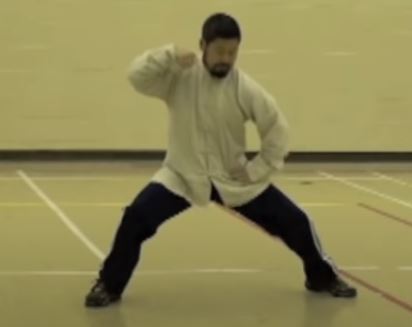
3 times a year taught by Master Chen Zhonghua on Hunyuan Qigong, Silk Reeling and Foundations.
Edifice Jules-Desbiens
109, rue Wright – local 002 Gatineau (secteur Hull) – Quebec
I was born with a weak constitution and relied on martial art training for my health recovery. Later on I met Grandmaster Hong Junsheng who transmitted Practical Method to me. Over dozens of years I repeatedly practiced it and benefited from it. I did not dare to take it as my own and vowed to pass it on. Another dozen years made me realize that I did not know enough to be a master. I therefore went to study from Grandmaster Feng Zhiqiang by devoting another dozen years to learning. Again, I gained a bit more knowledge and ability in taijiquan.
When I was young I believed that I was smart. Approaching the half mark in my life I realized that I was not. Taijiquan is not made for the average. It is not for smart people; slow people; light-hearted people; nor stubborn people. It is designed for those who are persistent, and focused. One must let go and be enlightened.
Daqingshan Mountain is pretty, picturesque, tranquil, and deep. It is a clear piece of land in crowded China. One can practice and meditate in between land and clouds. I chose this bit of special soil to start my teaching, to make friends with the like minded and to entertain myself. When the art is not perfect, one can continue to learn. When one is not enlightened he can seek.
The rock of Daqingshan, might be jade.
1. 混淆传承和名誉的问题
传承是练拳习武的首要问题,然而给这个问题一点思考的人极少。无论国内国外,崇拜师父是最突出的表现。 Read more
Originally written by: Ian Macrae
Maple Ridge Workshop July 25th and 26th, 2009
(A loose transcription of notes, not an organized article)
This month our workshop was in Pitt Meadows Heritage Hall. Our regular use of Thornhill Hall was preempted by the Disabled Games. What a nice big clean beautiful hall this was, notwithstanding that the A/C wasn’t working and it was almost too hot to do YiLu. Well, actually, it was too hot, so we didn’t work quite as hard as we usually do. Read more
When Master Chen was at my school in April he had us explore emptiness. Emptiness in the leg from the knee downward. Emptiness in the spine from the head down through to the coccyx. It was a challenging process.
He told us that, as human beings, we do all we can not to go there as we experience this as death. This emptiness is a space before muscles get involved.
To help my students move closer to this state as best as possible I spent one evening doing Mentastics. Mentastics means mental gymnastics. It was developed by Dr. Milton Trager, a former American professional acrobatic dancer, boxer, and physician. It is a companion method to the form of massage he also created and that bears his name. To find more about him just google his name. He had a beautiful book that is only available on e-Bay or Amazon as used copies, as far as I could find out. The title is: “Movement As a Way to Agelessness: A Guide to Trager Mentastics,” 1995, 176 pp., Station Hill Press, Barrytown, N.Y., ISBN 0-88268-167-2.
With Mentastics one wants to do as little as possible. Movement is minimal and pleasant. Each time one does a movement, the goal is to do 50% less the next time around, always asking the mind to answer a question that only it would answer in its own way without any need to bring the answer to consciousness.
It goes like this: How could this be free? How could this be freer? How could this be even freer? And even freer than this freer?
Mentastics is an approach. Not a goal. A way towards a state of freedom, wellness, happiness. Towards Oneness.
We explored breathing this way, walking this way, moving our arms this way, shifting from one leg to the other, and then front and back. (In our leg shifting we wanted to stop moving just before our small tight muscles in our spines would engage, relaxing them with the help from our sensors under the soles of our feet.)
We reached a state of “hook-up,” as Trager called it. We were in the zone as others would say. Or as the calligraphy that taiji master Al Chung-liang Huang designed for The Trager Institute says in Chinese, we were a “Dancing Cloud.”
So we danced for an evening. It helped moving closer to where we do not move anymore, yet are more alive than ever. More present than presence itself. Have overcome the fear of death that stops us from being before muscles move.
We have not reached that stage yet. We have just moved closer to not moving. We now have one more tool to help us along. It worked. It laid the ground for the next step that was taken on the first Monday in June. More about this in the next issue.
Some photos of Daqingshan in 2007。大青山照片 Read more
"Forget your perfect offering/There are cracks in everything/That’s how the light gets in" -Leonard i
“Forget your perfect offering/There are cracks in everything/That’s how the light gets in” -Leonard Cohen
Originally written by: Matej Velicky There are many stories about Chen Fake and Hong Junsheng and their fighting ability.
Payment notification form Read more
Originally written by: Jeff Higins
My name is Jeff Higgins. For those of you thinking about studying with Master Chen Zhonghua I would like to share my background and experience taking a workshop. I have been studying various Chinese martial arts since for the past 8 years. Read more
Master Chen Zhonghua conducted a series of teaching sessions in Puerto Rico on this trip, including a weekend workshop at the Zen center, evening lessons for the San Juan group of Raul Pujol and private lessons. At the Zen Center weekend seminar, Master Chen taught the Hunyuan Qigong system at the beginning. He instructed on all the 12 forms and then gave a step by step detailed instruction of the movements of each form.
Master Chen also gave a brief introduction to the Daoist theories in order to enhance student’s understanding of the lectures. The main portion of the time was devoted to the Chen Style Taijiquan Practical Method system foundations. Master Chen was assisted by Humberto Pomales (New Jersey) and Raul Pujol in his teachings of the foundational exercises. Master Chen paid a great deal of attention to the positive and negative circles as they are fundamental to the entire Practical Method system. Each action was explained in angles, weight distribution, application and intentions.
洪式太极拳家王宗宪先生简介 Read more
Originally written by: David Rivera
Dear Joseph:
I have a slight mixup with the multiple email addresses for you and the school. If its
ok with you I will continue to use this one. I located it as you can see from your first
visit to Puerto Rico. Read more
At a higher level, stretching moves are changed to arching moves. Arching is really a way of extension without stopping the energy flow.Arching is more stable than stretching. However, arching creates less distance than stretching.
Some examples:
- When moving the arm back towards your body, don’t allow your front knee to move backwards. This way, you can extend your foot hand arching length.
- When pushing the front arm out, don’t allow your rear knee to move forward. This will make your rear foot-front arm stretch longer.
On February 6, 2009, Xavier Santiago of San Juan was accepted as Master Chen Zhonghua’s disciple through a brief ceremony presided by Raul Pujol. Xavier has been a student of Chen for several years. He became increasingly interested in the Chen Style Taijiquan as taught by Master Chen Zhonghua after attending workshops in Atlanta and Fairfield, IA. Last year, Xavier made trips to Edmonton, Alberta, Canada and Maple Ridge, BC. Canada to work with Master Chen.
The ceremony marked a milestone in Xavier’s life. He is currently pursuing his studies as a medicine doctor. According to him, Chen Taiji has helped him concentrate in his academic studies and improve his marks.
The ceremony was witnessed by all participants of the San Juan workshop and fellow disciples Humberto Pomales, Raul Pujol, Richard Druitt and Rafael Velilla, all of Puerto Rico.
Originally written by: Jesse Thoma
Dear Master Chen,
Encouraging getting to work out with you after such a long absence. Training everyday for over 6 months in 2004 under your mentorship was very developmental. Each one of those sequential days spent on the same subject, you may not see big changes in tai chi that are occuring in you. To be able to revisit so many concepts you emphasize was refreshing. Hearing your teachings about “additions, giving your opponent the feeling that you have one more arm than them. 3 part foot, 1 part hand. Catching with the upper body, then arching power from below. Not tossing in the circles which is a type of retreating, yes? Read more
1. 出手不出肘;收肘不收手。 Read more
Master Chen,
Greetings. I’m not sure if you’re interested in these things, but just in case, here are my experiences with Qigong since March 2008. Zhan Zhuang Experiences (wuji posture only) Read more
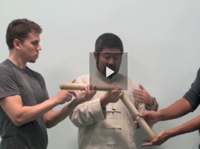
One of the characteristics of the Chen Style Taijiquan Practical Method System is the technique to bounce the opponent out. In this short video clip, Master Chen Zhonghua taught Nicholas Fung and Alex Nay to follow a simple procedure to start the bouncing sequence:
- Make sure that you make contact with your opponent.
- Always back off a bit so that you can feel you have absorbed your opponent’s power.
- Anchor you rear foot, or whichever foot is the farthest from your opponent. This is a two way lock. It cannot move sideways, or backwards.
- Lock your hand/hands onto your target. It is the same lock as your foot except the foot is locked onto the floor while the hand is locked onto your opponent.
- Make sure that you wiggle your hands a little bit so that they aim at your opponent’s center.
- Now move your waist. This move will create a tension that bounces your opponent out. This move is very much like the pull on the string of the bow as in using a bow and arrow.
Another way Master Chen teaches the students how to stick to your opponent. Master Chen believes that one of the most common errors in modern Taijiquan training is the use of other energies before “Squeezing” (press) energy is developed. The sequence of the primary four energies are:
Peng as a initial energy
Lu as a change of direction based on Peng
Ji as a step in (further energy) in addition to Lu, and
An as a result of the three previous energies.
Most people perform the four energies in an unrelated manner. They will not have progression in this way.
In the video clip below, Master Chen Zhonghua shows how two people are tied up with rubber cords to experience “snot” (sticking) energy. The aim is to make the lower body move and power up, while making the upper body to adapt and to adhere.
The knees are hinge joints, unlike ball joints. They only allow the thigh to move up and down. They cannot move horizontally.
This past summer Gord Muir and Master Chen Zhonghua together led an exceptional tour of China. Aside from the rejuvenating and inspirational training at the mountain resort known as Daqingshan, participants toured Beijing, Shanghai, Jinan, Weifang, Qufu, and Suzhou. Read more
Originally written by: John Brown
… I have been working with the bands, focusing on the instructions you have given me. Read more
Originally written by: Paul Hutcheson
Master Chen Zhonghua conducted a two evening workshop on July 29 and 30th, in Iowa, USA. During the day he conducted several private teaching sessions. The workshops were sponsored by John Brown. Over twenty people came to the workshop and private sessions.
Originally written by: Richard Johnson
I just spent a long time posting my notes from the workshop. They disappered into cyberspace when I tried to save them. I’ll have to re-post later.
This is a review of the 2008 Workshop with Chen Zhonghua from the viewpoint of the host. Read more
Originally written by: Jerry
It was great to come to the work shop. I am starting to really appreciate the special knowledge Master Chen has ………The special personal opportunity to study with him directly………………….to learn from such ancient traditions…………. It really is something to see him in person ………..
Jerry
Originally written by: Gene Hess
Private lesson with Master Chen Zhonghua during the Fairfield Workshop:
I have been to a number of Master Chen’s workshops in the past and have always gotten a lot out of them and I will enthusiastically continue to attend. This is the first time, however , that I have ever scheduled a private lesson with Master Chen. As the time drew closer, I looked forward to my lesson. I had a list of questions and a set of specific goals that I wanted to address during the lesson. When it started, Master Chen asked me what it was that I wanted to work on. I described my goals and he immediately began to lead me through a focused, step by step process of postures accompanied with in-depth explanations. As one idea became clear, he would start explaining the next part to me. Master Chen would demonstrate a posture and then have me copy him, correcting me so I replicated his examples as precisely as possible. He would add extra information at just the right time, as if he could sense when I understood a new concept and was ready for more. This created a nonstop experience of learning for me that was organized and complete. It definitely increased my understanding of Taiji.
I am very glad that I decided to take advantage of the opportunity to schedule a private lesson with Master Chen. Because of it, I was able to return home and immediately begin to improve the way that I practice Taiji. What a great thing!
Many thanks to Master Chen for offering these private lessons! I’ll look forward to the next one.
Gene Hess
Originally written by: Tim Duehring
Another great workshop given by Joseph and Richard. It seems that every time I go to a basic introduction workshop I end up with information overload. We worked on circles and I gained some new insight. Some day in the future I may be able to do one almost correctly.
It was good to get reaquainted with some old friends and make some new ones. Richard and his family were wonderful hosts and Master Chen continues to amaze us with his ability to make this mysterous art understandable.
The only bad thing for this Northern boy was the heat and humidity.