The Daqingshan Chen Zhonghua Taiji Academy teaches Chen Style Taijiquan Practical Method of GM Hong Junsheng and Hunyuan Taiji of GM Feng Zhiqiang. The Academy was original established in 2006 as Daqingshan International Taiji Training Center. In 2017 it was re-named Daqingshan Chen Zhonghua Taiji Academy (DCTA). Read more
Do it in a way that the arm triangle does not change shape externally.
Focus on the opening of the shoulder and the elbow
Think of the forearm and the upperarm rotating longitudinally and independently.
When doing elbow in, make sure that the shoulder is down. This is like instead of getting the elbow to go over on its own, make the shoulder contribute half the effort by going down, so that the elbow can go over by completing the other half. Read more
The Daqingshan Chen Zhonghua Taiji Academy teaches Chen Style Taijiquan Practical Method of GM Hong Junsheng and Hunyuan Taiji of GM Feng Zhiqiang. The Academy was original established in 2006 as Daqingshan International Taiji Training Center. In 2017 it was re-named Daqingshan Chen Zhonghua Taiji Academy (DCTA). Read more
– Clarity. At the beginning we learn the moves like following a printed instructional book. So we only learn the fixed posture, and the transition does not matter. This is called to trace the movements. No flow and as big as possible. Each move we pause like someone is taking a picture of your posture. Through years of practice the flow comes, without losing the frame.
Flash the back- the left hand cannot move.
Once you know the choreography, you will be corrected in terms of applications. The applications will help you with the choreography.
Step forward to hand covering punch – imagine as if your hands while you are punching are tearing something. The left hand holds hard and the right hand tears it. It is not like what we normally understand as a punch.
These are some photos of Kelvin Ho performing the Chen Style Taijiquan Practical Method Sword and Broadsword form in Marham, Ontario, Canada in Nov. 2020. Read more
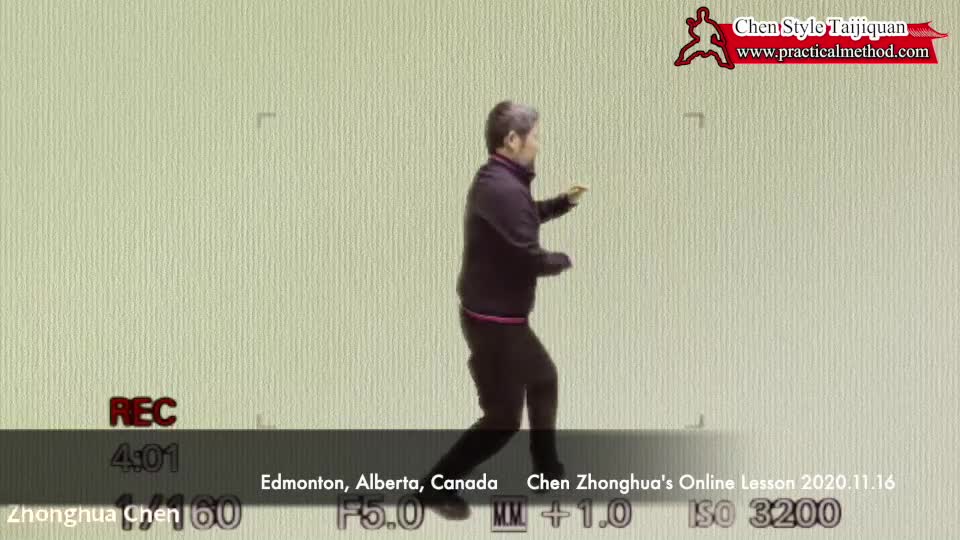
Being asked a question during this class, Master Chen pointed out that he seems to be giving contradictive information from time to time, e.g. to inviting us to ask questions and then saying: ‘You shouldn’t ask that kind of question’.
Missing one step. Do not miss any step: 1) in with elbow, 2) turn with the waist. Do not combine. Follow the steps. Follow the procedure. Follow the instruction
Today several students received partial Yilu corrections. Form corrections are always foundational.
– First Cloud Hands. 1.Three counts. Follow the steps and procedure. 2. First count, in with elbow need to be very clear. 3. On the second count, open the front kua and turn with the waist. Do it big. 3. On the second count, lock the kua and two knees, only rotate. 4. On the third count, only back kua folds, pivoting on the front kua. 5. Open the front kua – Lock the front kua – Squeeze the back kua to the front kua. Master Chen used first form Pound the Mortar as example to explain how the front kua locked can create power. The sixth move, center of chest is locked, only step up from the kua.
Master Chen Zhonghua always talks about the method of learning. The interaction of us asking and him answering is part of it. You have probably heard him say before, “Don’t ask that question”, but yet at a different time, he would ask students to ask questions. Read more
Elbow and hand relation must be there. Your elbow twists without moving your hand. You can exercise this by having one person hold your hand and you twist your elbow. Hand don’t move, shoulder don’t move and only rotate the elbow. Once you have a stretch in it, you have Taiji. You pull in with the elbow and your hand simultaneously pushes. To withdraw is to issue. When you are physically able to do this, you have Peng energy. Add this to the form. Once you understand this, you realize that there is a stretch. Read more
This is the first recording of Wang Kai’s routine practice in this manner. This video showed the second phase of the Chen Style Taijiquan Practical Method training. The first phase moves the outside (two hands, two feet and center/head). This is done by locked int inside centerline (with head on top). The first phase makes the movements look open and big. Every part of the body is stretched. The second phase locks the stretched out outside and only moves the inside.
Chen Ronghua, disciple of Chen Zhonghua, started teaching Chen Style Taijiquan Practical Method in local schools in Yangshuo, Guilin, China. These are some photos of him performing the Yilu form.
On line Yilu class November 12th 2020 by Johnny Upshaw
• When going down on the left side and brush the knee, the shape/ structure does not change.
• Going down while retaining our structure creates vertical Peng, which we try to train.
• Keep the structure is not to lose the Peng. Don’t retreat and don’t drop.
– Levels. On level one, we learn the choreography. On level two, we coordinate the moves. On level three, we learn the energy alignment and are able to manipulate.
If you are in level three, all the moves are from the core, the baihui to huiyin vertical line. Everything else is passive, they only adjust. It is the vertical line ties everything together. You can train exaggerating the moves of the torso, without compromising the structure.
– Moves go bigger so all the corners are open. Read more