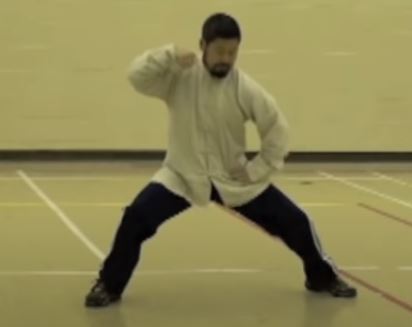
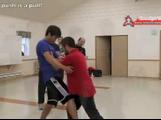
This is the second last Single Whip in the Yilu routine. It is different from other Single Whip moves. Before, stepping to the left, the right hand does a deep positive circle and goes way down before coming to the finished position. Hong changed it to this way through his personal experiences. Here is how it is applied. Notice that the left leg did not step forward as required in the form. Read more
On June 19, 2004, Chen Zhonghua was elected among Hong’s major disciples as Chen Style Taijiquan Practical Method International Standard Bearer. This election was Read more
This is a video project that students made in 1999-2006. Read more
These are some Chen Style Taijiquan Practical Method push hands and applications demonstrated by master Chen Zhonghua and Sensei Michael Calandra. Michael Calandra is an outstanding NY city Read more
This is the text for the 2004 China Trip narration: A Great Wall Read more
Jim Peters is from Regina, SK. Canada. He is a student of Ronnie Yee. Jim was the strongest fire fighter in Regina. He studies Aikiko and other martial arts before. This is what he has to say about Chen Style Taijiquan Practical Method and his 2004 trip to China
[youtube=http://www.youtube.com/watch?v=LHdYJ5gb2Bw]
 In a recent class, I was fortunate to get some lower-body corrections from my peers and Shifu on the circles. These corrections and instruction have made a huge difference in kua movement and solidifying connection from toe to finger. Would like to share these learnings for discussion.
The last workshop I attended with Master Chen Zhonghua had him correcting me on structural positions, and pushing hands positions with an idea that connects with several other, higher level ideas he has previously taught. Read more
John and Dave Dahms
We have been both thinking and practicing. We began by thinking that every part of the body is kind of like a cylinder, and vertically they are strong but horizontally they have no strength. So if everything just moved along its Read more
What would be the benefit of training both Chen and Hunyuan, instead of focusing on one or the other? 4
I teach the two systems for two reasons:
- Personal bias. You can also call this respect for my two masters. I am a disciple of both systems and therefore, I find in my heart that I must teach both systems. This does not mean that I always teach both Chen Style Taijiquan Practical Method and Hunyuan Taiji at the same time. Read more
I cannot tell you THE most important thing to pack. Here is a list from past graduates (no particular order):
- chocolate
- lots of socks
- really good hiking shoes
Sorry we have not included any information on this subject. It will be very easy to live as a vegetarian on the mountain. We are growning our own vegetables this year. If you decide to go, let us know as soon as you can, we will start planting things that will suit you. Lots of soya bean products. We make our own tofu on the mountain too!
I have had 1.5 years of training in Xingyi but no taiji training. Can I join the full time course? i
Definitely you can. First of all previous experience is not important for learning our style of Taijiquan. Secondly, what you have learned before is not essential either. Thirdly, how strong you are is not a factor. Read more
This is a very difficult question and yet it is a realistic question. If you want to commit three months of your life to do something so seriously, you want to know how much you can get in return. Fair enough. Let’s look at it in two different ways:
In between the Han Wang Fu and the Pagoda stood the Wan He Temple. Well, a Wan He Temple anyways, for the real one is buried right underneath what you can see now. “Wan” means ten thousand in Chinese while “He” means monk. 850 years ago the local magistrate sought to build a temple here to “subdue” the mountain. Read more
If you have climbed through the labyrinth of the Suo Yang Gong Caves , you might have noticed a flat rock toward the end of the climb. Legend has it that the colorful immortal Lu Dongbin (Guest of the Cave – one of the eight immortals) meditated on this rock and finally ascended from there! Read more
Han Wang Fu is the name of the Chinese restaurant on the mountain. It is located inside the Courtyard. Han Wang refers to Liu Bang, the first emperor of the Han Dynasty. It is said that after losing the first rebellion against the corrupt Qin Dynasty, he went into hiding in the Daqingshan. There, he rebuilt an army that eventually gave him the power to overthrow the Qin Dynasty. Read more
The following article is reprinted here with permission from Chen Zhonghua. It was first published on January 8, 2007, when Chen Zhonhua formally presented the material at the Premier Hunyuan Taiji International Symposium, in Beijing, China. In this presentation he offers some unique angles on the importance of practices for the specific cultivation of skill involved in co ordinated joint rotation. This perspective also adds a new dimension to the understanding of the concept of “gong”. Read more

This video clip was taped in 2003 when master Chen Zhonghua gave a workshop in Victoria, B.C. Canada. The workshop was sponsored by Gordon Muir. In keeping with his master’s tradition, master Chen seldom wears a uniform. This demonstration was done in slow and chopping movements so that the workshop attendees could see the full moves that they had learned. Front, rear and side views were shown in this clip.
There is a natural tendancy to power an attack (forward movement) but not so when withdrawing (movement towards oneself). In the positive circle, the outgoing upper half is often naturally powered. Read more
Roy Dawson
Date: 12/3/2005 0:00
Title: Nov. 3 and 4 Winnipeg Chen Style Taiji Workshop
Organizer: Roy Dawson
Location: Winnipeg
Comments: Master Chen finally came back to Winnipeg after more than two years. At this workshop we went back to the basics. We reviewed the positive and negative circles and did a stepping exercise.
Ed Zolpis
Points to remember re: Circle exercise-
-position of feet is so that when step to the side the feet are approximately 4.5 foot lengths apart with the back of the forward heel on the same line as the front of the toes of the back foot. Read more
Date: 11/26/2005 0:00
Title: Chen Zhonghua Workshop in Ottawa Nov 26, 2005
Reviewer: Daniel Mroz
Organizer: James Chan
Location: Ottawa, Ontario, Canada
On November 26 and 27, 2005, I took part in a two-day workshop on Hong Junsheng’s Practical Method of Chen style taijiquan, offered by Mr. Chen Zhong Hua in Ottawa, Canada. The workshop was arranged by Mr. Chen’s students and attracted about a dozen participants. Read more
Reviewed by Daniel Mroz
On November 26 and 27, 2005, I took part in a two-day workshop on Hong Junsheng’s Practical Method of Chen style taijiquan, offered by Mr. Chen Zhong Hua in Ottawa, Canada. The workshop was arranged by Mr. Chen’s students and attracted about a dozen participants. Read more
Guidelines:
No two parts align
Find or create a straight line on the floor. Come standing with your feet hip width apart, your toes just touching the bottom of the line on the floor. Turn your left foot slightly out at the toes.
Originally written by: Ed Zolpis
Date: 11/26/2005 0:00
Title: Return to the Basics: Stepping in Chen Style Taijiquan
Reviewer: Ed Zolpis
Organizer: James Chan
Location: Ottawa
Comments: Notes: Master Joseph Chen’s Workshop –
Ottawa – November 26-27, 2005
Ed Zolpis
Points to remember re: Circle exercise-
-position of feet is so that when step to the side the feet are approximately 4.5 foot lengths apart with the back of the forward heel on the same line as the front of the toes of the back foot.
-the back foot is slightly turned out from being perpendicular while the front foot is at approximately 45 degrees outwardly
-kua is open with knees stretched out and body low
-open the body so that it feels as if the energy of the body on the inside is struggling against the form of the body
-the energy of the knees go in opposite directions to each other, i.e. front knee energy goes upward while back knee energy goes downward, without the knee actually moving
-try to keep movements inside the body not allowing them to become predominantly outward, i.e. involving body peripherals(limbs) dominating the movement – another demonstration of this is using upper limbs to hold opponent while move him with lower limbs
-to increase stability, everytime you move, drop body by 5%
-“Double Heavy” is when 2 body section lines are on the same line (parallel). This is unstable. Instead one should try to have these body lines at an angle to each other to increase stability.
-bounce energy in body from foot to foot to top of head
-when stepping use a slipping action so as to insure energy is going outwards
-3 concepts to remember are: 1)withdraw elbow, push hand
2)sink the “dang” (groin)
3)hand grinds out
-training check method – if want to check if a particular move/technique is following principles of body dynamics, multiply its force by 10 to see if it works without overstraining the body
It makes sense. The circle is the strongest form possible. Connecting circles using interlocking gears means the coordination of parts in order to support and connect the structure. Master Chen gives us yet another analogy of structure. Imagine holding a rock away from your body with a straight arm. It requires muscles and strength and this eventually weakens. Read more
Originally written by: Michael Zimmer
Date: 5/17/2005 0:00 Read more
Gene Hess
Date: 3/16/2005 1:00
Title: Qigong brought back my health
Reviewer: Gene Hess
Organizer: John Brown
Location: Fairfield, IA, USA
Comments: Interestingly enough, as I just finished another appointment with my chiropractor, he asked me what I have been doing differently lately. (I have been seeing him about once every three months, for about ten years, on a regular schedule, after I got stabilized from my car/train accident in 1987. He has always had the same ‘trouble’ spots that need to be realigned.) This time, he says that I am a lot more stabile and need far fewer adjustments. I tell him that I am standing every day for at least 30 minutes, focusing on keeping the curves in my spine minimized and keeping a centered posture. He says “Keep doing it. It is making a big difference!” That tells me that just 6 months of standing is some pretty powerful stuff.
Thanks again, Joseph … Gene Hess
Compiled by Todd McGown
There must be horizontal and vertical movements. The shape of the positive and negative “circles” is that of an egg. Not a true circle and not a 2D oval. The horizontal movement is mainly achieved by the hand, shoulder, waist, opposite kua, opposite knee, opposite foot line of the body while the vertical action is achieved by the shoulder, waist, kua, knee, foot line of the body. Read more