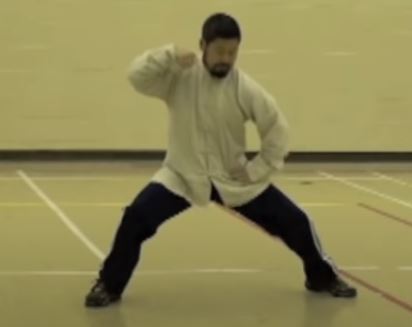
I believe that real progress in Taiji must be the product of many small achievements over many years. I am really pleased that the last three months has been marked by a number of small achievements. Read more
New buzz words in China compared to the old terms:
Meeting-Panel Read more
Meeting-Panel Read more
Now there is no limit on visa extension. Back in 2008 a Chinese entry visa can only be extended once inside China. The new requirement is that there has to be 100 US dollars available for each day extended. Some of the full time taiji students this year have to extend their visas twice.
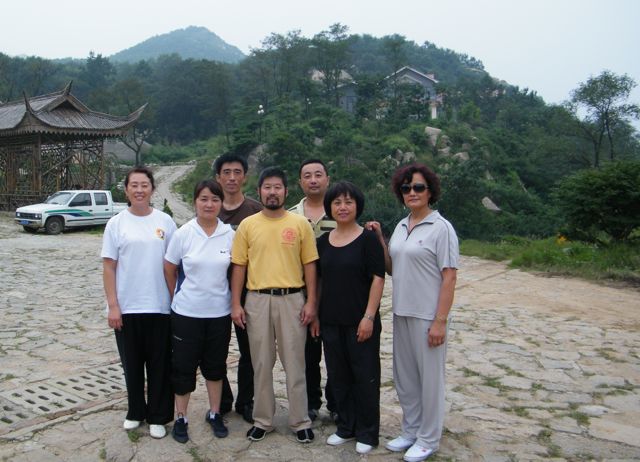
Wu Shaozhi of Linyi and Chen Xu of Zibo came to visit. They stayed for two days. Watched Wu’s form, made corrections and comments. He made progress again. Chen Xu came to Daqingshan through the Zibo Taijiquan Competition held in Yiyuan that the Daqingshan team attended. His push hands was quite good. He noticed that the feeling of push hands is not what he expected from observing my students at the competition.
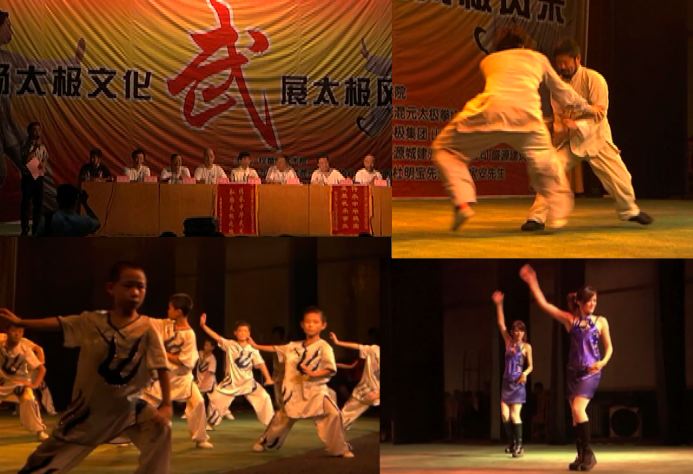
The students left for Rizhao at 4:45 this morning to perform a demonstration at the Rizhao National Water Games on the Wan Pingkou Beach. They will spend the day in Rizhao after the demonstration.
[nggallery id=61]
赤日高挂,晴空如洗,嵩山逶迤,春树勃发。那少林古寺,危簷大院,鳞次栉比,随山就势,气象庄严,真无愧禅宗祖庭之誉。寺内香烟缭绕,磬钵鸣奏,梵唱悠扬,原来正在作法事。 Read more
The front must be full and the back must be stable. You can push from the back but not the front.
When I started studying Practical Method Taijiquan with Ronnie Yee back home I knew I had found a martial art that was special. When he told me about the Victoria workshop last fall, and I mentioned interest in going he encouraged me, telling me it would be good for me to meet Masted Chen. Read more
 |
Chen Style Taijiquan Practical Method Toronto |
The Chen Style Taijiquan Practical Method Toronto practice group meets mulitple times a week at various locations. Read more
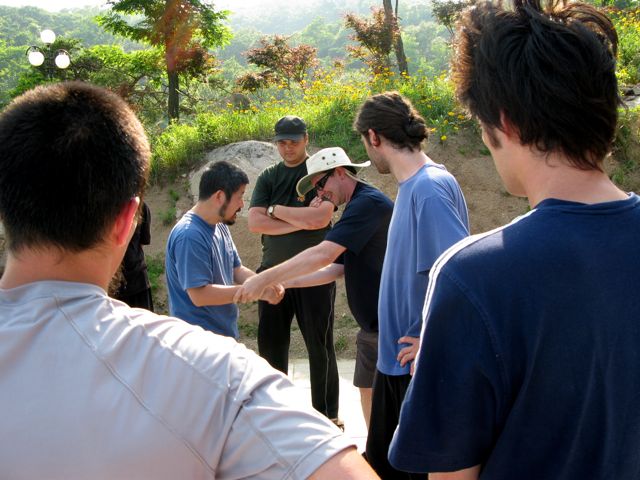 I came to the mountain in June with not much expectation, I saw it as a holiday with a chance to learn taiji. I knew it will be a long journey since I just met Master Chen in February, and through several workshops, I accepted that it will take a long time to gain any real progress.
However, it has become a memorable experience, Read more
Here are videos of push hand competition and weapon form.
Grandmaster Li Qingjia of Xuzhou at the 4th Chen Style Taijiquan Practical Method Conference on Daqingshan, Rizhao in 2010.
Read more
The fourth Chen Style Taijiquan Practical Method Conference ended today on Daqingshan. This conference included the Daqingshan Mountain tour, masters demonstrations, panel discussion, evening of movies and photos of Grandmdmaster Hong Junsheng, lectures, and discussions. Masters from Xu Zhou, Tai An, Jinan other places start to leave the mountain today. It was decided that the 5th conference will be held in August 2011 on Daqingshan. Next year’s event will feature a competition and more student participation. Please use this site for further information.
[nggallery id=60]
Here are some photos of a hike on Daqingshan by some of the Practical Method masters. We hiked from the Han Emperor Palace to the Dragon’s Abyss and then to the Garden.
[nggallery id=59]


Master Xu Guicheng recalls that Grandmaster Hong Junsheng did not like the saying “Entice into emptiness” as it denotes two actions. He preferred “Withdraw is to issue.”
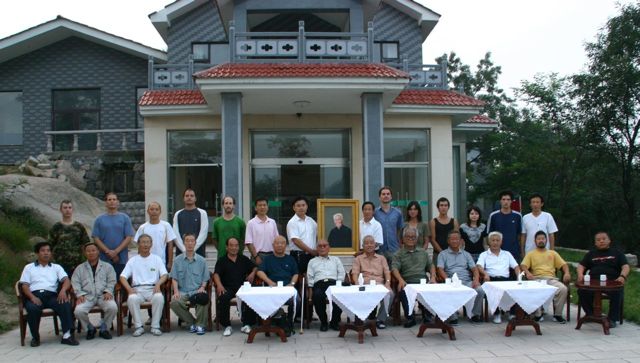
Cai Yanping, Dong Yuexing, Cai Shengye, Zhang Guangzong, Li Qingjia, Wang Deyou, Xu Guicheng, Li Chugong, Wang Jinxuan,
Chao Xiuzhen, Liu Weiguo, Chen Zhonghua, Li Shufeng,
蔡延平,董月兴,张广宗, 李庆佳,王德友,许贵成,李储功,李树峰,
Chao Xiuzhen, Liu Weiguo, Chen Zhonghua, Li Shufeng,
蔡延平,董月兴,张广宗, 李庆佳,王德友,许贵成,李储功,李树峰,
[nggallery id=58]
A friend of Master Chen invited the students to do demonstration during wushu competition in his school. We went there in the morning, had a very nice seafood lunch, and other treats in the afternoon.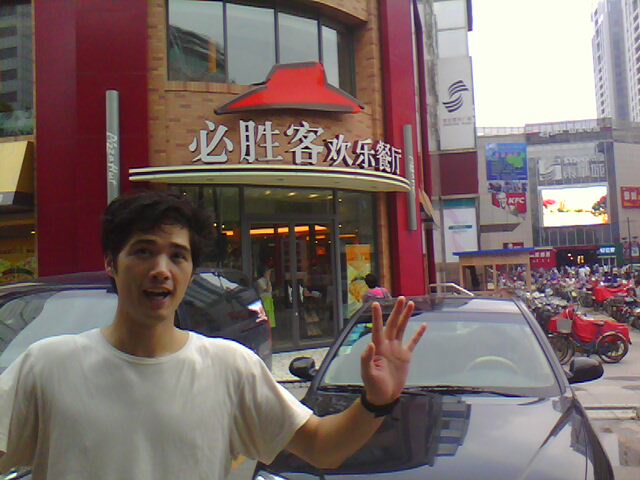
Video by Paul Janssens below.
Read more
Master Chen has stated that any similarities between Taijiquan and other martial arts are superficial. To be unaware of this point is to risk wandering off-course on the Taiji path.
- Dates: Sep 23-26, 2010
- Location: Bayviw Hill/Langstaff Community Center, Ontario, Canada Read more
Many more Chinese martial artists have visited Daqingshan this year compared to last, with various Taijiquan styles, Yiquan, Tongbeiquan, Baguazhang, Xingyiquan and Shaolinquan all being represented.Many have come from Linyi, a near-by city known in Shandong for its martial arts pedigree. Shandong itself is a province famous for its long and deep martial history in China. Outwardly these martial artists say they come to learn from Master Chen, however most if not all come to test his skill.
During a break from the constant stream of guests, Master Chen explained that all of his visitors come with their minds already made up, and thus will never be able to learn. “People will always believe what they want to believe, no matter how skillful you are”. No matter the outcome of these encounters, they all return home continuing to believe what they think they know about Master Chen and “real” Taiji skills. He then went on to describe people’s reactions after pushing with him, and how their minds get in the way of learning:
After pushing with Master Chen everyone’s reaction is the same: “He’s too strong. He’s just stronger than I am”.
After this experience, the correct progression of thought should be:
“No, it’s not just that he’s stronger than I am, it’s something he does”. Then,
“I can only be strong like him if I do what he does” (Practical Method).
However, after experiencing Master Chen’s power people react in the following ways:
“He’s stronger because he is younger – it’s not proper Taiji”. Or,
“He’s strong and fast. He got me this time but I’ll get him next time”. Or,
“I don’t understand it, I don’t like it, and I don’t want to try it”. Or,
“I want to be strong like him so I’ll learn his tricks and put them in my own form”.
Most visitors’ reactions fall into one of the top three but a few have been of the fourth, and so they returned to Daqingshan to learn from Master Chen. But according to him they will never succeed in learning because both their logic and their understanding of Taiji are flawed. Master Chen has no tricks, he has the Practical Method.
Master Chen recounted a story of Master Hong to illustrate how having pre-conceived ideas of Taiji inhibits learning. After moving back to Jinan from Beijing, Master Hong taught in many locations in Jinan and eventually ended up teaching at the Jinan Martial Arts Academy. For over 10 years Hong taught daily in the same gymnasium with Wushu instructor Master Wu. Wu thought Hong was a fake – his Taiji ridiculous – and for 10 years he had never shared a word with nor touched Master Hong.
One day while Master Hong was demonstrating a technique on a student, Master Wu had had enough – after teaching side-by-side with Hong for so many years, he could no longer stand to see this old man continue to cheat his students. Interrupting Master and student, Master Wu requested Hong to demonstrate the technique on himself instead, thinking he would finally expose Hong for the fraud he was. Upon first touch Master Wu was immediately thrown against the wall. In all his martial arts experience Master Wu had never felt anything like Hong’s energy. Completely surprised yet unhurt, Master Wu promptly requested to become a disciple of Master Hong. Imagine being Master Wu and realizing that you had wasted an opportunity to train every day with a high level Master for 10 years!
However, Master Chen raised this subject not out of despair but out of hope, for he said that for the first time in his teaching career he encountered a student who came to test him and came away from the encounter with the right mind towards learning. A fellow Taiji brother (Let’s call him Liu) of mine had studied another Chen Style Taijiquan for over 10 years when he first met Master Chen. He came to Daqingshan dissatisfied with his previous training, and when he first pushed with Master Chen he didn’t understand – he had never experienced anything like it, and from such a small man at that.
Liu had planned to spend 6 days training on Daqingshan, and at the end of the first day he thought to himself, “I need to lift more weights and train harder to beat him”.
After the second day he thought, “I need to learn his tricks in order to make my taiji as good as his”.
Upon the third day he realized “Putting his tricks in my form won’t help. I need to learn his form. I must start training the Practical Method”.
After only 3 days, Liu decided to return home, as this new realization meant he had to ask his current teacher for permission to start training with Master Chen. He had realized what most others do not: if 12 years of his previous training didn’t produce enough power, how would adding a few techniques from a different system help? Liu understood that Master Chen’s power is a result of his form, and so abandoning his other training to start the Practical Method is the only way.
Those of us who study with Master Chen are under no illusion as to how long and hard a road it is to achieve true Taiji skill. To fail to mention or deny this fact would only give his students a false impression of what Taiji truly is. The reason that Taiji is so difficult to master is the same reason why one cannot borrow Taiji techniques to supplement training in another martial art: Taiji movements are completely counter to human nature. And thus Taijiquan is a complete system unto itself; incompatible with any other. Master Chen has stated that any similarities between Taijiquan and other martial arts are superficial. To be unaware of this point is to risk wandering off-course on the Taiji path.
In order to attain his level of skill, we must train in the Practical Method for as long and as hard as Master Chen has. There are no shortcuts, there are no secrets. In his book, Master Hong quotes Grandmaster Chen Fake,
“In learning Taiji, one must pay attention to details to progress steadily. Gongfu is such that the time and effort you put into it is always the same as the result. If you put in as much time as I do, you should be as good as I am. If you put in more time than I do, your gongfu must be better than mine. In this art, there is no cheating. There is no short cut”.
And while this may be disheartening to some, it is also the reason why Master Chen has many dedicated students. We are lucky to have found a teacher who is so open and willing to share his knowledge. Master Chen often emphasizes the importance of correct learning because without this awareness we are likely to get side-tracked in our training. I would like to thank Master Chen for his generosity and guidance on the Taiji path, and offer this quote reproduced from Sun Zhonghua`s previous article on the website to inspire my fellow Taiji brothers and sisters,
“Just take one step at a time, understand one bit at a time. There is no fame. There is no obvious sign. Just follow the purity of the true path, while enjoying the journey and the process.”
[nggallery id=57]
 Author: Chen Zhonghua Language: Mandarin Length:20:47 min. In this lecture, Master Chen Zhonghua talked about five elements in Push Hands with hands on instructions.
The following Masters of the Chen Style Taijiquan Practical Method will be present at this gathering. Read more
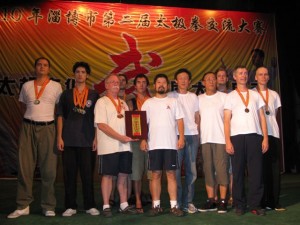
Chen style other form
- Charlie Gordon 1st place
- Steven Chan 2nd place
- Khamserk Yawnghwe 2nd place
- Pavel Codl 3rd place
- Paul Janssens 3rd place
- Lee Hrapsted 3rd place
[singlepic id=1172 w=400 h=225 float=] Read more