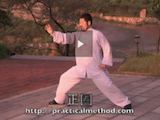
Body Part Proportion; Movement without losing power; Matching to be full; Use rubber cord to restrain upper body; Michael Koh Yilu parts; Theory and practical advise on learning; Yin yang separation; Relationships; Gears
Presenter: Chen Zhonghua Length: 57 min. In: English &Chinese Year: 2012 Difficulty:2/5 At:Singapore
Elbow in exercise;Don’t lose it;Spiral force and kungfu;Exercise no fighting; look for energy; Circle without the hand moving; Harmony; Discusson on theory
Presenter: Chen Zhonghua Length: 56 min. In: English & Chinese Year: 2012 Difficulty:2/5 At:Singapore
No problem, I really appreciate the opportunity to participate in these discussions. It helps to solidify my understanding of things as I study videos and practice. One of the videos that helped clarify one of the main contradictions/sources of confusion is the mini lesson “Hands on Positive Circle Sequence” where Master Chen is detailing the 9 count circle for you, Michael, and a small group of students on the mountain. Read more
Around The Web
With Just Four Ounces Of Strength, Science Of Spirituality Article on Speakingtree.in by Sandeep Desai Link
Quotation
From complexity to simplicity Practicing taiji is to train to make all the complex moves and routines simple for execution. In order to do so one must be able to “See” the simplicity in the complexity.
Correction of Louise (17min) , Spencer (15min), Lutz (15min) Presenter: Chen Zhonghua Length: 40 min. In: English Year: 2012 Difficulty:1/5
[videos hosted on new streaming server supporting seek ahead]
I did publish a gallery with screenshots of Master Chen’s Yilu 2009 on my webpage as a tool for learning the choreography. I also want to privode all the form names in English & Chinese (Characters plus pinyin with tones).
So I like to ask everybody to have a look and leave some comments in order to correct mistakes, esp. with the Chinese names. Also they are not complete yet. Read more
A method for a short cut; Changing the focus; Cord exercise detail; Double heavy test;Punch alignment test; How to enhance power. Presenter: Chen Zhonghua Length: 46 min. In: English/Chinese Year: 2012 Difficulty:2/5 At:Singapore
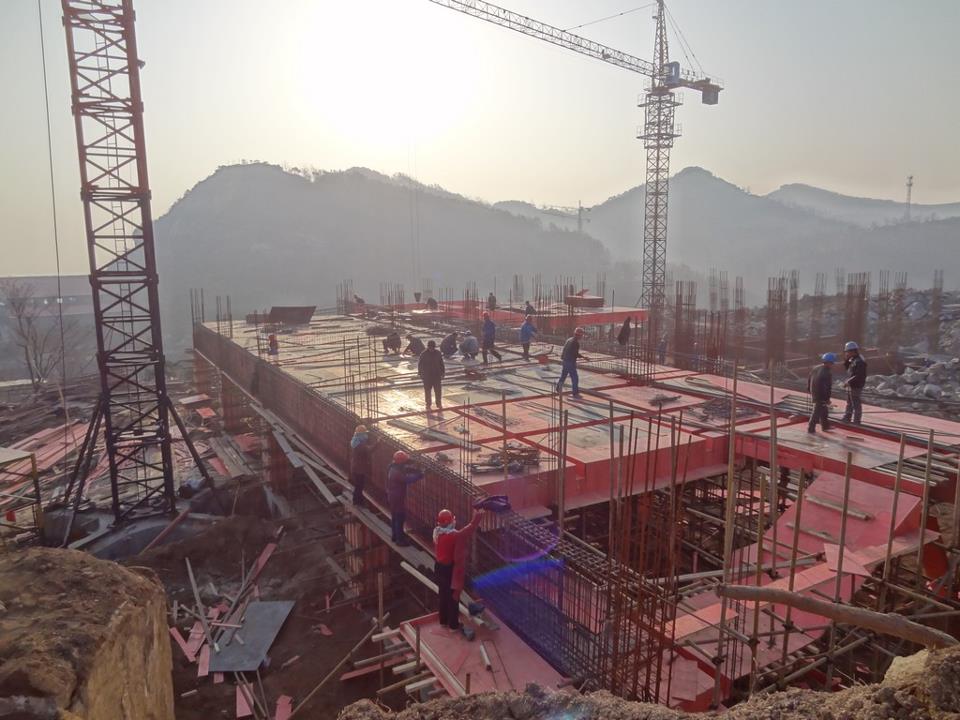
This is a photo of construction of the Daqingshan Hotel (4-star) on Nov. 17, 2012. This hotel must be completed by May for the May 25, 2013 Daqingshan International Taiji Festival.
I am very impressed with Steve’s demos, he is able to explain his actions exactly like Master Chen with no deviation. It’s like deja-vu. I have heard the same explanations from Master Chen in a different place at a different time. I can learn so much from him.
During Master Chen Zhonghua’s Nov. 2012 Phoenix workshop, local students and the organizer Master Ping Wei accompanied everybody on a tour of the Grand Canyon and Sedona. Here are some photos of their Grand Canyon visit.
[wowslider id=”10″] Read more
In preparation for the May 2013 Daqingshan Premier International Taiji Festival, the Daqingshan staff have been learning taiji since the summer of 2013. Here is a photo slide of their evening training in November 2013.
Front forward, back backwards; What is stretch; Movement over quality; What is fajin; Common language; Central equilibrium; Relax fang song; Feet dang positions; Touching point cannot move; Positive circle detail
Presenter: Chen Zhonghua Length: 42 min. In: English Year: 2009 Difficulty:2/5 At:Toronto
For those of you that come from other taichi backgrounds and now do the Practical Method, I’m curious as to what led you along this path. Also, what was your first impression of the Practical Method style? I’ll tell you a little about my story. Read more
The longer the better;Triangulation, missing line in a triangle;Adhere; Size of stance; One third rule and lever; Push from the feet; How to move, transmission of power; Presenter: Chen Zhonghua Length: 74 min. In: English Year: 2012 Difficulty:2/5 At:Toronto
Our first foreign resident of Daqingshan succeeded in making pizza for the Daqingshan staff. He got ingredients from Singapore, Beijing, etc. In the future, Tim will attempt to make more western food when full time students are on Daqingshan.
In many cases, when people move, they always render their kua too short in consideration of the opponent’s position. In the following photos, one shows that the kua is too short (the one that has an overall bent body) and one shows the correct kua.
We distinguish between movement, which is used for positioning, and action which facilitates rotation. Movement is horizontal in space, forward or backward, left or right. Rotation involves internal vertical adjustments and repositioning of inner space, actions required for directing power outwards, from a stable structure.
Learning Taiji is to solve a set of contradictions.
Neither over-extended, nor deficient.
Anything that exists is the resolution of a contradiction. Therefore, when you see a contradiction in a matter, you have not resolved the issue. When you have, you will not see the contradiction any more.
In taiji, you must reach a stage when you create movements without moving; you don’t push but your opponent is pushed out; etc. When you still cannot do this, you are still not at the level yet.
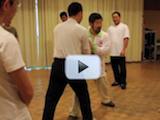
Some clips of master Chen Zhonghua’s push hand teaching sessions of Daqingshan in the summer of 2012. These are extracted from the 7 volumes of the Daqingshan 2012 push hands training videos. This video is also available at: http://chenzhonghua.cn/2012/11/陈中华老师2012年大青山推手训练精选视频花絮/ Presenter: Chen Zhonghua Length: 8 min. In: Chinese Year: 2012 Difficulty:4/5 At:Daqingshan
Master Chen and to those on this web site, I have a question I would like to get your input on. In the taichi classics there is an expression, “Stillness in Motion, Motion in Stillness”. I’ve always had this explained to me that it relates to the mind being still while the body is in motion and vice versa. This has always perplexed me somewhat and didn’t seem like a thorough answer. Read more
During the recent Chen Taiji Seminar in early Mar 2012 conducted by Master Chen Zhong Hua, he used an analogy of how striking in Taiji is like being “struck by a bullet.” Read more
Thank you to everyone who attended the intro to Practical Method event this past Sunday. We had a very good turnout. Taiji classes will continue at Bend Yoga and Movement Studio after Thanksgiving, Read more
The shape and actions of the kua in Chen Style Taijiquan Practical Method. Presenter: Chen Zhonghua Length: 3 min. In: English Year: 2012 Difficulty:3/5 At:Maple Ridge, B.C. Canada
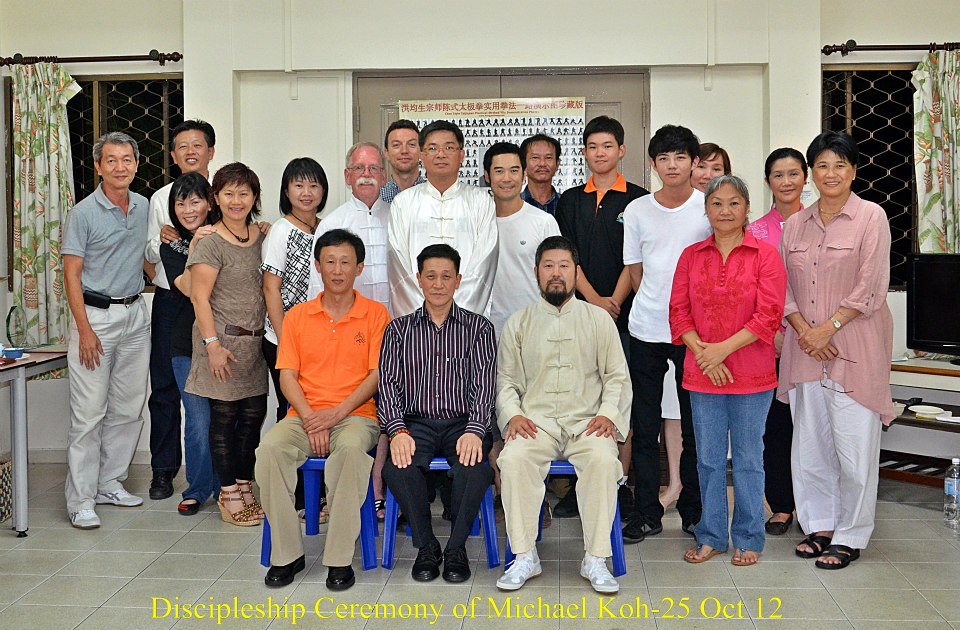
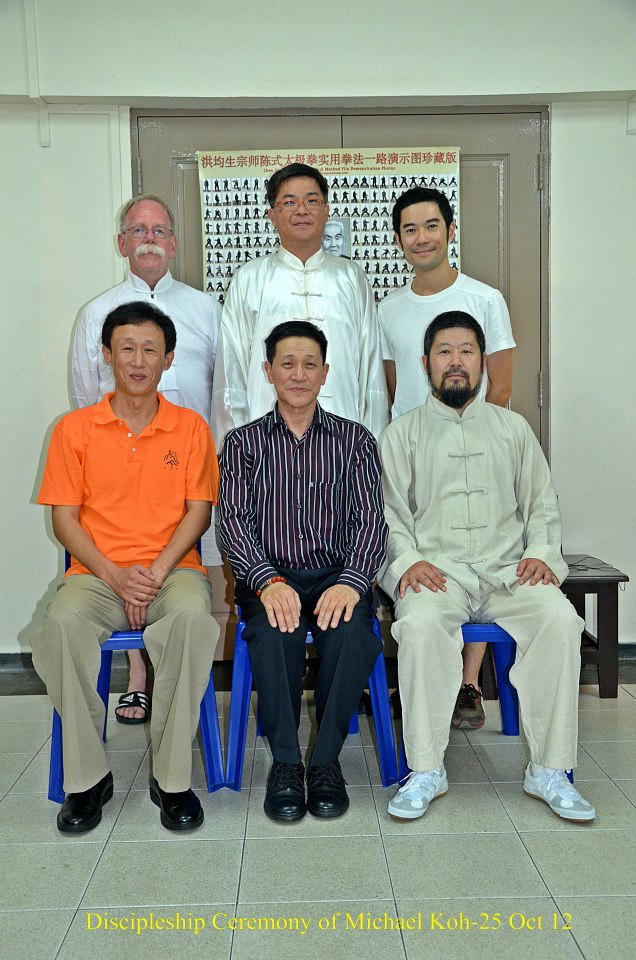
Michael Koh was accepted as Master Chen Zhonghua’s disciple in the Chen Style Taijiquan Practical Method system. The ceremony was attended by Master Hong Sen and Master Xu Jinge. Other disciples present at the event: Tim Duehring and Nicholas Fung.
The shape of the hand in Chen Style Taijiquan Practical Method. The hand and fingers are shaped like an ancient Chinese roof tile. This ensures that the base is tight and the fingers span out. Presenter: Chen Zhonghua Length: 5 min. In: English Year: 2012 Difficulty:1/5 At:Maple Ridge, B.C. Canada
Weight shifting or weight switching is an important technical principle of the Chen Style Taijiquan Practical Method. Presenter: Chen Zhonghua Length: 2 min. In: English Year: 2012 Difficulty:3/5 At:Maple Ridge, B.C. Canada
My disciple Michael Calandra will be in London from November 23 to the 28, 2012. Anyone interested in learning the Chen Style Taijiquan Practical Method, please contact him. oikddojo@aol.com He will be officially teaching Karate on this tour. His website: http://www.seishinkanonline.com/
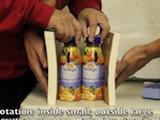
Here is a short video that we filmed in my class last night. In the gym where I teach, we found an exercise device that can illustrate the importance of the alternating fixed point in the Practical Method. The explanation is not as precise as I would have wanted, but we filmed this on the spur of the moment.
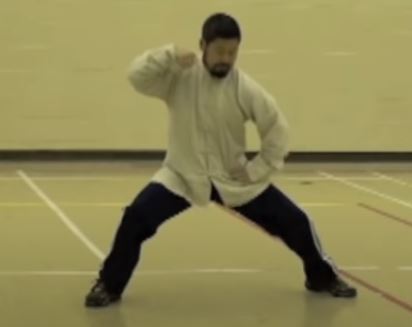
On the way from China to Vancouver workshop, Master Chen has a free day to talk and demonstrate basic principle often misunderstood in Taijiquan. Using “Six Sealing and Four Closing” to show how to split of yin and yang. Presenter: Chen Zhonghua Length: 3 min. In: English Year: 2012 Difficulty:2/5 At:Stanley Park Vancouver, Canada
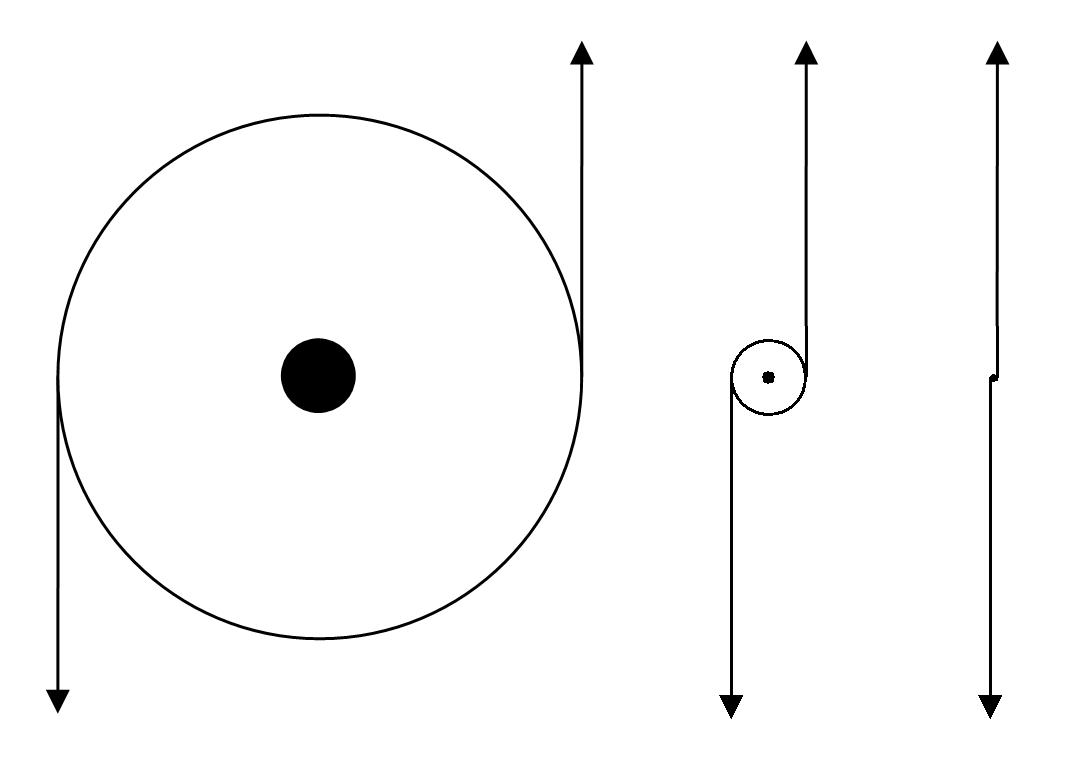
Figure 1.
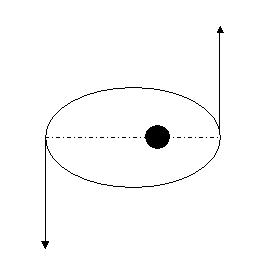
Figure 2.
Master Chen says that separation of yin and yang is rotation in today’s terms. He also mentions that stretching is an instance of separation of yin and yang. Today, I came to a realization that when the circle becomes infinitely small, rotation and stretching are really one and the same. The key is that the setup needs 3 points, and one action, which is the rotation, at the centre or the pivoting point or the fixed point. The rotation at the centre is the only thing I can do to ensure that the other 2 points are opposites but of the exact same size. For example, if I just move the hands in opposite directions, since there is no relationship between them (no 3rd point linking the two together), there is no guarantee that their actions are the same in size. At the beginning, I can visualize how the dantian acts the centre and modulates the other 2 points (hand and foot). Hopefully in the future, I can place the centre/fixed point anywhere inside or outside of the body as desired like Master Chen said.
In order to materialize this theory in practice, more training in foundation and yilu will be the way to go.



 Correction of Louise (17min) , Spencer (15min), Lutz (15min)

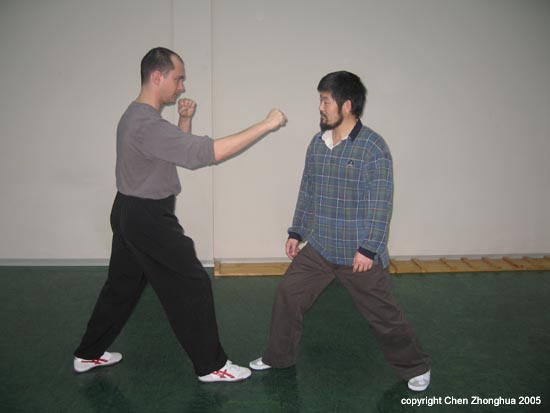
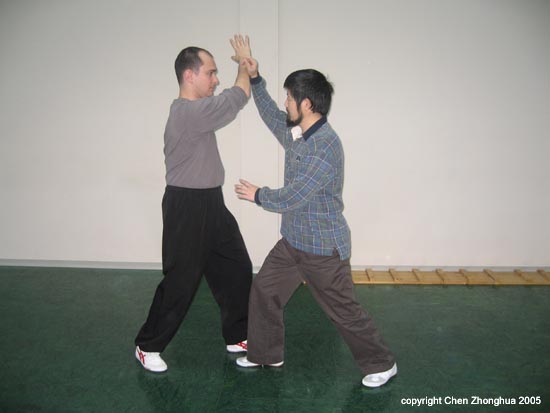

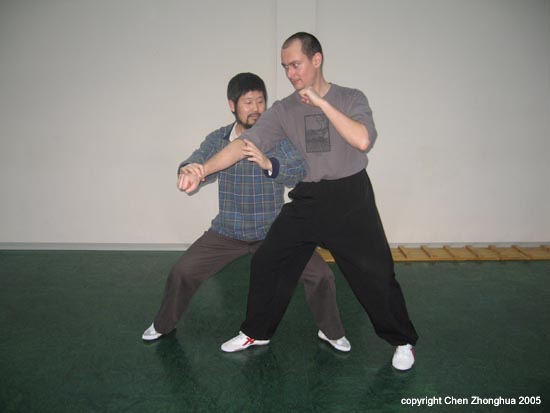
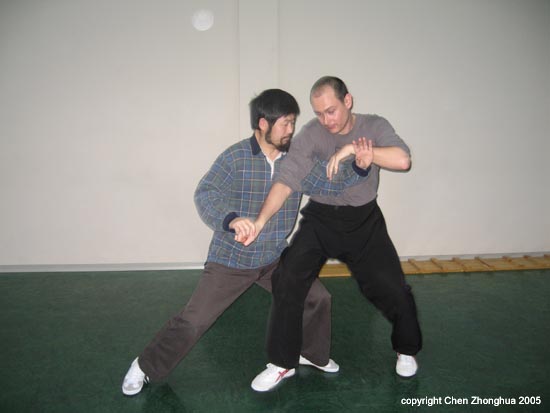
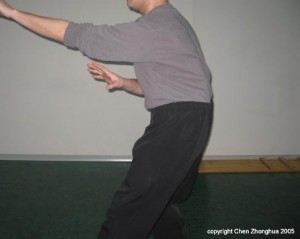 In many cases, when people move, they always render their kua too short in consideration of the opponent’s position. In the following photos, one shows that the kua is too short (the one that has an overall bent body) and one shows the correct kua.
 The shape and actions of the kua in Chen Style Taijiquan Practical Method. Presenter: Chen Zhonghua Length: 3 min. In: English Year: 2012 Difficulty:3/5 At:Maple Ridge, B.C. Canada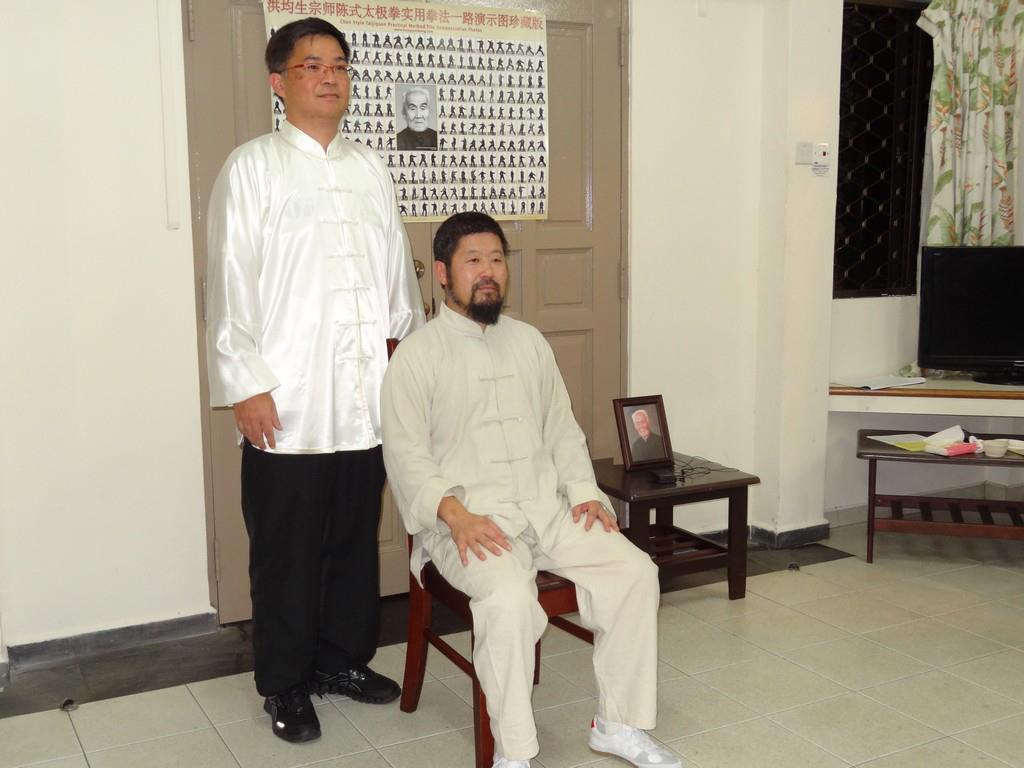
 How to produce power in the body. Presenter: Chen Zhonghua Length: 2 min. In: English Year: 2012 Difficulty:2/5 At:Maple Ridge, B.C. Canada
 The shape of the hand in Chen Style Taijiquan Practical Method. The hand and fingers are shaped like an ancient Chinese roof tile. This ensures that the base is tight and the fingers span out. Presenter: Chen Zhonghua Length: 5 min. In: English Year: 2012 Difficulty:1/5 At:Maple Ridge, B.C. Canada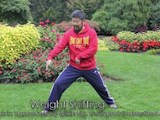
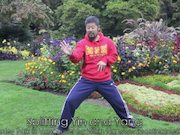 On the way from China to Vancouver workshop, Master Chen has a free day to talk and demonstrate basic principle often misunderstood in Taijiquan. Using “Six Sealing and Four Closing” to show how to split of yin and yang. Presenter: Chen Zhonghua Length: 3 min. In: English Year: 2012 Difficulty:2/5 At:Stanley Park Vancouver, Canada