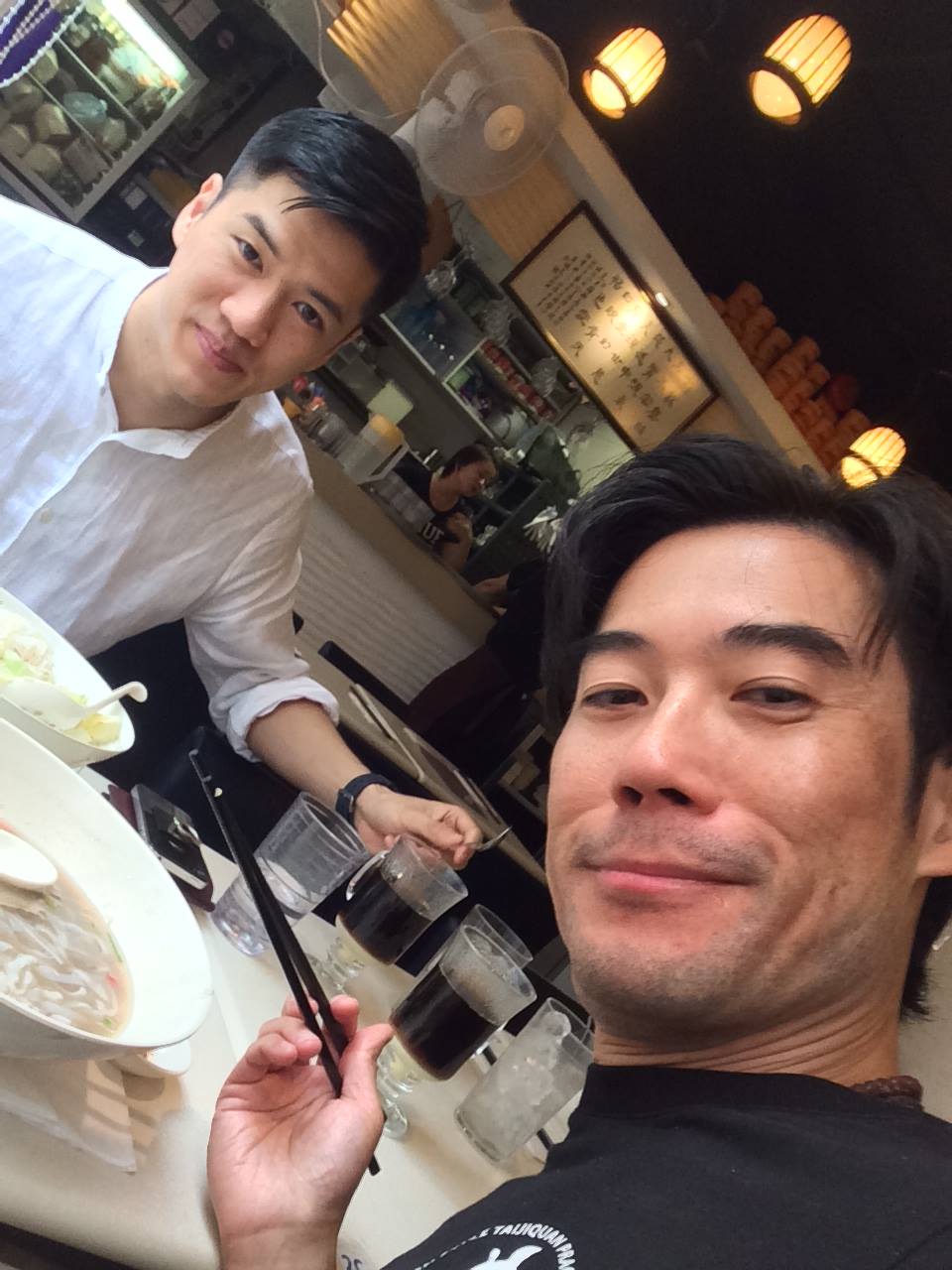
Here are some notes of a “Dinner-Lecture“, it was funny to re-listen 😉
if you can rotate your shoulder, the power from your body will transmit to your hand; many people fight tough but they have no power, because power comes from the ground, by connecting soledly on to the ground → this is upper body solution
when the qua is open, your upper body will connect to the ground, if you can not connect to the ground your power is a superficial power
saying: a piece of wood can stand 1000 pounds but if it`s cricket, it cannot stand anything
you need to be straight, straight basically meens there is no deviation with the incoming force
*This article was originally published in T’ai Chi, the International Magazine of T’ai Chi Ch’uan, Vol. 29, No.5, October 2005. ISSN 0730-1049, Wayfarer Publications, Los Angeles, CA 90039.
Fresh new Mr. accountant John and I had a catch up today and celebrated. Despite his absence, he has been keeping up with the basics and was able to develop new moves on the basketball court. Yeah, he sent a guy rolling across the court when pushed from behind. I am impressed! And, John didn’t know what had happened except for not moving!
Iowa workshop participants, please comment on what you learn from this drill.
Todd Elihu : Response Drill is to train not to react locally to the opponent’s touch on your shoulder but to simultaneously move your hand in toward the opponent. Therefore the intention is on hand out and not on the opponent touching your shoulder. It also trains timing.
The following is my proposal for teaching Tai Chi at Paradise Valley Community College (Phoenix, AZ). It was accepted and the class will be scheduled for the Spring 2017.
Demonstration and explanation of how to have a ‘down’ position
Presenter: Chen Zhonghua Length: 3 min. In: English Year: 2016 Difficulty:1/5 At:Daqingshan
Let’s do an experiment. Find a stick about a foot long. Put a mark on the center point. Use fingers of one hand to hold one end of the stick in horizontal position. Now, try to rotate the stick horizontally, and make the center point of the stick as the rotation center, and try your best to keep the center point not moving around. Soon you’ll find out that is not a simple task even though it sounds simple. This is not because you don’t have enough strength in your hand/arm to hold steady of the stick. It’s because you only control one end of the stick.
Master Chen’s disciple Ping Wei will teach a full day workshop in Irvine, California on August 21, 2016 (Sunday).
The workshop will cover foundations and Yilu; and it also prepares us for the upcoming Phoenix Workshop with Master Chen in October. For location and other details, please contact Al Yu, mralyu@yahoo.com, (949) 331-2735; or Ping Wei, peace_defender2003@yahoo.com, (602) 373-3457.
Master Chen Zhonghua accepted Charlie Wishon as a disciple on July 17, 2016.
On July 17, 2016, Master Chen Zhonghua accepted Charlie Wishon as his 201st disciple at the workshop held in Iowa City. Todd Elihu emceed the ceremony and many other disciples were present including Levi Sowers, John Upshaw, John Dahms, Brennan Toh, Kelvin Ho, Hugo Ramiro, Xavier Santiago, Jeff Clevenger, Bruce Schaub, Erwin Ramthun, and Chris Dusek. At the conclusion of the ceremony, Master Chen briefly spoke about the privileges, responsibilities, and ethics of being one of his disciples.
There are some small details in stepping forward and finishing the form that I have been focusing while doing Yilu. I’d like to share here and hopefully generate some discussion.
In Practical Method, we first (1) shuffle one heel out when we step forward. Then (2) we move the knee forward and the body is shifted to center (roughly).
Some people would do (1) and (2) together, so it really looks like stepping and weight shifting are done at the same time. It’s partly due to the weak supporting leg. With more practicing and increased leg strength, it can be easily corrected.
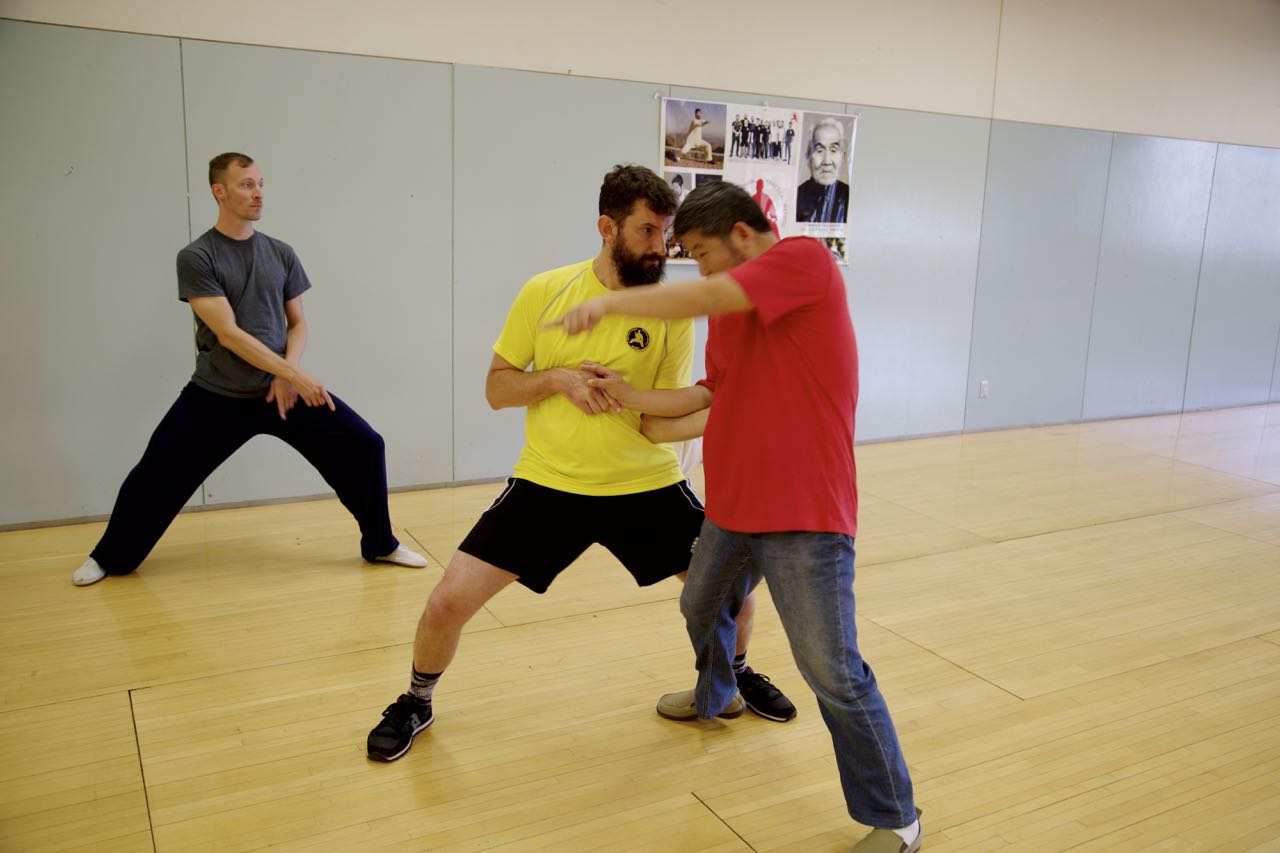
Chen Zhonghua correcting Todd Elihu at the 2016 Iowa Workshop.
When the elbow comes in, the finger must aim onto person. Actually, every move must aim onto person.
When locked at one or two points, utilize another set of points beyond the initial set of points to go over/break out.
Isolation exercise #1: partner holds your arm at the wrist and shoulder. You squeeze the muscles on the body-side of the where he has his hand on your shoulder, then extend the fingers. Each move must be independent from one another. Switch back and forth. Read more

 Here are some notes of a “Dinner-Lecture“, it was funny to re-listen 😉