_2021-04-24.jpg)
Presenter: Chen Zhonghua Length: 10 min. In: English Year: 2018 Difficulty:1/5
Presenter: Chen Zhonghua Length: 10 min. In: English Year: 2018 Difficulty:1/5
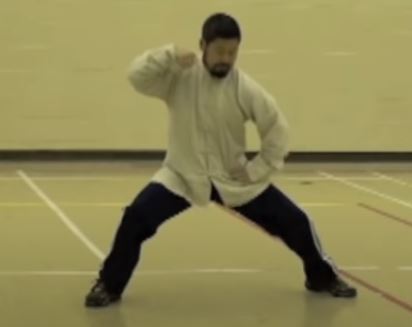
Turning Flower over from the Sea Bottom
Today, there is a big breakthrough.
The shoulders finally find the kuas in this movement. It was very possibly due to the exercise taught on Mar 30, 2021:
REMEMBER THE PROCEDURE that gets me here, but DON’T FOLLOW THE FEELING.
Fist of Hitting and Lifting
The flip from one side to another needs to happen because of torso going down. More precisely, the two shoulder-to-kua axes go up and down against the central non-moving axis. Read more
Presenter: Chen Zhonghua Length: 76 min. In: English Year: 2021 Difficulty:5/5 At:Edmonton Chen Zhonghua Taiji Academy
_2021-04-23.jpg)
Presenter: Chen Zhonghua Length: 10 min. In: English Year: 2018 Difficulty:1/5
Train the scissors as an ability/skill. Two way split, in both elbow and armpit, 2 dots. In use or push hands, it is paper cut model, with one side being fixed, like an opponent holding you and you cannot move. Like the crab pincers.
Train the elbow. Thread through the needle, push into pull. Pass the demarcation line/dot. We always move after going through the hole. Before that, it is a push. Elbow has to pass the line, go over.
Read more
Presenter: Chen Zhonghua Length: 57 min. In: English Year: 2021 Difficulty:3/5 At:Edmonton Chen Zhonghua Taiji Academy
Presenter: Chen Zhonghua Length: 45 min. In: English Year: 2021 Difficulty:3/5 At:Edmonton Chen Zhonghua Taiji Academy
_2021-04-22.jpg)
Presenter: Chen Zhonghua Length: 10 min. In: English Year: 2018 Difficulty:1/5
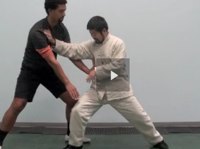
Chen Zhonghua’s disciple Sun Yang in black pushes hands in a friendly manner with the fourth place winner of Shandong Provincial wrestling competition. The person in white is a professional wrestler from the Shandong University of Sports.
Fist of Lifting and Blocking 搬拦肘
Presenter: Chen Zhonghua Length: 64 min. In: English Year: 2021 Difficulty:1/5 At:Edmonton Chen Zhonghua Taiji Academy
_2021-04-21.jpg)
Presenter: Chen Zhonghua Length: 10 min. In: English Year: 2018 Difficulty:1/5
In our school we use GM Feng Zhiqiang”s fajin as our training template.
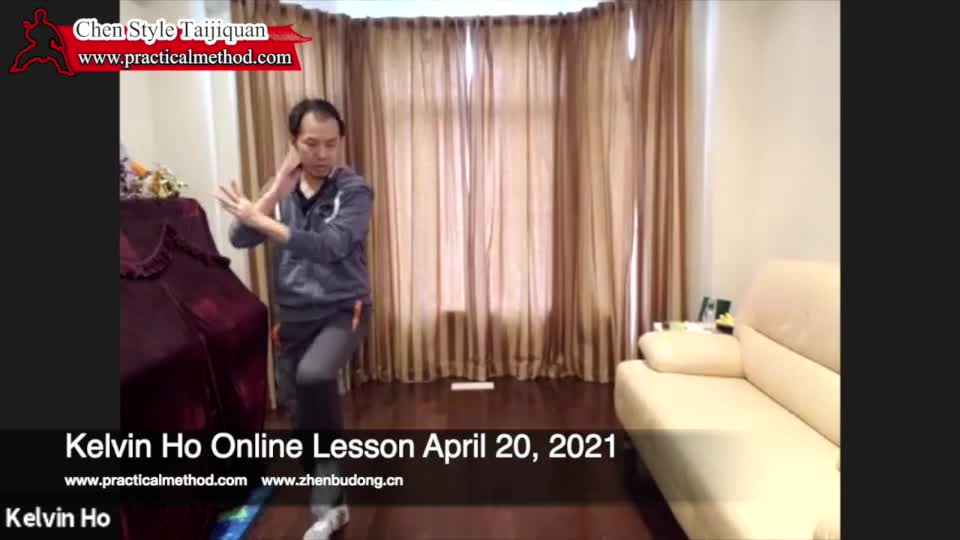
Presenter: Kelvin Ho Length: 61 min. In: English Year: 2021 Difficulty:2/5 At:Toronto Chen Zhonghua Taiji Academy
_2021-04-20.jpg)
Presenter: Chen Zhonghua Length: 10 min. In: English Year: 2018 Difficulty:1/5
Kelvin corrected me on #42 to #44
#42 Embrace Head to Push Mountain
Starting position: chest facing N; hand facing W; half-horse stance R foot rear, L foot front.
#43 Change Palm Three Times
#44 Oblique Single Whip
Position check: chest faces NE; 2 feet on NW line; half-horse stance.
Presenter: Kelvin Ho Length: 59 min. In: English Year: 2021 Difficulty:2/5 At:Toronto Chen Zhonghua Taiji Academy
_2021-04-19.jpg)
Presenter: Chen Zhonghua Length: 10 min. In: English Year: 2018 Difficulty:1/5

Presenter: Kelvin Ho Length: 30 min. In: English Year: 2021 Difficulty:2/5 At:Toronto Chen Zhonghua Taiji Academy
_2021-04-18.jpg)
Presenter: Chen Zhonghua Length: 10 min. In: English Year: 2018 Difficulty:1/5
_2021-04-17.jpg)
Presenter: Chen Zhonghua Length: 10 min. In: English Year: 2018 Difficulty:1/5
Common mistake in push hands:
_2021-04-16.jpg)
Presenter: Chen Zhonghua Length: 10 min. In: English Year: 2018 Difficulty:1/5
3 beats. Cloud hands. When it is 3, the middle is stable and not affected, 2 is swollen but time is taken.
Stepping in six sealing four closing, avoid double heavy, arms go vertical and stepping is horizontal.
Dantian fits tight in a pipe with a lot of tension, no slack/tossing/large protrusion. Example: fist draping over body. The torso is switching inside a pipe, you have to turn over the joints. Foot and oppo arm stretch, the arm is rotating in the shape/frame. Forearm no move can only rotate in a pipe, twist the waist to create the stretch. To twist, you have to lock and move the rest, to create the helix. No twist, no power. It is the yin yang separation. And we continue to create tension on top of the other without releasing/losing any, until the jar explodes. Fundamental moves are a circle.
Read more
Presenter: Chen Zhonghua Length: 77 min. In: English Year: 2021 Difficulty:3/5 At:Edmonton Chen Zhonghua Taiji Academy
_2021-04-15.jpg)
Presenter: Chen Zhonghua Length: 10 min. In: English Year: 2018 Difficulty:1/5
Presenter: Chen Zhonghua Length: 77 min. In: English Year: 2021 Difficulty:2/5 At:Edmonton Chen Zhonghua Taiji Academy
_2021-04-14.jpg)
Presenter: Chen Zhonghua Length: 10 min. In: English Year: 2018 Difficulty:1/5
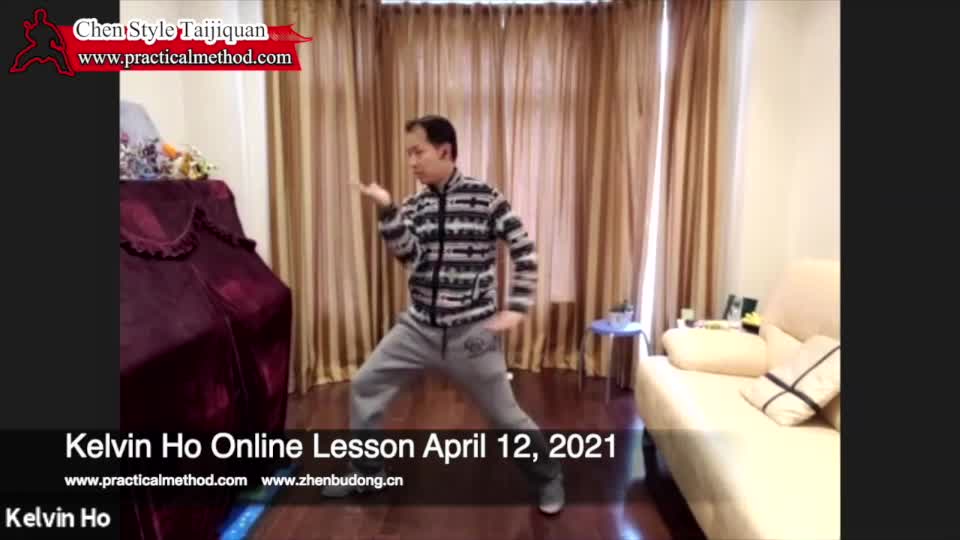
Kelvin corrected me on #37 to #41:
#37 Fist Protecting the Heart
1)Chest facing NW; in with R elbow, out with L hand.
2)Shift weight to R foot and step back L foot diagonally, R and L hands circling back then to R side, palms down; L foot facing NW.
3)Pull R foot closer to L foot.
4)Step up with R foot (big step) to land foot facing SW; adjust L foot so that you are in half horse stance (R foot as front & L foot rear); chest faces SW.
5)Double negative circle. R palm passes ear level to front of forehead, changing to a fist facing out. L hand goes out, palm up.
6)R fist is pulled downward to chest level, fist rotating inward, while L hand forms a fist, pulling towards the body.
Position check at the end of the move: facing SW; R fist in front of chest.
#38 Tornado Kick
1)Pull R foot in; shift weight to R foot and rotate on heel so R foot faces N; R elbow in, palm up, hand pointing towards NE.
2)Stretch R hand towards NE, palm down; after making sure your weight is entirely on your R foot, kick L foot towards R hand.
3)Momentum of kick will land L foot to face S. Swivel R foot on toes to also face S. Both hands down in front.
#39 Turn Right & Kick with Right Heel
1)Chest facing S, both hands down, fist facing body, shift weight to L foot.
2)Lift R foot lightly, R toes touching floor.
3)Holding elbows in, cross arms at chest level, fist facing down, L arm outside.
4)Lift R foot and kick with heel while at same time extend both arms, L arm diagonally upwards and R arm diagonally downwards; fists facing outwards; head and torso upright. Position check: L arm and R foot form a straight diagonal line.
5)Do not land R foot immediately after kicking. Make sure you are stable on L foot before landing R foot.
Position check: standing on two feet, chest facing S, both hands down.
Turning Flowers at the Bottom of the Sea (this move, preceding Fist Covering Hand, is not in the numbered sequence of yilu)
1)Shift weight to L foot; R fist in front of L side of chest; L fist on L side of body.
2)Lift R foot.
3)Swing R fist over head clockwise, and landing next to right thigh, fist facing outward while at the same time turn body clockwise by pivoting L foot on toes; at the same time swing L fist to near L temple.
4)Land R foot to face NW; adjust L foot so that you are in half horse stance (R foot front, L foot rear); chest facing NW.
5)Drop both hands and come up in double negative circle.
#40 Fist Covering Hand
1)L hand out palm up.
2)R hand forming fist facing up, passing R ear going out in a line extended from the mouth.
3)After passing L palm, R fist turns face down and continues to punch out; L palm becomes a fist after R fist passes it.
4)Withdraw L fist; at the same time finish the R punch with force.
#41 Small Catching & Seizing
Position check: chest facing NW; L foot facing W & R foot facing N
1)Take a big step with R foot so that it is directly in front of L foot (both feet are now on the same line facing W).
2)Step forward with L foot on the same line; hands doing positive negative circle; chest facing N.
Position check: Hands and feet on a line facing W; chest faces N
_2021-04-13.jpg)
Presenter: Chen Zhonghua Length: 10 min. In: English Year: 2018 Difficulty:1/5
Presenter: Kelvin Ho Length: 77 min. In: English Year: 2021 Difficulty:2/5 At:Toronto Chen Zhonghua Taiji Academy
_2021-04-12.jpg)
Presenter: Chen Zhonghua Length: 10 min. In: English Year: 2018 Difficulty:1/5
_2021-04-11.jpg)
Presenter: Chen Zhonghua Length: 10 min. In: English Year: 2018 Difficulty:1/5
_2021-04-10.jpg)
Presenter: Chen Zhonghua Length: 10 min. In: English Year: 2018 Difficulty:1/5
Presenter: Chen Zhonghua Length: 3 min. In: English Year: 2021 Difficulty:1/5 At:Edmonton Chen Zhonghua Taiji
_2021-04-09.jpg)
Presenter: Chen Zhonghua Length: 10 min. In: English Year: 2018 Difficulty:1/5