Master Chen Foundations Class 2 November 2020
If the hand cannot move, the body must move vertically
Hand cannot move, head cannot move, feet cannot move – only the inside can move
‘Elbow is left behind’ – elbow must lead, kua must lead
Read more
by Raymond Dickey on 2020/11/02
Master Chen Foundations Class 2 November 2020
If the hand cannot move, the body must move vertically
Hand cannot move, head cannot move, feet cannot move – only the inside can move
‘Elbow is left behind’ – elbow must lead, kua must lead
Read more
by Adarsh Khalsa on 2020/11/01
Hello, live in Phoenix, I’ve been studying with Ping Wei for not quite two years. Looking forward to many more years of practice.
by Karen Mattox on 2020/11/01
Hi all,
Here is my first recorded Yilu-First 13, with a little help from my dog, Calli.
I have been studying Practical Method in Phoenix for three years with Ping Wei.
Until this week, I never tried recording myself, but boy am I glad I did! It is such a helpful tool. .
by Ang Kwang on 2020/10/30
Hi, on Tues 27 Oct 7:30AM Foundation class, Master Chen shared that when he studied with Grandmaster Feng (I am assuming its Xin Yi Hun Yuan Taiji Quan) he mentioned Grandmaster Feng’s style of instruction was to walk around and execute a single movement (randomly) and not in a continuous manner. Master Chen went on to explain that the continuous execution of Taiji styles has diluted the original essence of each individual movement as the practitioner transits between each movement. While performing it may look impressive, but these transitions between movements don’t help in mastering the power of each individual movement.
All the videos I’ve seen of Master Feng (and his daughters) executing Hunyuan are in continuous mode, so it was refreshing to hear from Master Chen about this perspective. I sincerely hope that Master Chen could share more of his learning experience from Master Feng (and Master Chen Fa Ke as well) so that we can appreciate the differences.
by Kelvin Ho on 2020/10/29
Separation of Yin and Yang
by Kelvin Ho on 2020/10/28
Going Over – We focus on this concept in several moves today.
Flash the back
by John Upshaw on 2020/10/27
Master Chen is showing us something that we cannot do. So, if we fake it, we are not learning. It is something we cannot do. The learning is to show us our deficiencies not our efficiencies.
It is very important that we never become comfortable. We must be in that position that we are uncomfortable, and stay in that position. We need to stay in that state of uncomfortable without changing our structure. This will allow our us to re calibrate.
In yilu, we must do it one move at a time until we reach our fullest extent and then reset. Master Chen is trying to bring back the original idea, not continuous. Train each move separately.
The stretch from knee to kua the thigh lengthens. We need to go into the uncomfortable position that we are about to fall down or we do fall down.
We need a clear net gain without changing shape. This net gain can only be created with the stretch and no rotation. This needs to be applied in push hands and in practice. To train this you cannot have wobbly moves. If the opponent creates a net gain during push hands and you don’t that goes into you and you lose. Net gain equals net distance.
by Practical Method on 2020/10/27
Correction on my form Need to have 3 solids There is a line at the shoulder level between the front hand and rear shoulder (first 2 solids) I need to stretch the kua down to create the 3rd solid. Read more
by Yuxin Liu on 2020/10/26
Learning Taiji is like climbing the stairs. The teacher has to grind hard on you until you see the first step and put your foot on it. Whatever is correct has to be driven into you. Read more
by Kelvin Ho on 2020/10/26
Correction on my form
by John Upshaw on 2020/10/26
Today we worked on isolating a movement and twisting the towel. During previous training sessions we did it to feel the trajectory and range. Now we do it with a restriction. The restriction that we did it with was not to move the knee. The main action we were training was twisting the towel with a stretch, not a rotation. Read more
by Kelvin Ho on 2020/10/22
We do our form in a low stance to train gong. When we use it, we don’t go so low, because it is not agile enough.
Movements need to be big and long.
The kuas need to be just a bit higher than the knees. Read more
by Kelvin Ho on 2020/10/21
by Kelvin Ho on 2020/10/20
Negative Circle
Rotation is when there is movement without displacement.
Read more
by Raymond Dickey on 2020/10/19
Remember to lock one body part to do stretching. Find one thing and do it right. Once you have the method, you can repeat it until it exhausts you. Read more
by Chen Zhonghua Taiji Academy on 2020/10/18
5th Juxian Practical Method Seminar from Oct. 17th to 18th, 2020.
Instructor: Chen Xu.
Wang Kai, Qiu Yingdong. Read more
by Kelvin Ho on 2020/10/15
Our movements must have a horizontal one and a vertical one intersecting/interacting at the same time.
Three parallel planes
The integrity of each plane must be maintained. There is a vertical rod that goes through the middle to connect all three planes to fix them in a particular way, but yet they are free to move any other way. Each plane is like a trampoline. This is how we convert opponent’s incoming kinetic energy into potential energy stored in the trampoline, and eventually back to kinetic energy aimed at the opponent. You can also lock any of the planes, and move a different one to create a vertical stretch. With these 3 planes, you can create a lot of variations and configurations.
Read more
by Kelvin Ho on 2020/10/14
Whatever it is that you know, the truth is not like that. Whatever you don’t realize, accidentally it is the correct thing.
Read more
by Kelvin Ho on 2020/10/14
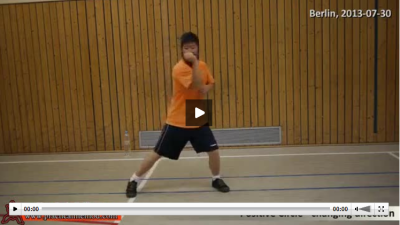
Positive Circle
by John Upshaw on 2020/10/13
Foundations on line notes ~ October 13th 2020 by John Upshaw
Kelvin Ho lead us through a positive circle stepping back drill. With our front hand out, we would step back with a rear foot causing us to go lower, we rotated/shifted from our front kua to our rear kua, rotating the elbow in on the same line with hand staying fixed on that same line…like a spear, tip pointed at the opponent. By using my kuas in this manner, my range increased.
by Paul Carlson on 2020/10/12
The subject of the lesson was foundations/positive circle.
Master Chen provided some history of China and the development of taijiquan. He also related a story about how the Practical Method foundations were developed. Read more
by Kelvin Ho on 2020/10/12
Master Chen Zhonghua started with a story about the history of China and Chen Style Taijiquan. Before the first Qin emperor defeated 6 other kings and united China, there was the period of Spring and Autumn 春秋 (which has nothing to do with the two seasons). Back then, there were 800 states, each had their own cultures, and they all flourished. Today, there are different levels of governments in China: Federal, Provincial, and County. The Chinese government wanted to get rid of the county level government, but they couldn’t done. Each county turned out to map back to the old states. The Chinese government had full election for village officials, but there are large families at the county levels, with full election, these large families will gain control at the county level goverments. These families managed to get around the one-child policy themselves.
Read more
by Steve Doob on 2020/10/10
Once again Master Chen found it necessary to tell us how to learn. Many of us were practicing as he was teaching. And of course, I was one of them. He was giving each of us a private lesson and we should have been listening intently. At that point, practicing was just a distraction. Yes, practicing is totally necessary, but not when the teacher is telling us the important things that other teachers would call secrets and probably wouldn’t even teach. If we’re at all smart, we’ll take advantage of the wonderful opportunity Master Chen is providing. Read more
by Paul Carlson on 2020/10/08
by Kelvin Ho on 2020/10/08
by Kelvin Ho on 2020/10/07
by Kelvin Ho on 2020/10/06
Today, shifu emphasized on how to learn. The first thing about learning is to listen to instructions and then to copy. Some people tried to copy without listening to the full instructions, and that won’t be a success copy either.
To copy, it’s to do everything exactly the same by definition.
Read more
by Paul Carlson on 2020/10/06
[singlepic id=4 w=320 h=240 float=none]
The subject of the lesson continued working on six sealing four closing.
Master Chen said that people can train for many years but never make the change that will help them improve. They keep doing the same thing that they always have done. We often say old bottle with new wine but in China it is turned around, old wine in new bottle.
Read more
by John Upshaw on 2020/10/06
October 6th 2020 foundations On-line Class
Today we worked on staying on the line, which exists between the front shoulder and the front hand, and beyond with the same trajectory . The elbow pushes into that line, Which is activating the elbow, thus forcing the handout. The elbow withdraws in a way that integrity of the line between the shoulder and the hand remains intact.
by Brian Chung on 2020/10/05
[singlepic id=3695 w=320 h=240 float=none]
Today Master Chen provides instructions and corrections on Six Sealing Four Closing.
– The shoulder has to totally disappear.
– The move is a rotation from the central vertical rod.
– Only rotate from the shoulder. The hand, elbow and shoulder is one piece.
by Kelvin Ho on 2020/09/30
Master Chen started today’s class with a story and a method people used to remember things precisely.
The story was about how the Secretary was corrected by an old person on the details of an event. The Secretary referred his speech to a document. However, it turned out that the document was incorrect, and the audio recording had the truth as pointed out by the old person. In today’s society, we rely on a lot of documents instead of trying to remember things in our heads. If the documents were actually recorded in correctly, we would have the facts incorrect.
Read more
by Kelvin Ho on 2020/09/30
Chinese Class
Master Chen Zhonghua introduced Wild Horse Parts Its Mane as a foundation exercise. If space is available, we can do it as a line drill.
Read more
by Kelvin Ho on 2020/09/30
We started with the various foundations. Master Chen Zhonghua mentioned that we must be able to copy the external shape first, e.g. he must be able to recognize which foundation we were attempting to do. If we were doing the yilu, others must recognize that we were doing a Chen Style Yilu, and then a Practical Method Yilu.
Read more
by Doug Gauld on 2020/09/27

…during the Sept 23 Zoom class GM got that gleam in his eye, we’ve all come to know, “Little sparrow wags its tail…” and he went on to share a story about developing the skill of intention and about the skill of not telegraphing intent through micro-level somatic signals…
by Kelvin Ho on 2020/09/24
by Kelvin Ho on 2020/09/22
Exercise 1
Open the kua to cause a horizontal rotation. Lock the top by using one hand to the hold the wrist on the other side. Stretch the fingers. Where the middle finger is pointing at changes as the rotation caused by the kua happens.
Open the right kua to turn left.
Open the left kua to turn right.
Don’t let the left knee point down when opening the left kua.
Read more
by Kelvin Ho on 2020/09/21
We started with double positive circle.
We used a rubber cord to tie to elbow to the waist, so that the elbow does not move by itself.
Read more