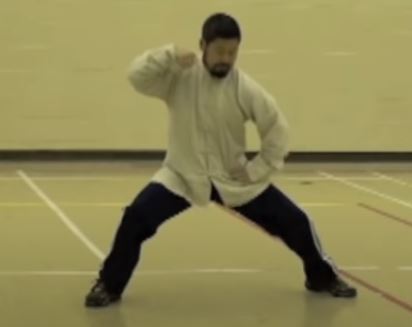
Back in 2011, I wrote about how my taiji journey got started: http://practicalmethod.com/2011/10/how-did-my-taiji-journey-get-started/. 7 more years passed by quickly on this journey, and it is now 2018. Much of the time was spent learning how to learn. In this article, rather than talking about taiji principles or concepts, let me share Master Chen Zhonghua’s teachings on learning.
Read more
Presenter: Chen Zhonghua Length: 10 min. In: English Year: 2018 Difficulty:1/5
Presenter: Chen Zhonghua Length: 10 min. In: English Year: 2018 Difficulty:1/5
About learning
1. Give it enough time. The secret is time.
2. Give yourself enough time to find the shortcuts.
3. Progress comes from holding yourself. Don’t overshoot yourself. Don’t use power.
4. Train the rail – first, you will not get the line. 3-months later, the trajectory is imprinted on the body [with practice]. You’ll see the line.
Read more
 Today, I trained with John Dahms. We discussed about creating a shell around ourselves to prevent ourselves from moving. Creating such a shell is only half of the equation, the other half is that we must stretch/expand the inside as much as possible. This is like a fight between containment and breakout. It is a conflict that we must find a resolution. I think of it as building up a bomb, and then doing a controlled release of the energy through a narrow tube aimed at the target. For this to work, the person doing the containment should be different from the person trying to break out, so that each person is not affected by the other person when performing the desired function. The difficulty comes when in reality there are no two people, but just myself. Ideally, I would be required to split myself into two. In actual practice, we need to use different body parts to perform these separate functions, so they don’t interfere with each other. These actions must be clear. Read more
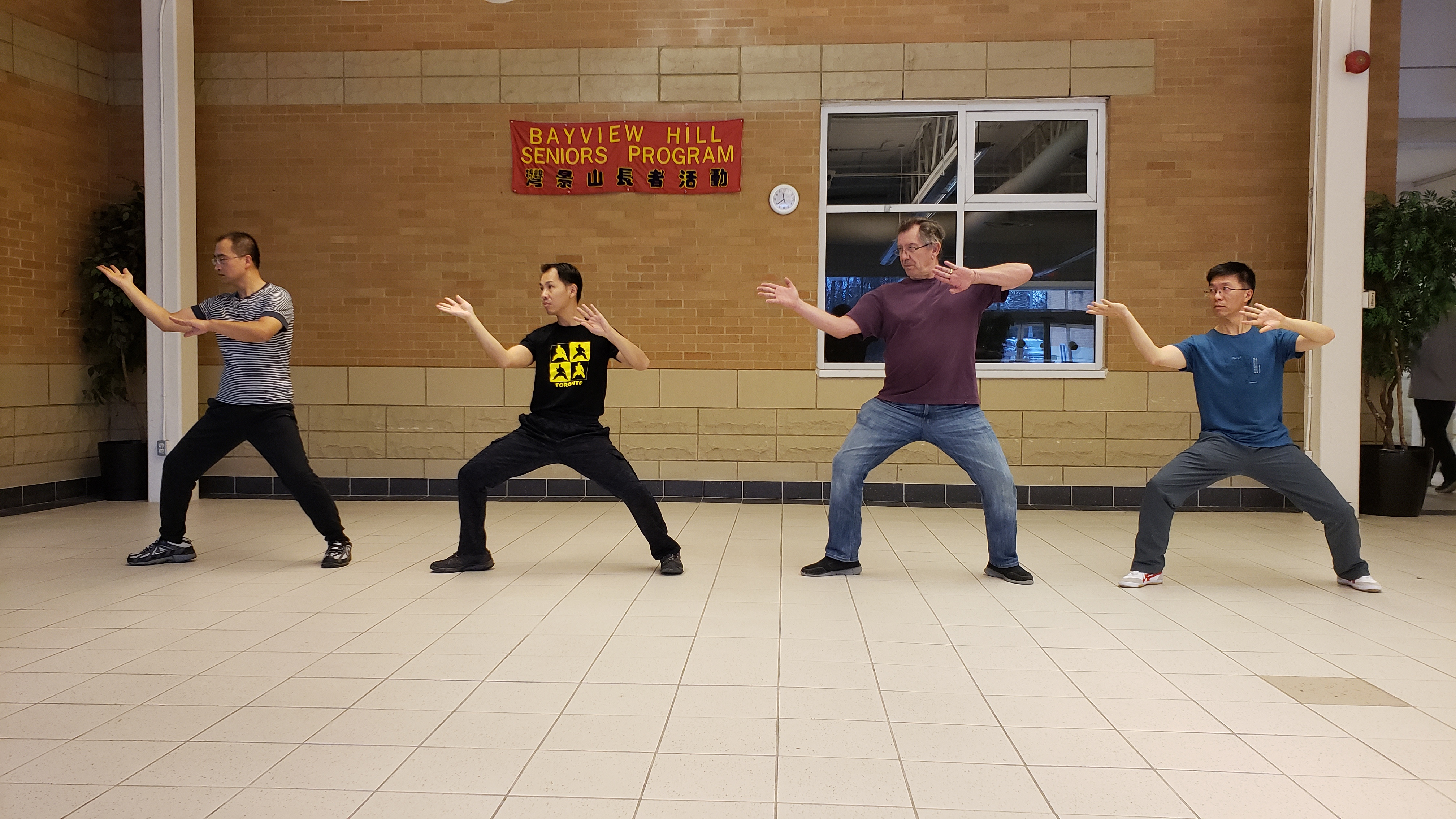 During practice on Dec. 23, 2018, we were practicing how to move in after making contact with the opponent. The particular exercise involved the two right forearms touching at one point. One person attempted his best to prevent the opponent from coming in, including moving his arm around. Everyone did this exercise against the others one by one. One student observed that when I showed how to move in, the opponent always appeared to have stopped his arm movement as soon as I started to move in. Others would struggle to fight at the upper body or the arm with the opponent. I found that being an interesting observation. Another student commented that he didn’t react or do any subsequent action when I moved in because there was no feedback/trigger to tell him to do anything, and he would just “watch” me coming in. I further demonstrated what they tended to do, which was to push his hand/arm forwarded as they moved the body forward, in which case, the opponent would respond immediately and stop me from coming in possibly using different methods. There should be no push at any time. Read more
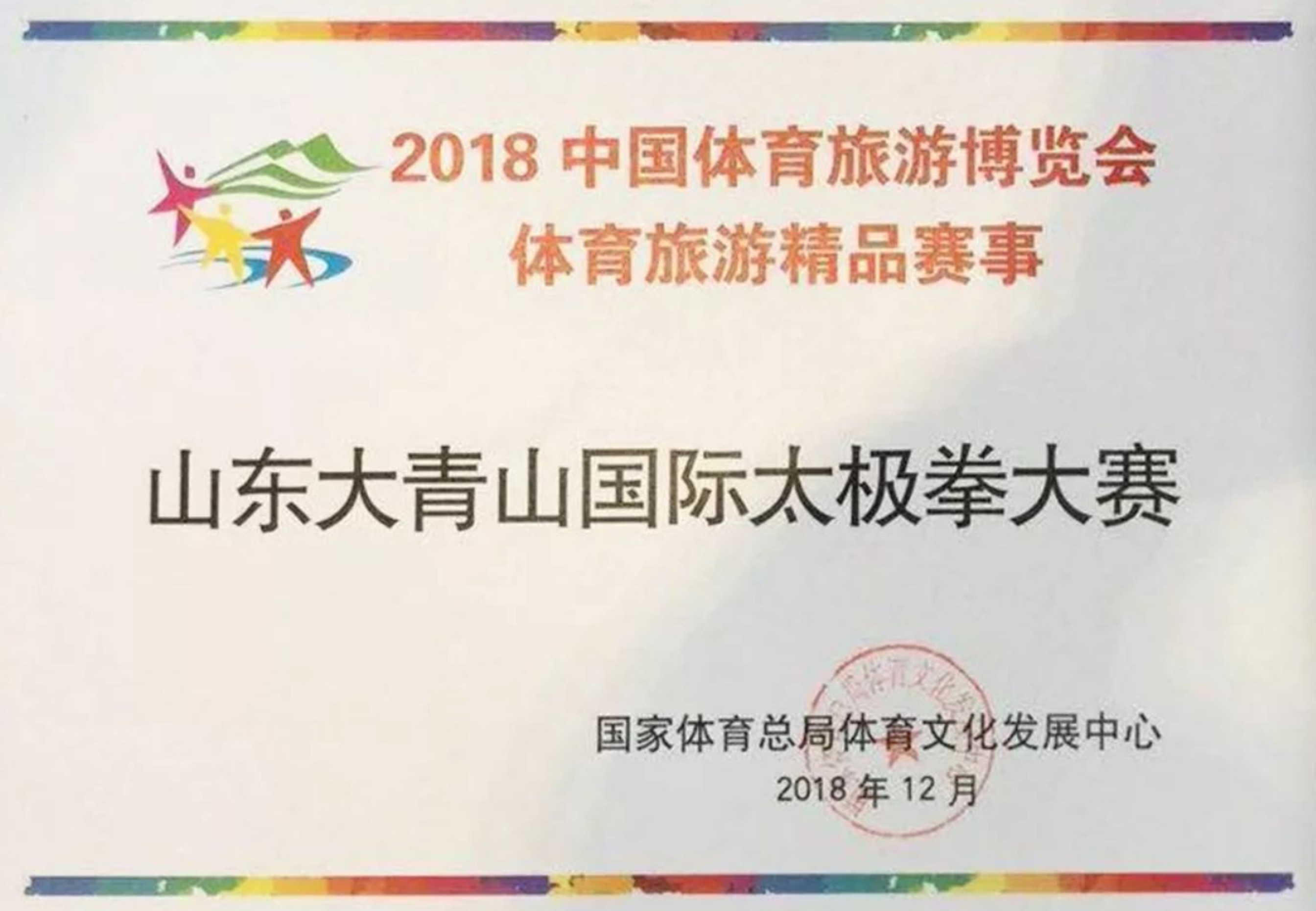 2018 China Sports and Tourism Exposition Award of Excellence for A Sport Event
Awarded to:
Shandong Daqingshan International Taiji Competition
China National Sport Commission Sport and Cultural Development Center
December 2018
2018中国体育旅游博览会体育旅游精品赛事
山东大青山国际太极拳大赛
国际体育总局体育文化发展中心
2018年12月
About learning
1. “The teacher teaches the principle. You go home and practice.”
2. Follow the principle. Don’t deviate.
Read more
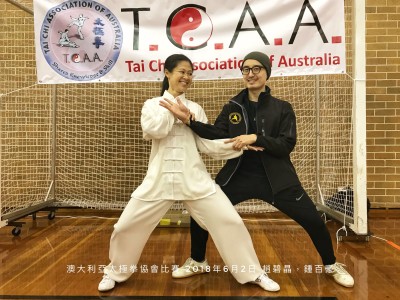
Tinh Thai and disciple Brian Chung (June 2018)
Isn’t it incredible how life gives you the things that you need when you need it?
I wanted to learn Chinese martial arts since I was a little girl. Read more
Presenter: Chen Zhonghua Length: 10 min. In: English Year: 2018 Difficulty:1/5
Presenter: Chen Zhonghua Length: 20 min. In: English Year: 2018 Difficulty:1/5
2018.12.16 Sydney Workshop Day Two Notes – Brian Chung Read more
2018.12.15 Sydney Workshop Day One Notes – Brian Chung Read more
Presenter: Chen Zhonghua Length: 10 min. In: English Year: 2018 Difficulty:1/5
Presenter: Chen Zhonghua Length: 10 min. In: English Year: 2018 Difficulty:1/5
Hi everyone,
I’ve been looking up and down the webpage to find out what the following abbreviations mean. In words, at least :))
LFSB – ?????
SWPE – sink waist press elbow
SYYZ (?) -?????
All come up in the New York 2018 workshop and the vid doesn’t talk about the remaining two. I GUESS SYY means “seperate yin and yang” but I am clueless about the “Z”
Can anyone help me out? And yeah, I am aware that the mere wording means nothing and I’ll probably not be closer to being able to do it than before but I am CURIOUS 🙂
Thanks in advance!
Barbara
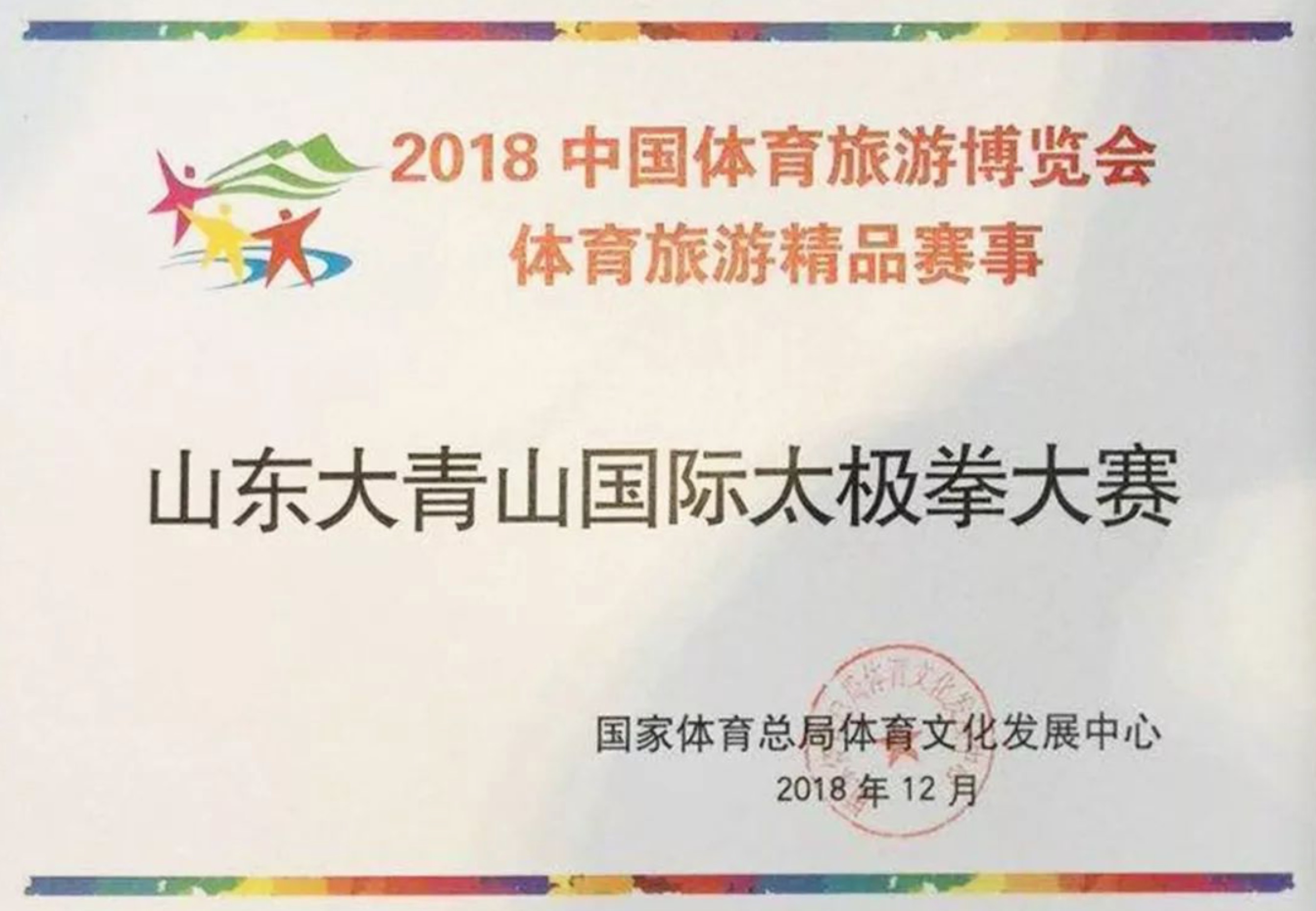
2018 China Sport-Tourism Exhibition Special Sport Event
2018 China Sport-Tourism Exhibition Special Sport Event:
Shandong Daqingshan International Taiji Competition
Issued by:
Sport and Cultural Development Center of the
National Sport Bureau
Dates for 2019: May 18-19, 2019
http://

Recently, I had a dream where I used my thigh to push down the opponent at his thigh. Shifu came over and mentioned something that I didn’t quite understand. I then practiced that move with another student named Benz, and I got that move in the dream. When I woke up, I realized that I learned something.
Read more
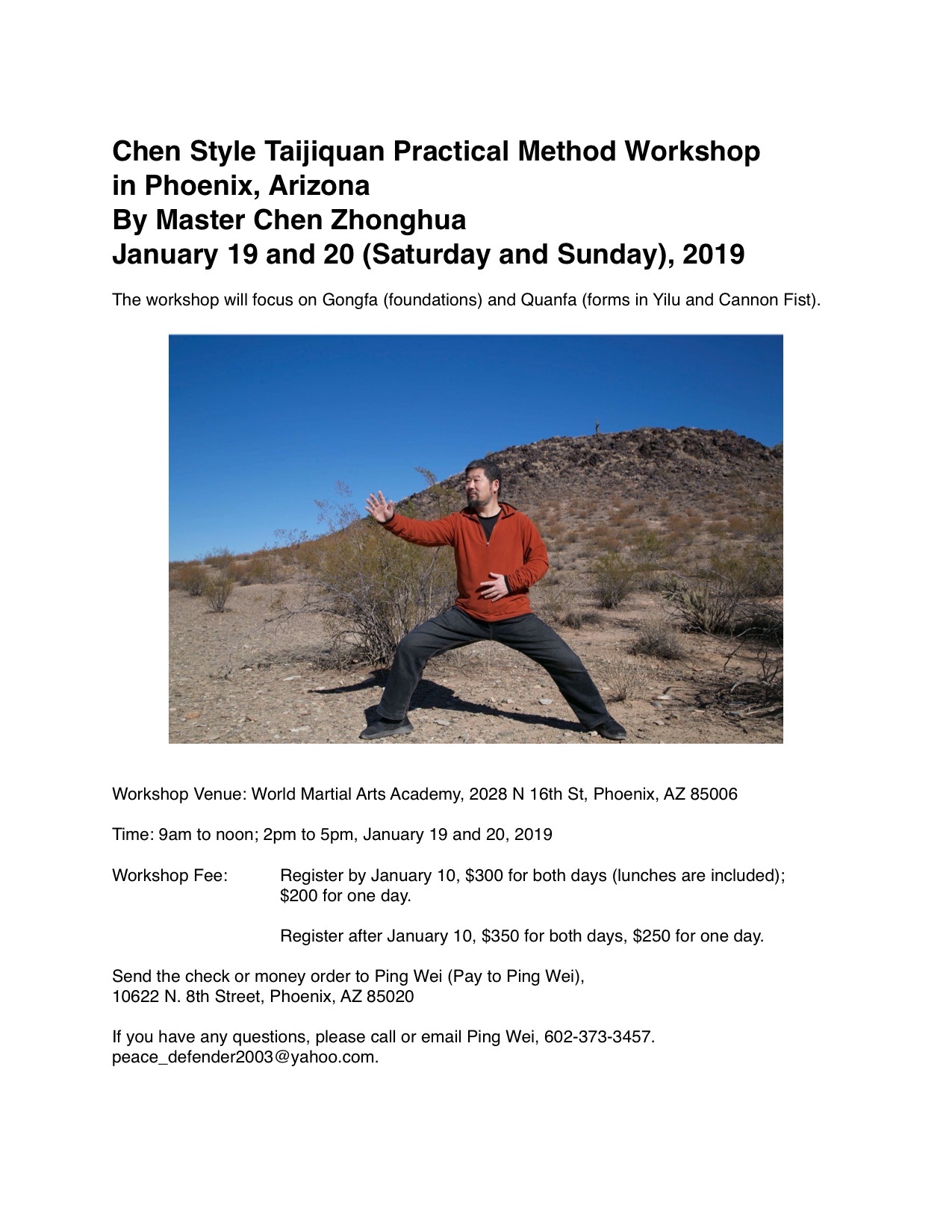
Attendees: Alex, OngWM, Flo, Chandra, Jojo
1. Twisting Towel train the Elbow to be in the Middle
2. Six Sealing 4 Closing train the Shoulder to
be in the Middle
3. Fetch Water train the Kua to be in the Middle
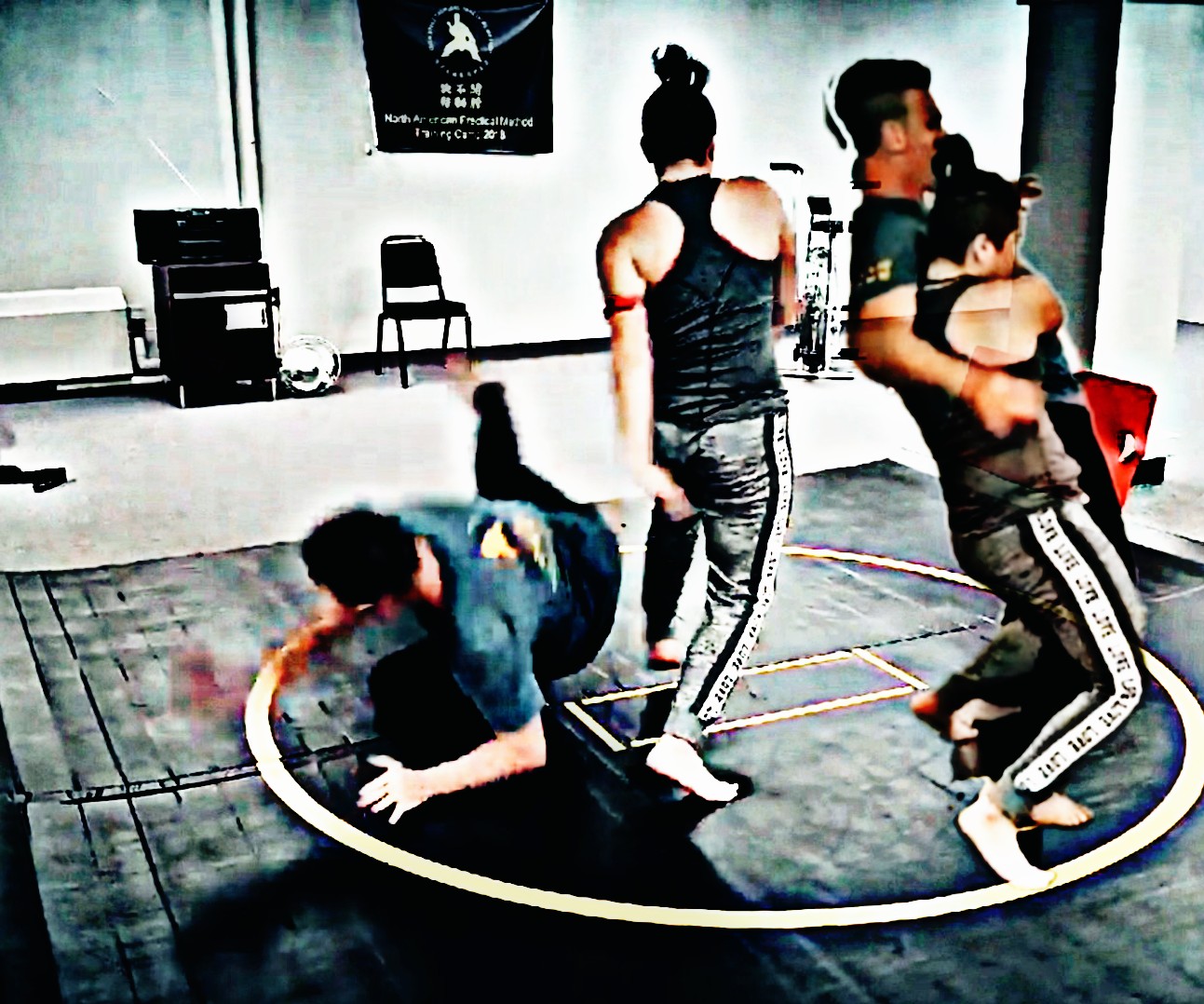
I was having a discussion with my disciple brother Brennan Toh about what I have been working on with my long term students Gerry and Emily, with specific attention to Lie , one of the 8 techniques of Taiji. At the North American Practical Method Training Camp last year Brennan was taking me down with this same technique, except his upper/lower body separation was crazily effective….he took out significant space from below without his top moving (his top continued to match my upper body). This lead to him suggesting the following drill: Read more
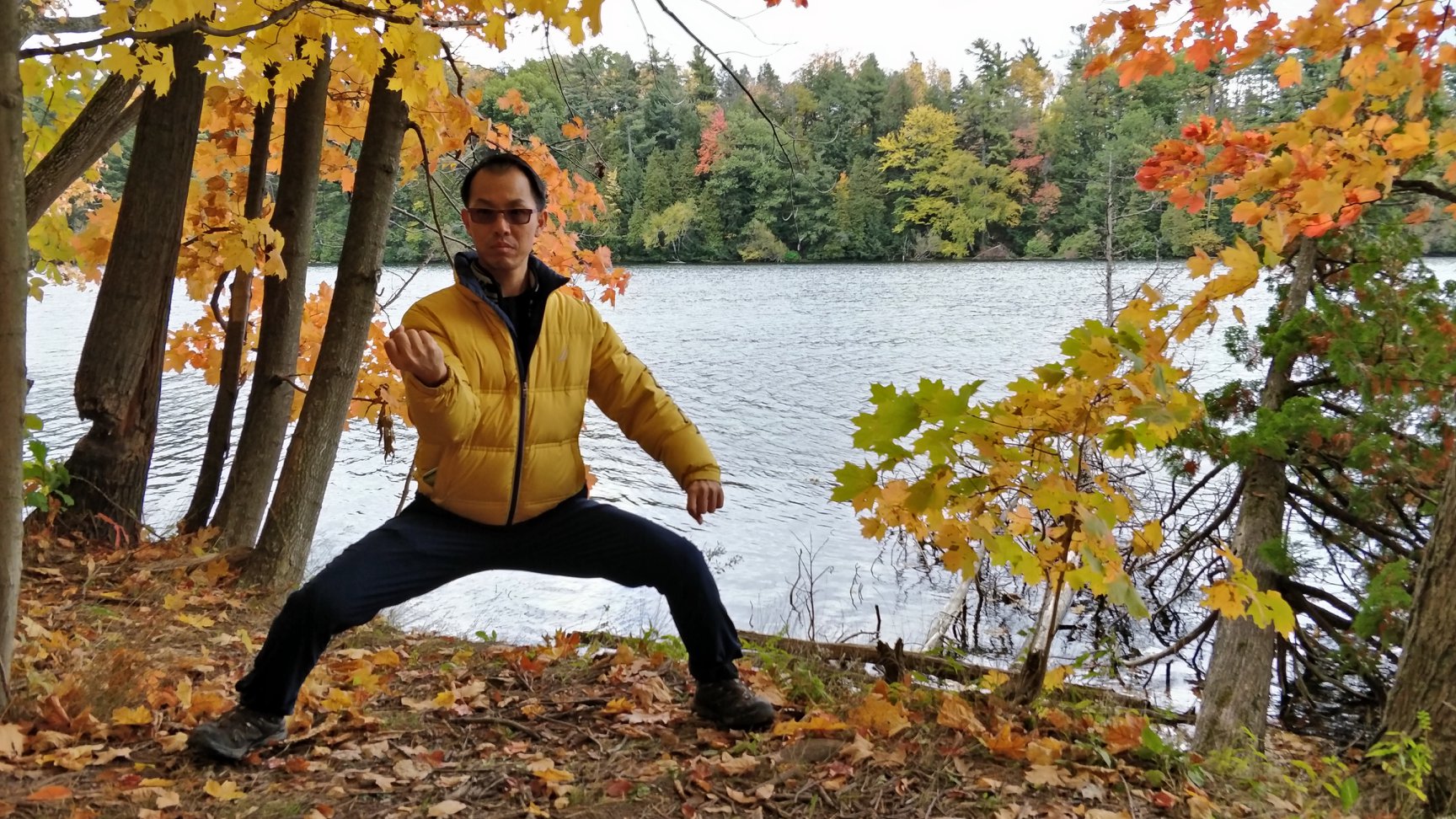
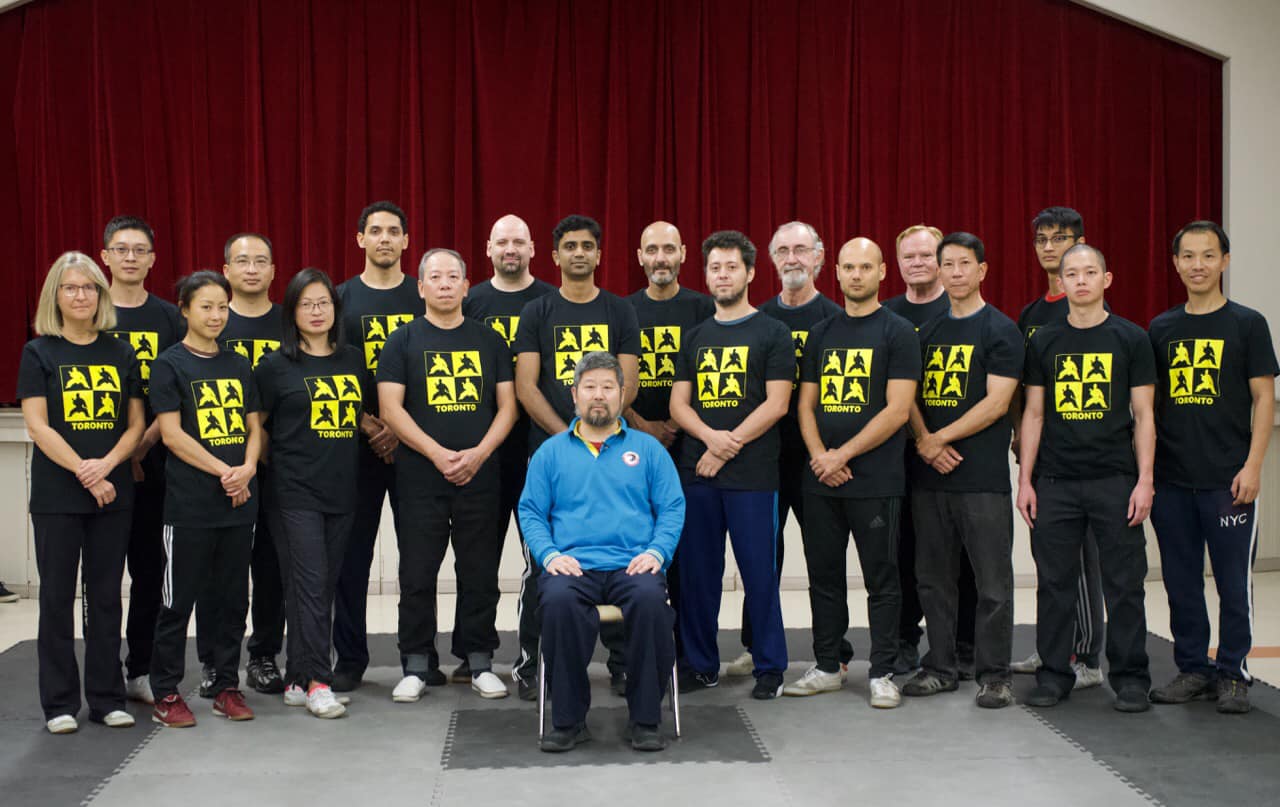
Toronto Oct 13, 2018
Master Chen has stated before fajin is everything is in the correct place, add speed. How do we add speed?
Read more
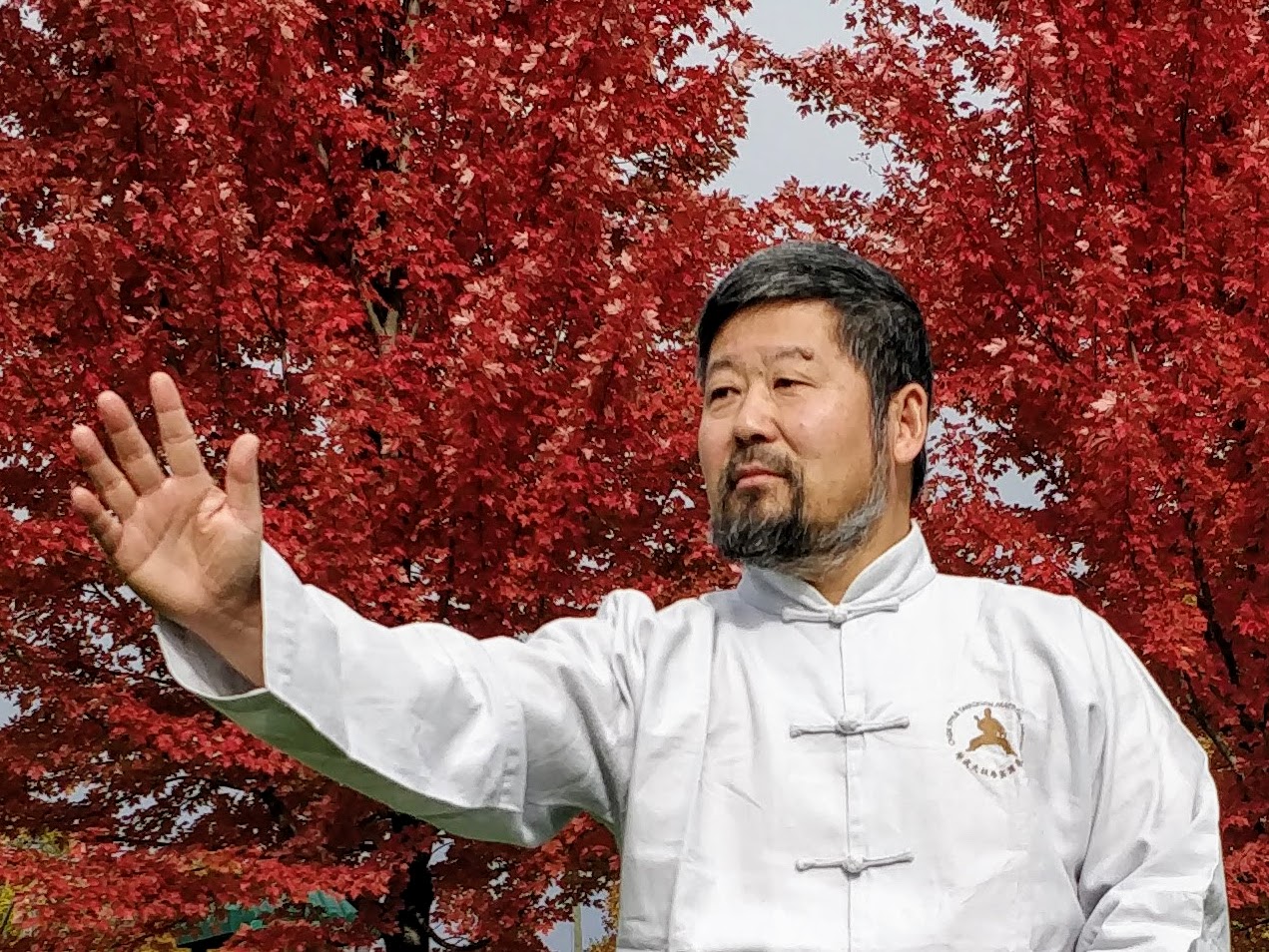
Toronto, Oct 23, 2018
Read more
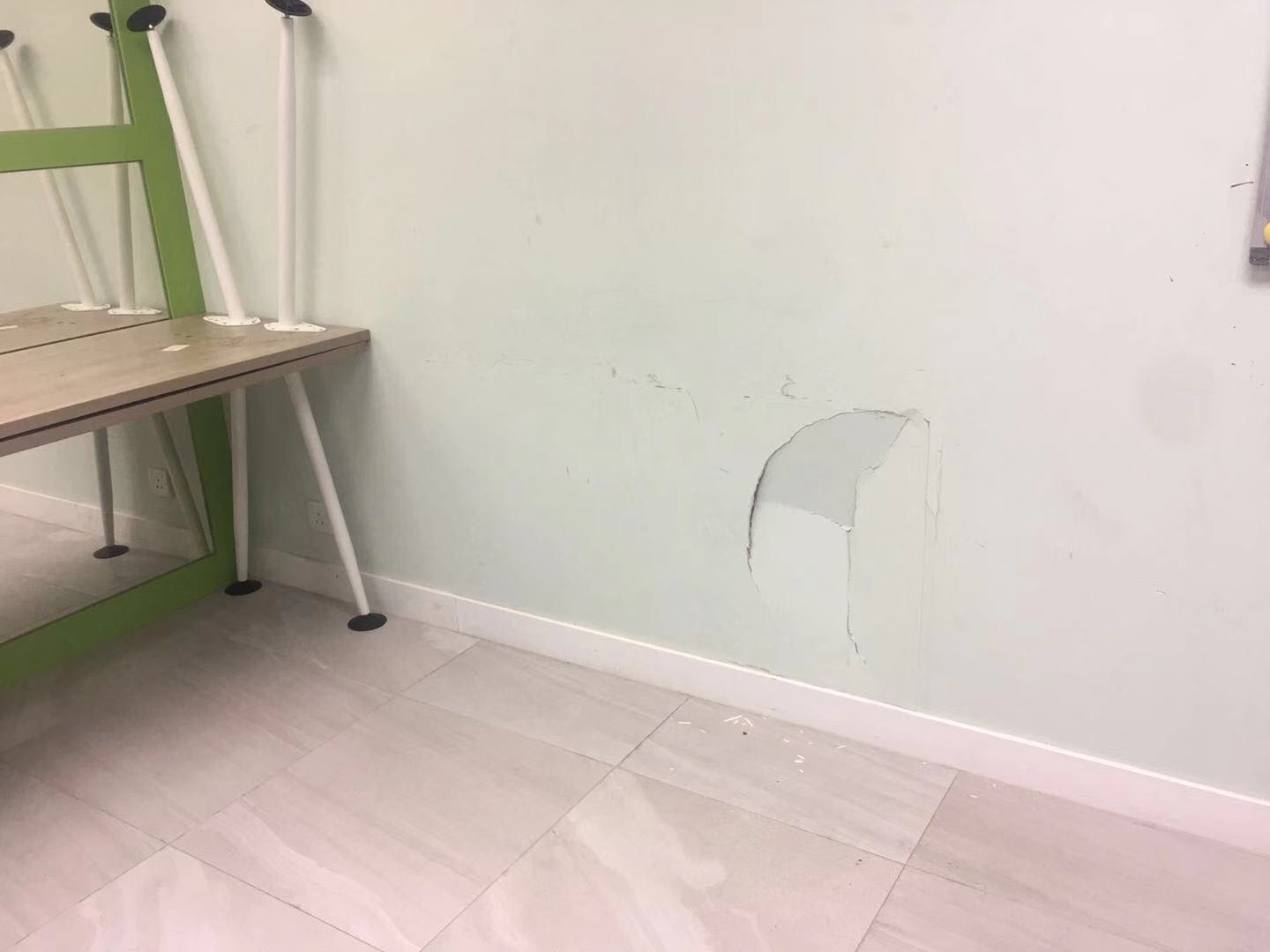
You are looking at the aftermath of the Hong Kong workshop. Apparently, Master sent Wu (the guy fixing the wall) flying into the wall I hope the action is captured in the video:

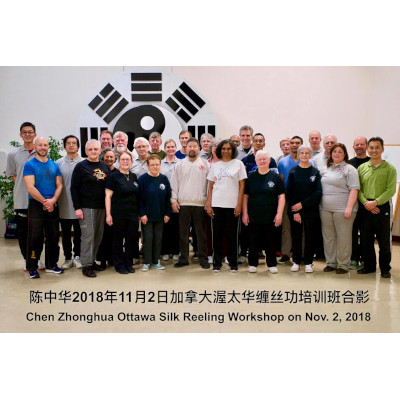 20th Anniversary of Ottawa-Gatineau Workshops |
Each year, Master Chen have tirelessly come to Ottawa to share his special insight in the art of Taijiquan. This year makes the Twentieth Anniversary of those annual workshops. Disciples Rachelle B.and James T. organized a series of workshops, special events and produced a commemorative T-shirts for each participants inorder to honor this special occasion. Participants from Ottawa, Toronto, Montreal and Quebec City joined in our celebration. Over the weekend, there was a special seminar on Silk-Reeling, a review of the concept of Internal and External and many other facets in the training of the Practical Method of Chen Style Taijiquan. |

Over the past weekend at the Hong Kong workshop, Master Chen’s move on KT trigged the fall detection feature on the Apple Watch Series 4:
https://www.popsci.com/apple-watch-fall-detection
The incredible thing was that KT hasn’t fallen. He merely was knocked away from Master Chen. Obviously, this blow has enough acceleration and gyration on KT and in turn the Apple Watch asked if KT needs medical attention.
Will we see the day that we can use the watch replacing the needs for mats?
Any engineers here can shed some light on the physics?

I was privileged to spend a couple of days with Master and Master Sun. Here are my notes:
The opponent completes the circuit. When you are about to fall, that is when your power transfers. This goes back to an explanation where Master propped up two cards leaning on each other. Master said that his previous videos showing this technique received a lot of flack since it looked like he was stumbling.
The shoulder has to rotate while the Kua moves up. What is outside is outside. Inside is inside. Hand coming in is the result of failing to achieve this.
Elbow in is the only focus. Any other focus causes power to go to other parts.
Only up and down. No sideways. I have been leaning during Walk Obliquely. Read more
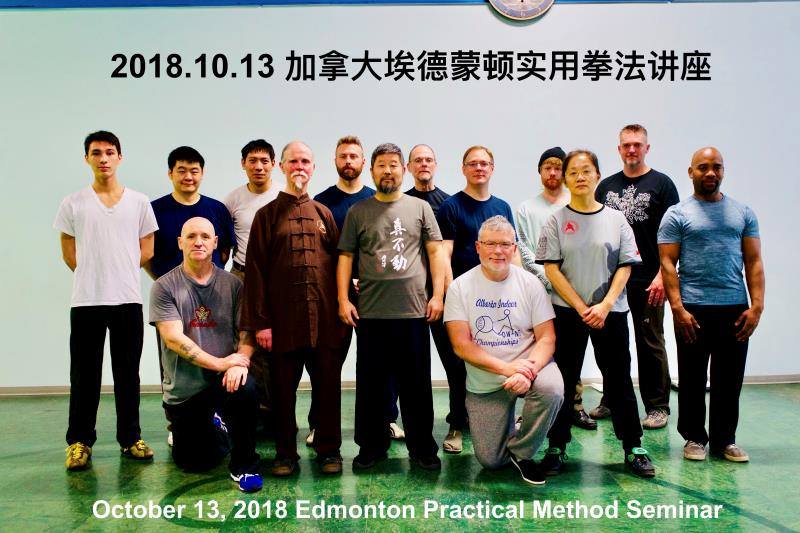
SATURDAY, OCTOBER 13
-No move, only rotate
-Rotation –> power
-Friction (feet) eventually on the opponent
-Action and Attachment
-Movement without movement
-move –> you become dead (like a top spinning, then starting to wobble, then falling over)
-Stretch –> life Read more
Day one
Moving Steps positive circle instructions
Do not involve torso, Do not lean
Torso and elbow are locked, isolate torso from hand and foot, Stretch is a must.
Use front of the torso to catch the opponent at 45 to front
And use rear Kua and elbow to throw the opponent
Elbow coming and Kua going out must be like a pair of scissors
If the elbow is on Kua it’s locked and if it’s not connected there is no bite.
Initially, do not worry about power, only direction.
Train your body to become a pair of scissors.
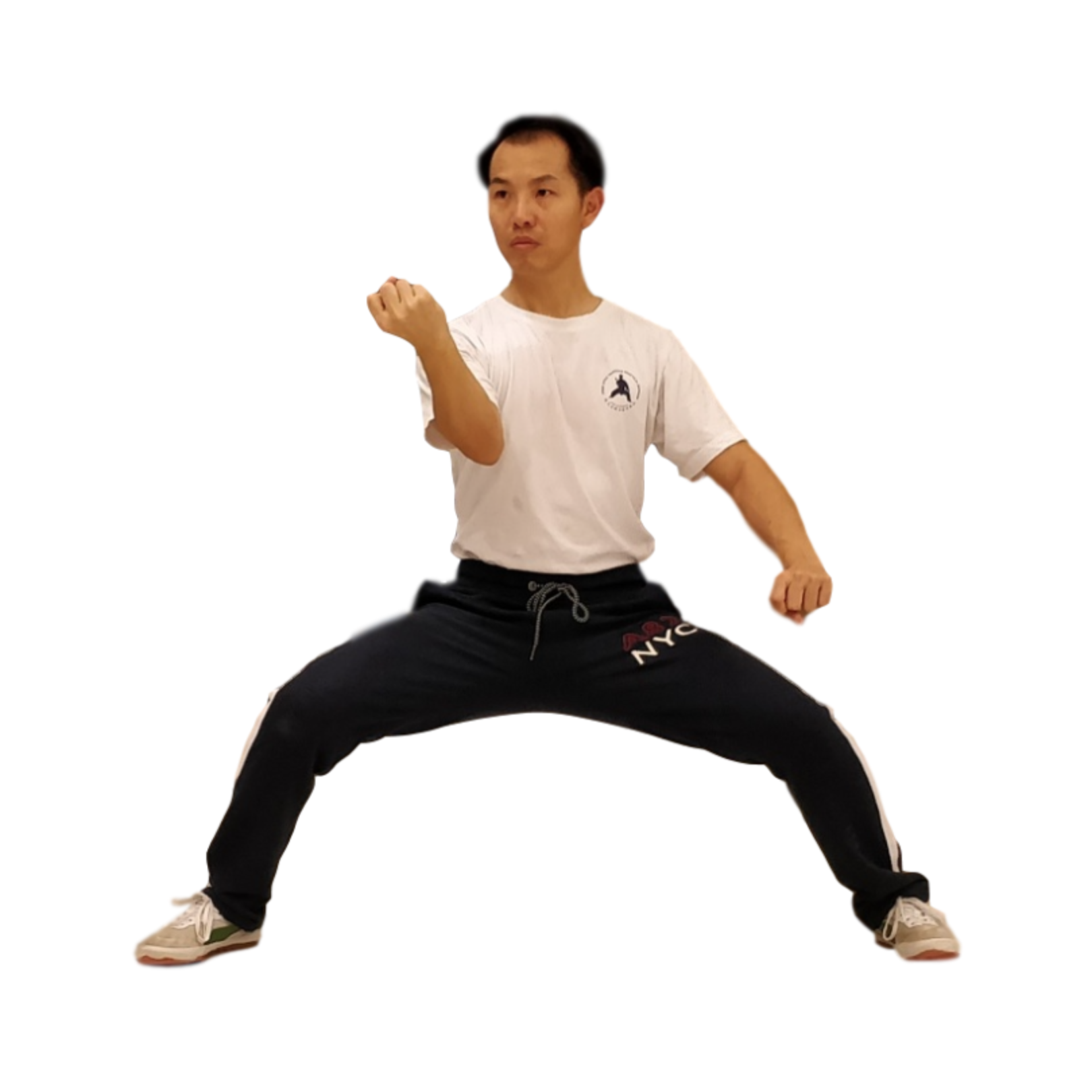
The ability to lock the opponent is an important one we need to continuously to improve on in Practical Method. In order to send the opponent to the floor in what seemingly an effortless manner (in reality, it is not really effortless), we always need to lock the opponent first. However, more often than not, especially at the beginning of our learning, we use a lot of brute force to keep the opponent in certain position. However, locking the opponent simply means disallowing him or her to move. As long as the opponent is not moving, the objective is achieved. Read more
CHEN STYLE TAIJIQUAN PRACTICAL METHOD TESTIMONIAL
JAN GOULD and ROSS McLACHLAN, October 2018, Phoenix
Presenter: Chen Zhonghua Length: 10 min. In: English Year: 2018 Difficulty:1/5
Presenter: Chen Zhonghua Length: 10 min. In: English Year: 2018 Difficulty:1/5
Presenter: Chen Zhonghua Length: 10 min. In: English Year: 2018 Difficulty:1/5
Presenter: Chen Zhonghua Length: 10 min. In: English Year: 2018 Difficulty:1/5
Presenter: Chen Zhonghua Length: 10 min. In: English Year: 2018 Difficulty:1/5