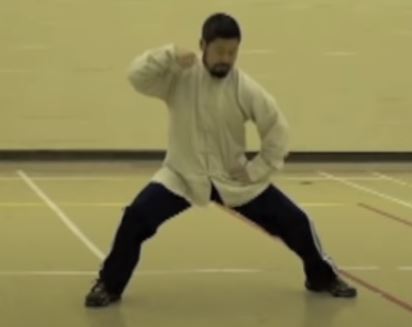
Cross hand
First only open the hands without any other movements. Then push the shoulders to open/propel the arms. Read more
Going Over – We focus on this concept in several moves today.
Flash the back
- After elbow-in, we use the kua to cause the elbow to go over, so that we can grab the opponent’s wrist on the other side.
- The other elbow moves in this move also requires going over to break the opponent’s arm at the elbow.
- Before turning backwards, we just lock the left hand, and bring the right foot over to the other side. Read more
Recorded Oct 28, 2020 in Panama. Started PM mid Sept 2020
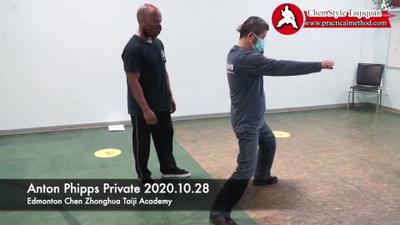
Chen Zhonghua’s private lesson for Anton Phipps. Presenter: Chen Zhonghua Length: 44 min. In: English Year: 2020 Difficulty:3/5 At:Edmonton Chen Zhonghua Academy
Read more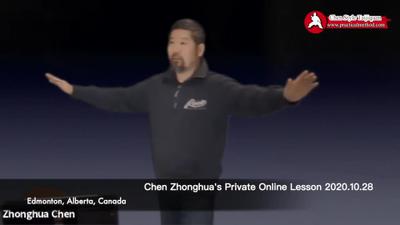
Chen Zhonghua’s online lesson on Chen Style Taijiquan Practical Method on Oct. 28, 2020. Presenter: Chen Zhonghua Length: 62 min. In: English Year: 2020 Difficulty:1/5 At:Edmonton Chen Zhonghua Academy
Read more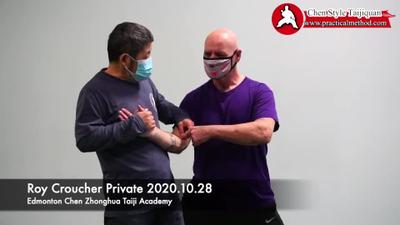
Chen Zhonghua’s private lesson for Roy Croucher on Oct. 28, 2020. Presenter: Chen Zhonghua Length: 54 min. In: English Year: 2020 Difficulty:2/5 At:Edmonton Chen Zhonghua Academy
Read moreMaster Chen is showing us something that we cannot do. So, if we fake it, we are not learning. It is something we cannot do. The learning is to show us our deficiencies not our efficiencies.
It is very important that we never become comfortable. We must be in that position that we are uncomfortable, and stay in that position. We need to stay in that state of uncomfortable without changing our structure. This will allow our us to re calibrate.
In yilu, we must do it one move at a time until we reach our fullest extent and then reset. Master Chen is trying to bring back the original idea, not continuous. Train each move separately.
The stretch from knee to kua the thigh lengthens. We need to go into the uncomfortable position that we are about to fall down or we do fall down.
We need a clear net gain without changing shape. This net gain can only be created with the stretch and no rotation. This needs to be applied in push hands and in practice. To train this you cannot have wobbly moves. If the opponent creates a net gain during push hands and you don’t that goes into you and you lose. Net gain equals net distance.
Correction on my form Need to have 3 solids There is a line at the shoulder level between the front hand and rear shoulder (first 2 solids) I need to stretch the kua down to create the 3rd solid. Read more
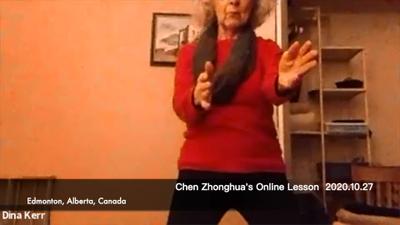
Master Chen Zhonghua’s Online Lesson on Practical Method on Oct. 27, 2020.
Presenter: Chen Zhonghua Length: 61 min. In: English Year: 2020 Difficulty:1/5 At:Edmonton Chen Zhonghua Academy
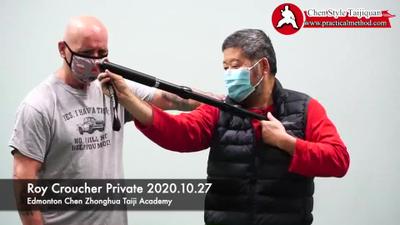
Master Chen Zhonghua’s Private Lesson with Roy Croucher on Oct. 27, 2020. Presenter: Chen Zhonghua Length: 53 min. In: English Year: 2020 Difficulty:3/5 At:Edmonton Chen Zhonghua Academy
Read moreMaster Chen Zhonghua’s private lesson for Anton Phipps on Oct. 27, 2020.Presenter: Chen Zhonghua Length: 45 min. In: English Year: 2020 Difficulty:2/5 At:Edmonton Chen Zhonghua Taiji Academy
Read moreLearning Taiji is like climbing the stairs. The teacher has to grind hard on you until you see the first step and put your foot on it. Whatever is correct has to be driven into you. Read more
Correction on my form
- Need to have 3 solids
- There is a line at the shoulder level between the front hand and rear shoulder (first 2 solids)
- I need to stretch the kua down to create the 3rd solid.
- The first 2 solids form the horizontal bar of a T-bar, while the kua stretching down creates the rod of the T-bar.
- Master Chen Zhonghua demonstrated six sealing four closing with that rod not moving. Without this part, I will not be able to rotate. With it, things start to become 3-dimensional. It was really like that there was an auger in him.
- This may seem like a contradiction while we need to push the front kua up, we also need to stretch it down to create a solid. Read more
Today we worked on isolating a movement and twisting the towel. During previous training sessions we did it to feel the trajectory and range. Now we do it with a restriction. The restriction that we did it with was not to move the knee. The main action we were training was twisting the towel with a stretch, not a rotation. Read more
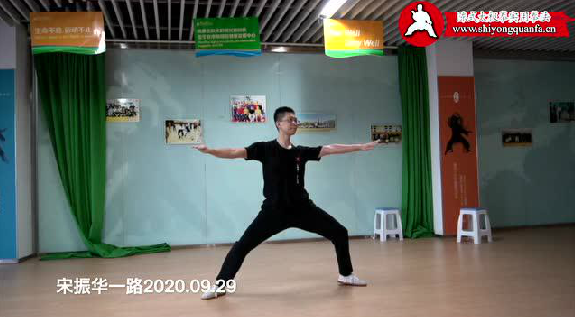
- Create an account on YouTube if you don’t have one yet.
- Shoot your yilu video in landscape mode like the above picture.
- Upload your yilu video to YouTube.
- In the description of your YouTube video, add the following:
- Name: Your name
- Location: Where was the yilu was recorded at?
- Date: Which date the yilu was recorded on?
- Yilu Count: Approx. # of yilus you have practiced so far, please see http://practicalmethod.com/pm_practice_record_main/pm_practice_personal_totals/.
- Copy the link to your YouTube video.
- Create a new post at this website: http://practicalmethod.com/wp-admin/post-new.php
- If you have access problem with this link, please contact Kelvin Ho at kelvin.ho@practicalmethod.ca, as you will need author access to this website.
- Paste the link in the body of the new post.
- Edit the title of the post in the following format:
- John Doe Yilu on Oct. 26, 2020
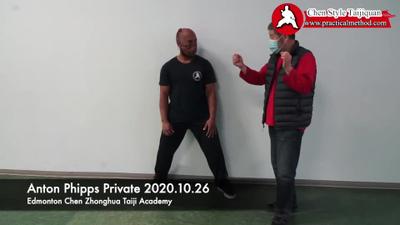
Master Chen Zhonghua’s private lesson for Anton Phipps on Oct. 26, 2020. This lesson focused on the finding of the two points that forms the line. Presenter: Chen Zhonghua Length: 54 min. In: English Year: 2020 Difficulty:1/5 At:Edmonton Chen Zhonghua Taiji Academy 埃德蒙顿陈中华太极馆
Read more
Using “Twisting the Towel” exercise as a training tool for this lesson, Master Chen Zhonghua taught the method of “keeping one” while moving. This method trains the ability to create a dot in Taiji movements.
Presenter: Chen Zhonghua Length: 63 min. In: English Year: 2020 Difficulty:3/5 At:Edmonton Chen Zhonghua Taiji Academy
Dear Master Chen Zhonghua,
I started following you and Taiji practical method in the middle of 2016, after my friend and teacher Ong Wenming, who we practiced together deferent styles of kongfu, introduced me to your school. Read more
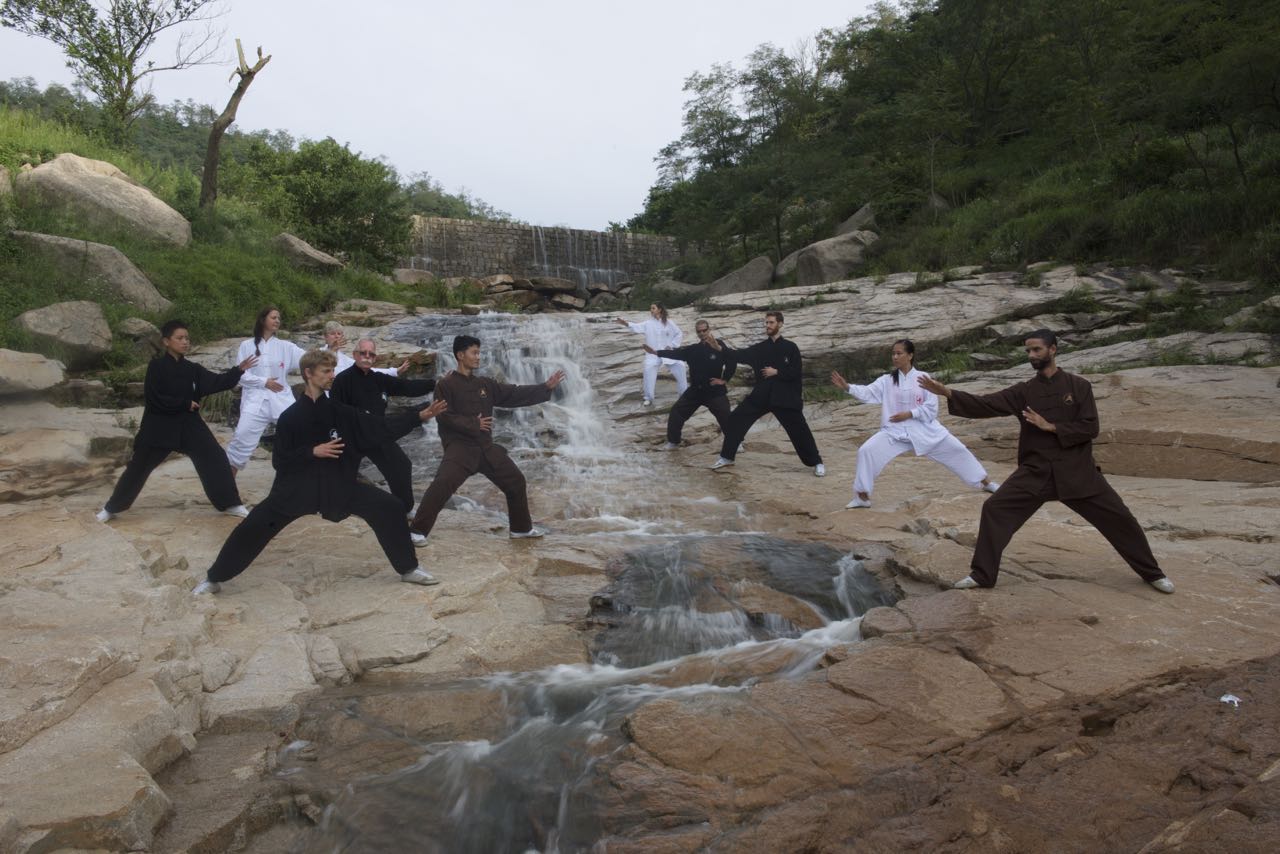
Student Photos of The Dragon’s Abyss on Daqingshan in 2016. Read more
I recorded my illu about 10 days ago and put it here with the hope to get some corrections. Read more
Presenter: Kelvin Ho Length: 69 min. In: English Year: 2020 Difficulty: 3/5 At: Toronto and Iowa
Read moreConservation of Energy
Master Chen used this term in one of his lectures. Here is my understanding:
In an ideal closed 2 energy system, Conservation of Energy means the total energy is the same while the magnitude of kinetic energy and potential energy can vary.
Mathematically, total energy = kinetic energy + potential energy.
Read more
Not Moving is one of the most important concepts in Practical Method. There are 3 types of Not Moving.
Absolutely Not Moving
- Also known as: Truely Not Moving
- This point is simply not allowed to move in any way.
- Example: A nail on the wall. The nail is not moving in any direction.
Relatively Not Moving
- Also known as: Structurally Not Moving
- Between two points, a constant relationshiop is maintained.
- Example: A passenger seating in the car going from place to place. The passenger is not moving relative to the car.
Restrictively Not Moving
- Also known as: Staying on the track
- This point is only allowed to move in a very specific way.
- Example: A train can only move along the track. It works properly only when it does not derail.
Mark
Rub foot
- In between the two rub foot, make a pit stop. 90 degrees to your initial position.
- Chest parallel to back wall when you kick with heel.
Fist protecting heart
- Feet 45 degrees to back wall.
- Don’t rush it.
On October 20th, 2020, during an online class Master Chen Zhonghua shared and demonstrated an important action of the knee that has not been disclosed before. Prior to discussing the important action, I shall discuss some important functional and structural aspects of the knee as a means of providing a context to help the reader conceptualize how this recently disclosed information is applied in practice and applications.
Chinese Class
We do our form in a low stance to train gong. When we use it, we don’t go so low, because it is not agile enough.
Movements need to be big and long.
The kuas need to be just a bit higher than the knees. Read more
Chen Zhonghua’s Online Lesson on Oct. 22, 2020. This is a session on Yilu corrections.
Presenter: Chen Zhonghua Length: 67 min. In: English Year: 2020 Difficulty:2/5 At:Edmonton Chen Zhonghua Taiji Academy
Language
- Using Westernized vocabulary for taiji concepts.
- No difference. Even if you don’t know any language. Some students found they learned more when turning off the sound. The language is an interference until the language is recalibrated. Same thing applies when teaching in Chinese.
Separation of Yin and Yang. Separate to 2 things. Yin and Yang is a relationship.
Three types to relationship:
1. Not related. A watermelon cut into two halves.
2. Positively related.
3. Negatively related. When the door is closed, it is part of the wall. When the door is open, it is separated but related. Read more
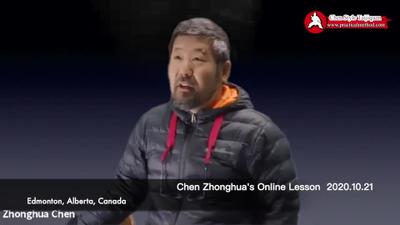
Master Chen Zhonghua’s online lesson on Oct. 21, 2020. This is a lesson on Yilu corrections. At the beginning of the hour, there was some information on the theory of Chen Style Taijiquan Practical Method. The general theory of Yin Yang separation.
Presenter: Chen Zhonghua Length: 67 min. In: English Year: 2020 Difficulty:3/5 At:Edmonton Chen Zhonghua Taiji Academy
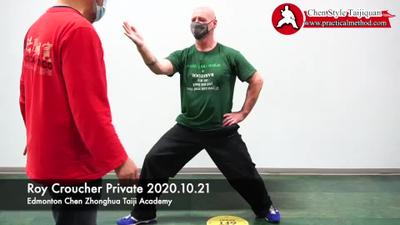
Chen Zhonghua’s Private Lesson for Roy Croucher on Oct. 21, 2020. Presenter: Chen Zhonghua Length: 43 min. In: English Year: 2020 Difficulty:2/5 At:Edmonton Chen Zhonghua Taiji Academy
Read more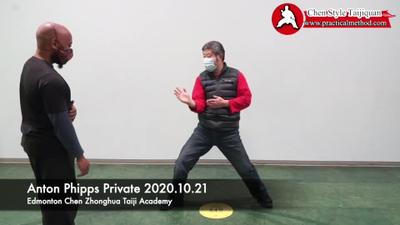
Positive circle and beyond. Sound was captured by camera, not wireless mic. Presenter: Chen Zhonghua Length: 64 min. In: English Year: 2020 Difficulty:3/5 At:Edmonton Chen Zhonghua Taiji Academy
Read moreBy the time I first met Master Chen at a Phoenix workshop in 2015, I had already studied martial arts for a long time, since 1963 to be precise. So, I had strong opinions about what was correct and what wasn’t. I thought (and still do) that tai chi is called a martial art for a reason. It’s not called a health, meditative or energy art. Martial means it can be used to kill, but at the same time the killing has to be done artfully. Just clubbing someone to death doesn’t qualify. Read more
Chinese Class
Negative Circle
- In-with-elbow, Zhuan Guan, Out-with-hand
- We have get the proper ideal image in our mind, even though we can’t do it properly at this point.
- We must be expressive in our movement during training, so the teacher/instructor can see your intent.
Rotation is when there is movement without displacement.
Read more