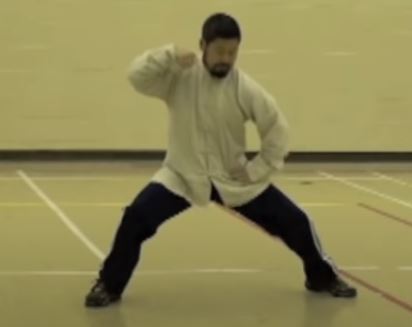
Master Chen demonstrated the foundation exercise Moving-Step Shake the pole, which is the positive and negative circle. He held a real pole to begin with to show the idea behind the foundation exercise. He locked his fron hand, which was holding the pole as a pivot. The rear hand moved the pole. Read more
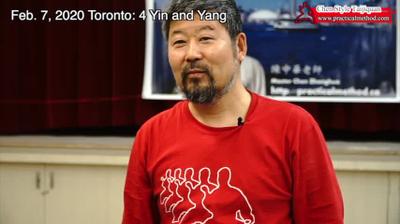
Master Chen Zhonghua’s Toronto Workshop March 2020-4
Presenter: Chen Zhonghua Length: 9 min. In: English Year: 2020 Difficulty:2/5 At: Toronto, Canada
Master Chen performed a magic trick. No one saw what he did. Once he told us, we could then see it. Would you like to see it too?
Chen Zhonghua’s online lesson on Foundations. This episode is on the Pole-shaking exercise, which is a left-hand negative circle, right hand positive circle moving step combination. The exercise is designed for training without the pole.
Presenter: Chen Zhonghua Length: 73 min. In: English Year: 2020 Difficulty:2/5 At:Edmonton Chen Zhonghua Taiji Academy
Chen Zhonghua’s Online Lesson on Sept. 2, 2020.
Presenter: Chen Zhonghua Length: 73 min. In: English Year: 2020 Difficulty:2/5 At:Edmonton Chen Zhonghua Taiji Academy
Chen Zhonghua corrected John Dahms’ first 13 moves of Yilu in Edmonton, Alberta, Canada on Sept. 1, 2020.
Presenter: Chen Zhonghua Length: 13 min. In: English Year: 2020 Difficulty:3/5 At:Edmonton Chen Zhonghua Taiji Academy
Master Chen corrected a few people’s partial yilu today. Each person should remember himself/herself the stopping point, and so it can be continued from that point in future lessons when it is that person’s turn for correction again.
To stretch, we need to so find anchors on the two ends.
Empty means solid, it means power.
We need to find a line in ourselves. Master Chen showed Tinh Thai a version of fetch water that line up her rear elbow with the front hand. We need to make sure that the front shoulder is not in the way.
If we want to have grip in the hands, we need to have grip in the teeth and in the toes.
Chen Zhonghua taught the important concept of the frontal vertical line in Chen Style Taijiquan Practical Method. This is a must to have. Presenter: Chen Zhonghua Length: 67 min. In: English Year: 2020 Difficulty:4/5 At:Edmonton Chen Zhonghua Taiji Academy
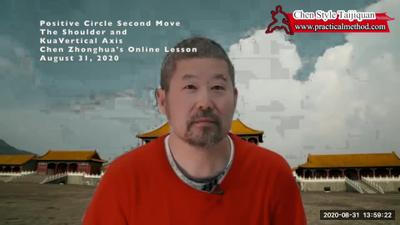
Rotation of front shoulder and front kua in positive circle.
Front shoulder and kua is the rotational vertical axis, which does not move. Read more
Rear shoulder hold on the way out (controlled release)
5 points fighting outward, everything else fights inward
Lock shoulders head, only cave in the chest to drive hand out. Put hand on chest and move it down as hand goes out to train the right intent.
Clear – locked part must be locked, moving part must be moving
Front kua needs to rotate in turn with waist. It looks like it comes up towards the shoulder.
Raise of kua up when coming in, chest pushes down when coming out
Rear shoulder must not move when turning waist. Front kua and shoulder has a large move.
Rotate your spine not your head. Don’t move your eyes. Only a rotation, no movement.
Don’t move hand backwards.
Homework, 6 sealing 4 closing, face on to mirror, don’t let rear shoulder move, but it rotates. 1000x.
Dao shou – to change the orientation of the hand. Coming in, it’s pulling from elbow. Going out, the hand pulls the arm.
Every body part has a role, but which ones are primary and which ones are secondary (only getting out of the way).
Knee up knee down. Like a physically solid structure like a bike and the pedals are the knees. Feels like a foot and a half, but it looks like no move.
6 sealing 4 closing. First one is 70 rear, 30 front. Front becomes long back becomes short. Second one switches the pivot to the rear side of body (rear shoulder/kua axis).
Recently I understood how to continue a stretch by switching to different body parts.
- For a while I had experienced tightness in the shoulder while performing Yilu. This is also apparent when practicing Basic Foundations, specifically in a three count Positive Circle right between Step 2 and Step 3.
- In a recent online lesson on 18th August 2020, an Master Chen gave an instruction on second count of the Positive Circle. Excerpt from Kelvin Ho’s notes http://practicalmethod.com/2020/08/64906/ In the 3-count positive circle: In with elbow, turn with kua, out with hand. When we do turn with (front) kua, the rear kua does not move. This action itself has already started to drive the hand out. When the front kua can’t go anymore, we open the armpit, and the rear knee while the rea kua is still not moving.
- After practicing according to this instruction by sequentially focusing on (1) opening the front kua, then (2) the rear knee and armpit. This completely changed my Basic Foundations and Yilu.
- When splitting in step (1), there is a clear ‘hit’ point where continuing the action beyond this will cause the front shoulder to get stuck, the chest will pop, and the torso will toss sideways.
- By locking in position at the ‘hit’ point and switching to open the rear knee and armpit without moving the rear kua, the split in step (1) is continued while the body itself remains stable.
Practising this throughout Yilu and all of the Basic Foundations it suddenly became clear to me today that there is a three way split occurring. Implementing this concept every move in Yilu took forty two minutes.
Example – Six Sealing Four Closing
The result is as follows:
-
Front Kua splits to
-
Rear Kua / Front Shoulder / Front Knee
-
Rear Knee / Front Elbow / Front Heel
-
Rear Heel / Front Finger / Front Toes
Keep in mind it was only necessary to follow the simple instruction to create the result.
Considerations:
-
These moves are sequential.
-
What is done must be maintained. Nothing can be undone.
-
Overall there is only one outcome of splitting on the 45 degree line.
-
In each segmented step, the action is on a specific body part. In order not to break this action, the other body parts adjust in position without themselves moving.
-
Different body parts are used to complete the one action in a sequential order.
-
In the final step, the end result is that the power is on the front finger and rear heel.
Related:

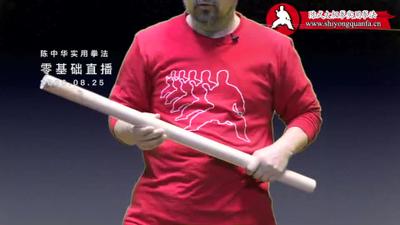
This is Master Chen Zhonghua’s official teaching version of the relationship between the two hands in all taiji moves. This mini video was taped on August 25, 2020 in Edmonton, Alberta, Canada. Read more
Six Sealing Four Closing
- Hands don’t move. Create a line between the front hand and rear foot. Read more
Zoom lecture with Master Chen and Kelvin Ho covering six sealing four closing.
Six Sealing Four Closing Notes – Master Chen Zhonghua Online Zoom Lesson – 27 Aug 2020 – Brian Chung i
Master and Kelvin Ho provided instructions and corrections on Six Sealing Four Closing today.
Six Sealing Four Closing – Kelvin Ho
– Hand does not move. Dantian initiates the action. Kua lines up with elbow. Rotate the dantian to push the kua out.
– To connect the rear leg through the kua to the front arm. We don’t want the upper body there.
– Create a line from the front arm to the rear foot.
In this video, Master Chen Zhonghua mainly focused on establishing a relationship between the front hand and the shoulder. This relationship is an invisible line. Once the two points line up, there will be power and the arm movement will become a stretch.
Presenter: Chen Zhonghua Length: 61 min. In: English Year: 2020 Difficulty:2/5 At:Edmonton Chen Zhonghua Taiji Academy
Master Chen Zhonghua’s Online lesson on August 27, 2020. This lesson focused on the following topics:
1. The rear foot, rear kua, front kua, front elbow, front hand will form a straight line 45 degrees upwards. This line does not connect to the upper body. This is an essential part of body postural change.
2. The shoulder cannot move forward with the arm.
3. The front kua pushed the front vertical line up all the way to the head, while the front shoulder pushes downward to form two opposite vertical lines: one up and one down.
This lesson also corrected many students online.
Presenter: Chen Zhonghua Length: 71 min. In: English Year: 2020 Difficulty:3/5 At:Edmonton Chen Zhonghua Taiji Academy
Master Chen Zhonghua’s online lesson on Chen Style Taijiquan Practical Method on August 25, 2020. This one hour lesson involved teaching some theory, with a focus on the idea of Daoshou, how to switch grip so that the movement can be continous, and student practice corrections.
Presenter: Chen Zhonghua Length: 60 min. In: English Year: 2020 Difficulty:1/5 At:Edmonton Chen Zhonghua Taiji Academy
In this mini-video, Master Chen Zhonghua teaches the negative circle with a sword. This is a basic sword foundational exercise. It is in total congruence with the negative circle of the Chen Style Taijiquan Practical Method foundations.
Doing the negative circle with a sword further extends the arm. This in turn helps to show the rules of movement of taijiquan. When done incorrectly, for example, the the hand leading the way back, you will cut yourself with the sword.
Presenter: Chen Zhonghua Length: 2 min. In: English Year: 2020 Difficulty:1/5 At:Edmonton Chen Zhonghua Taiji Academy
Moving Step Positive Circle
- Hold your head up, tuck the chin.
- Each body part performs its own duty. Don’t merge together.
- Factory workers work, not everyone does the same job, but at the same time.
- Example: Move the feet back and forth by themselves, keep the central axis upright, move your hand out and elbow in.
- The waist must go backward while the hand goes forward.
Notes from the Zoom class on the concept of dao shou.
Read more
倒手 Dao Shou
Master and Kelvin Ho explained, demonstrated and gave examples of Dao Shou.
Read more
In this mini-video, Master Chen Zhonghua teaches the positive circle with a sword. This is a basic sword foundational exercise. It is in total congruence with the positive circle of the Chen Style Taijiquan Practical Method foundations.
Doing the positive circle with a sword further extends the arm. This in turn helps to show the rules of movement of taijiquan. When done incorrectly, for example, the the hand leading the way back, you will cut yourself with the sword.
Presenter: Chen Zhonghua Length: 2 min. In: English Year: 2020 Difficulty:1/5 At:Edmonton Chen Zhonghua Taiji Academy
Notes from the Zoom class on the double negative circle.
Read more
Double Negative Circle Notes – Master Chen Zhonghua Online Zoom Lesson – 21 Aug 2020 – Brian Chung i
Master and Kelvin Ho provided instructions and corrections on the double negative circle. (1) Fist draping over body (2) Double push down.
Master gave a physical example: hold a stick to cross a door that is 3 feet wide and 6 feet tall.
Read more
Master Chen Zhonghua taught and corrected the Double Negative Circle. 陈中华老师讲解和改正了学生的双反圈。
Presenter: Chen Zhonghua Length: 61 min. In: English Year: 2020 Difficulty:2/5 At:Edmonton Chen Zhonghua Taiji Academy
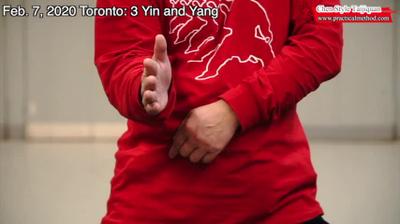
Master Chen Zhonghua’s Toronto Workshop March 2020-3
Presenter: Chen Zhonghua Length: 9 min. In: English Year: 2020 Difficulty:2/5 At: Toronto, Canada
Movement is yin, and structure is yang. Master Chen demonstrated what that meant in this video. There were also other discussions on yin-yang theory, which requires constant practice and understanding.
Negative circle correction and second section o f Yilu.
Presenter: Chen Zhonghua Length: 44 min. In: English Year: 2020 Difficulty:3/5 At:Edmonton Chen Zhonghua Taiji Academy
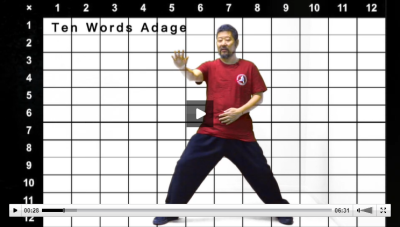
In this mini video, Master Chen Zhonghua explains the concept of “In With Elbow, No Hand; Out With Hand, No Elbow”. This is the famous ten-word adage by Grandmaster Hong Junsheng. Master Chen shows how this adage can be translated into actions in our Practical Method system.
Presenter: Chen Zhonghua Length: 6 min. In: English Year: 2020 Difficulty:1/5 At:Edmonton Chen Zhonghua Taiji Academy
This is a short video with detailed explanations of the concept, actions and training methods of In With Elbow.
Presenter: Chen Zhonghua Length: 7 min. In: English Year: 2020 Difficulty:1/5 At:Edmonton Chen Zhonghua Taiji Academy. Please note that there is static with the sound in this video.
My notes from the Negative Circle procedure lecture.
Read more
These are my notes from the 2 hour lesson Master Chen did on twist towel. I missed the beginning of the lesson, so if anyone could fill in the gaps I would appreciate it.
-
Redirect lightning through you to the ground
-
When doing twist towel, lock the 2 ends, move the middle.
-
We can’t actually not move the head, we are not open enough, but we try to move the head only 1 unit; the kua moves 3 units. (Something moves 2 units. I missed this.)
-
the kua moves the hands. Like moving a book on the table. The book doesn’t move by itself.
-
Our body has a tendency that every body part likes to follow the other body parts, but it’s just tossing
-
You need to have independent moves
-
When you hammer a nail, the swing is a swing, the straight line is a straight line. The hammer swings, the nail goes in straight.
-
E.g. a kid jumping to reach a basketball net. They run fast, then stop under the net and jump up to reach it. They don’t use the run and convert it into a vertical jump
-
Thrust is still there. Convert your run to the movement forward
-
The vertical move is designed to power your arm
-
First we try with bending at the waist forward and backward, but actually, it’s a vertical move
-
The shoulder goes down, the heel pumps to move the kua up towards the shoulder
-
We all need to re-calibrate. We think we are doing everything with the kua. Actually we are doing very little.
-
Your hand is tied to your opponent
-
Your kua needs to go to your elbow, not your shoulder
-
This is a characteristic of our system. There are 3 parts to each move so it can apply to any body part
-
Power comes from the kua, there are no individual moves
-
Zhuo. Connect between kua and elbow. It means clutch. Or to adhere.
-
First we train to isolate body parts so that they don’t affect each other. Then they must be able to engage and disengage
-
it is exactly gears
-
The centre cannot move, you can’t reach out, you only extend
-
This is the connection we want: the opponent is on your foot
-
Kua very big, shoulder is zero
-
During training; foot to kua to elbow to hand, this is the alignment
-
During Push hands, when you touch your opponent; hand to elbow to kua to floor. Your opponent feels it on their foot.
-
This was a characteristic when you touch grandmaster Hong. You touch him and you immediately feel like you’re floating, or something is wrong with your shoes
-
Energy alignment (? I missed this)
-
Application is 用法
-
打法 is free fighting
-
The kua is the semi opposite of the hand. The foot is the complete opposite of the hand
-
At first, when you begin learning, you use your kua to mirror the opponent’s hand.
-
Then as you get better, use your foot to mirror your opponent’s hand. You mirror from below, so your movement is much bigger than your opponent’s move
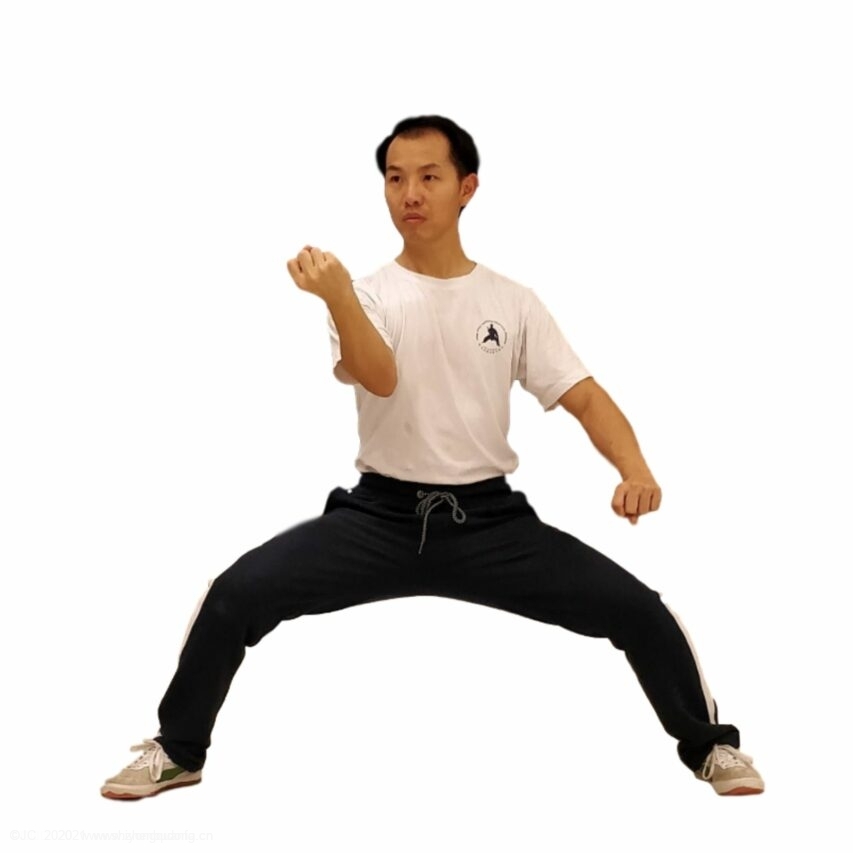
Morning Session
1-2-3 in general means that we must have a method, and there is a procedure.
We have to listen with our eyes. We can’t just close our eyes and say that we are listening.
Read more
Negative Circle Procedure Notes – Master Chen Zhonghua Online Zoom Lesson – 18 Aug 2020 – Brian Chung 1
Master Chen and Kelvin Ho provided instructions and corrections on the following Negative Circle procedure.