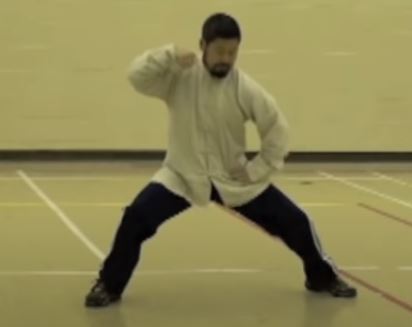
Presenter: Chen Zhonghua Length: 3 mins Difficulty: 3/5 Language: English Year: 2021 Location: Edmonton, Canada
Stretching is essential in Taiji but it takes many methods to stretch. In this video, Master Chen Zhonghua shows a two-way stretching method. Stretching two points in opposite direction along the same line.
Presenter: Chen Zhonghua Length: 7 mins Difficulty: 3/5 Language: English Year: 2021 Location: Edmonton, Canada
This is a mini video of the essential contents of Master Chen Zhonghua's Oct. 6, 2021 online lesson. The main topic is how to expand from inside to create power and movements.
The last move we worked on in today’s lesson was the second move in Jin Gang Dao Zhui (Buddha’s Warrior Attendant Pounds Mortar), when the dantien turns right, left elbow comes in on a positive circle and the right hand goes out in a negative circle. The arm (hand) is out of control and the dantien is in control. This means the hand is expressed yet is passively powered by the dantien.
Presenter: Chen Zhonghua Length: 4 mins Difficulty: 3/5 Language: English Year: 2021 Location: Edmonton, Canada
In learning, we face to things. One is that the master will constantly how you things. Another is that the actual doing of taiji. These two are not the same. Master Chen Zhonghua shows the difference and how knowing the difference will help you in your learning.
Presenter: Chen Zhonghua Length: 2 mins Difficulty: 3/5 Language: English Year: 2021 Location: Edmonton, Canada
Stretching is an important concept in Practical Method. Stretching moves conform to peng principles of taiji. In this video, Master Chen Zhonghua explains how to stretch on a line. He also shows common mistakes such as too much rotation that makes the line deviate from the line.
Presenter: Chen Zhonghua Length: 4 mins Difficulty: 3/5 Language: English Year: 2021 Location: Edmonton, Canada
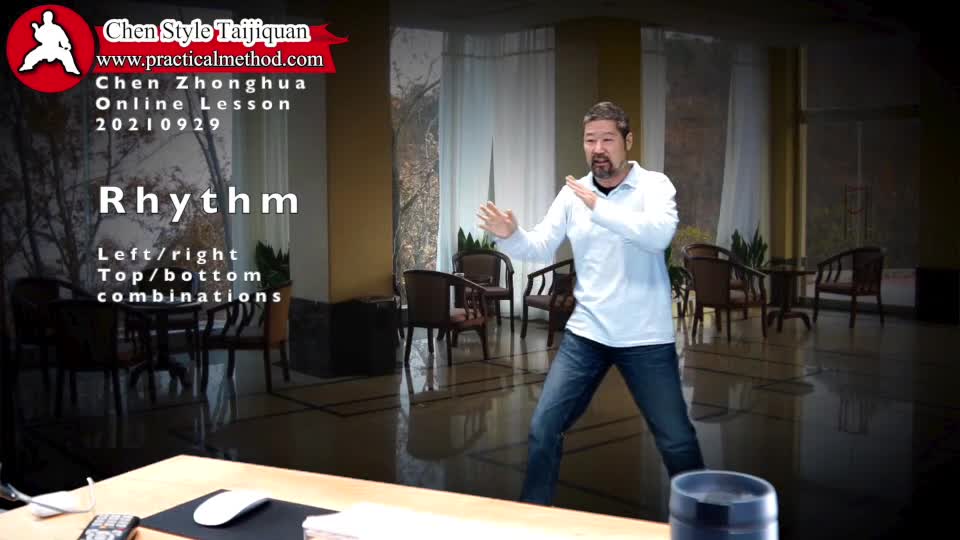
There are three level of taiji power/ability. One is basic human power. Two is structural power. Three is speed power. Rhythm is a higher level manipulation of speed.
Presenter: Chen Zhonghua Length: 5 mins Difficulty: 3/5 Language: English Year: 2021 Location: Edmonton, Canada
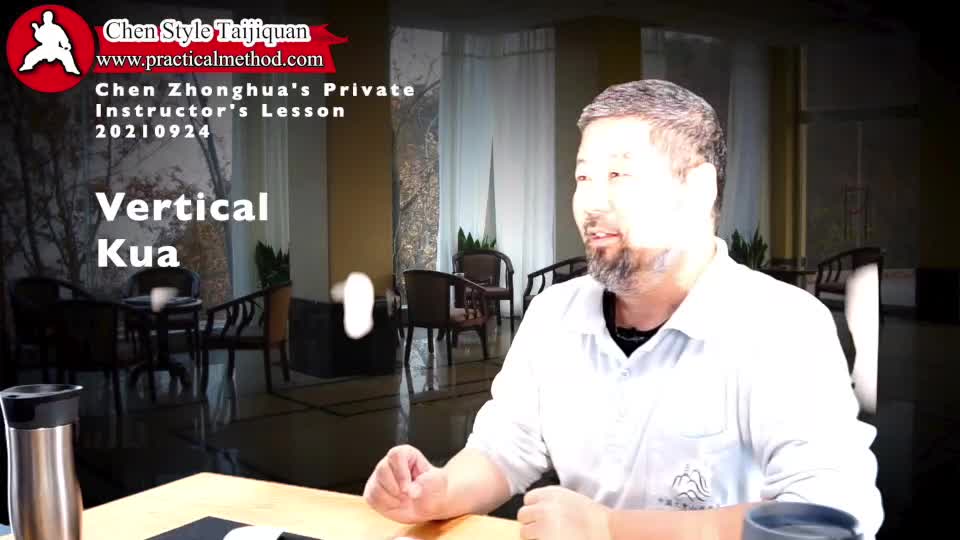
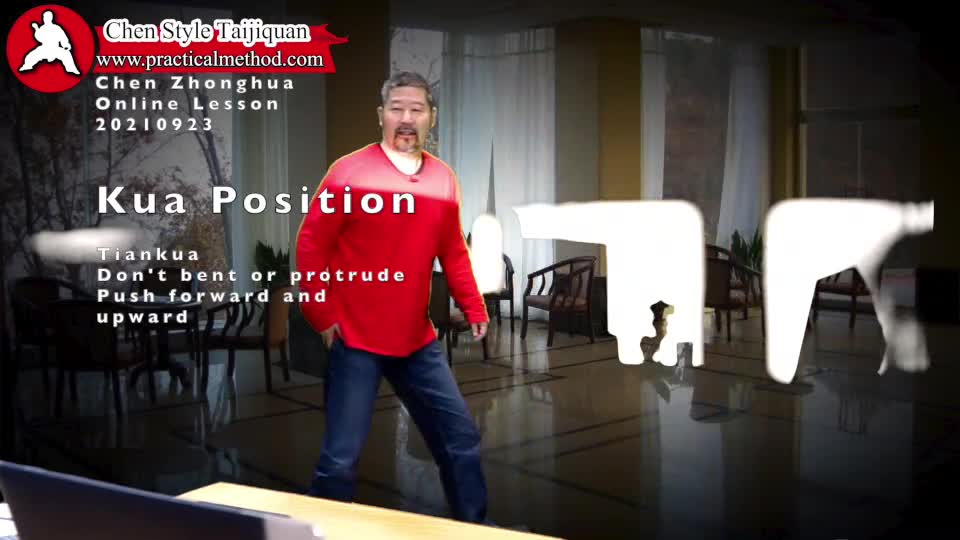
Kua is one of the MOST important part in the learning of Chen Style Taijiquan Practical Method. In this mini video, Master Chen Zhonghua gave a lengthy treatment of the Kua position and movements.
Presenter: Chen Zhonghua Length: 2 mins Difficulty: 3/5 Language: English Year: 2021 Location: Edmonton, Canada
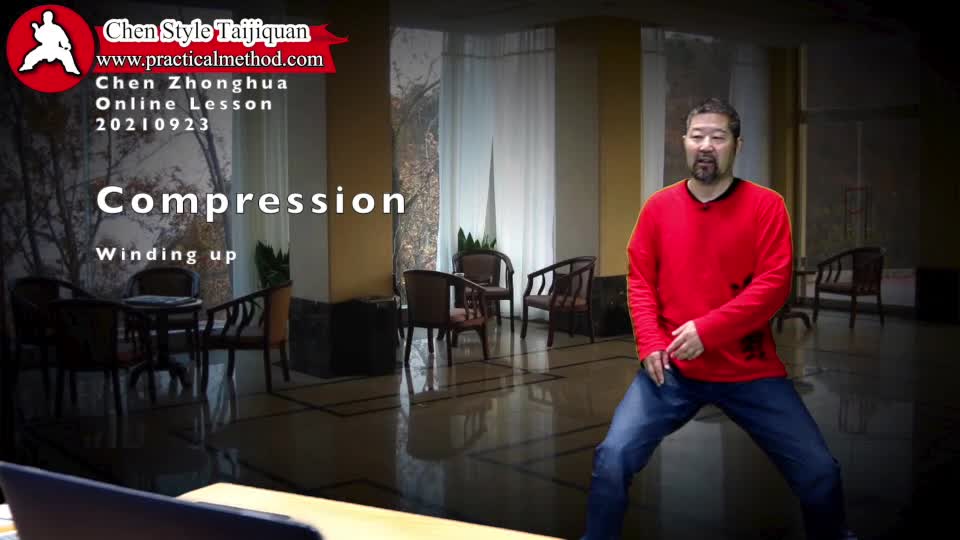
Once the five-heads (two hands, two feet and head) are fixed, movement of any other part of the body will create compression or extension. In this mini video, Master Chen Zhonghua explains how to do so.
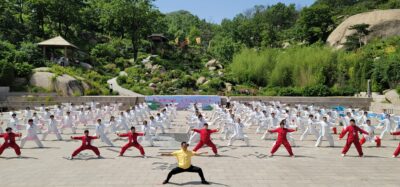
Master Chen Zhonghua always says that we need to do 20 yilus a day. If you haven’t done it before, consider to give this a try. For this challenge, you will need about 2 hours a day, which can be divided into multiple sessions to fit into your busy schedule to practice 20 yilus. By the end, you will complete about 1200 yilus. Read more
Presenter: Chen Zhonghua Length: 5 mins Difficulty: 3/5 Language: English Year: 2021 Location: Edmonton, Canada
The theory has a sequence of different stages. In practice, the sequence is often opposite of how it is described in theory.
The stages of Practical Method learning is 1, open the kua (joints), 2, rotate, 3, don't move.
When we learn and practice, we must first find an external locked spot (don't move), and then we can rotate. The end result of this will be the opening of the kua (joints).
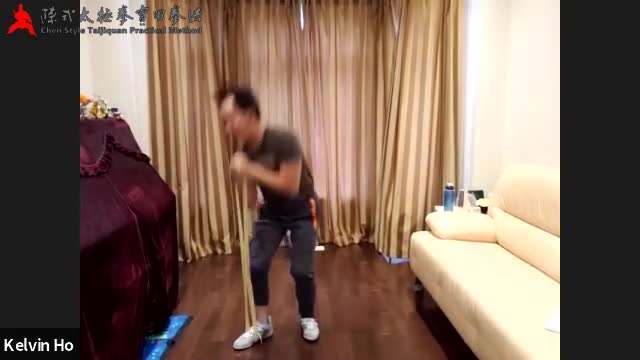
Rubber between the hand and the foot. Bend down first. Lock the upper body. Push the kua forward towards the rubber. The focus of this exercise is to train the kua, the use of power in the kua to extend the rubber. This is converting a horizontal movement to a vertical one. We want to train a great range of kua movement. Gradually, increase the tension of the rubber.
The above exercise trains a vertical movement. This is a precursor to the movement needed to do Six Sealing Four Closing. Read more
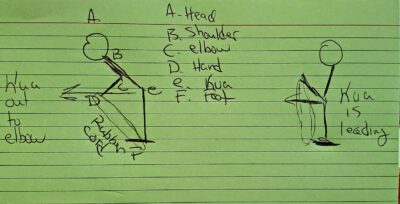
Lock head, shoulder and elbow into one piece. Make sure the elbow is being pushed into the palm.
Have rubber cord under lead foot and in lead hand.
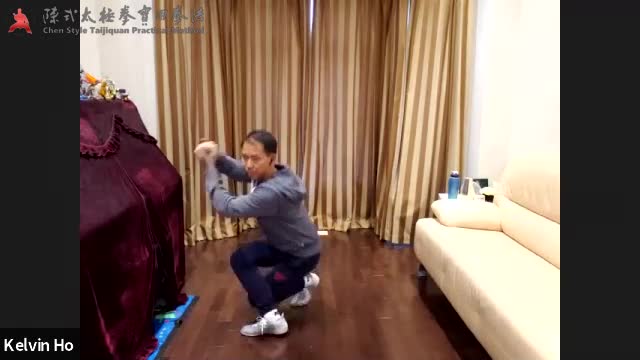
Get into position (see picture). The upper body (waist up) and lower body (below waist) are solid like 2 separate pieces of wood.
Shove front kua forward into the elbow that goes into the hand holding the rubber cord. This action from the kua makes the back straighten.
The strength of the rubber cord has to be more than you can handle. Make the tension “real” and size of cord needs to be just right that the power is coming from the kua and not other body parts.
Presenter: Kelvin Ho Length: 99 mins Difficulty: 3/5 Language: English Year: 2021 Location: Toronto, Canada
1) Small Six Sealing and Four Closing 2) Moving hands vs moving the kuas 3) Stages for progression 4) What do "no retreat" and "going over" mean? 5) Difference between positive and negative circles
Presenter: Chen Zhonghua Length: 5 mins Difficulty: 3/5 Language: English Year: 2021 Location: Edmonton, Canada
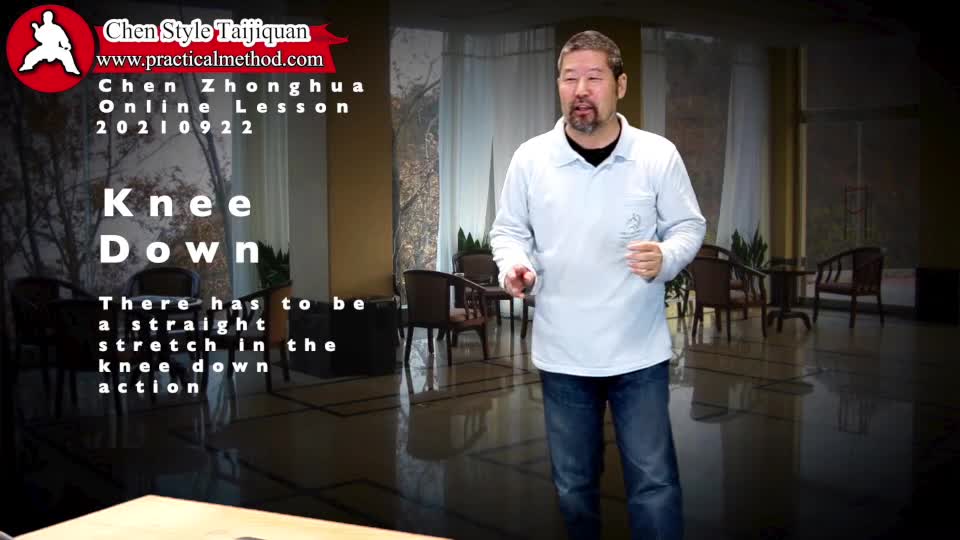
The body of a Practical Method person moves up and down by the knee going up and down. This is a specialized technique. Without professional targeted training, one cannot make the knee go up and down.
The normal knee up and down is called Guixi, which is an error.
In this video, Master Chen Zhonghua explains that proper knee up and down means and how to train your body to do it.
Presenter: Chen Zhonghua Length: 6 mins Difficulty: 3/5 Language: English Year: 2021 Location: Edmonton, Canada
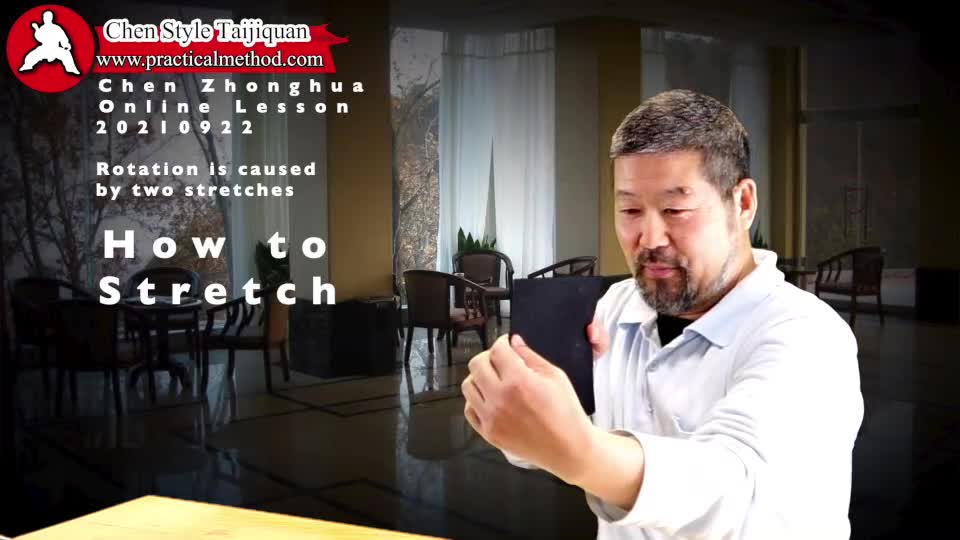
The ultimate action of Practical Method is a rotation. In order to reach that goal, the most useful action is to stretch. In this video, Master Chen Zhonghua teaches to to stretch.

_2021-10-28.jpg)
_2021-10-27.jpg)
_2021-10-26.jpg)
_2021-10-25.jpg)
_2021-10-24.jpg)
 Master Chen Zhonghua always says that we need to do 20 yilus a day. If you haven’t done it before, consider to give this a try. For this challenge, you will need about 2 hours a day, which can be divided into multiple sessions to fit into your busy schedule to practice 20 yilus. By the end, you will complete about 1200 yilus. Read more
_2021-10-23.jpg)
_2021-10-22.jpg)
_2021-10-21.jpg)