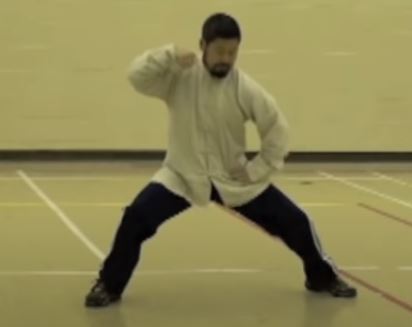
武林大会用法:肘。
Martial Conference. Elbow applications by Jiang Jiajun.
Chen Style Taijiquan and Hunyuan Taiji email: practicalmethod@qq.com
I watched the Toronto Workshop 3-4 video today. I got a different understanding on the material presented. Although I was there at the workshop, I didn’t really understand much at the time as I was so new to Taiji. I had no clue on many of the concepts.
Use this to try to learn how to pull with elbow, not hand.
At a higher level, stretching moves are changed to arching moves. Arching is really a way of extension without stopping the energy flow.Arching is more stable than stretching. However, arching creates less distance than stretching.
Some examples:
How to Arch the Lower Body Video
In this teaching animation model, Master Chen Zhonghua shows how the elbow interacts with the knee in a negative circle.
In relation to the viewer’s eyes, the elbow point moves more horizontally from left to right then the other point points. The two knee points move more in line with the eye vision’s depth. Essentially, you should try to understand that the three points don’t change relationships. Only the three dimensional perspectives cause the flat one planed photos to appear to have the changes.

In this animation model, I tried to show how the energy moves in a line of energy from front hand to the rear foot. 在这个幻影里,我演示前手到后脚的劲路方向
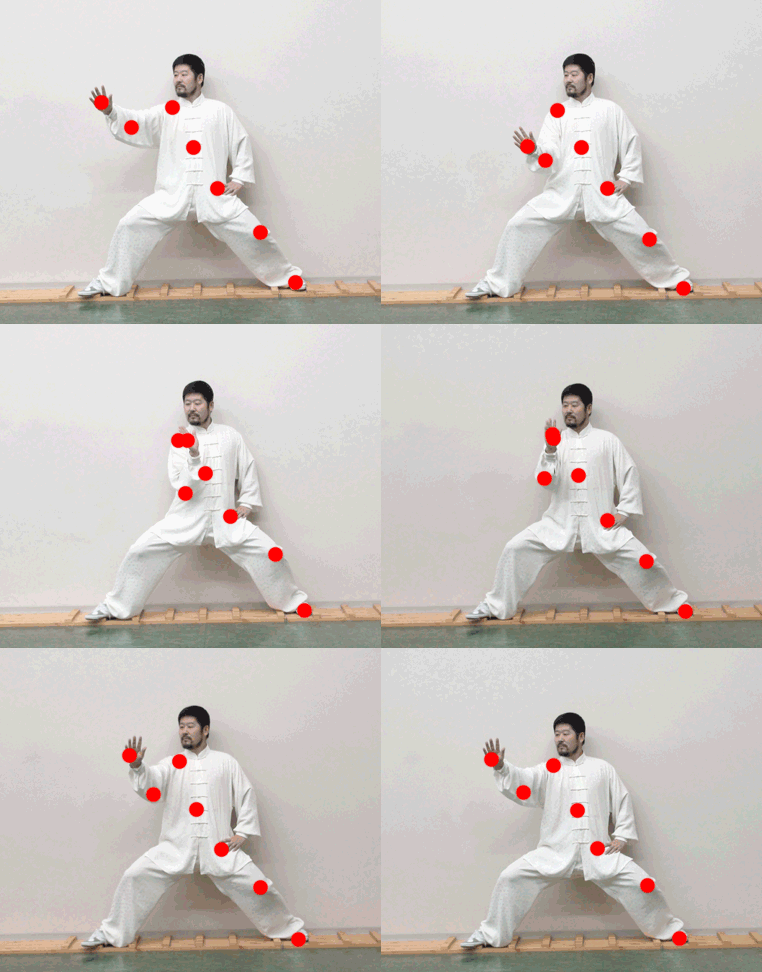
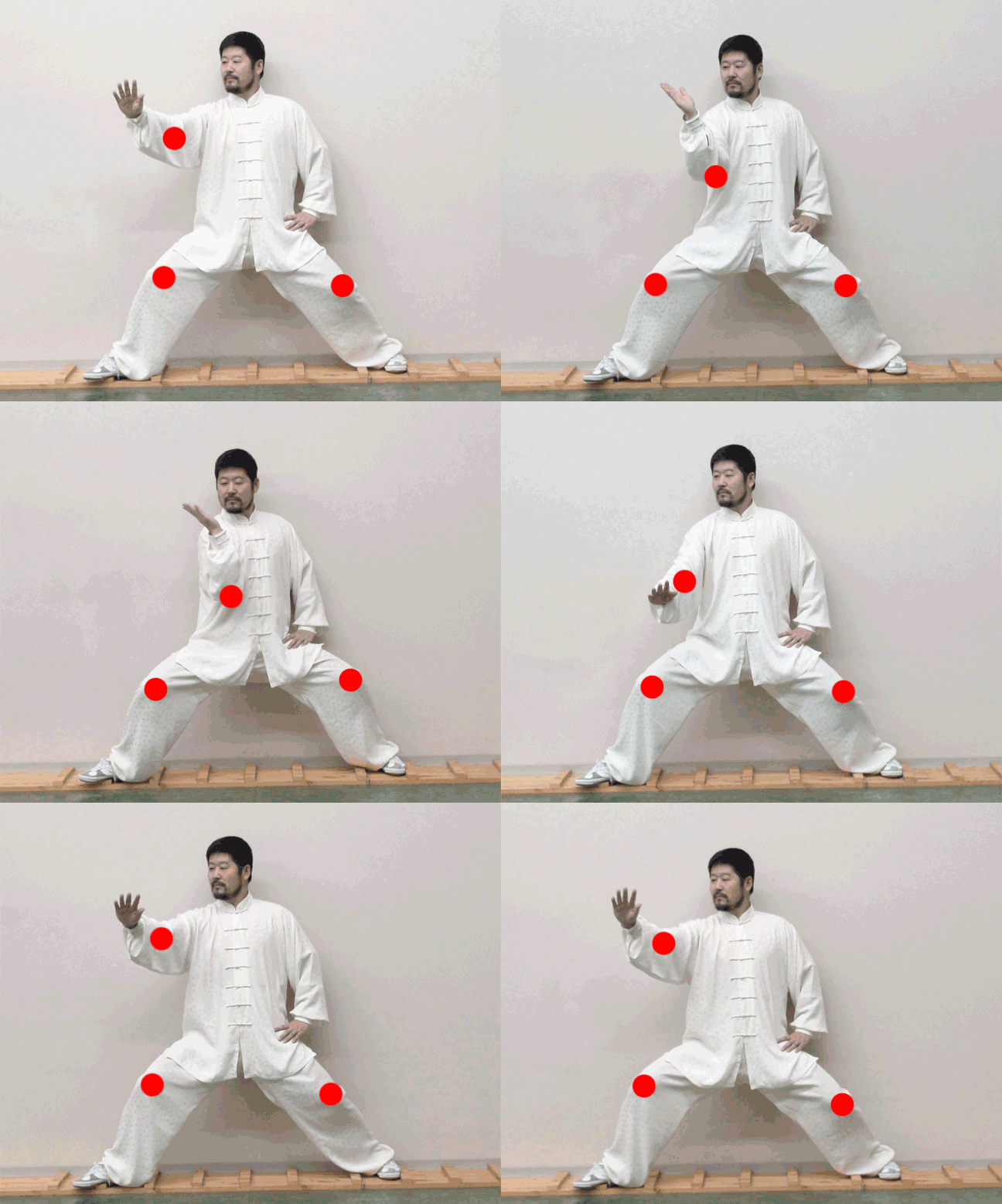
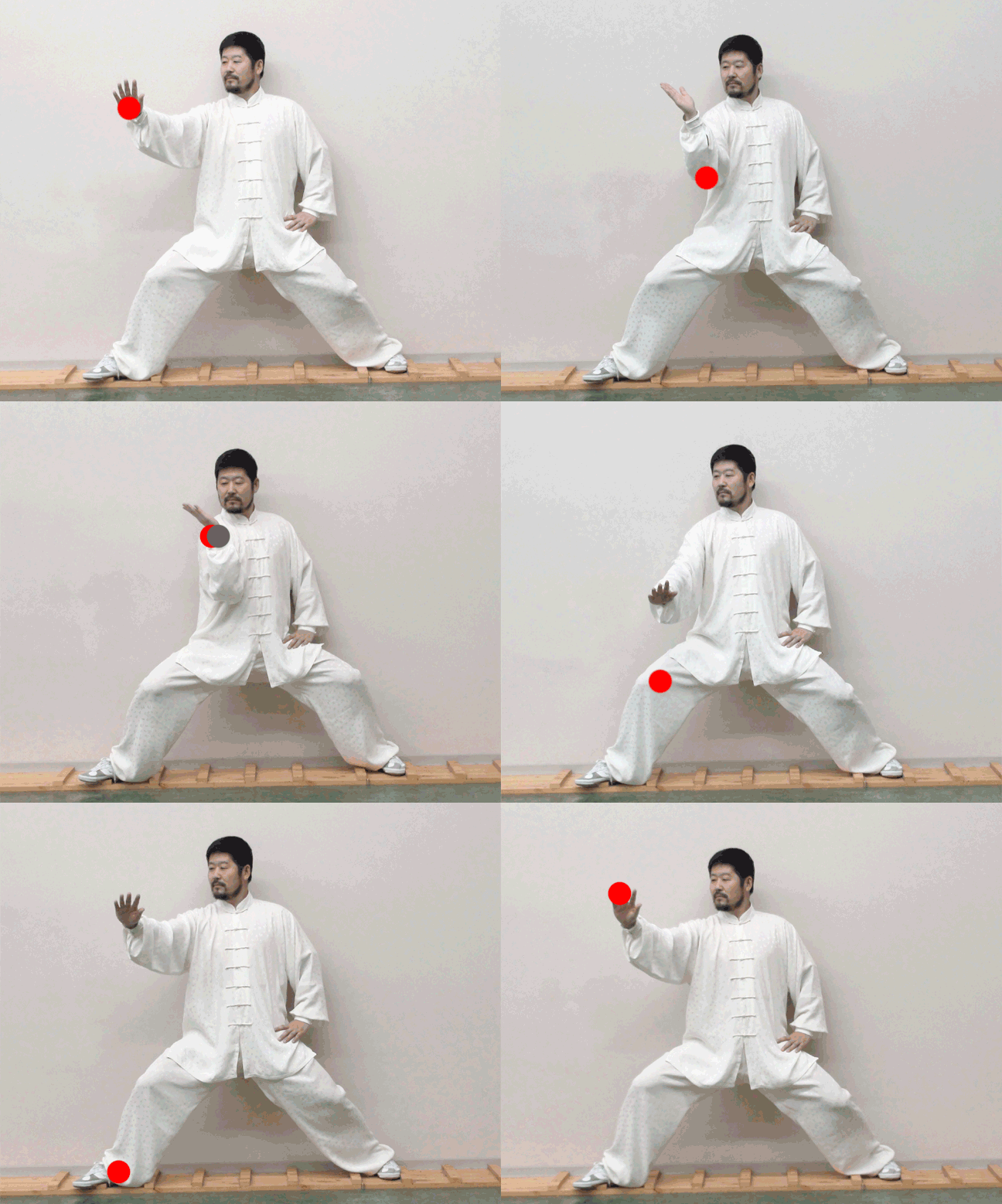
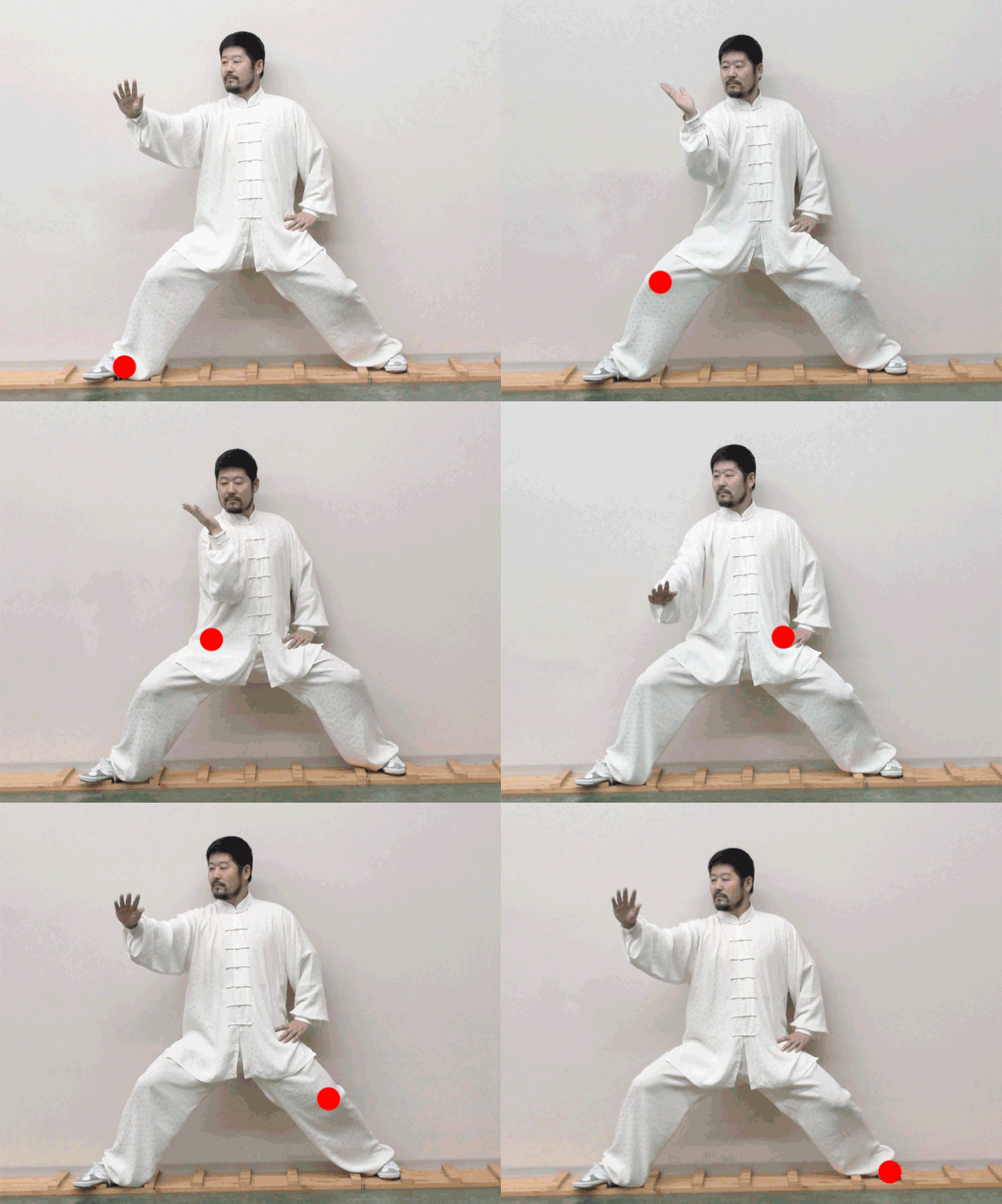
In this model, Master Chen Zhonghua shows the energy of the lower arch while in a negative circle. 
In this model, Master Chen Zhonghua shows how the energy (as one dot) moves on the lower body arch during a negative circle execution. 
This is a model to show how the energy moves on the right hand side of the body in a negative circle.

What are the Three Pans of Taiji?
This photo graph is designed to deal with knee problems in training.

In order to avoid injuries, the most important thing to avoid is the knee pushing outward away from the body, as illustrated in the picture above: the yellow dot cannot move towards the blue line. The blue line is an imagined wall that the knee cannot push against.
The following youtube clip shows the actions of the rear knee.
Originally written by: Tim Duehring
Chen Cake is a variation on the children’s game of Patty Cake. Here is how we play it.
The participants will stand facing each other with their arms outstretched in front of them. The wrists will be bent and the fingers pointed at the ceiling. They will adjust the distance between them until the backs of their hands are in line. From this position they will proceed to slap their palms together trying to upset the balance of their opponent.
They are not allowed to move their feet except to avoid falling over.
This exercise will result in a better sense of timing, balance, recognition of the opponent’s structure, and a good flow of blood to the hands.
Elbow Sticks to the Ribs
“Elbow Sticks to the Ribs” is a principle that is shared by all martial arts, not only Taijiquan. It’s a pity that most martial artists only pay lip service to this age-old aphorism. This is indeed a secret training method to higher levels of martial attainment.
Chen Style Taijiquan Practical Method regards this aphorism as a major principle to follow.
One of the terms we hear often in the Chen Style Taijiquan Practical Method system is “Rotation”. This term relates to silk reeling, spiral, circles, turning, etc. It is an inseparable part of the Chen Style Taijiquan Practical Method system.
In dealing with this concept, one must keep in mind the following:
“Don’t Move Your Hands!”
Contrary to what most believe, the hand in most cases move too much. Everybody wants to learn how to move the hand. In fact, they should learn how NOT to move it! Read more
Chen (2) Jian (1) Zhui (4) Zhou (2) 沉肩坠肘
Sink the shoulder and pull down the elbow.
The shoulder can only sink downwards towards the direction of the kua. It cannot move sideways. It cannot move upwards either.
The elbow must point downwards towards the direction of the Dantian. It cannot raise upwards.
The eight techniques of Taiji: peng, lu, ji, an, cai, lie, zhou and kao.
1. Peng: overall expanding energy.
2. Lu: energy that catches the opponent and make it come towards you.
3. Ji: energy that gets in close to the opponent but will not act on him.
4. An: energy that pushes but mainly separates from opponent.
5. Cai: energy that severs opponent by a pull or a jerk.
6. Lie (Lieh): energy that severs opponent by a even break (power on both ends or hands).
7. Zhou: energy that twists the opponent.
8. Kao: energy that is whole body action.
To Adhere.
This is one of the central concepts that used to be in the daily Taijiquan vocabulary. It is hardly mentioned today. Zhuo is very illusive as it encompasses several actions.
“Don’t Move Your Hands!” Contrary to what most believe, the hand in most cases move too much. Everybody wants to learn how to move the hand. In fact, they should learn how NOT to move it!
When the hand moves too much, the following will occur:
So it is very important to keep your hand inline (that’s a different topic) and don’t move it around too much!
Another way Master Chen teaches the students how to stick to your opponent. Master Chen believes that one of the most common errors in modern Taijiquan training is the use of other energies before “Squeezing” (press) energy is developed. The sequence of the primary four energies are:
Peng as a initial energy
Lu as a change of direction based on Peng
Ji as a step in (further energy) in addition to Lu, and
An as a result of the three previous energies.
Most people perform the four energies in an unrelated manner. They will not have progression in this way.
In the video clip below, Master Chen Zhonghua shows how two people are tied up with rubber cords to experience “snot” (sticking) energy. The aim is to make the lower body move and power up, while making the upper body to adapt and to adhere.
One of the most difficult things to do in the CTS system is to keep the elbows in. Master says “the elbow must be no more than 3 inches from the ribcage.”
While we cannot take these words literally, it does remind us just how important it is to keep the elbows in. While the hand moves outwards, the elbow must always have the orientation of moving towards the center, or the Dantian.
Here, Master Chen Zhonghua uses rubber cords to ties the students down at the elbow so that they will always keep their elbows in.
In this video, master Chen Zhonghua shows the positive circle and negative circle using a rubber cord. This exercise is very effective in getting the pulling energy and the pushing energy to move along the correct line.
from http://practicalmethod.com/?p=18680
youtube version
You can generate power by pivoting on your foot. Here is a clip from master Chen Zhonghua’s 2005 Taiji Tradition Camp in Victoria, BC, Canada.
[youtube=http://www.youtube.com/watch?v=DlFW7GjBri4]
Go here for more on this topic:
http://wujimon.com/2007/what-does-a-camera-tripod-have-to-do-with-taiji/
http://hunyuantaiji.livejournal.com/
One of the aims of Chen Style Taijiquan training is to achieve the ability of penetrating power. Read more
After “Punch to the Ground”, you turn to the right and then double kick. This is the transition to the double kick. The first turn to the right is a right elbow strike. In this case, the previous move of “Punch to the ground” actually dodges the opponent’s punch or kick to the head. You then strike your opponent’s ribs with the elbow.
After the right arm goes out to the right with the hand as a hook, the body turns left to drive the right arm to make a strong negative circle (power). In this video, in order to get into position, the master had to compromise his central equilibrium first. Best done without this loss.
[youtube=http://www.youtube.com/watch?v=nYLblJ73ECU]
Right arm positive circle while the waist turns left to set up. When executing, the waist turns right and then to the right again (two beats) while the right arm is doing one beat with elbow moving to the right in a negative (bottom portion) circle. In this video, the elbow was not physically used but the actions are exactly the same.
[youtube=http://www.youtube.com/watch?v=R8E8GyjHdJo]
This is the second last Single Whip in the Yilu routine. It is different from other Single Whip moves. Before, stepping to the left, the right hand does a deep positive circle and goes way down before coming to the finished position. Hong changed it to this way through his personal experiences. Here is how it is applied. Notice that the left leg did not step forward as required in the form. Read more