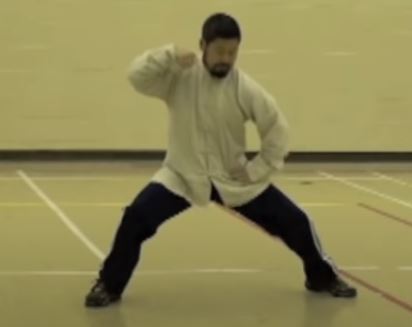
Body movement principle is that the upper and lower parts of the body must not be synchronized. When the upper body moves, the lower body must not move. When the left side of the body moves, the right side of the body cannot move. When the hands move, the waist cannot move.
Standing atop a mountain in China’s Shandong province, Tai Chi master SENSEI SANDEEP DESAI finds himself.
When my trip to Daqingshan, a mountain in the Shandong province of China came through, I was delirious with joy. It not only gave me an opportunity to further my development in the art but also fulfilled my ultimate fantasy to dissolve into T’ai Chi while experiencing the fresh chi of the mountain. I was seized by an overwhelming urge to realise my full potential while soaking in tranquility and serenity. Read more
Master Chen Zhonghua corrected Kham Serk’s “Fetch Water” move. He also used “Six Sealing and Four Closing” to teach how to make a yin yang split.
Presenter: Chen Zhonghua Length: 20 min. In: English Year: 2011 Difficulty:3/5 At:Edmonton, Alberta, Canada
Learn from Chen Zhonghua online as though you were at his private workshops.
Presenter: Chen Zhonghua Length: 65 min. In: English Year: 2011 Difficulty:2/5 At:Germany
[Post in Progress] I have observed that the rotation in the arm can never be on the central axis of the limb. It must continually switch between the ulna and the radius. Read more
The hand is the most used part of the body. It is also the focus of taijiquan activities. This video clips shows how the power of the entire body can be focused onto the hands and even fingers to fight again an opponent.
Pulling energy is also called “Pull back”, or “Roll Back”. In general it is an energy pulling the opponent towards yourself. The key is that your pulling power must originate from your own dantian. It cannot originate from your hand. Here is a video clip to illustrate this point.
Being able to “stack the joints” is an important skill in Practical Method. It means not only that all joints have to be aligned to be able to receive the oncoming force, it also means that they have to react in sequence.
Rotation is the driving force of all taiji movements. Rotation is movement without displacement of space. Here is a video clip of a rotation. It is similar to the concept of hinge and axis. Read more
Nothing is as good as personal instruction. This is close to it.
Presenter: Chen Zhonghua Length: 76 min. In: English Year: 2011 Difficulty:2/5 At:Germany
We had a great time this past weekend. A lot of sweat was shed but no blood. Everyone gained a lot in understanding and ability. A special “Thank You” goes to John Upshaw and his family for hosting us. Here for your delight and critique is our group doing the 1st 13. Midwest Practical Method Yilu
The body must be trained to have multiple axis and they must be in multiple dimensions. One of them is the VERTICAL AXIS. Vertical axis acts exactly the same way as a door hinge. Read more
Zhu Dongsheng started learning taiji in 2005. He started with Yang style. From 2006 to 2009 he followed monk Shi Guozhuang to learn Chen Style Small frame. From 2009 to 2010 he studied Chen Style Old Frame yilu from friend Zhao Yanan. Read more
It is a fact that most modern people, especially westerners living in urbanized areas, are not as physically active as they once were. As society becomes more dependent on machines and electric tools to do the physical labour once done manually, the bodies of modern men seem to be changing accordingly. Read more
When I first started taiji training with my teacher Kee Hong, he would always say: if you want power, you have to sink your weight. In fact, I would observe his center of gravity sink whenever someone pushed him. I would also feel his push getting “under me” whenever I pushed on him.
Chen Zhensheng, also known as Waterheart, Gonghe, and Liaoweng. When he was young, he studied Chinese wrestling, Shaolin and then Yang style taijiquan, Sun Style Taijiquan , Wuu Style Taijiquan and Chen Style Taijiquan. He became a disciple of Grandmaster Hong Junsheng in 1978 in the lineage of Chen Style Taijiquan Practical Method. He is a major lineage holder of Chen Style Taijiquan Practical Method.
In my experience, it is a common problem for taiji beginners to feel strain in the knee because the rules of Taijiquan say we should “rotate our hips”. When the kua (the technical term for the hip area) is not open enough, the knees tend to overcompensate and end up rotating. But the knees can only bend and unbend, they aren’t meant to rotate, so when they rotate, it leads to injury. Read more
1. Introduction. 2. Open and Close. 3. Open Triangle in the body. 4. Experiments with the open and close. 5. Six Sealing and Four Closing exercises. Presenter: Chen Zhonghua Length: 39 min. In: English Year: 2011 Difficulty:3/5 At:Maple Ridge, B.C. Canada
Over the past few months I have noticed something becoming more and more prominent. On elbow in, I hit this “sweet spot” where it feels like everything is locked up to it’s maximum – very stiff almost bone on bone feeling in between the joints, yet muscles are softish. So much so that the tip of my fingers vibrate as if from reverberation. I don’t get this feeling from any other movement, so I’m not sure if this normal?
Recently, I notice when I rotate the rear kua in a certain way to bring the knee up, a stick seems to be created between the rear kua and the rear ankle. Note that the leg itself is actually not straight, it really is just like the half horse stance with the rear side longer than the front side. It feels like this stick can support me with the proper alignment against an incoming force.
Anyone who has done some form of Taiji for a while has invariably come to know the importance of sinking the shoulders. Master Chen Zhonghua takes it a step further, however, by instructing students to “feed the shoulder to the dog!”
Taiji is supposed to be about relaxation. If that is the case, why is there such a heavy emphasis on low stances in Chen style? Doesn’t that contradict the requirement for relaxation?
Eventually, higher level students of Taijiquan come realize that the power produced in practice should never be produced by the muscles. But if it isn’t produced in the muscles, where does the incredible strength, flexibility and speed of the great masters come from? I believe this question can be answered by understanding the amazing system of tendons and ligaments which connects the muscular and skeletal structures. Although many people like to believe that “qi”


 It is a fact that most modern people, especially westerners living in urbanized areas, are not as physically active as they once were. As society becomes more dependent on machines and electric tools to do the physical labour once done manually, the bodies of modern men seem to be changing accordingly.
 1st Australian visit by Master Chen Zhonghua in March 2012, Sydney and Canberra. Registration and more info: