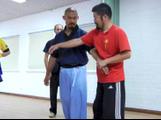
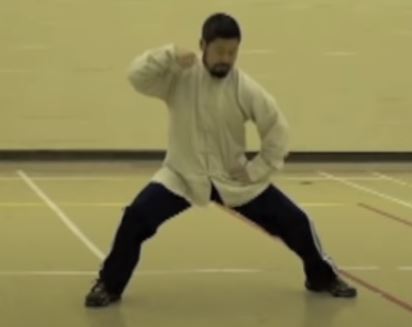
Some theory, three lines of energy, kua must be open,shoulder-kua-wrist hand must be dead, peng energy, moving step, stepping exercise,pulling exercise
turning of joints, use connection not power, what does it mean to relax.
Presenter: Chen Zhonghua Length: 70 min. In: English Year: 2013 Difficulty:2/5 At:Berlin
Rotation is the key characteristic of Chen Style Taijiquan Practical Method. It sets this art apart from other arts. There are no natural rotations in human movements. They are made up as a result of specialized training in the Chen Style Taijiquan Practical Method system.
In recent years, taiji has been (in China because of the demonstration at the 2008 Olympic Games Opening ceremony) described as moving clouds and running water. 行云流水。 Read more
Hi everybody,
This weekend I’ll hold another workshop “Introduction to Practical Method” at the university in Berlin. Still some capacities left. Nice price because sponsored by the university.
Concepts covered in this video: 1) Separation of Yin and Yang. 2) The crucial angle of 45 degrees. 3) Creating and maintaining a structure. 4) Separation of bone and muscle. 5) Daoist philosophy. 6) How to line up energy and movement. 7) Positive circle. Presenter: Chen Zhonghua Length: 70 min. In: English Year: 2013 Difficulty: 1/5 At: Berlin, Germany.
This is the vertical alignment for the third vertical line. The kua acts as a socket for the shoulder. The shoulder does not physically sit inside the kua but must always be sitting in the kua remotely in terms of position and direction.
This concept is similar to the idea that what driving downhill, don’t put your car into neutral. Power must be constant and consistent in all taiji movements.
By following this principle of Chen Style Taijiquan Practical Method, our taiji actions will be different from normal human movements. We therefore, no longer “move” (Don’t move!). We become the other “Kind”. Read more
The outside must always be stronger than the inside like a bomb and an egg. The shells are considered outside. The reference to stronger or not of the outside and inside refers only to the physical property.
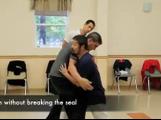
Stepping and the sequence of movements, Take out space, Move the floor not the body, Push without breaking the seal, Transfer the power from inside to the outside, Read more
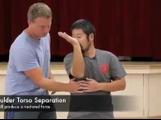
1. The human body and machine. 2. Shoulder-torso separation. 3. Upper and lower body separation. 4. Open the power to the outside. 5. How to go down. 6. Stretch out. Read more
Sit the wrist is a special term used in Chen Style Taijiquan Practical Method. It means that the wrist must be stretched open into a curved position and then locked into place. This is also part of the Tile Hand requirement.
“the inside stays on the inside and the outside stays on the outside” is a major taiji principle. The five heads are considered outside; everything else is considered inside.
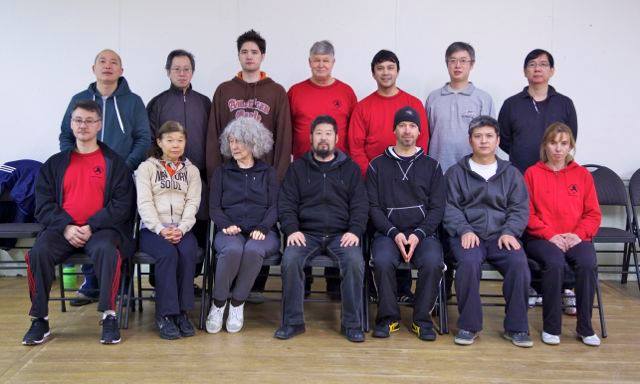
Blake from Seattle, and KS from Malaysia came to the workshop. Master Chen went over the Yin Yang relation in the legs, where one leg has to be still which sound simple but I find it hard to keep the front leg to not move. (Photos by Jay Smith) Read more
The kua must be higher than the knee. This ensures that the lower body stance remains an bridge arch. If the kua is lower than the knee, then this arch is reversed.
In transitional and extreme cases, this principle is temporarily violated.
This means that the left hand must only be allowed to move in the left side of the torso. The right hand is only allowed to move in the right side of the torso. The demarcation line is the centerline of the chest.

.jpg)