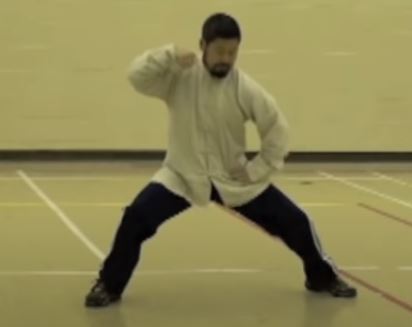
When I asked about the concept of “needle wrapped in cotton”, the master countered with a question, “Do you fight with cotton or with needle? I answered that I would use needle instead of cotton. “In that case, why did you ask me, then?” the master said. “Cotton” is just a decoy to “cheat” the enemy is off his guard, make him think you are not strong. When you use your power to get him, he does not have the time to react. The bottom line is that we train power “jin”. Without power there is no basis for anything in martial art. Read more
Hunyuantaiji Academy, 5222-86 street, Edmonton will be having our New Year’s Open House on Saturday January 12 and Sunday January 13 from 10 am until 1 pm. Join a Free lesson and find out what our Academy can do for you to help you become fit, healthy and able to develop both brain and body as lifelong learning. Read more
This was supposed to be a video from the Staff on Daqingshan, but I got called back to the USA before we could record it, so you will have to put up with my solo version. Read more
O Mestre Chen Zhonghua deu um seminário no Brasil em Guaratinguetá, SP em Novembro de 2012. Ele solicitou a mim que postasse minhas anotações, então aqui estão elas. Eu estou postando uma versão resumida agora, e postarei mais detalhes com o tempo.
O Seminário foi incrível, nossos professores e alunos tiveram a sorte de não só receberem aulas de taiji, mas também lições de vida.
Originally written by: Blake Caldwell Feb 2008
Squares Triangles Rectangles Cylinders Circles. All of these are used in Taiji? Squares, rectangles, and triangles are all used in foundation and strength, circles and cylinders in movement, redirection.
By using mind intent we move the lengths of angles to make the angles center obscure and to increase the strength of the angle in relation to our movement and opponent (i.e. leverage)
A: No, we see GM Hong still had a very high skill when he was old. Taiji skill is just like riding a bike, or swimming, you will never lose it once you master it. Internal strength is not based on muscle, but rotational joint dexterity for precise manipulation of power.
Just exactly how the kua works? In this mini lesson, master Chen Zhonghua gives details of the mechanics of the kua opening action. Presenter: Chen Zhonghua Length: 17 min. In: English Year: 2012 Difficulty:2/5 At: Maple Ridge, B.C
Presenter: Chen Zhonghua Length: 12 min. In: English Year: 2012 Difficulty:1/5 At:Singapore
A: Other Chen style is for form competition and has been modified so it is easier to learn. Martial art form is more precise and is harder to learn.
A: We are doing push hand as a martial art and that requires special ways other than simple drills.
Presenter: Chen Zhonghua Length: 6 min. In: English Year: 2012 Difficulty:3/5.
In and Out is an important principle often overlooked in Taijiquan practice, it has to be clearly expressed in every move in yilu.
 When I first heard Master Chen said “not-on not-off” in push hand a few years ago, I thought it was impossible. We either push (on), or not push (off). Through years of training, I slowly come to understand that “not-on not-off” is the result of “peng”, or Yin Yang separation.
A few days ago, after I wrote about stepping training by hugging a tree, I dreamed about a new exercise to help students experiencing “not-on not-off” by pushing a tree. Read more
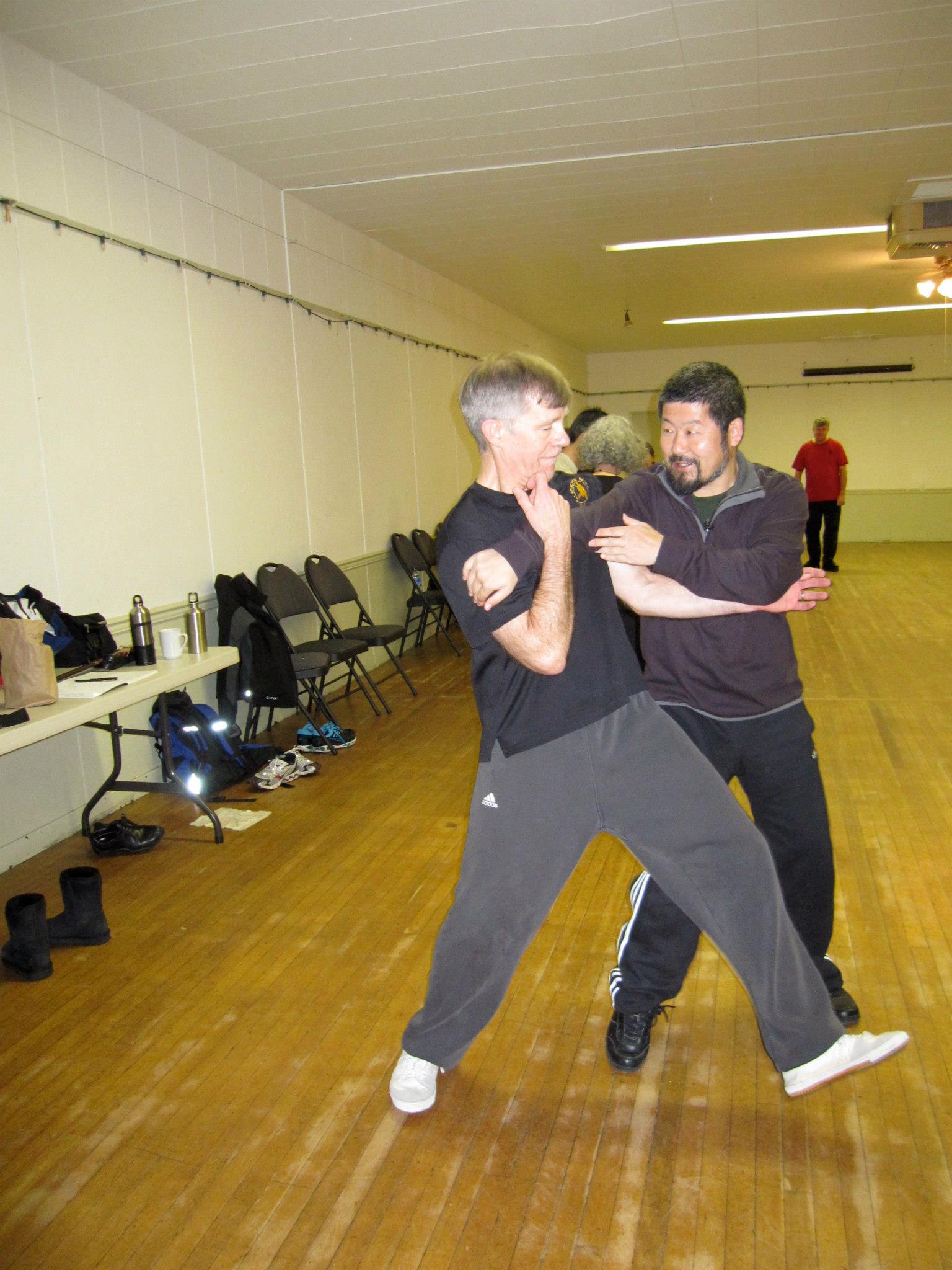
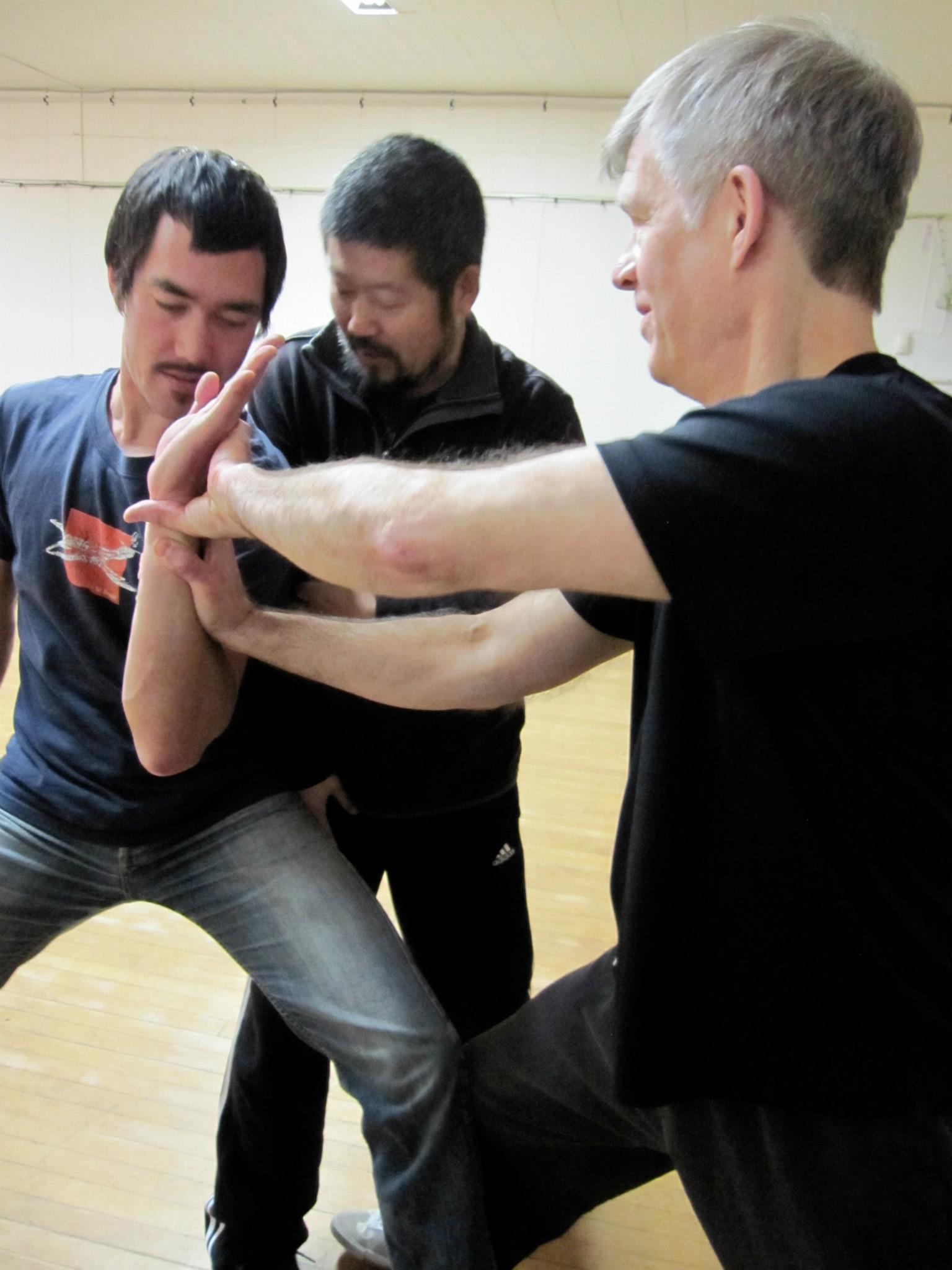

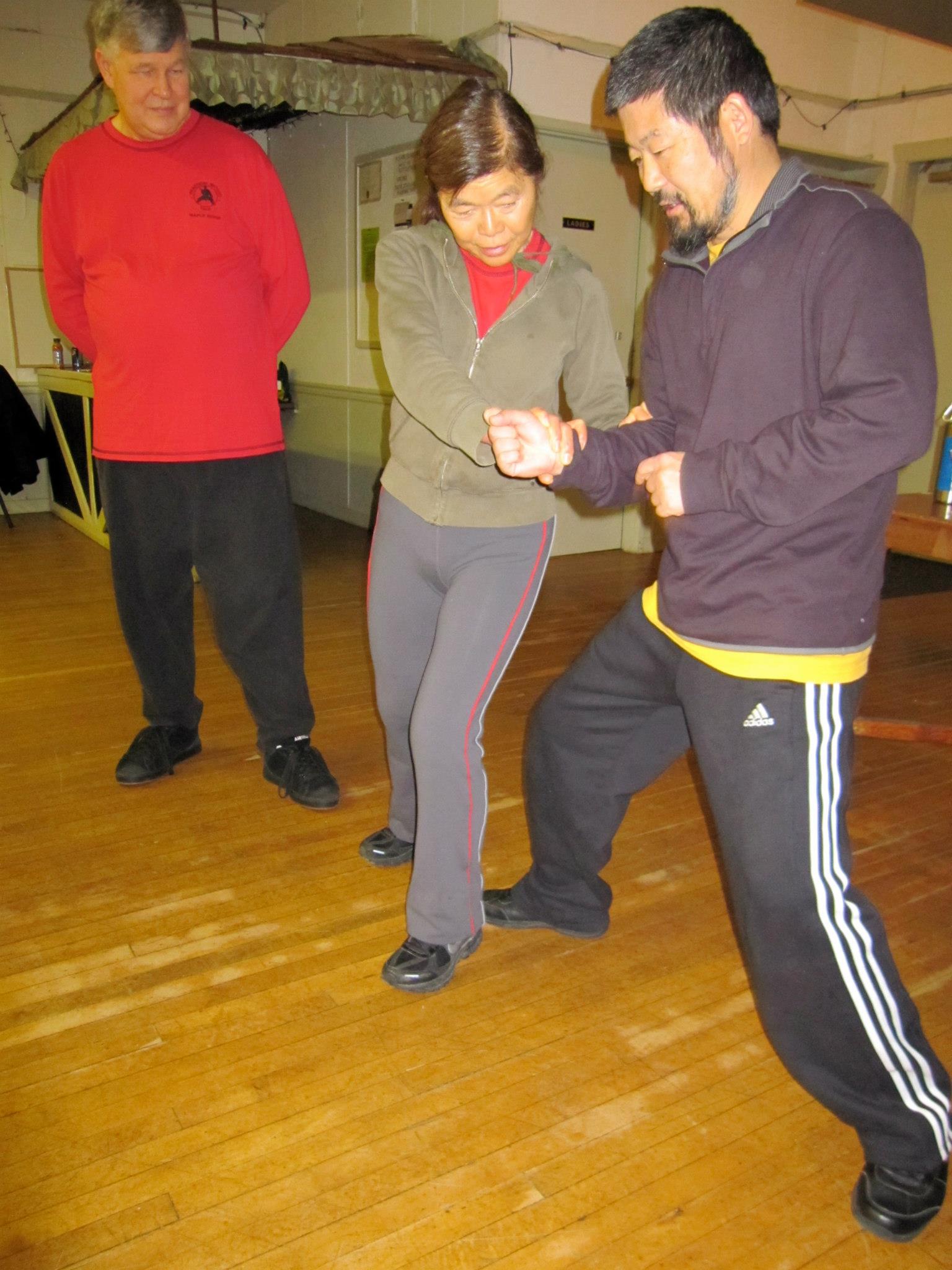
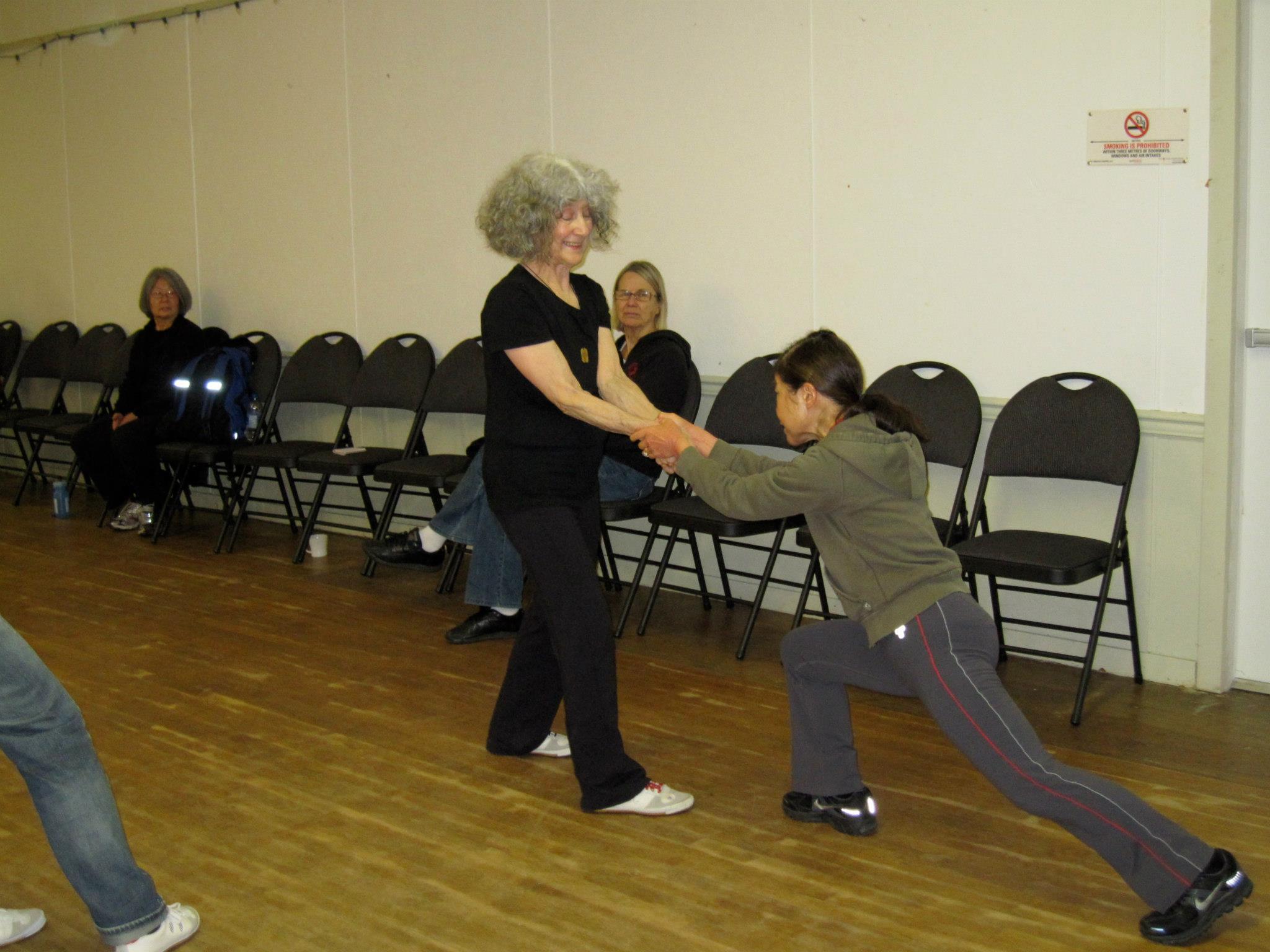
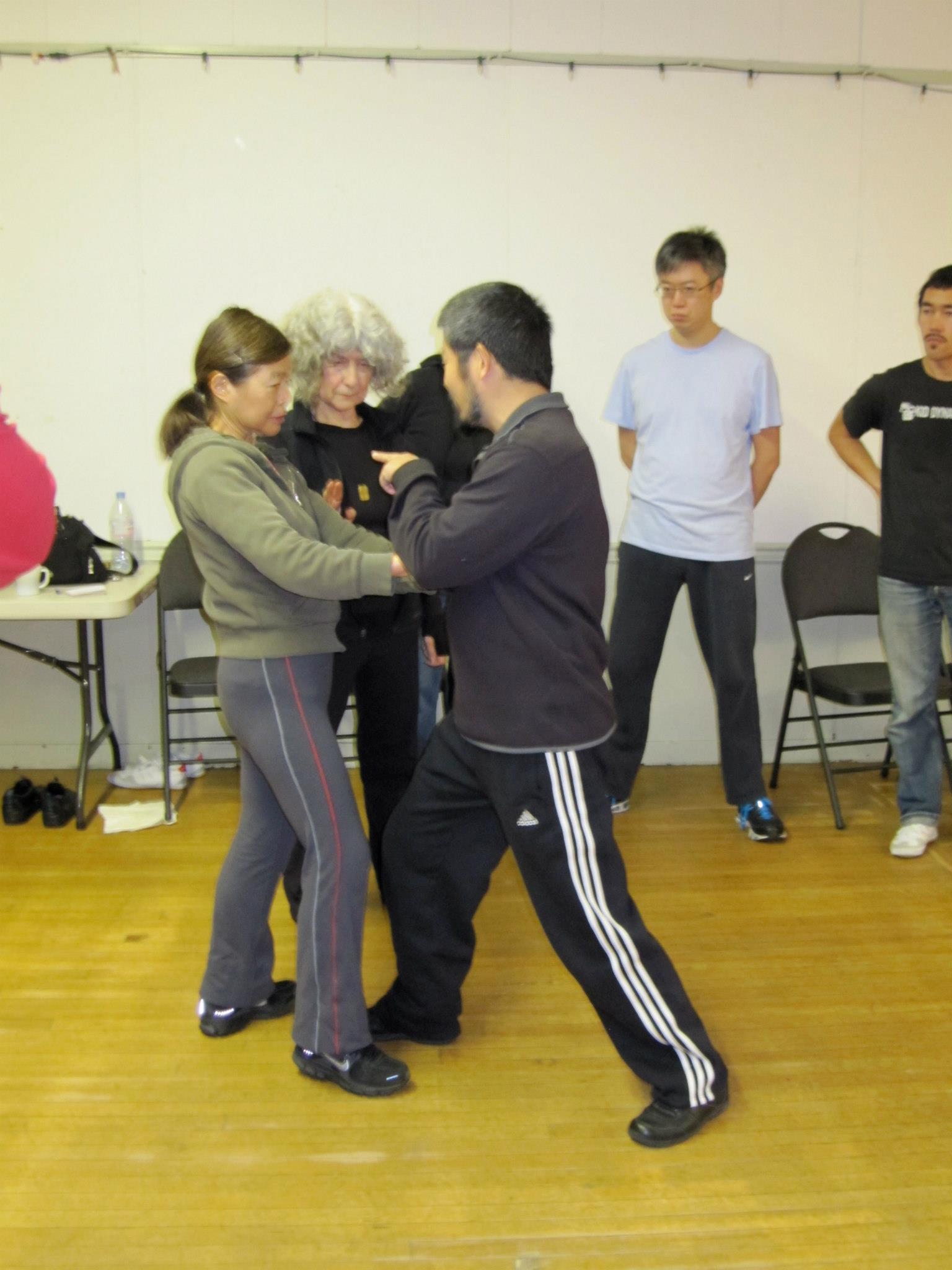
Photos by Jay Smith
Master Chen gave us detail correction of the circle, always more detail to discover in circle. We also did several push hand instruction session.
Four chapters of video that starts with a brief introduction to the Chen Style Taijiquan Practical Method. Master Chen covered a lot of ground on this one on one session, as he is intent on giving as much correction and knowledge from which the student can work on until they meet again next time.
Presenter: Chen Zhonghua Length: 64 min. In: English Year: 2012 Difficulty:3/5 At:Phoenix, AZ. USA
6 Chapters of Master Chen Zhonghua’s hands-on push hands application instruction during a private workshop in Phoenix, AZ, USA. This is a must-have for those interested in taiji applications. Many subtle and difficult concepts and applications are taught in this video. Presenter: Chen Zhonghua Length: 57 min. In: English Year: 2012 Difficulty:4/5 At:Phoenix, AZ. USA
Master Chen:
I was reading the notes posted by one of the attendees at your Brazil workshop and he made the following notes: Read more
This is a saying from GM Hong Junsheng
Many people regard Taijiquan as a slow, gentle and soft art. The original principle, however, points to a different and more reasonable direction.
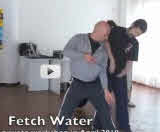
Alignment with staff;Move as One Piece;Two Halves of the Circle;Six Sealing and Four Closing detail;Fetch Water detail;Body Weight on solid ground;Hong Characteristics;Twisting Towel detail;Don’t adapt to your opponent
Presenter: Chen Zhonghua Length: 55 min. In: English Year: 2012 Difficulty:1/5 At:Italy
Guidance of a teacher is meaningless without a common experience between the teacher and the students
Any time you have a large surface of contact you are double heavy – no surface – only use a dot. The exception is when you intentionally create a large surface to counter your opponent’s particular action.
 This “natural” is not your “natural”. The master said so right at the first meeting. His explanations later on were mainly based on how to separate “self” from the objects that we observe. The “nature” taiji talks about is about the real nature out there. It is the one outside of self. Not the one the observer feels, sees, or believes. The master used the analogy of chopsticks to illustrate the Read more
In Practical Method, when we want to move foot forward, back, or side, we need to have the weight shift to the supporting leg and “pump” the other leg out. In other words, the leg which is moving out will not interfere the whole body balance. It’s independent from the rest of the body. It can move freely. The taiji terminology for this is “Chan Chu” (Shovel out). Read more
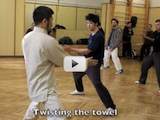
The Core Structure of Taiji Body;Twist Towel Detail; Double negative detail;Yilu 1-13 detail; Simple application drill;Stepping drill; Definition of open and close;
Presenter: Chen Zhonghua Length: 46 min. In: English Year: 2012 Difficulty:2/5 At:Prague
The most pervasive human behavior is rationalization. Rationalization happens after people make a mistake.
Here is an example. On our 2004 trip to China, a Chinese master was explaining a technique to Yaron Seidman. He said that his arm was so rubber-like that it was not possible for Yaron to catch it (usually catch means to render it straight thus losing ability to neutralize). Read more
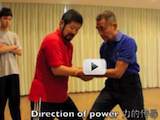
How to find the dot; Direction of power; Level of power and distance; Switching of power
Presenter: Chen Zhonghua Length: 41 min. In: English & Chinese Year: 2012 Difficulty:2/5 At:Singapore
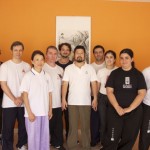 Master Chen gave a seminar in Guaratinguetá, Brazil (near São Paulo) in November 2012. He asked me to post my notes, and so here they are. I am posting the summarized version now, and will post more detail on these from time to time.
The seminar was amazing. Our teachers and students had the good fortune to be left with not just a lesson in Taiji, but also with lessons to be applied in their lives. Read more
 To start off I thank Master Chen for inviting me to write this an article comparing juggling and Taiji.
I am both a juggler and a taijiquan practitioner. This doesn’t mean that I am good at either of these activities, rather that I persist in doing them. I have noticed several common points between juggling and taiji, though even in they differ even in these commonalities. Read More
 I had always believed that the Hong Junsheng school of Chen Style Taijiquan Practical Method was not for curiosity seekers. All who gravitated to Hong were serious students or masters of Taijiquan.
So much so that a certain master named Zhao was not ready to join Hong’s classes, even after observing training at Daming Lake for three days. Zhao had come to Jinan from the eastern part of the province in search of Hong Junsheng. When he saw the dedication of the students and the level of difficulty of their practice, he decided to look elsewhere. (When I spoke with him, years later, he recalled that even the old people were doing Hong’s taiji in very low stances). Read more
 Just one more Yilu…
Everyone was training inside, while i had chosen a small space in the yard outside by the entrance of the academy, Master Chen walked by and said -“oh, you really wanna get a sun tan”. It was really hot that day, but as i did my Yilus and sweat started covering my face, i remembered much of how all of this started, why i originally choose Martial Arts, and everything that lead me to Taiji. Read more
 Famous Bagua Grandmaster Ge Chunyan will teach a 5-day seminar on Daqingshan, Wulian, Rizhao city, Shandong province, China from May 27th to May 31, 2013. Grandmaster Ge is a 5-time champion of Bagua in China and Taiji champion. She was the former famed Beijing wushu team coach. More about her: http://bafangwushu.com/
 It’s easier to know the Dao than to believe in the Dao;
It’s easier to believe in the Dao than to act on the Dao.
It’s easier to act on the Dao than to gain the Dao.
It’s easier to gain the Dao than to keep the Dao. Read more
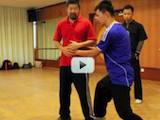
Basic requirements for the circle; The gearbox in Taiji; Meaning of “Don’t Move”; Error and relevancy; One-third stance. Presenter: Chen Zhonghua Length: 45 min. In: English/Chinese Year: 2012 Difficulty:2/5 At:Singapore
The staff here at Daqingshan have finished the form, now they begin the process of refining and correcting and practicing, lots of practicing.
[wowslider id="12"]