Presenter: Kelvin Ho Length: 70 mins Difficulty: 3/5 Language: English Year: 2021 Location: Toronto, Canada
This class covers the following:
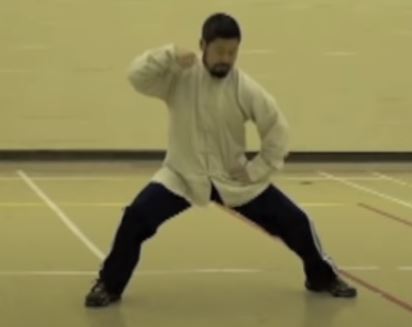
1) Cannon Fist Corrections for some students 2) Review of the Large Six Sealing Four Closing foundation exercise 3) Train the Small Six Sealing Four Closing - Idea of two cylinders (gears) - Kua initiates the rotation, shoulder and elbow coordinate - Front hand stays on the track and it is squeezed out
Presenter: Chen Zhonghua Length: 2 mins Difficulty: 3/5 Language: English Year: 2021 Location: Edmonton, Canada
The hand must be fixed on the target and will never move off. The rest of the body must make their way via curvatures to aim at the hand. The elbow is the first to do so. If you know how to deliver power from the elbow to your hand, you can do the rest. Master Chen Zhonghua shows how to do this.
Presenter: Kelvin Ho Length: 63 mins Difficulty: 3/5 Language: English Year: 2021 Location: Toronto, Canada
We discussed about Large Six Sealing Four Closing today.
1) Line up the front hand with the rear shoulder. This is our non-moving track of our action. 2) Start with the elbow placed horizontally. 3) Bring the front elbow into the track horizontally. 4) Bring the front shoulder into the track without popping. 5) The front hand must stay on the track. 6) Put a wall in front of the front hand, and a wall behind the rear shoulder. These walls square up with each other. The rear wall absolutely does not move. 7) By bringing in the front elbow, the wall in front of the hand is squeezed out. The wall represents some amount of resistence for the front hand, so the front hand can't move freely by itself. 8) When the hand meets the resistence head on, we rotate the elbow slightly to go over, then we continue with the linear motion. We repeat this process many times over to get the front hand travel along the track. 9) After the hand can't go any further out along the track, we reset to the starting position and repeat the exercise.
Presenter: Chen Zhonghua Length: 1 mins Difficulty: 3/5 Language: English Year: 2021 Location: Edmonton, Canada
First you have to have a true rotation. Why are we saying this? Because the human body is not designed to rotate. So you cannot assume you can rotate. We also need to know that while you rotate, you must step forward to gain advantage over your opponent. This simple exercise that Master Chen Zhonghua shows will give you that bit of special power.
23rd:
Three iron hat. Head(fixed), shoulder/waist/kua(can be flexible), knee. Make sure the power is not leaked out. Big inside moves, outside is locked, so the power is contained, compressed and trapped, and it goes back to the floor. Move with pressure is the training.
Kua and elbow. When the kua is indented/short, we tend to overdo the elbow(too straight). The buttock should be hidden under by filling the kua. Read more
Presenter: Chen Zhonghua Length: 1 mins Difficulty: 3/5 Language: English Year: 2021 Location: Edmonton, Canada
Cut-Hand is part of the Cannon Fist form. It is an application designed to break the opponent's arm. How does it work? What do you use to do the cutting?
Lever: one side goes down, but it actually needs to move, so the pivot keeps moving backward within the rod.
Book exercise: Not allowing the book to fall down with your hand and opponent’s hand on it. One person pushs and pulls, the opponent matches the action with the elbow, shoulder, kua, feet.
Presenter: Chen Zhonghua Length: 4 mins Difficulty: 3/5 Language: English Year: 2021 Location: Edmonton, Canada
A major characteristic of the Hong Junsheng Practical Method system of Chen Style Taijiquan is its concave circles. Other styles of taiji mainly utilize convex circles. Another trailer of concave circle: https://www.youtube.com/watch?v=LwXPmj0N6LU
Presenter: Chen Zhonghua Length: 1 mins Difficulty: 3/5 Language: English Year: 2021 Location: Edmonton, Canada
A major characteristic of the Hong Junsheng Practical Method system of Chen Style Taijiquan is its concave circles. Other styles of taiji mainly utilize convex circles.
Presenter: Chen Zhonghua Length: 5 mins Difficulty: 3/5 Language: English Year: 2021 Location: Edmonton, Canada
Master Chen Zhonghua shows how to create a fist hit by locking the torso and stretching/grinding the armpit. This is part of the system that requires the power to be generated from within through rubbing, grinding, twisting and opening.
First step in the first move:
After the right turn, my left hand is on the opponent’s elbow not moving, while my right hand holds the opponent’s wrist. Lock my outside, shrink the distance between my right elbow and right kua. This is to fali 发力.
3-count positive circle:
Imagine a fixed point beyond the right hand on the straight line between the right hand and right elbow. Pull in the elbow along this line.
Imagine a fixed point behind the right kua on the straight line between the right kua and right elbow. Open the kua to stretch and extend the distance along this line.
Imagine a fixed point behind the right elbow on the straight line between the right elbow and the right hand. Stretch the right hand out along this line.
Presenter: Chen Zhonghua Length: 5 mins Difficulty: 3/5 Language: English Year: 2021 Location: Edmonton, Canada
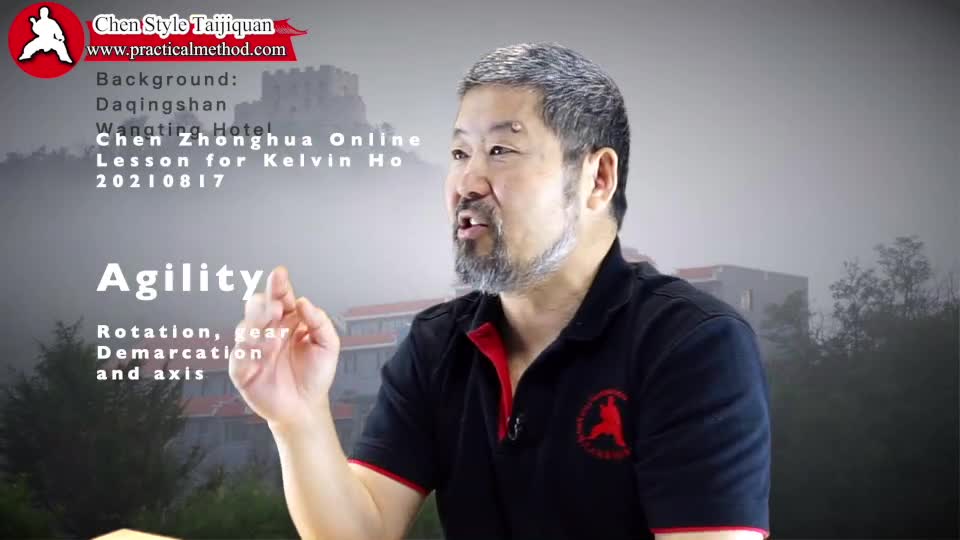
Agility is a special taiji quality that one must possess in order to make taiji push hands work. This quality involves ability to bear heavy weight while being totally mobile. An object that shows this quality is a ball-bearing. This is a clip of Master Chen Zhonghua's online class covering for Kelvin Ho.
One of the actions of taiji is to scoop/carve. It is like when you use a spoon to pick up soft/jello-like yogurt. You can put the spoon on the surface and rotate under it to pick up what the spoon can hold. By tossing it in the yogurt will on disturb and destroy the yogurt.
A static version of this is a half-pipe/concave circle. When an object hits it, the object will travel on it and return.
In this video clip, Master Chen Zhonghua shows how to lock the rear kua as the stable support while moving the front kua. This will create a trajectory that will return the opponent’s oncoming force.