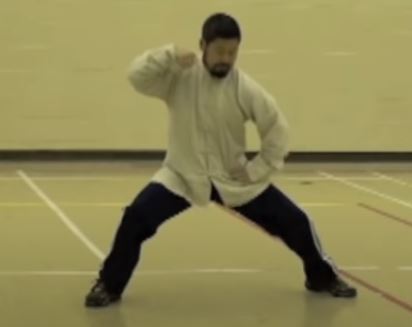
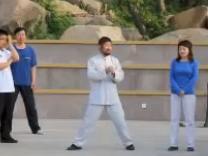
When issuing power, the shoulder must stay stable, not popping up or moving, in order to transmit power from hand to foot, or vice versa.
Knowledge : Body and Posture
Being able to “stack the joints” is an important skill in Practical Method. It means not only that all joints have to be aligned to be able to receive the oncoming force, it also means that they have to react in sequence.
 It is a fact that most modern people, especially westerners living in urbanized areas, are not as physically active as they once were. As society becomes more dependent on machines and electric tools to do the physical labour once done manually, the bodies of modern men seem to be changing accordingly. Read more
When I first started taiji training with my teacher Kee Hong, he would always say: if you want power, you have to sink your weight. In fact, I would observe his center of gravity sink whenever someone pushed him. I would also feel his push getting “under me” whenever I pushed on him.
In my experience, it is a common problem for taiji beginners to feel strain in the knee because the rules of Taijiquan say we should “rotate our hips”. When the kua (the technical term for the hip area) is not open enough, the knees tend to overcompensate and end up rotating. But the knees can only bend and unbend, they aren’t meant to rotate, so when they rotate, it leads to injury. Read more
Recently, I notice when I rotate the rear kua in a certain way to bring the knee up, a stick seems to be created between the rear kua and the rear ankle. Note that the leg itself is actually not straight, it really is just like the half horse stance with the rear side longer than the front side. It feels like this stick can support me with the proper alignment against an incoming force.
Anyone who has done some form of Taiji for a while has invariably come to know the importance of sinking the shoulders. Master Chen Zhonghua takes it a step further, however, by instructing students to “feed the shoulder to the dog!”
Taiji is supposed to be about relaxation. If that is the case, why is there such a heavy emphasis on low stances in Chen style? Doesn’t that contradict the requirement for relaxation?
The elbow leads back to the body, the hand leads away from the body
The body has 18 joints, nine on each side. They are: Read more

Believe it or not, this is from a Chinese twitter post. I often talk about actions in Taiji that are similar to this.

Master: Double checking: Aside from the Kua opening, i.e. making a line towards the opponent, the Kua also rotates? That is it turns like a wheel along that line? That feeling is rather strong lately. Thanks! Nicholas
Ping Wei is one of Master Chen Zhonghua’s indoor disciples. He lives and teaches Chen Style Taijiquan Practical Method in Phoenix, AZ. USA.
August 28, 6:30am, Phoenix, AZ. Temp: 35 C. Read more
Taiji movement is similar to movement of the umbrella top, which is controlled by the ring around its handle.
Videos below.
Master Chen corrected Levi: “You went down, don’t do that” Fetch water is a stretch on the front leg, not moving down.
Pay attention to make sure shoulders rotate in yilu practice.
Clip from Yilu Correction Collection
Clip from Yilu Correction Collection Kick is fully explained in One Leg Online Video
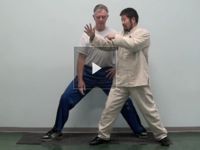
1. Beginning. 2. Circle Corrections. 3. The Stretch. 4. The Replacement Stretch. 5. Dont’ Move Your Hand!
Author: Chen Zhonghua Length: 38 min. In: English Year: 2010 Difficulty:3/5 At:Edmonton
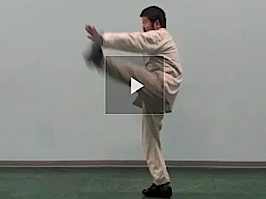
1. Beginning. 2. Tornado Kick Questions. 3. Structural Explanation of the Vertical Line. 4. Neutralization Without Absorption. 5. Neutralization with a bite. 6. Transfer of Weight on legs. 7. How to Get the 3 Vertical Lines? 8. Movement With a Center. 9. One Leg Movement in the Form. 10. Tornado Kick Explained. 11. Step Back to Whirl Arms. 12. White Ape Presents Fruit. 13. Rub Feet. 14. Kick with Heels.
Author: Chen Zhonghua Length: 25 min. In: English Year: 2010 Difficulty:2/5 At:Edmonton
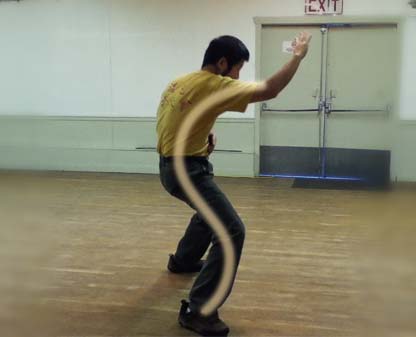
Power in Taiji comes from rotation, but how does rotation generate power?.
The key is S-Line structure that can transform rotation to movement.
Power and stability in rotation only come from proper S-Line alignment.
See Taiji S-Line Video Training for detailed explanation.
Taiji S-Line Demonstration Clip
Hi Master Chen, lately I have been feeling a rotation or opening and closing of the lower back which seems to slightly precede and facilitate the switch from kau to kua and turning of the waist. Should this be persued or ignored?
One day at lunch I pointed out a deficiency of our training to Master Chen. Read more
William: Master Chen, I have noticed that my hands get warm when I do a part of the Yilu (First Routine) correctly. What is happening ?
Zhonghua Chen: Nothing is happening. It’s just part of the progress. Stay on track. Ignore what is happening and continue to train correctly. This is where some people will start seeking the sensations that will eventually cause the practice to deviate.