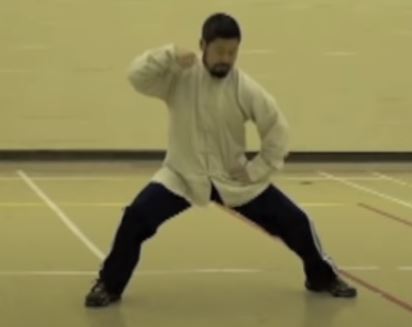
In the positive and negative circles, the thigh rotates outward in the opposite direction from the turning of the waist. This, along with tucking in the tailbone and pushing out the lower back, helps to keep the front flat so as to attain “no indentation and no protrusion”. So if the front is flat then the kua can’t fold (indentation) and the butt can’t stick out (protrusion) so the kua must only move downwards as the thigh rotates outwards for this move.
Kham Serk
Hi Master Chen,
I wanted to say thank you as I succeeded to use what you taught us at the last seminar when facing a very bad situation. Last Friday, I was seriously verbally aggressed and threatened with a knife and taiji philosophy saved my life. I used a lot of psychology, lots self-control not to show my fear and to disarm my attacker, and good communication skills that also disarmed him. I managed to get out of the situation without a single scratch god thanks! I was thinking of those principles that you taught us and I used them in a psychological fight instead of a combat fight and it worked very well. Read more
- Worked on Yilu form to half mark.
- Completed basic foundations.
- Push hands.
- Master Ai Shenghua from Weifang came to visit. He is currently in Toronto on a work permit.
- We welcomed Allan Haddad to our workshop.
- Worked on how to find the exact opposite and stretch on it.
- Worked on using your opponent’s pushing force as a point of anchor to get in/close to the opponent.
- Made individual corrections.
I watched the Toronto Workshop 3-4 video today. I got a different understanding on the material presented. Although I was there at the workshop, I didn’t really understand much at the time as I was so new to Taiji. I had no clue on many of the concepts.
Read more
I just had my third taiji workshop with Master Chen in the last weekend (May 22-23, 2010). I had an extreme great time in this workshop. I was really glad to have him confirmed my little improvement thus far, in particular: my yilu form is starting to take shape, and I am not moving my hand (or at least as much as before).I would need to continue to work hard, so that I don’t regress, and hopefully continue to improve.
Read more
Master Chen mentioned in the last workshop about the concept of 45 degrees. He was referring if there was an incoming energy directing at you at 45 degrees, one way to react would be to push at 45 degrees w.r.t to your body. Doing a rotation would be the same thing.
Here is my understanding after thinking about it:
The outgoing energy will be perpendicular to the incoming force. For the rotation part, a tangent of a circle is always perpendicular to the centre, so it is the same thing.
Earlier today, I was doing some gardening at my backyard. I had to create a flower bed, so I needed to remove some existing grass. I was using this half-circular flat shovel usually used to create a nice edge. At first I was using it perpendicular to the ground, trying to cut through the grass and its roots by hammering it or stepping onto it. It didn’t really work. The shovel wasn’t sharp, and a fair amount of the force going down to the ground was bounced straight up back to my hand. By accident, one of the hits landed at 45 degrees to the ground, and on impact, the shovel slided across horizontally, and it worked much better like a knife this way, and my hand didn’t feel any rebounding force. I believed that this could be explained in physics, however, the more important point was that Master Chen demonstrated something quite similar before.
You push on something in one direction, and since the hand couldn’t get advancement, it went to a different place.
I found this taiji thought during gardening interesting.
Head Shaolin & Tai Chi Chuan Instructor
(Posted with permission from the author)
Within Chinese culture, any traditional skill may be passed down from master to disciple, whether it be martial arts, scholarly arts, painting, cooking, even the art of being a barber or an executioner. Becoming a disciple forges a unique bond between you and the long line of ancestors who forged your tradition before you. It is a very special relationship between master and disciple, full of ritual and meaning. You become family. However, like so many aspects of Chinese culture, it is woefully misunderstood by outsiders. Read more
Most traditional Chinese martial artists use ‘internal’, i.e. the timed squeezing of their torsos, to STOP or brake the momentum of limb movement. What you do is to START (and brake and stop) the movements of your limbs using the timed pressure in your torso.
Hello all my Taiji brothers and sister!
I just registered this site, and breaking it in by dropping you all a line and say “hello”. I look forward to seeing old friends and meeting new ones on Daiqingshan this August! I will be accepted as a disciple! I am very excited about it!
Nicholas
This article first appeared in the May/June Issue of Brazil Tai Chi
Magazine (Revista Tai Chi Brasil), and has been translated from
Portuguese to English. Read more
It was good to come to the Edmonton class after a long absence. Thanks to Allan and Yen for taking over classes in my absence. We worked on concept of splitting from the kua, using the “fetch water” as a drill. From the kua and elbow, everything moves down and up with the kua and elbow as the central points. However, the kua must move horizontally forward while the up and down moves are being executed. Here are some photos of the move.
Read more
You won’t believe me if I told you that we spent three hours working on the first move of the
positive circle. That’s what we did! Of course we also went through the entire circle in 9 moves as a warm up. We worked on not moving the hand; block touching coat and drills. Time to get some sleep for tomorrow’s workshop!
Read more
May is locust flower season on Daqingshan, China. In previous years, we held our annual full time taiji courses on Daqingshan from May to July. This year we have a late start in June. Here is a photo of the locust flower on Daiqngshan last week for those who miss the sweet aroma of the flowers and the hum of a million bees.