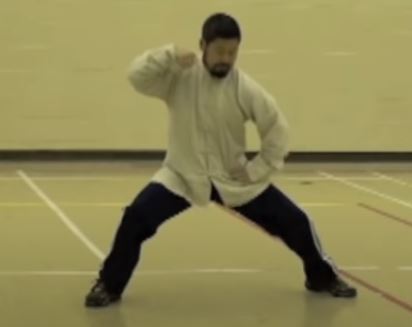
I am wondering, is it just me or everybody feel the same that practical method, quite challanging in learning…..
Q: i am wondering, what should i do in order to make sure all my learning is correct. Any advise ?? 2
Wayne started learning the yilu in Oct 2011.
O’Keefe Centre
St. Thomas University
Fredericton, NB
 Chen Zhensheng, also known as Waterheart, Gonghe, and Liaoweng. When he was young, he studied Chinese wrestling, Shaolin and then Yang style taijiquan, Sun Style Taijiquan , Wuu Style Taijiquan and Chen Style Taijiquan. He became a disciple of Grandmaster Hong Junsheng in 1978 in the lineage of Chen Style Taijiquan Practical Method. He is a major lineage holder of Chen Style Taijiquan Practical Method.
In my experience, it is a common problem for taiji beginners to feel strain in the knee because the rules of Taijiquan say we should “rotate our hips”. When the kua (the technical term for the hip area) is not open enough, the knees tend to overcompensate and end up rotating. But the knees can only bend and unbend, they aren’t meant to rotate, so when they rotate, it leads to injury. Read more
1. Introduction. 2. Open and Close. 3. Open Triangle in the body. 4. Experiments with the open and close. 5. Six Sealing and Four Closing exercises. Presenter: Chen Zhonghua Length: 39 min. In: English Year: 2011 Difficulty:3/5 At:Maple Ridge, B.C. Canada
New Year’s day, a beautiful sunny day in Phoenix, Arizona. Today’s training theme is Yin and Yang split.
Over the past few months I have noticed something becoming more and more prominent. On elbow in, I hit this “sweet spot” where it feels like everything is locked up to it’s maximum – very stiff almost bone on bone feeling in between the joints, yet muscles are softish. So much so that the tip of my fingers vibrate as if from reverberation. I don’t get this feeling from any other movement, so I’m not sure if this normal?
Recently, I notice when I rotate the rear kua in a certain way to bring the knee up, a stick seems to be created between the rear kua and the rear ankle. Note that the leg itself is actually not straight, it really is just like the half horse stance with the rear side longer than the front side. It feels like this stick can support me with the proper alignment against an incoming force.
Anyone who has done some form of Taiji for a while has invariably come to know the importance of sinking the shoulders. Master Chen Zhonghua takes it a step further, however, by instructing students to “feed the shoulder to the dog!”
Taiji is supposed to be about relaxation. If that is the case, why is there such a heavy emphasis on low stances in Chen style? Doesn’t that contradict the requirement for relaxation?
 Eventually, higher level students of Taijiquan come realize that the power produced in practice should never be produced by the muscles. But if it isn’t produced in the muscles, where does the incredible strength, flexibility and speed of the great masters come from? I believe this question can be answered by understanding the amazing system of tendons and ligaments which connects the muscular and skeletal structures. Although many people like to believe that “qi”
Singapore Workshop
Instructor : Master Chen Zhong Hua
Date : 25th & 26th of Feb, 2012
Time : 10am to 5pm
Location : The Grassroots’ Club, 190 Ang Mo Kio Avenue 8, Singapore 568046
Topic : History, Theory, Foundations, Yilu (1st 13 moves), Push Hand
Cost : SGD260 for 2 days, SGD180 for 1 day
Contact : Michael Koh at (65)96680069 or michaelkoh@hotmail.com
http://www.youtube.com/watch?v=nmU_ZZwiDAw
[nggallery id=160]
[nggallery id=159]
The elbow leads back to the body, the hand leads away from the body
 1st Australian visit by Master Chen Zhonghua in March 2012, Sydney and Canberra. Registration and more info: chenpracticalmethod.com.au
“People work very hard for a long time to acheive the wrong things.” -Chen Zhonghua
The Master once said, “Everybody in the world uses momentum-based movement, therefore we do not. Taiji involves ‘contained spiral force’ that generates momentum on something external to oneself.”
When you fix your eyes on the target, you can truly rotate your body. Otherwise, you are just tossing!
A good video to compare with the Victoria 2009 yilu (the one in the left sidebar). Please comment your observation of the differences.
There must be a proportional dispensation of movement, or in other words, one body part should not be outdoing the others.
Part five of the 2011 4-day Toronto workshop on Chen Style Taijiquan Practical Method by Master Chen Zhonghua. Presenter: Chen Zhonghua Length: 85 min. In: English Year: 2011 Difficulty: 3/5 At: Toronto
Open for discussion. Consider:
- Theory:
- What is right and what is wrong.
- What is possible
- Reality:
- What you can achieve.
- What a human can achieve.
During a weekend workshop in Maple Ridge, B.C. Canada on Dec. 18, 2011, Gino Nasato of Victoria, B.C. Canada became Master Chen Zhonghua’s latest disciple in the lineage of Hong Master Hong Junsheng’s Chen Style Taijiquan Practical Method system. Gino is Master Chen Zhonghua’s 90th disciple.
The ceremony was attended by 16 people from Maple Ridge, Vancouver, Seattle, Vancouver Island and Philadelphia.
[nggallery id=147]
 This time a long time student of Master Chen James Chan from Philadelphia joined us. Lots of push hand on Sunday as four students from Seattle joined us. Topics covered:
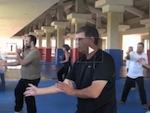
This is the private portion of the workshop. Students work on specific skills, not necessarily suitable for the general public. 1. Workshop. 2. Discipleship. 3.Student yilus. 4. push hands instructions. Presenter: Chen Zhonghua Length: 64 min. In: English Year: 2011 Difficulty:4/5 At:San Juan, Puerto Rico
I’m still at the “slow” phase.
Edwin started learning the yilu in Oct 2011.
It seems to me that most people are not aware of the spiraling that should occur throughout the body while doing Taijiquan. Even though most people must have seen the ancient diagrams of a body coiled in lines representing the spiraling paths of the silk reeling energy (chansijin) characteristic of Chen style Taijiquan, very few people seem to be able to explain or even understand what this principle actually is. Obviously, it is not only important to know how to create spiraling throughout the body, but also to understand why spiraling and the unique energy it creates is so important to the art.
The only difference between the master and student is that the student learns publicly and the master learns privately.
Chen Zhonghua’s Chen Style Taijiquan Practical Method in Yantai, China.
Contact Master Huaizhong Li
at: 13605359901
email: lihuaizhong88@hotmail.com