Presenter: Pavel Codl Length: 0 mins Difficulty: 3/5 Language: English Year: 2019 Location: Edmonton, Canada
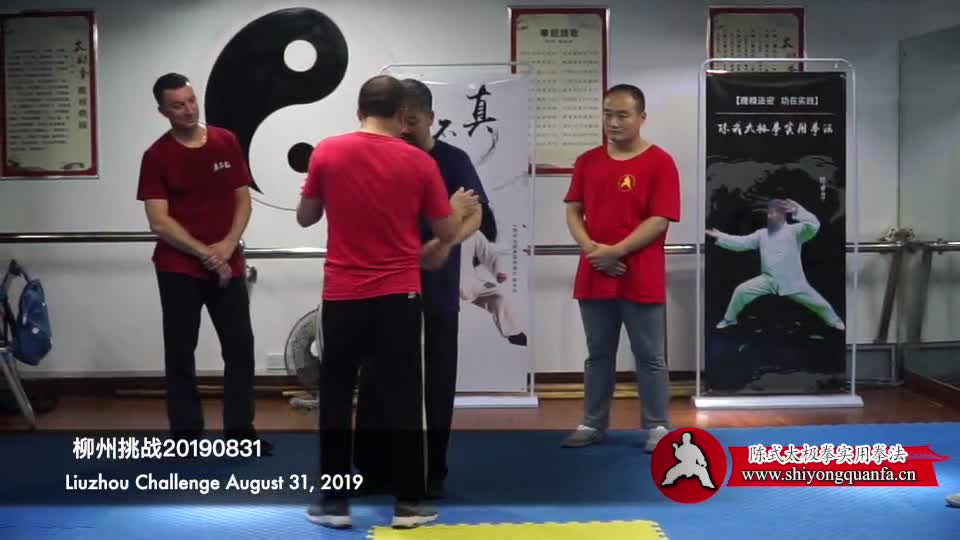
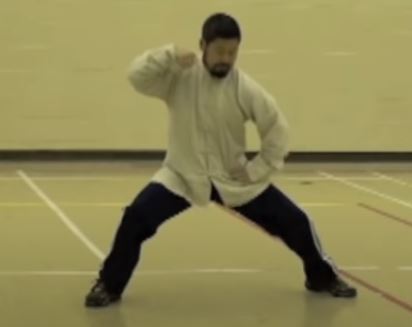
As you can see this guy came to the workshop to make trouble. He pretended to be a student and used the instructional occasion to issue a surprise attack. This clip showed the reaction time and way of reaction. What happened after that is not shown. It became a real fight and for legal reasons, the rest is not shown.
Please watch as discuss what you see and what you think.
During a meal at the latest Iowa training camp, I was speaking to Mater Chen about an event that happened a couple years ago at a workshop in Phoenix. That chat prompted me to retell the anecdote now.
Master Chen was demonstrating a Chen Style Taijiquan Practical Method counter-attack from a right strike/right foot forward. I asked him how he would counter a right cross strike (with the left foot forward). As I would find out later, he wasn’t familiar with the term “right cross” so he simply asked me to execute one at him.
With my left fist protecting my chin, I began to throw the right. Before I was able to issue the punch, Master Chen was inches away from me, the fingers of his left hand grabbing my throat and his right hand had my left in a joint lock. I was tapping-out, as the pain from the joint lock was debilitating.
I did not telegraph the strike, did not blink and did it at full speed. I could not understand how a moment of time was seemingly lost – between me initiating and him arriving. It wasn’t just speed: I’ve sparred with professional fighters and know even very fast movements can be tracked with the eye.
Having thought about this event many times since, a video with Master Chen discussing “indirect movements” caught my attention. He said Practical Method indirect movements cannot be easily detected by an opponent. It’s all in the training: do not move.
Last week we concluded another great workshop/training camp in Iowa with Master Chen. There was a good turnout with around 50 attendees. The vibes were good and the lessons were clear and concise.
Probably the biggest thing had to do with the learning process: The questions that arise in my mind are usually off topic and I think their purpose is to distract me from paying full attention to what Master Chen is teaching at the moment. By asking them out loud I’m distracting everyone else too. My mind doesn’t want to give up control. Read more
Comments on 2019 North American Practical Method training camp
From my perspective, this year’s training camp was outstanding! I came with the thought that I had progressed a lot but after a short time I realized (as usual) I have so much to learn. I am basically a very beginner but I can see that each time I attend a function with Master Chen I can get a little better grasp of what he is teaching. Read more
I am an interpreter from Inner Mongolia, I continued to learn practical method for third time during the month of July .I felt honored to learn with Shabar from New York and Mike from France. Read more
This morning was my first post-training camp workout, and it was awesome. My mind was flooded with all the great corrections and insights Master Chen gave us. There was a virtual wooden TV tray on my head during the yilus (private lesson reference). Read more
The kua has to come out (draw a line forward with the kua). Don’t move anything but the kua.
Partner exercise: partner sets a dot a few inches in front of the kua; you have to get your kua to touch it.
Add speed – do it 5 times fast. Add power – have someone hold onto your kua from the rear. Add stepping – connect it to your elbow and don’t let the elbow move.
Learning – have to make ideas based on physical reality, not on ideas.
I moved out of Vienna and I‘ve been thinking how I could offer Practical Method classes here in Lower Austria. In Vienna I started a group from scratch, together with Fabian. But with three kids now and a full time job I simply have no resources to start a group this way. “There must be a better method” I thought. And, as is often the case at the country side, my neighbor helped me out. Read more
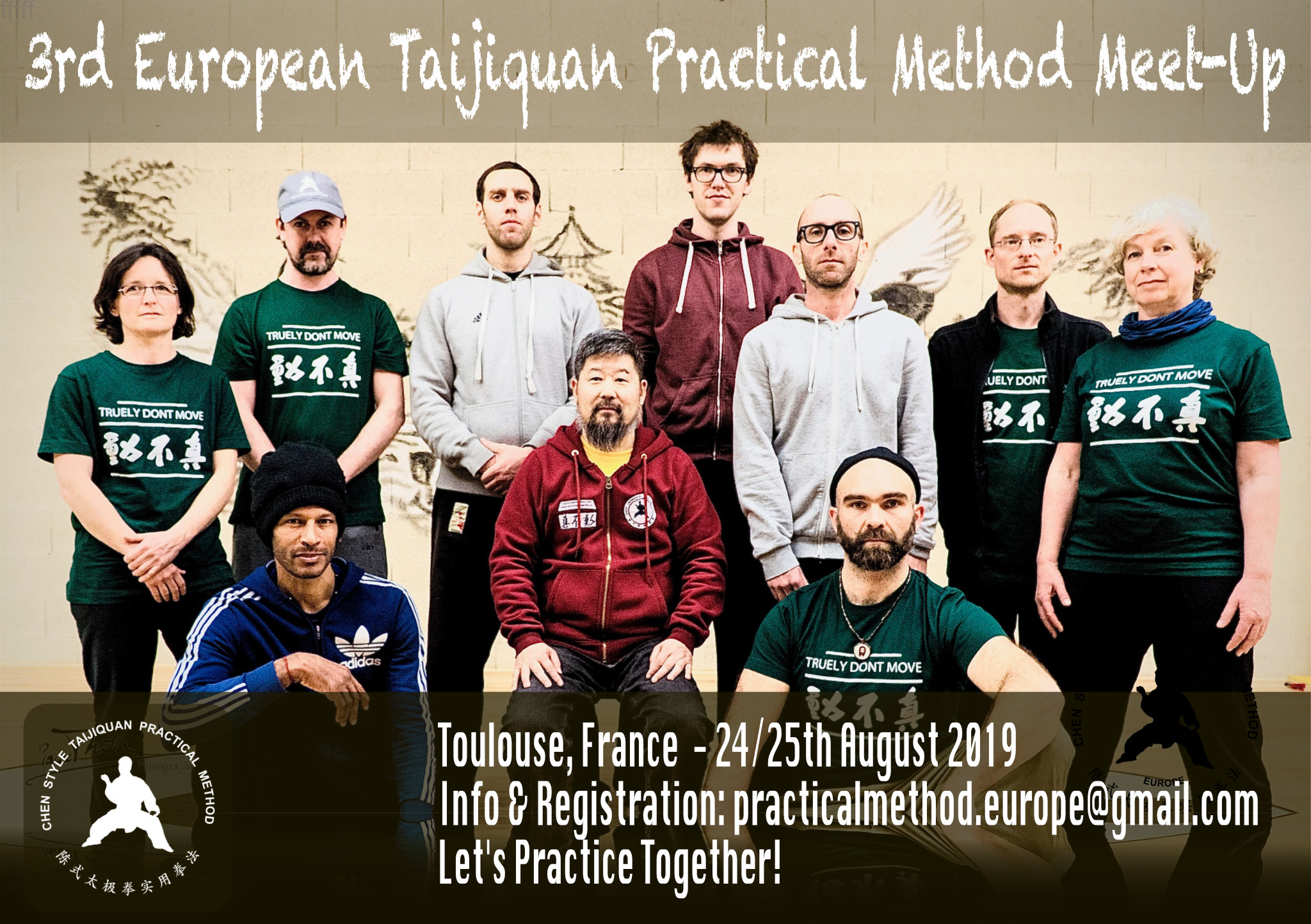
It’s the third year since we started the European Chen Style Taijiquan Practical Method Meet-Up Series. It continues this year in Toulouse, France in August 24/25th at the Main Garden Square or at the 3 rue du Gorp 31 400, depending on weather.
During a workshop earlier this year, Master Chen recommended that we utilize the “Yilu Record” tab to track our practice. As a result of starting this, I have found that it motivates me to basically do more, and to practice more consistently. Recording progress provides definitive feedback on effort and accomplishment. I have found it to be a very positive tool and extremely easy to use.
How to engage the waist
1) Move the waist first.
a. What it looks like: Have it move broadly right or left prior any movements with the arms or hands. This creates a ‘foundation’ for the move to base itself off of.
b. Result: Less movement of the arms. More solid arm movement. Starting to anchor upper body movement from the waist.
2) Make sure your move is represented on the bottom.
a. What it looks like: When your upper body moves, there is expansion in the bottom. Typically both knees expanding outwards.
b. Result: Body becomes more even, action is created from the waist (and lower) rather than entirely from the top.
3) Lock one kua, in order to turn the joint. Continuing to open through multiple movements. Creates an ‘S’ curve.
a. What it looks like: The kua acts exactly like the shoulder joint, it starts to turn then locks so the other can move.
b. Result: All movement starts from the waist, and is proportionally represented on the top and bottom.
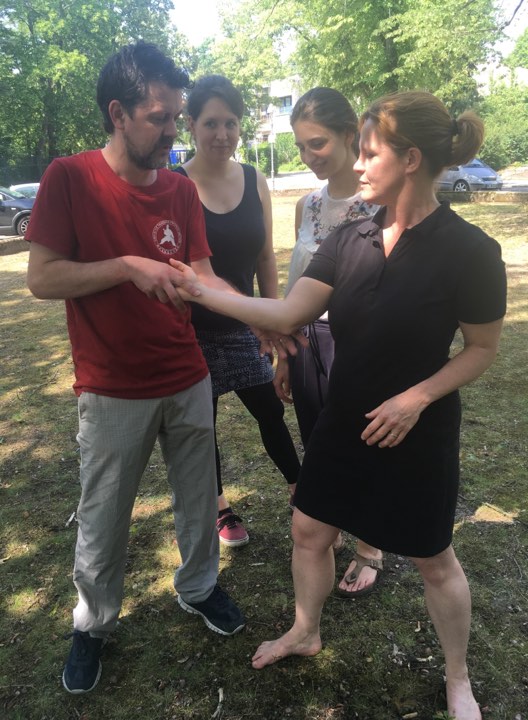
For more than a year now, Sven Gusowski from Practical Method-Berlin visits us each monday at our office at Freie Universität Berlin (FU Berlin) to do fifteen minutes of basic foundations exercises. We basically do variations of the positive circle and learn movements that can be easily repeated at home or anywhere. Read more