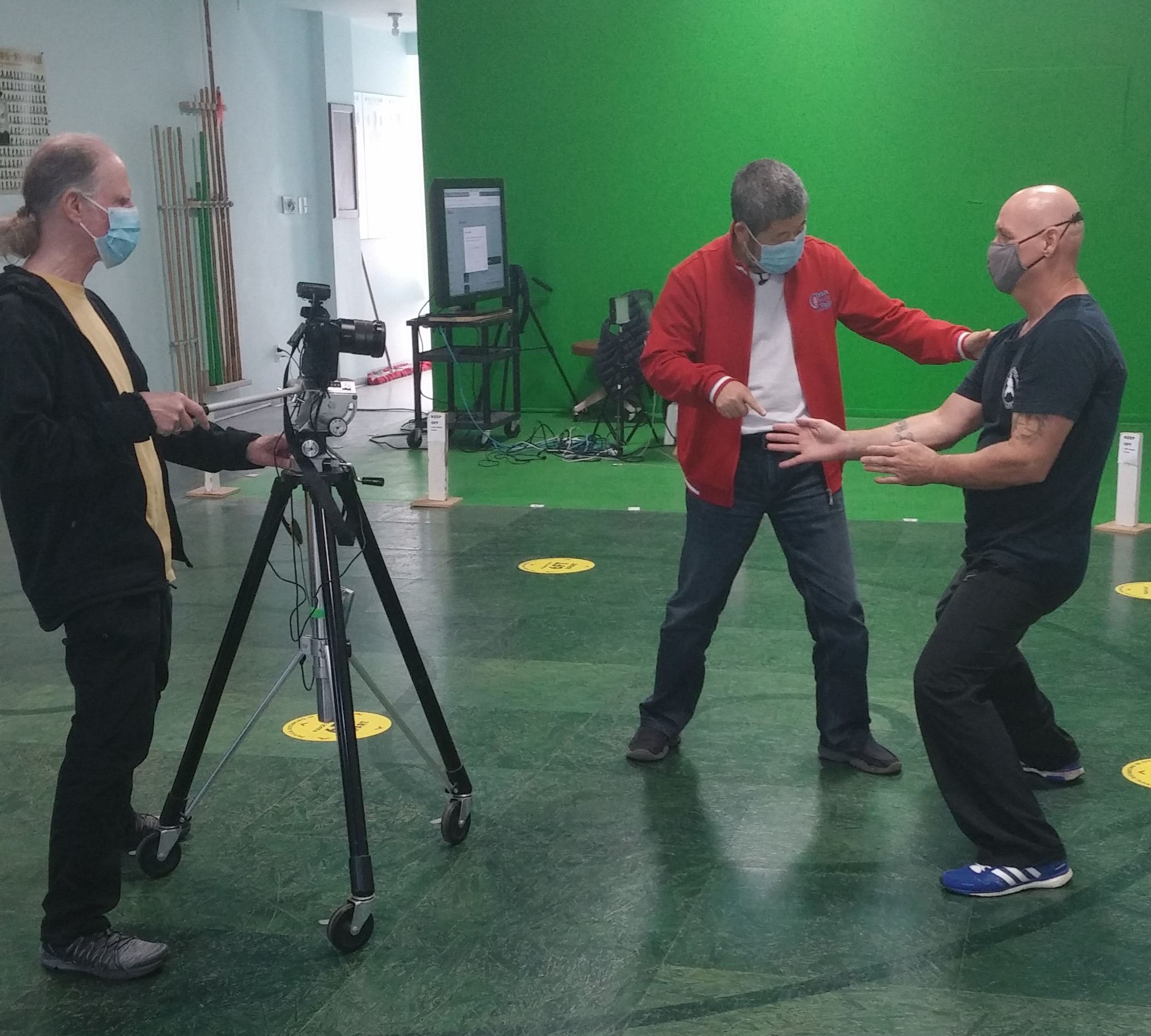
“The movements of the body are in the Dantian and nothing leaves the dantian. Only power gets out of the Dantian.”
The quote above from Master Chen Zhonghua and his assigning me to write on the dantian sent me on a journey of understanding…and to be forthright, I got stuck. I over thought things and I had difficulties “getting the ball rolling” or rather the dantian article. So being an educated person, I did what students do, and gathered up my information from the online lecture and from past videos from Master Chen Zhonghua.
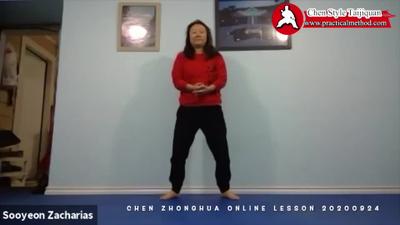
…class was a part of the online Zoom ‘Make it Real’ series of lessons, focusing on the double-positive circle…be sure to check out the posted video this review relates to…
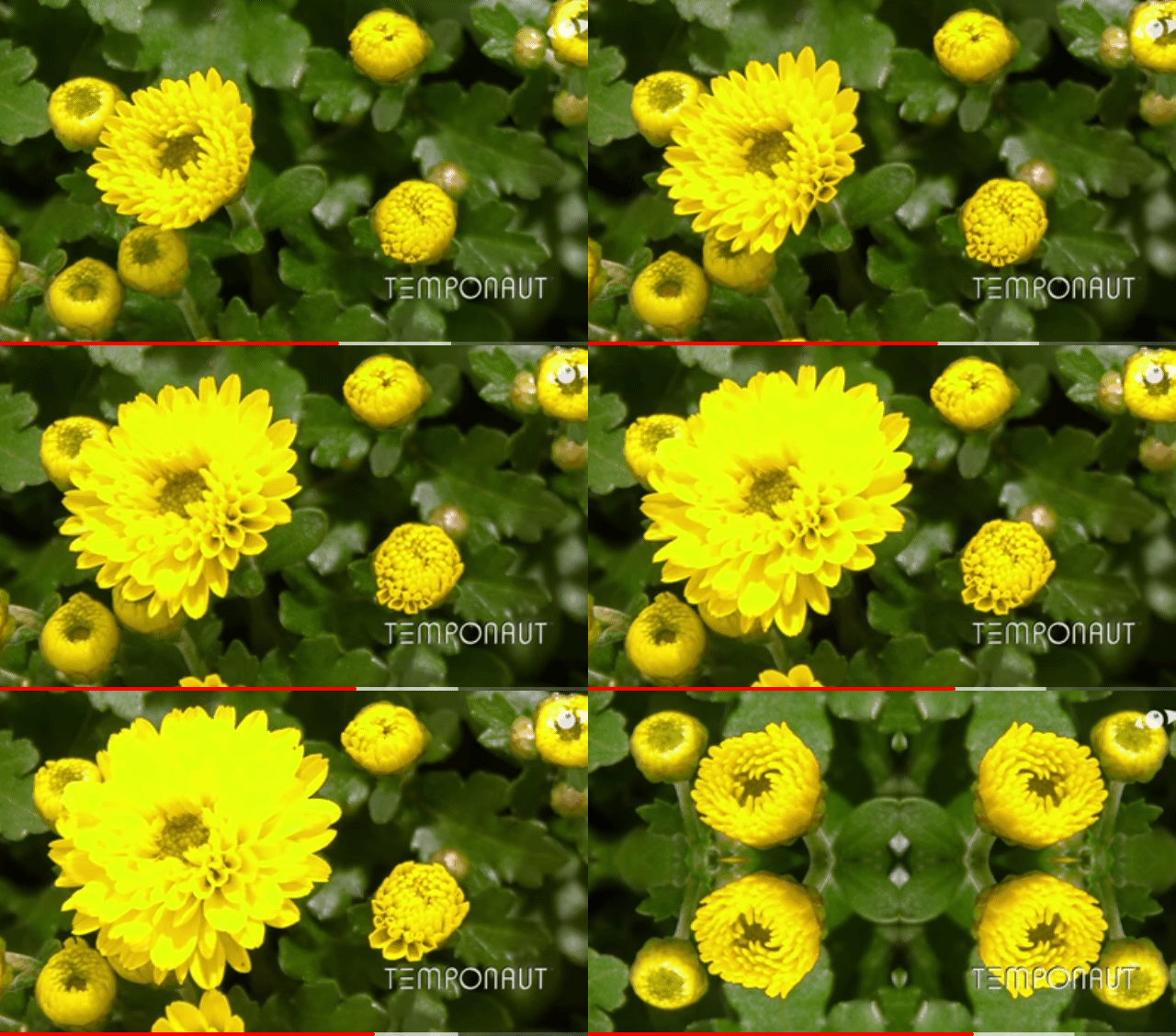
Beauty is a chrysanthemum bud opening up until it reaches it’s maximum, then withers away. If it gets disrupted, it withers away prematurely. Beauty in taiji is being fully expressed. We can’t be deficient, not reaching our maximum; nor can we be over extended…
The central vertical line (CVL) is an internal stretch that exists between the bau hui to the hui yin. I have heard Master Chen refer to this as a “rod” in the body. It should be present whether we’re doing foundations, form or push hands.
When I’m starting with students that need to strengthen the CVL, I have them do a guided imagery drill. The guided imagery was taught to me by Richard Johnson when I attended a week long workshop with Master Chen in 2011. I adopted the guided imagery and added a partner component as a means of enhancing the physical understanding and strengthening the central vertical line.
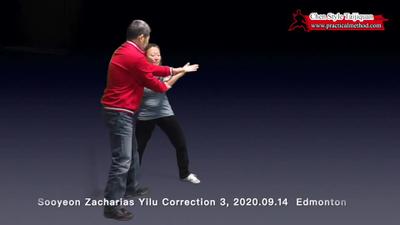
Yilu corrections for students. Mostly starting from Cross Hands. Presenter: Chen Zhonghua Length: 60 min. In: English Year: 2020 Difficulty:3/5 At:Edmonton Chen Zhonghua Taiji Academy
After many years of watching Master Chen practice taiji, it occurred to me that he moves like a predator. I have always known that he makes micro-adjustments in each muscle when he does the form, but watching it has always felt mechanical; like he is a machine, able to move each joint in his body independently. But, when I watched my cat hunt for the first time, I realized that his movements are actually very natural. Read more
Quick notes from my private lesson with Master Chen – Twisting The Towel
– assuming you know the basics adopt proper training stance with left hand forward and right hand rearward, distance between hands is the length of your opponents elbow to their wrist or hand.
– create 2 horizontal tracts, 1 thru the mid section and 1, in this case with the right hand moving forward, forearm parallel to the ground. Without proper guidance we only create 1 tract.
– the 2 tracks can only be created if if we lock or create a bite, in this case on the left side of the body
– to create the lock or bite we must stretch.
– push dow on the thigh muscle, open the kua and stretch in opposite directions, this is the lock or bite it cannot move.
– right hand can now begin moving forward.
– open the right kua and drop the right shoulder to cause compression, this will force the elbow in toward the dantien.
– the hand can now mov forward in a straight line, extend through the index finger.
– when the hand reaches a certain point in travel we must lock the shoulder and allow extension to continue by opening the elbow. to do this we must actiivate the small muscle on the inside of the elbow, This is very difficult and requires much training
– throughout the exercise the spine must be pulled up or stretched.
– when the right hand reaches full extension the process can now be reversed with the left hand moving forward.
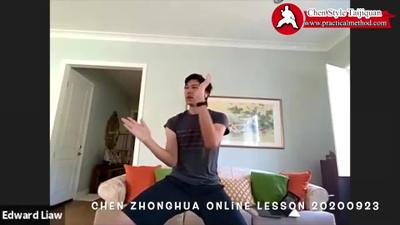
Chen Zhonghua’s Practical Method Online Lesson on Sept. 23, 2020. This lesson focused on the 3-count Cloud Hands.
Presenter: Chen Zhonghua Length: 62 min. In: English Year: 2020 Difficulty:1/5 At:Edmonton Chen Zhonghua Taiji Academy
Open the kua to cause a horizontal rotation. Lock the top by using one hand to the hold the wrist on the other side. Stretch the fingers. Where the middle finger is pointing at changes as the rotation caused by the kua happens.
Open the right kua to turn left.
Open the left kua to turn right.
Don’t let the left knee point down when opening the left kua. Read more
In learning Taiji, Master Chen would often say that we create power with size and restriction. He would also say that we must develop the ability to separate every single part of our body. This includes left and right, top and bottom, front and back, and inside and outside. Read more
Master Chen Zhonghua’s online lesson on Chen Style Taijiquan Practical Method on Sept. 22, 2020. This lesson focused on the double positive circle. Training steps of locking the arm onto the torso; rotate horizontally, rotate vertically; and rotate three-dimensionally.
Presenter: Chen Zhonghua Length: 65 min. In: English Year: 2020 Difficulty:1/5 At:Edmonton Chen Zhonghua Taiji Academy
Master Chen Zhonghua’s corrections on Roy Croucher’s Six Sealing and Four Closing. It covers the basic function of the exercise and various subtle points. Presenter: Chen Zhonghua Length: 57 min. In: English Year: 2020 Difficulty:1/5 At:Edmonton Chen Zhonghua Taiji Academy
I entered into class late and saw everyone doing double positive circles. He instructed us to do it in a higher stance with our elbows attached to our waist. Read more
– just after Roy’s 2nd private lesson with GM, it was suggested that I record his impressions about his experiences in this learning process
– I’m no journalist so bear with me here Read more
– I am beginning to understand some of the challenges in trying to describe, discuss, even think about PM in ways that pass along that information, in digestible bites to other people Read more
My Yilu video started a discussion on Facebook that Taiji doesn’t look like robotic movements.
Several people tried to explain why we practice this way until we came to the term of paper tigers.
I decided to describe in a longer post why I practice this way and for me this method works. Read more
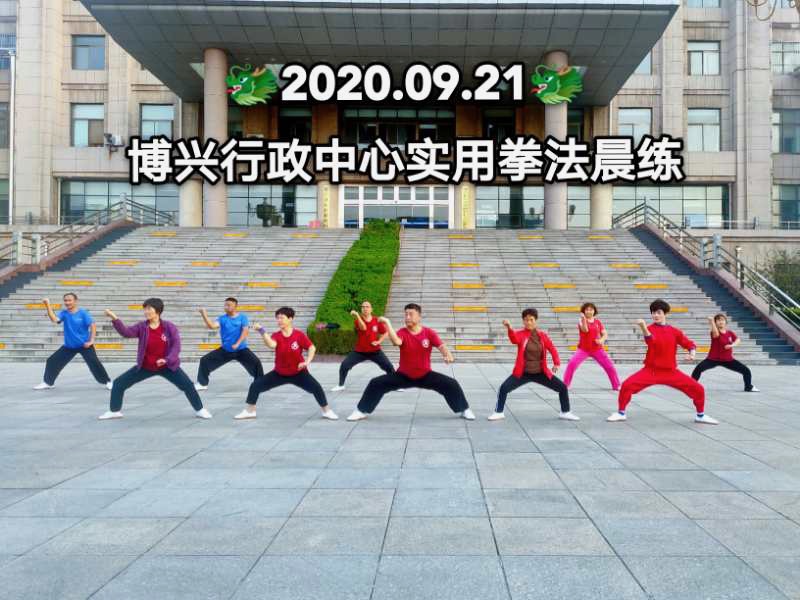
In view of the current Covid-19 restrictions, the government of Wulian held a county wide sports meet, part of it is the 8th Daqingshan Taiji Competition. Thanks to Han Rui, Qiu Liwen, Wang Guixiu and Sun Peiliang.
-so it was just myself, in back of a digital camera, watching GM teach a Zoom class, at 7:30 AM and I thought to myself, ‘Man I have to be careful of what I wish for because sometimes the fates are listening’ Read more
Your body may be tired and sore from the previous day(s), and you will ask yourself if a day of rest would be better than going to train. Go to class! Once you start moving, blood will flow, and that soreness will go away. Every class has multiple gems, but they’re only available in the moment and in the context of what is being taught. If you miss it, you miss it, which I find to be more painful than the discomfort of tired muscles.
Move with power: This is a martial art, not a dance. Every move must come from a place of power. Visualise your opponent and make sure you are affecting their body with each movement.
Our arms are not part of the movement; they are only along for the ride. EVERYTHING comes from the kua and rotation.
When Master Chen demonstrates a specific point, only look at that point. He could be sacrificing his form elsewhere in the body to emphasise something very specific. If you’re watching other things, you could be learning something wrong.
When Master Chen is demonstrating a movement, he is not teaching anything theoretical. He is showing you EXACTLY what he is expecting you to do. Do not try to analyse it. Mirror it to the best of your ability.
Training should not be comfortable. Always grind your joints that little bit further than they want to go, so they will continue to open up.
We all make the same mistakes! This was evident after Wednesday with Master Chen present for Master Allan’s class. Everyone felt personally targeted by the new elbow exercise video the following day: http://practicalmethod.com/2020/09/elbow-exercise-20200917/
It isn’t easy in the time of covid, but if possible train with a partner. The difference in someone physically stopping your shoulder from moving back, or locking your knee so it doesn’t follow, makes a big difference! (Please be safe! I’m lucky to get to train with family)
Practice your form without moving.
As always: Don’t move, only rotate!
I know I am missing so much, but it was a week of brain overload. I’m very happy with the progress I felt in my body. I was a little concerned on Wednesday as I felt a pop in my right kua. Thankfully it was a good pop. My right side has opened up a lot!
I’m looking forward to seeing the video from Wednesday’s private session. We worked through section 3, which I’m just trying to get my head wrapped around the choreography. If you’re looking for some great detail on that section, I’m sure between my session and Anton’s you’ll get great material. If you’re looking for a great taiji comedy, I’m fairly certain I played the part of the uncoordinated court jester to a T 😀
While observing my training, Master Chen explained that I had slack in my foundation exercise. He went on to clarify that when I was in a posture and started the transition to another posture the tension/stretch was lost. This stretch must be maintained even if one is letting a joint adjust. Master Chen used the example of the elbow, the section below the elbow must be like a stick, and the section above the elbow must also not be slack. To elaborate, Master Chen said to think of a car. Even though the gears rotate, the physical structure of the car is solid. He said that this concept of removing the slack must be used on all parts of the body so that in push hands you will not collapse under the push of your opponent.
Next, Master Chen spoke on posture. He was pointing out the delicate balance of where the knee placement was relative to foot on the front leg. During this demonstration I made a learning error which I will share for the benefit of readers:
Master Chen was showing me specifically the placement of the front leg, pointing to the front leg to make that clear. After I was convinced that I had an image of how his leg was positioned, I moved around to get another perspective of the overall posture, this is a mistake. Master Chen pointed out that he was specifically making sure that the front leg was correct so that we could learn from the placement. He went on to say that he may even sacrifice some other aspects of his posture to make sure the single point is demonstrated as accurately as possible, so if we as observers look elsewhere we may be copying an incorrect body position.
Specific to the posture, Master Chen demonstrated when the knee was too far back how there was an inability to get full power out of the front lower leg muscles (Tibialis anterior, and Extensor digitorum longus from what I felt). When the knee was bent too far forward, Master Chen demonstrated the inability to get a bite (also resulting on the muscles not engaging). Once the position was correct, he demonstrated that a bite could be obtained, and this could be felt through the Master Chen’s leg muscles.
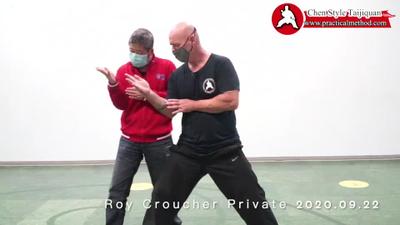
This is Roy Croucher’s second private lesson. This lesson focused on the mechanics of Fetch Water, one of the foundations exercises.
Presenter: Chen Zhonghua Length: 55 min. In: English Year: 2020 Difficulty:2/5 At:Edmonton Chen Zhonghua Taiji Academy
Practical Method requires that the elbow cannot be hyper-extended. It cannot be strange. In our special language/terminology, we open the elbow with a result that it becomes lively (活).
This exercise is designed to form a habit that the elbow is always slight bent.