 |
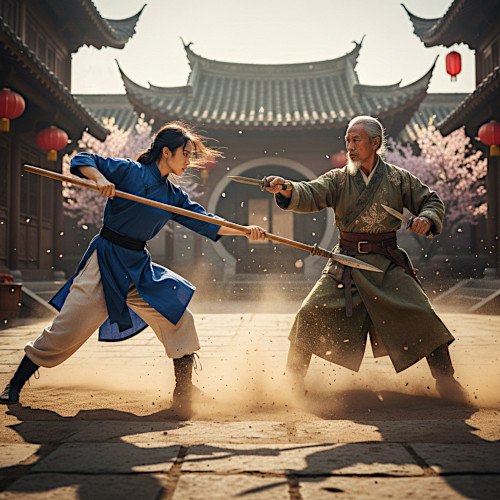
A classic Chinese martial arts principle states: “One inch longer, one inch stronger; one inch shorter, one inch more dangerous” (一寸长,一寸强;一寸短,一寸险; Yī cùn cháng, yī cùn qiáng; yī cùn duǎn, yī cùn xiǎn.). This emphasizes the importance of tool mastery, distance control, and the contextual nature of danger.
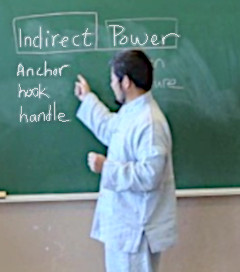
In the Practical Method system, this principle is manifested through Indirect Power. This involves using a “handle” or a “hook” to execute pushes and pulls, rather than relying on direct limb strength. |
| The strategy is rooted in distance control: Positive Indirect Power increases the distance between an anchor and its power source, while Negative Indirect Power decreases it.Both strategies maintain the serene quality of Taijiquan while producing drastic results. Negative Indirect Power, in particular, prioritizes structural alignment and spatial manipulation over local exertion. Unlike direct force, which relies on tension at the point of contact, it utilizes a two-stage process rooted in the principle of non-movement. By mastering this dual strategy, the Practical Method creates a system engineered to lure, enter, and control the opponent within that treacherous, intimate space—achieving decisive results through leverage rather than conflict. | |
| (This is is an articles is based on the Theory and demonstration of “Indirect Power” filmed in Ottawa, Canada Dec 3, 2014.) |
|
 |
Part 1. Don’t Eat with Your Hands
Part 3. Learning How to Fish
Part 4. Yang Actions
Part 5. Yin Actions
Part 7. Not using force is a magic trick
|
Part 5. Yin Action
Negative Indirect Power
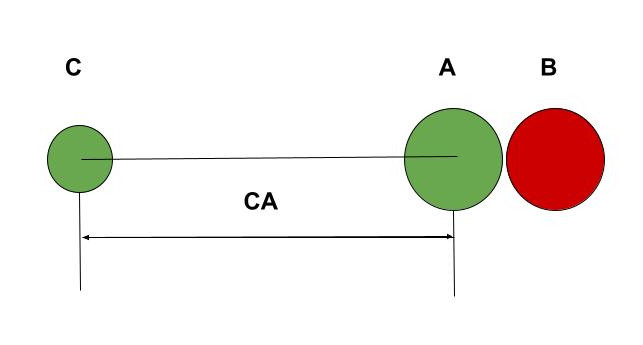 |
Master Chen introduces the second strategy of Indirect Power, a method rooted in the principle of subtraction. While Positive Indirect Power is based on addition, Negative Indirect Power is based on “subtracting.” This method utilizes the same diagram as Positive Indirect Power (Figure 38), where Point A represents the position or magnitude of power from the Taiji practitioner, while Point B represents the opponent’s contact point and Point C represents an anchor point or an auxiliary power source located elsewhere. |
For both Positive and Negative Indirect Power, however, the fundamental rule remains: the contact point, Point A, must never move. As Master Chen explains, “this one [the contact point A] does not move. So this one here [negative indirect power], same thing, A does not move.”
The Mathematical Formula of Power
To understand the mechanics of Negative Indirect Power, one can look at the spatial relationship between the anchor point C (the practitioner’s core or base) and the contact point A. Initially, the CA distance is represented as a value of 1. While Positive Indirect Power might increase this to 1.1, the objective here is to decrease the distance, making it “0.9 instead of 1.1.”
Crucially, this power is not “felt” by the practitioner during the execution. Just as with Positive Indirect Power, there is a distinct lack of physical feedback. |
 |
Master Chen instructs that “You must follow the structure, the procedure, do not ask ‘when I do this am I fighting? Do I have power?’ No! You just go through the procedure.” By moving the anchor point C toward A, the practitioner creates an “equal potential of moving this [A] again.” This initial change is so subtle and light that it “almost equals zero,” leaving the opponent unaware of the trap until they are suddenly launched away, asking, “‘How come you do this I jump?'”
The Biomechanics of Torque and Force Vectors
Modern physics and biomechanics provide a grounded validation for these “mysterious” internal changes. The difficulty of pushing an object increases significantly with distance; it is far easier to move a weight at 1.5 feet than at 3 feet. While a person’s raw output might be measured at 50 N regardless of reach, our structural capacity—the ability to actually deliver that force—is the true limit.
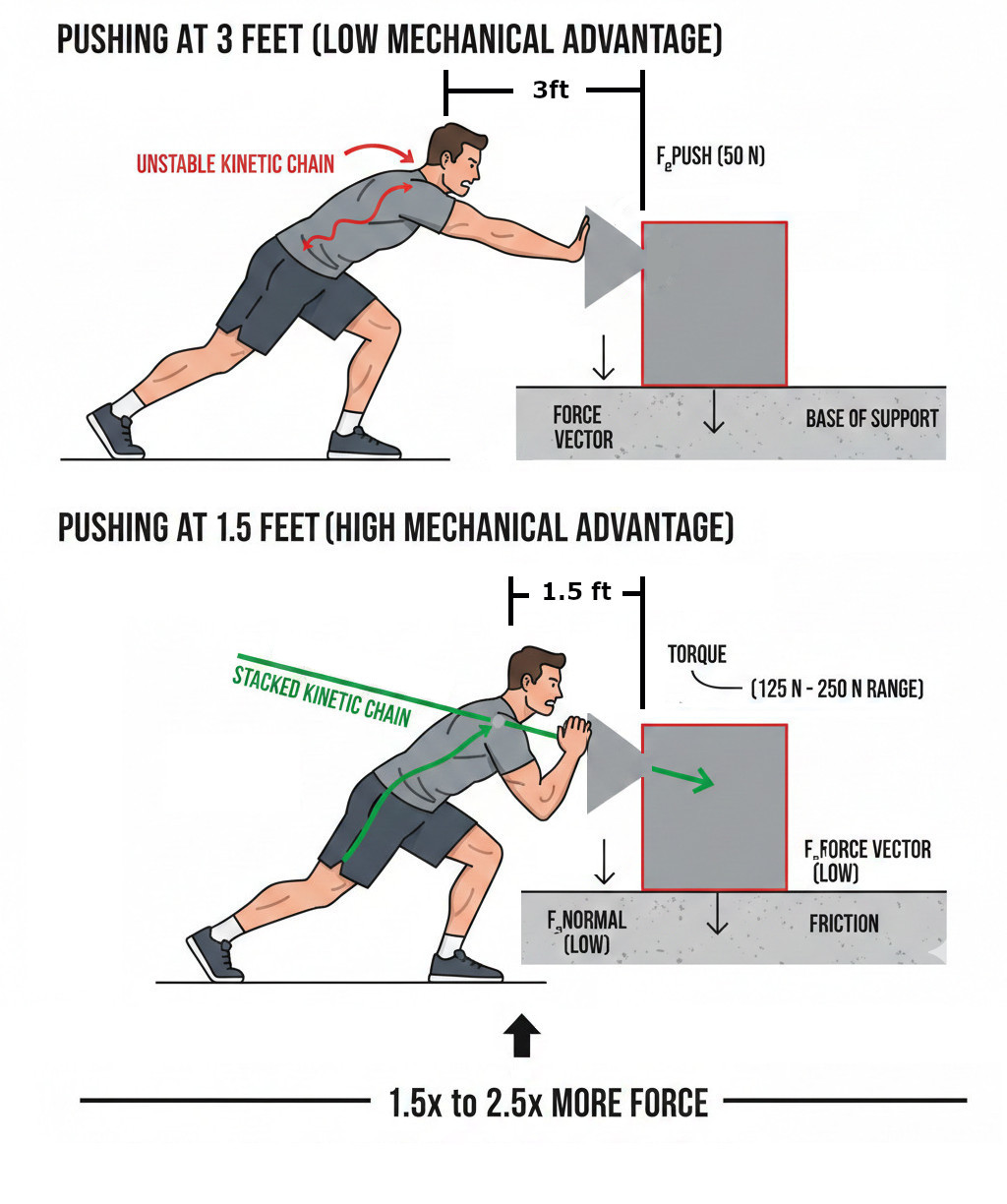 |
The governing principle is Torque (τ = F × d). By doubling the distance of a reach, a practitioner doubles the rotational force acting against their own joints. At a distance of 3 feet, an opponent’s resistance has twice the leverage to “fold” the shoulder or elbow. By halving that distance to 1.5 feet, as seen in Negative Indirect Power, the practitioner minimizes this external Torque, allowing for joint stacking. This alignment enables the skeletal system to support the load, potentially increasing the effective force to 125 N–250 N because the body has become a more efficient machine.Furthermore, the efficiency of the movement is dictated by the force vector—the specific direction and magnitude of the energy being projected. When overextended, the force vector becomes fragmented, leaking energy. |
Through core bracing, the practitioner aligns their internal geometry to create a linear vector that connects the feet directly to the point of contact. This ensures the ground reaction force is channeled forward as a unified surge. This alignment ensures the Ground Reaction Force (GRF) is channeled forward as a unified surge. By stabilizing the force vector and eliminating structural ‘leaks,’ the practitioner embodies embodies the technique of Ji (挤 pressing) energy, one of the Four Primary Energies (正劲) in the Eight Methods of Taijiquan. This allows them to use the Earth as a counter-weight, manifesting power through a perfectly pressurized frame.
The Illusion of Shrinking and Expansion
Master Chen concludes by noting that while these actions are often described as “shrinking and expansion,” such terms are “only superficial [descriptions]” because “that [term] is [a description of] the action.” The reality lies in the stability of the contact point. “In reality, both of them, the important thing is A never moved.”
Whether the practitioner expands by moving Point C further away or contracts by moving Point C closer, the result is the same: Point B is moved. This “contracting” movement is often more mysterious to the opponent because “he does not know why” he is being moved.
The practitioner may not “feel” the power themselves—”you [also] do not know why [all you did was to follow this Taiji procedure]”—but by strictly following the Taiji procedure, they create a situation where the opponent simply “can’t take it anymore” and is forced to retreat. Ultimately, the relationship between A and C represents the practitioner’s internal work, while the relationship between A and B represents the bridge between practitioner and opponent.
Application of Negative Indirect Power
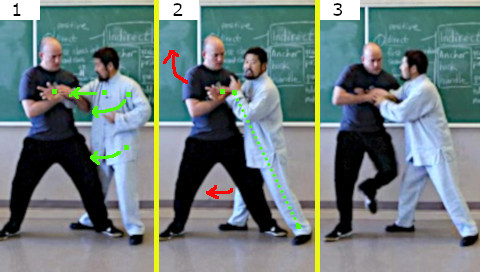
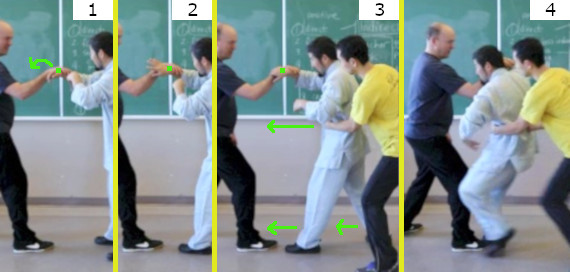
| Master Chen provides a physical demonstration of negative indirect power, beginning with a foundational positioning. He initiates the sequence, noting that “number two [negative indirect power] is the same thing” regarding the initial setup as previous techniques. He places his right forearm on the chest of a student, who uses both hands to hug and pin the forearm to their chest.As Master Chen applies a light pressure to the student’s chest, he instructs them to “hold the forearm to feel the initial pressure of this contact,” asking them to confirm that the connection is “locked up.” This initial engagement is illustrated in Figure 43-1. |
 |
The Mechanics of Closing the Distance
Master Chen explains that rather than increasing the distance from the contact point to a point on the body—such as the rear shoulder—the practitioner must first ensure there is “no move at the point of contact.” He demonstrates the process by decreasing the distance of his body to that point of contact, asking the student if they can see the shift.
As shown by the green arrows in Figure 43-1, Master Chen moves his front foot forward while his front shoulder and rear shoulder turn toward the student. He notes that the student “doesn’t feel anything” during this adjustment, but the power becomes apparent after the distance is closed.
Master Chen then executes the second stage by transmitting power from his rear foot. In Figure 43-2, a green dotted line illustrates the connection of the rear leg to the contact point, while a red arrow indicates the student’s reaction. He observes how effortless the reaction becomes, telling the student, “Look how easy it is here; you are just like a feather. [I can move you with a finger].” This final result is captured in Figure 43-3.
Contrasting Direct and Indirect Power
To clarify, Master Chen contrasts this with direct power. He presses into the student’s chest using local force, which the student easily withstands. He explains that “before the decrease, watch,” the power is easily resisted. However, by using the negative indirect method, he demonstrates a “finger power” that moves the opponent with ease. He summarizes the sequence: “Every time I push you, I go like this [I stop moving the point of contact], I did something here [bring the body closer to the point of contact]. Once it’s done, it is here [I can express the power with just a flick of the finger].”
Distance and Vectors
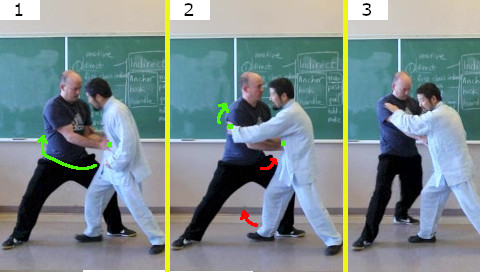 |
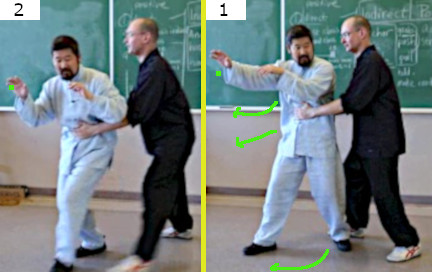
Master Chen offers another demonstration, asking the student to “push very clearly” so they can feel the interaction. The student steps forward with their left leg and places both hands on Master Chen’s stomach, as shown in Figure 44-1.If he reacts with direct power, Master Chen simply leans forward against the push. He demonstrates this, showing that it results in a struggle where the student can easily counter the force. Even stepping forward leads to a “fight” at the point of contact. |
Switching to negative indirect power, Master Chen explains, “I don’t interact here [at the point of contact – my stomach. I keep this point still.]” As seen in Figure 44-1, he moves his left hand in an arc (represented by a green arrow) toward the student’s right tricep. He explains that by moving his hand toward the student, he is “changing this distance [between the point of contact and my left hand]” from the location of the push on his stomach to a point behind the student.
By extending his left hand behind the student’s right side, Master Chen establishes a kinetic chain that creates a continuous force path stretching from his left rear foot to his extended left hand. Once this rigid structure is anchored, he introduces a secondary rightward force vector. This interaction (F⃑net) can be modeled by the summation of the structural alignment (F⃑structure) and the applied directional force (F⃑vector): F⃑net = F⃑structure + F⃑vector.
As illustrated in Figure 44-2, this combined force disrupts the student’s equilibrium, causing them to stumble backward and to the right (Figure 44-3). Master Chen describes the drastic physical reaction resulting from such a subtle, integrated move as “the magic.”
Finesse and the Masked Technique
In a third demonstration, Master Chen introduces the concept of finesse, which he describes as performing the move “with a mask. So you do not know [what my actions are].”
To illustrate, Master Chen instructs his student to use a systematic process for a push. The student places both hands on Master Chen’s stomach, but Chen prompts him for more detail: “Go back and do a gradual whole procedure.”
Master Chen approves: “Yeah, like that. Finish it.” He encourages the student to fully extend his arms, ensuring he is pushing through the opponent rather than just at them.
Once the student demonstrates a clear understanding of the mechanics, Master Chen continues the example.
|
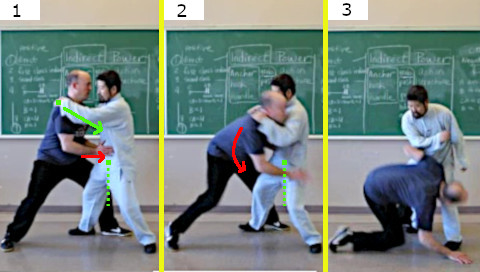 |
Master Chen applies a force vector toward his own left side (the green arrow in Figure 45-1). This causes the student to lose balance and stumble forward toward his own right side (red arrow, Figure 45-2). Finally, the student falls to the floor as a direct result of this negative indirect power (Figure 45-3).
Master Chen explains the disparity between how the move looks and how it feels: “You [the external observer] will think I did something here [with my hands on his upper shoulder]. But he [the one experiencing the technique] knows I didn’t [do anything with my hands].”
He further clarifies the mechanics of why he extended his left hand:”What I did is I changed the relationship of size of here [at the contact point]. [Initially,] I’m here [there is a small fixed point at the point of contact]. I changed this size [by extending this arm behind the point of contact].”
Master Chen emphasizes that the technique relies on structure rather than exertion: “You know that I never tensed up. I never increased the power anywhere [I only change the structure of my body and the force distribution within this structure].”
When the student asks about the role of direction in these techniques, Master Chen answers succinctly:”Direction changes the angle. The angle changes the size.”
The student seeks further clarification on the mechanics: “So the negative [Indirect Power], it’s not so much that you’re pulling [yourself into the point of contact]. You’re pulling [to get closer to the point of contact].”
Master Chen confirms: “Just that move [that closes the distance].”
The student continues, ” [The first step of negative indirect power is to close the distance.] In order to go back to Positive Indirect Power? On the extension?” Master Chen confirms this sequence.
Exercise: Closing in Without Moving
Master Chen introduces a specific exercise to practice the transition from negative to positive indirect power. He begins by reaching out with his right hand to grab the student’s right hand.
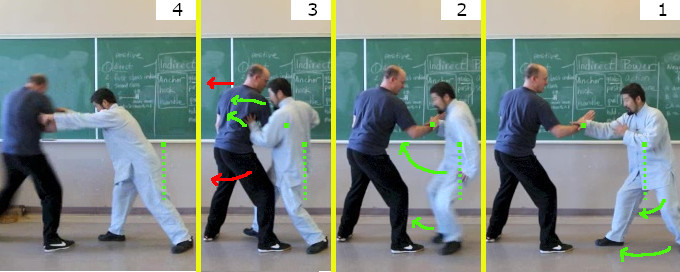 |
“This is the exercise,” Master Chen begins. “He’s there. Can you feel that?” (Figure 46-1).Master Chen notes the student’s instinctive resistance. “You don’t like it [grabbing your hand]? There is a little bit of a fight [You try to get out of the grab]. You feel that? When he fights, I do not use direct power [by struggling at the grab]. He fights, I do this [I move my entire body closer to the point of contact].” |
In the second stage, he steps forward with his right leg and places his left hand on the student’s shoulder, all while keeping the initial contact point stationary. Finally, he extends his arms (Figure 46-3). The student is moved away by the sheer volume of power generated. Master Chen concludes that the essence of the exercise is “to close in without moving. So that’s why I said. A, not moving is crucial.”
Stage One: Closing the Distance
In the first stage of Negative Indirect Power, Master Chen brings his body closer to the point of contact by stepping forward with his rear left leg. This movement is indicated by the green arrows in Figure 46-2.
Master Chen explains: “Now, can you see? [This is the first stage of Negative Indirect Power. I have closed the distance. Then] I do this.”
Stage Two: The Shift to Extension
Master Chen then initiates the second stage. He steps forward with his right leg and places his left hand on the student’s shoulder. Crucially, the initial point of contact at the hand does not change.
|
Master Chen describes the transition: “But at the end of that [movement that brought me as close as possible… then I extend my arms].” This extension is shown in Figure 46-3 with green arrows, while the student’s reaction is marked with red arrows.
Conclusion of the Exercise
The student is forced to move away as a result of the accumulated power (Figure 46-4). Master Chen concludes, “Can you see how much power [I have after following this process of negative indirect power]?”
He summarizes the core lesson of the drill: “So this [exercise shows the meaning of negative indirect power which] is to close in without moving. So that’s why I said: A, not moving is crucial.”
The Futility of Local Power vs. Negative Indirect Process
Master Chen demonstrates the exercise again to highlight the difference between pulling and closing the distance. “Watch again. When he fights, I do this [pulling his leading hand with local power]. It’s useless.”
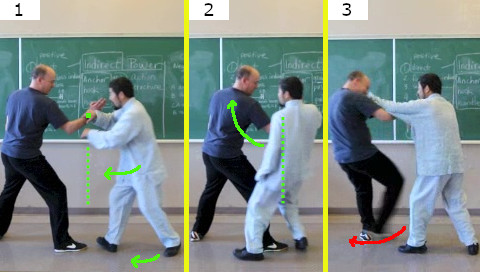
As demonstrated, the opponent can easily counter a direct pull. To show the Negative Indirect Process instead, Master Chen grabs the student’s leading right hand with his own right hand. He maintains this hold strictly, without adding tension or changing the initial grip.
Executing the Move
 |
|
Demonstration: Tenderness and Structural Power
Master Chen provides another demonstration to show how little effort is required when the structure is correct. “I can do it [the actions] with a lot of tenderness. Touch me like this.”
The student grabs the top of Master Chen’s right wrist with his right hand. Master Chen uses a “small wrapping” technique that places his right hand on top of the student’s forearm, creating a hook at the point of contact (Figures 48-1 and 48-2).
 |
Master Chen explains: “Just like that. You see here? [With the action of this small wrapping] I create [a hook at the point of contact]. See? Feel this here?”
Note: Master Chen emphasizes using only enough power to maintain the hook’s position. Adding any more power at the point of contact leads to unnecessary conflict.
The Dragging Effect
To further illustrate the power of the body’s movement, Master Chen instructs another student to hold his stomach.
|
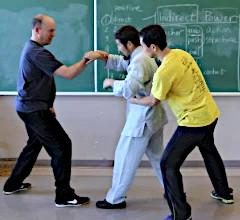 |
Master Chen points out: “But, you see? Feel how much power [I have when I close this distance]?” This final position is captured in Figure 48-4.
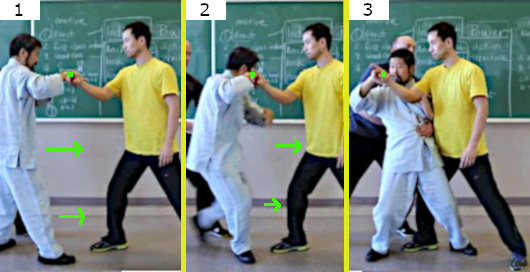
Master Chen then reproduces this demonstration with another student to confirm the consistency of the technique, as shown in the sequence in Figure 49.
 |
Solo Practice
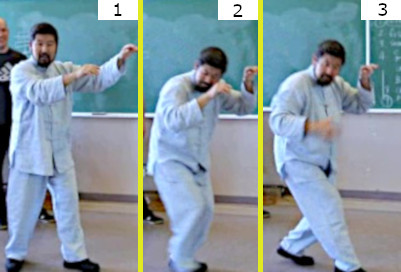
In Figure 50, Master Chen applies the concept of Negative Indirect Power to solo practice.
Master Chen reminds his students that even though the sequence appears effortless, significant power is inherent once the distance is closed. |
 |
The Battery Analogy: Charging the Self vs. the Opponent
Master Chen explains the difference between Positive and Negative Indirect Power as a “reversed yin-yang.”
Master Chen uses a battery analogy to further clarify:
|
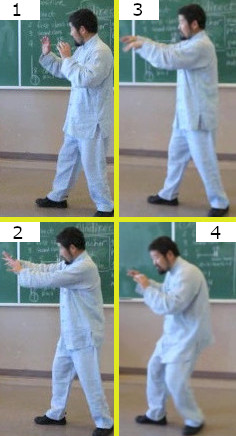 |
Demonstration of Stored Energy
To show this stored energy, a student holds Master Chen’s stomach while Chen performs the sequence “empty hand” (without a partner).
Master Chen explains: “I use my power on me. My opponent cannot feel it. By the time I stop, the power is released onto the opponent.” |
 |
The Golden Rule: “[The most important concept] is the not-moving part. If I [just] did this [move both hands and body forward together], there is no power.”
Figure 53 Shows the expression of power after closing the distance in Negative Indirect Power.
Expanding the Contact Point: The Anchor
Master Chen expands the definition of a contact point to an Anchor Point. An anchor can be placed anywhere—on the body or in space—provided it remains motionless.
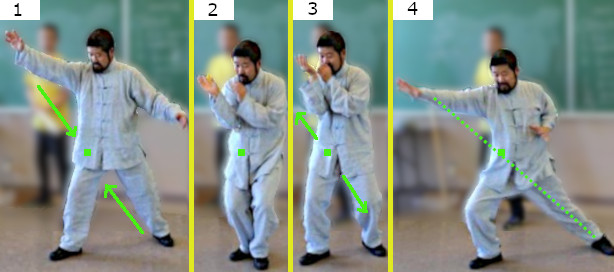
The Anchor in the Positive Circle
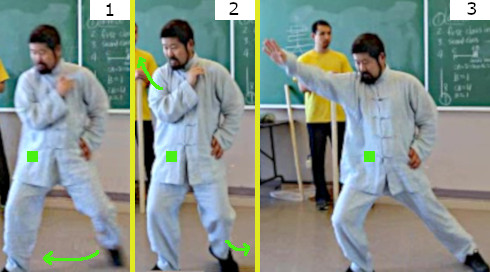
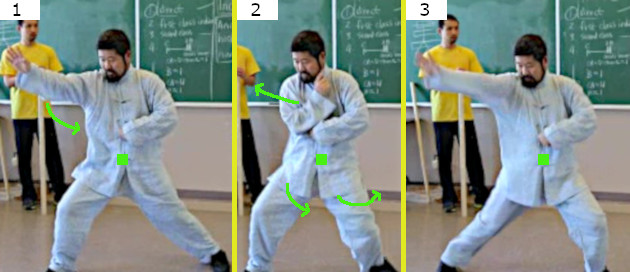
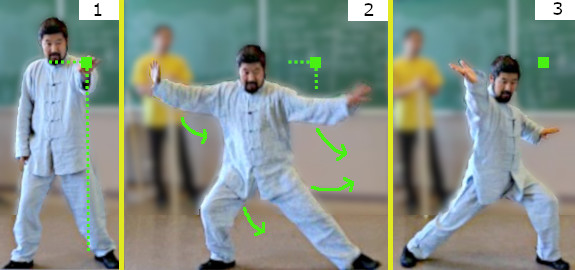
Using the Positive Circle, Master Chen points to a spot in space about a foot in front of his front kua (Figure 54-1, green square).
|
 |
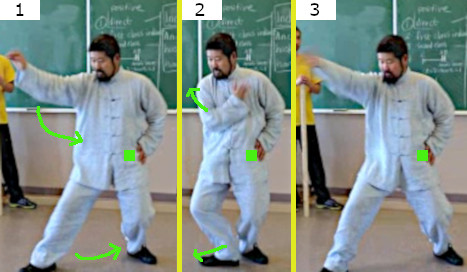
Anchor Points Can Be Anywhere
Master Chen demonstrates that the anchor can be shifted to different locations:
 |
 |
 |
 |
 |
He concludes: “You can put that [fixed] spot [or anchor] anywhere you want… but the most important aspect is that it must not move until you finish your task. To put it very far from you is very difficult, but it’s the same theory. Okay. Let’s do this one [Negative Indirect Power] with a partner.” |
The Geometry of the “Danger Zone”: Internal Length and the Singularity
 |
While Kenny Loggins might have been singing about fighter jets, in Taijiquan, the “Danger Zone” is much more intimate. It is that treacherous space where the gap between you and your opponent vanishes—the “inch” range where most practitioners panic, but where the Practical Method (实用拳法) thrives.
|
A classic Chinese martial arts axiom states: “One inch longer, one inch stronger; one inch shorter, one inch more dangerous” (一寸长,一寸强;一寸短,一寸险 — Yī cùn cháng, yī cùn qiáng; yī cùn duǎn, yī cùn xiǎn). Traditionally, this warns of the lethal advantage of reach. However, in the Practical Method, this “danger” is reframe from an external threat into a controlled internal principle.
In this close-quarter domain, you enter the realm of Stick, Adhere, Connect, and Follow (粘黏连随; zhān nián lián suí). This is where the physics of Master Hong Junsheng transforms the “shorter” range into a position of decisive control.
The Paradox of Internal Length: Peng and Ji Jin
The core of Taiji’s paradox lies in the relationship between external space and internal structure. The Practical Method manages the high-pressure environment of close combat through two primary modes of Indirect Power:
|
 |
According to a modern pedagogical summary of the Taiji Classics (太极拳论):
|
From Circles to Points: Master Hong’s Riddle
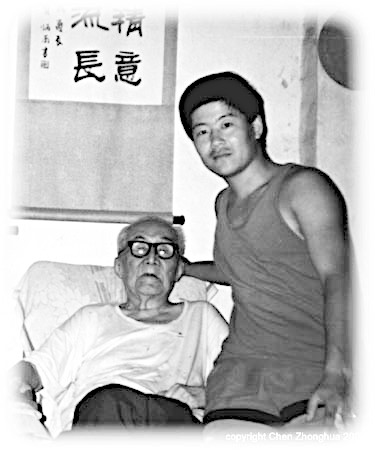
Master Hong Junsheng, distilling decades of study under Master Chen Fake (陈发科), proposed a riddle: “There are no circles, only points” (没有圈,只有点; méiyǒu quān, zhǐyǒu diǎn). While this seems to contradict traditional Taijiquan imagery, it is the secret to close-range application.
In the “Danger Zone“, large, visible circles are impossible to execute. Success instead depends on flawless body mechanics and three critical factors:
|
 |
The Resolution of the Paradox
The traditional warning—that being “one inch shorter” is “one inch more dangerous”—only holds true if your internal structure collapses. Under the teaching system of Master Chen Zhonghua, we learn that physical proximity does not dictate vulnerability. By moving from the ambiguity of “circles” to the mechanical certainty of “points,” we redefine the geometry of the fight.
The strategy follows the Classic Taijiquan principle: “Remain still to control motion; meet change with no change” (以静制动,以不变应万变; yǐ jìng zhì dòng, yǐ bù biàn yìng wàn biàn).
Ultimately, the “Danger Zone” is only treacherous for the opponent who relies on brute force and stiffness. For the Taiji practitioner who maintains internal length and masters the point of contact, the danger is neutralized. We don’t just survive the short range; we occupy it, turning the opponent’s proximity into our greatest mechanical advantage.