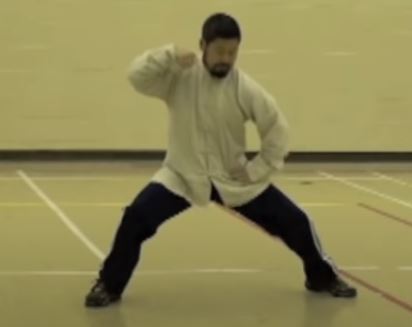
 |
In the intricate mechanics of Taiji, Indirect Power is not about conflict at the point of contact, but a chain of structural alignments that transforms the body into a high-leverage machine. By establishing a “Handle” on an opponent—a fixed point of contact that remains unchanged—the practitioner shifts the source of movement away from the limbs and into the kua, waist, and heels. This method relies on the “Analogy of the Train,” where each additional joint engaged adds a new carriage of force to the engine, resulting in a cumulative pressure that overwhelms linear resistance without a corresponding increase in effort. |
| Central to this mastery is the distinction between Positive and Negative strategies, governed by the geometry of contact. Through Positive Indirect Power, the practitioner maintains a steady point of contact while expanding the internal distance from their anchor to create a mechanical advantage. This expansion effectively increases the “lever arm” of the body, applying the physics of torque to multiply “four ounces into a thousand pounds of force“. By ensuring that power is added sequentially and locked into a single unit, the Taiji practitioner moves from the struggle of “one-on-one” direct power into a sophisticated system of indirect transmission where structure trumps raw power. | |
| (This is is an articles is based on the Theory and demonstration of “Indirect Power” filmed in Ottawa, Canada Dec 3, 2014.) |
|
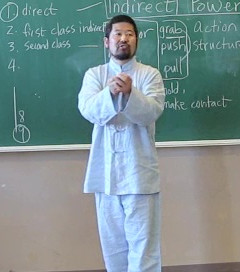 |
Part 1. Don’t Eat with Your Hands
Part 4. Yang Actions
Part 5. Yin Actions
Part 7. Not using force is a magic trick
|
Part 4. Yang Action
Exercise to Understand Indirect Power 2
Sequential Accumulation and Structural Integrity
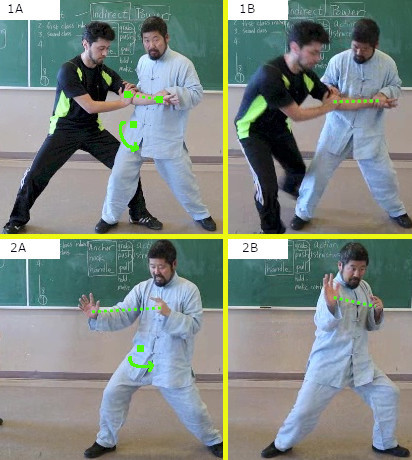 |
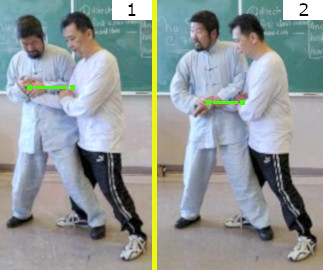
Continuing the technical demonstration of Taiji mechanics, Master Chen explores the principle of Indirect Power through a series of partner drills and solo forms. He begins by establishing a control point on a student, using his left hand to grab the student’s left inside wrist while his right hand presses firmly into the student’s left elbow. This counter-pressure transforms the student’s arm into a functional handle for the technique. As a safety precaution, Master Chen instructs the student to use his free right hand to brace his own left elbow, noting that this specific application can easily lead to a dislocation if the power is not strictly controlled.Master Chen emphasizes the necessity of maintaining a consistent connection, explaining, “I only grab [his wrist] and apply this [hand on his elbow. At the elbow,] I apply enough [force with my hands in order] to have good contact with him. You feel that pressure?” This initial setup is illustrated in Figure 20-1A, where a green dot highlights the anchor point of the elbow and the kua, and a dotted green line identifies the forearm’s role as a handle. |
The Mechanics of the kua and the Handle
To initiate the technique without breaking the established contact, Master Chen shifts the source of power away from the hands. “I’m going to add to that [pressure but] not by moving anything except my kua. Can you feel my kua is going into it [the opponent’s elbow]?” The arrow in Figure 20-1A tracks this internal movement of the kua, while Figure 20-2A displays the final result: the student stumbling forward under the weight of the indirect force.
Master Chen then demonstrates the same sequence using an “empty hand” method common in solo form practice. He reproduces the pushing and pulling actions with high intensity, as if a resisting opponent were present. “[This handle] can be anywhere,” he explains, showing various hand positions that adhere to the same fundamental principle of controlling the opponent’s frame as a single unit.
When an opponent resists the initial “cut” or grip, Master Chen views this as an opportunity rather than an obstacle. “[He reacts to counter this initial move; this counter means] he’s stronger than me. I added something [to the initial handle. The pressure on the handle must not change. The added action comes from my kua, an anchor that is away from the point of contact.] Can you see that motion [of my kua opening]?” This expanded position is shown in Figure 20-2B; the structural similarities between the partner drill and solo practice are evident when comparing Figure 20-1 and Figure 20-2.
Solo Illustrations and Directional Shifts
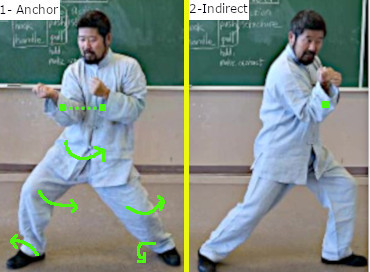
Master Chen provides a solo illustration of Indirect Power by closing both hands into fists and pulling them toward his chest, simulating a pull on an opponent. “Can you see I’m pulling [him into me with both of my hands]?” This position is seen in Figure 21-1, where a green dot marks the anchor of the hand and a dashed line represents the handle created by the opponent’s imagined resistance.
| When the resistance becomes too great to overcome with the arms alone, Master Chen transitions the power source. “Can you see [what] I did there?” he asks, as he opens his front right kua, drops the right knee, and pivots the right heel out, followed by opening the left knee and pivoting the left heel in. These joint actions, indicated by green arrows in Figure 21-1, rotate the body and the “handle” toward the left, reaching the final position seen in Figure 21-2. He cautions that these actions must be added sequentially rather than being a continuous, muddy movement: “So it’s not continuously like that.” This approach prevents the practitioner from struggling at the grip with isolated arm movements. |
 |
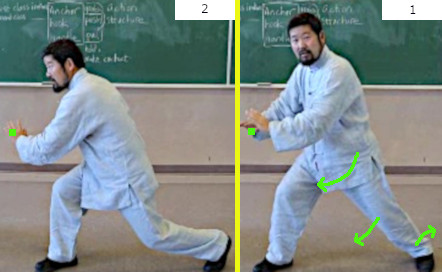 |
Master Chen applies the same logic to a pushing technique, pressing both hands down on an imagined opponent’s front kua. “So I’m pushing you [at the kua.] You’re too strong [at that position.] Can you see I add in my waist at that point?” As shown in Figure 22-1, he closes the rear kua, drops the rear knee, and pivots the rear heel out to generate the force seen in Figure 22-2. He warns that relying solely on the limbs is a finite strategy: “If I do this [continue to only press with the hands and arms, eventually] I have no more power.” |
The Levels of Indirect Power
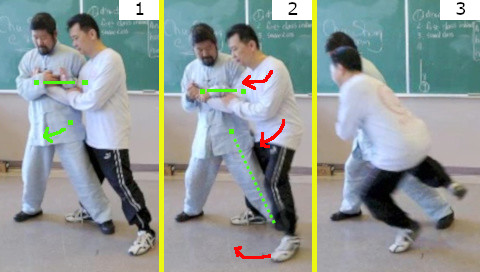
| Returning to partner work, Master Chen demonstrates a more complex lock. The student presses a left forearm into Master Chen’s chest; Master Chen responds by grabbing the inside of the student’s forearm and pressing his own right elbow into the student’s outside biceps. He secures the grip with his left hand over the student’s wrist. This setup, shown in Figure 23-1, again requires the student to support their own elbow for safety.He instructs the student to remain firm: “Don’t deviate. Deviate means you try to get away [or you are fighting against my hand and elbow]. Try to be stronger than me.” Once the student is stabilized, Master Chen identifies this as a “consistent” state. |
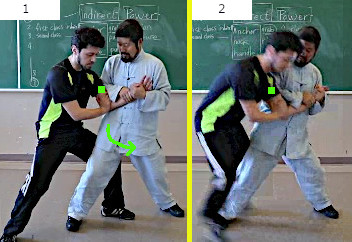 |
He then describes the generation of First Level Indirect Power. “I’m using here [the grip on the forearm] and here [the press on the biceps] [to create the handle. This is using Direct Power]. Then I added this [the power of the dantian] to here [my front right kua.] Can you see that?” Green arrows in Figure 23-1 denote this added power, which causes the student to stumble, as shown in Figure 23-2. He emphasizes that the power originates “from here [the dantian].”
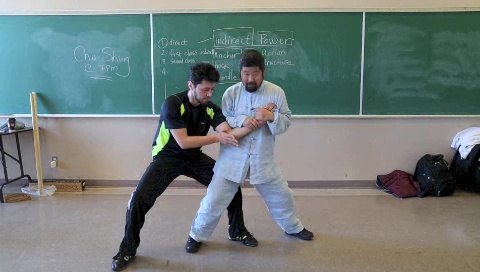
Progressing to Level Two Indirect Power, Master Chen uses the same initial hold. “Same. One [the lock on the forearm is secured]. Feel that? [This is Direct Power] One on One. [Two. Level One **Indirect Power**] Waist is there. [Do] you feel that? Now look at my rear knee [I will add this power to create Level Two Indirect Power].” He breaks the sequence down into a clear count:
This progressive rotation, shown in Figure 24, creates an overwhelming cumulative force. |
 |
The Analogy of the Truck and the Train
 |
To explain the importance of linking these actions, Master Chen uses the analogy of a delivery truck. “Once you finish [using] one [source of Indirect Power], you have to lock it [this source and all previous sources] into a single unit. Think of it like a truck: as it passes the first door, you load [one of your] bags onto it. That bag stays on that truck. When the truck reaches the next door, you add another bag. Now, there are two bags [on the truck], and you cannot switch between them or swap them out; [otherwise, the structural integrity of the situation changes].”It is like a train engine: Once a carriage is hitched, it becomes part of the whole. You cannot remove or ignore any of the added carriages while the train is in motion; they all move together as one solid piece. |
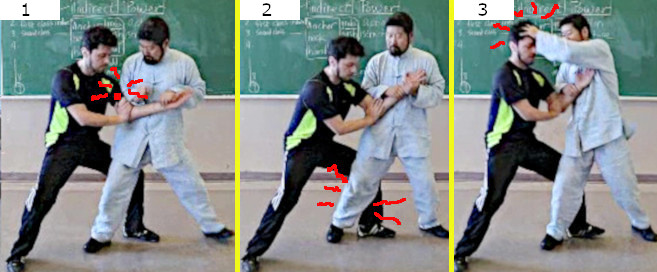
| Conversely, Master Chen demonstrates “switching,” an incorrect method where the practitioner abandons one failed move for another. In Figure 25-1, a red wavy line shows an unsuccessful attempt to lock the elbow. “Now I decide to do this,” he says, attempting a kick Figure 25-2, followed by an attempted punch Figure 25-3. “Can you see I’m doing three [separate and distinct] moves.” |
 |
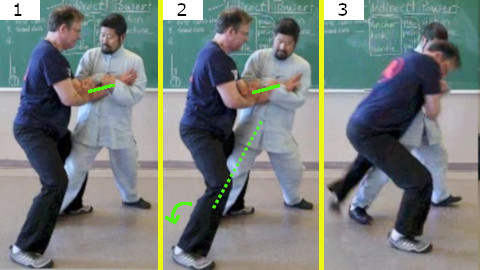 |
Unlike Direct Power, which resets with every move, Indirect Power accumulates. “Let’s say [this move produces] 50 pounds. [I] didn’t get him. [I] maintain the 50 pounds [from the lock, then] add another 50 pounds [from my waist. This action still did not get him. So I] add another 50 pounds [by using my from heel].” This results in a total of 150 pounds of force at the point of contact. This sequence is shown in Figure 26. |
Versatility and Consistency
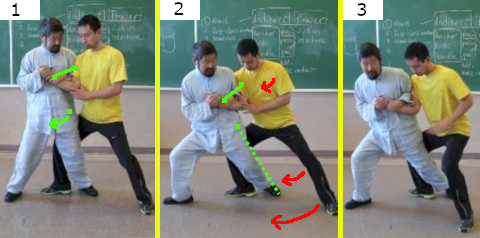
| Master Chen continues the demonstration with various students to show the principle’s universal application. In Figure 27, he demonstrates from a different perspective, using his left side to press into a student’s right biceps. “I do more [action that increases the pressure on your biceps and forearm] until I feel you’re stronger [at the area of contact]… At that point I lock [the area of contact. I] only push my [front left] foot into my waist.” He then adds the rear knee to reach Level Two. |
 |
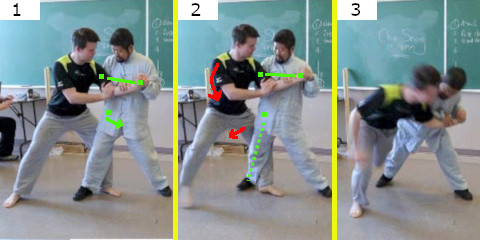 |
He stresses that the upper body must remain calm and unchanged: “Can you see the upper body is all the same.” If he were to lean forward to create power, the action would revert to Direct Power and lead to a struggle. “It’s very important in learning you don’t change. [For Indirect Power, once a body part has been used,] It stays here, and [then I proceed to the next location, for example,] add my waist.” Figures 28 and 28-1 illustrate this cumulative force, with green dots marking each additional anchor. |
| Even when a student’s arm placement differs—such as being positioned lower across the stomach rather than the chest—Master Chen adapts the grip while keeping the principle intact. As seen in Figures 29-1 and 29-2, he may use the rear forearm or the rear hip to secure the elbow depending on the height of the “handle”. |
 |
 |
Master Chen concludes by returning to the primary exercise. Starting from the position in Figure 30-1, he executes the sequence seen in Figure 30-2. “[After I secure the hold, this Level One Indirect Power.] Add my waist to it [resulting in Level Ywo Indirect Power]. [Then I] Add my knee to it [creating Level Three Indirect Power].” As the student stumbles forward Figure 30-3, Master Chen notes the effortlessness of the finished technique: “Feel my waist. It’s on you. Okay. I don’t have to do anything.” |
A Series of Quick Examples
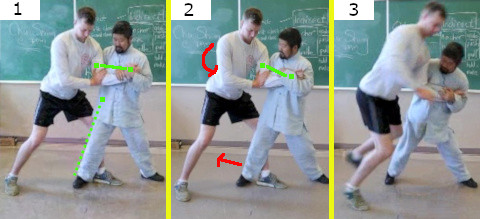
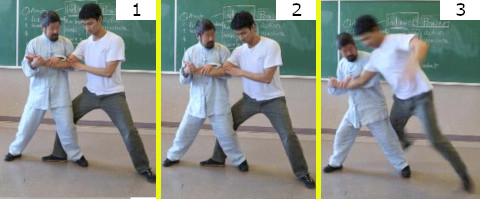
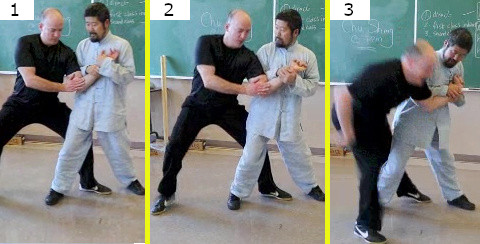
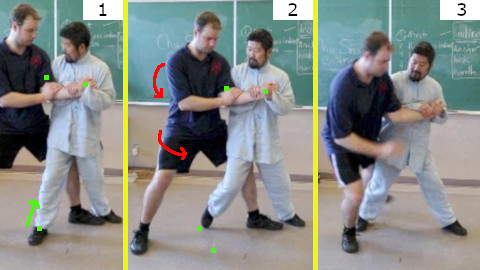
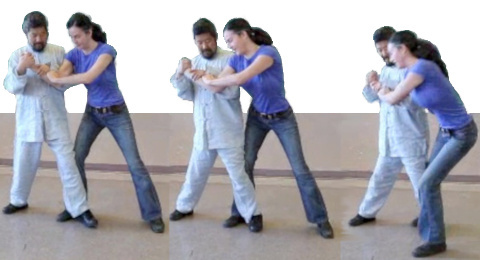
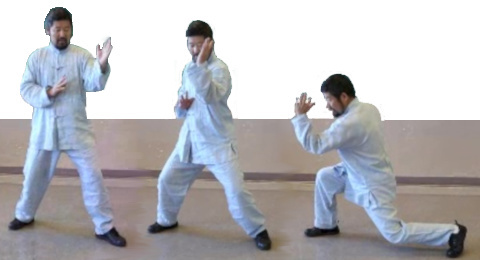
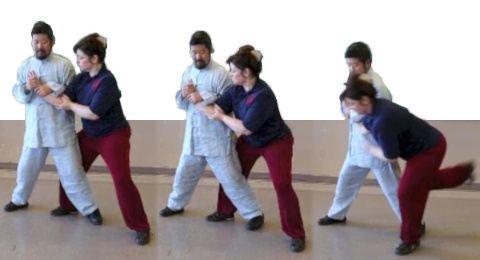
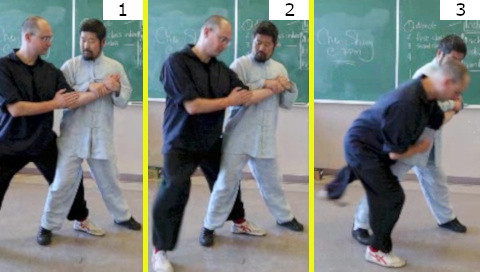
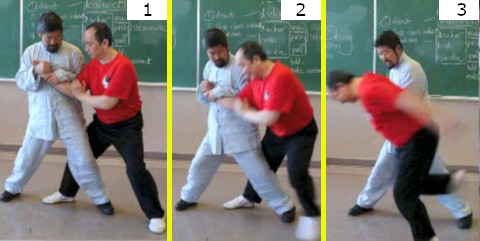
Master Chen continue the Indirect Power exercise with different students.
 |
 |
 |
 |
 |
 |
 |
 |
 |
From Philosophy to Physics: The Duality of Power
| The Tao Te Ching teaches that the soft overcomes the hard, but the broader Taoist tradition reminds us that “Extreme Yang creates Yin, and extreme Yin creates Yang.” This is the Way of the Tao: a constant, self-correcting cycle of forces where no single power remains absolute. In Chinese philosophy, this concept is summarized as: “物極必反,陰陽轉化” (Wù jí bì fǎn, yīn yáng zhuǎnhuà)—when things reach their limit, they must reverse; Yin and Yang transform into one another. These roots are found in the 《黃帝內經》 (Huángdì Nèijīng), specifically the Suwen section: “Extreme Yin must become Yang; extreme Yang must become Yin” (重陰必陽,重陽必陰; Zhòng yīn bì yáng, zhòng yáng bì yīn). Movement and stillness alternate, each serving as the root of the other. |
 |
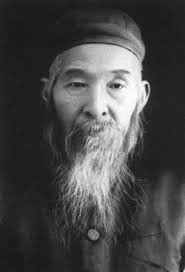 |
The practice of Taiji requires a binary system: the practitioner and the opponent. To bridge the gap between solo meditation and martial application, Master Sun Lutang (孫祿堂 1860–1933) summarized the essential mindset: “In solo practice, train as if an opponent is before you. In combat, fight as if no one is there” (练時無人若有人,用時有人若無人; Liàn shí wú rén ruò yǒu rén, yòng shí yǒu rén ruò wú rén). This paradox ensures that intent is present during form work and that structural integrity remains undisturbed during conflict. |
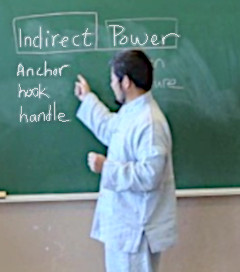
Applying binary logic to Indirect Power reveals its foundation in two primary actions: the Push and the Pull. In accordance with Taoist division, these forces manifest as the Handle and the Hook. The resulting strategies—Positive and Negative—are governed by the spatial relationship between the contact point and the power source. Through this categorization, the practitioner learns to redirect any external pressure, refining it into a precise, indirect transmission of energy.
Positive Indirect Power
The Geometry of Contact
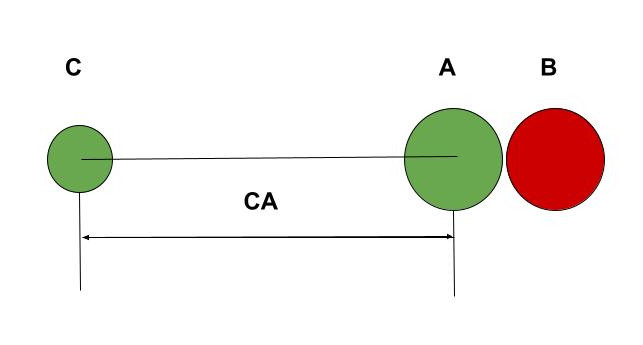 |
To illustrate this, Master Chen draws two large dots side by side on the board, labeling them Point A and Point B. Point A represents the position or magnitude of power from the Taiji practitioner, while Point B represents the opponent. Master Chen describes the scenario of positive indirect power as “two dots touching each other,” where the intersection serves as the point of contact. Figure 38: Illustration of Point A and Point B as two circles initially overlapping, then separated as touching on the side to show the state of equilibrium. |
Introducing the Anchor Point
Master Chen then draws a third point, Point C, at a distance from Point A. He explains the necessity of this addition: “And then you need [another point] C to create this [indirect] power.” In this model, Point C represents an anchor point or an auxiliary power source located elsewhere on the practitioner’s body.
The “[source of] C power is [a result] that you [are reacting because your opponent] are pushing [you].” This type of power functions like a lever, with Point C being the anchor or a pivot. Master Chen notes that “in order to create this power [requires] a distance [that is removed from the initial point of contact].” In this model, the distance is labeled as CA. “The more length you create in the CA distance, the [greater] you can create this power,” he explains. “So the combined A and C power has to be bigger than before [the initial A power] in order to move B.”
The Mathematics of Expansion
Master Chen admits that while he is not “writing everything out,” he provides a mathematical framework for the concept. He defines the initial CA distance as one unit and the power at the contact point as one unit by definition. To create movement, the practitioner must perform an action—”Adding something”—to the internal structure.
“So our finished position [after our action] must be CA equals 1.1,” Master Chen states. Because of this structural change, the balance is broken: “B is still one. So because of that, B gets pushed. Do you understand?” He repeats the idea to ensure clarity, noting that the practitioner’s action is “to cause CA distance to [increase for example to] 1.1 unit” while the power at B remains at one. Consequently, the power at A has increased because of this increased length, and B has no choice but to move.
Practical Application: The Open Chest
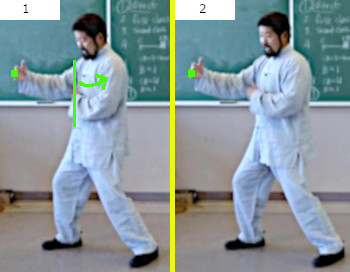
| Master Chen transitions to the practical application of positive indirect power in Taiji mechanics. He notes that “[at the moment of contact] your opponent is the same. You touch him. You are the same,” representing the state of equilibrium.The specific Taiji action involves maintaining stillness at the point of contact while expanding elsewhere. Master Chen instructs: “[Don’t move at the point of contact] And then you open yourself up, like this here [open up the chest].” This chest opening. Figure 39 provides a detailed view of the practitioner opening the chest to create internal leverage, while the hands remain fixed at the point of contact to create the necessary distance. |
 |
“And you [at Point A] become 1.1. Your opponent [at B] is still one, so you are bigger than him,” he explains. “That bigger, or you can say 1.1 pound. You can say 1.1 unit. You can say 1.1 distance.” In Taiji vernacular, this is known as “adding one grain,” or more specifically, the idea of using four ounces to deflect a thousand pounds (察四兩撥千斤, Chá sì liǎng bō qiān jīn).
Master Chen recalls the basic assumption of positive indirect power: “The key, go back here, is A does not move. It’s the increase of this distance [CA] caused the movement [of your opponent at B]. And that’s why it’s very, very difficult to learn, because you don’t feel anything. I said, longer. And your opponent says, you’re pushing me. I said, no, no, I didn’t. Do you understand? So the difficulty is, when you follow the procedure, you don’t feel you did anything.”
Master Chen demonstrates this idea, saying, “So now, the opponent is here [at the contact point of AB]. No move [at the point of contact, A]. All I am doing is [stretch and lengthen the distance between A and C].” He illustrates this by opening his chest, which from an external perspective appears as a movement backwards of the chest. “Can you see the distance [between the contact point A and the point C, the chest] is bigger? Can you see it’s bigger from here [the point of contact] to here [the chest]?”
Master Chen adds different levels of indirect power, including opening the rear kua and dropping the rear knee. “Including this movement. It [the anchors behind A is further away from A and as a result the overall structure] is bigger.” He concludes by noting that “when it’s bigger, your opponent says, you are pushing me. But the definition of that push [as a result of indirect power] is different from you pushing [locally with your hands]. Do you understand that?”
“So we did the same,” he continues, meaning the technique of indirect power created the same reaction by the opponent as a push—the opponent reacts by moving away. However, using this method “avoided you to see this [obvious movement at the contact point such as the movement of the hand].” Master Chen physically moves his hand to emphasize this point, explaining that “because you are touching here [at the contact point] whatever I do is directly telegraphed to you.”
He contrasts this direct action with the Taiji concept of indirect power: “but if I did this [moving anchor points away from the point of contact,] you don’t know why all of a sudden I’m stronger because I never moved there. That’s why it’s called the indirect power. [Whether it is direct or indirect power,] power is the same [It causes a reaction from your opponent].” Master Chen explains the similarity between direct and indirect power, stating that they are “meaning same as this [as direct power] because [the final expression of power] the distance has to change. [In the case of direct power, the distance change is at the point of contact. In contrast, the distance change for indirect power is behind the point of contact.] Now is that clear?”
The Biomechanics of Positive Indirect Power
In Taiji, Positive Indirect Power is the art of using a power source far removed from the point of contact to overcome an opponent. While it can feel like “magic,” it is the result of Total Body Structural Integration and the Kinetic Chain.
Transitioning from pushing with the hands to pushing with the feet represents the shift from isolated muscular force (Li 括力) to integrated internal power (Jin 勁). As the Classics state: “Rooted in the feet, issued through the legs, directed by the waist, and expressed through the fingers” (其根在腳,發於腿,主宰於腰,形於手指).
1. The Localized Push (Hands Only)
In this scenario, the feet and torso are static. The movement is purely “external“. The push is the result of direct power on the hand.
|
 |
2. The Upper Body Drive (Shoulders/Torso)
Here, the arms are held firm, and the force comes from the torso and the dropping of the shoulder. If performed correctly, this is the First level of Indirect Power.
|
 |
3. The Ground Reaction Force (Feet)
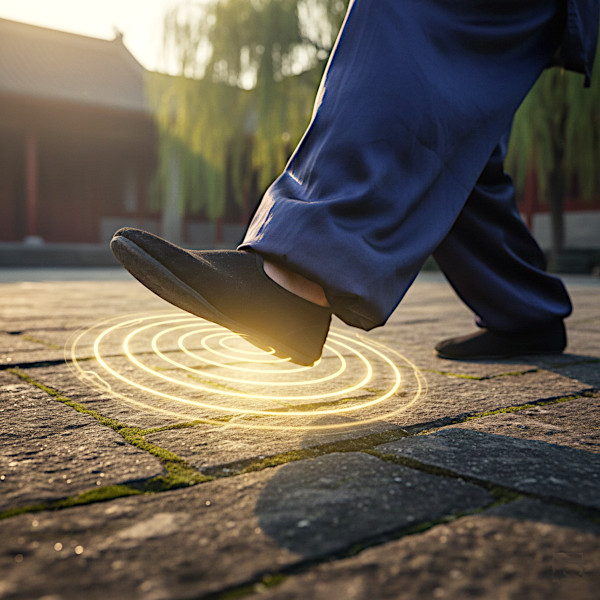
This is the “gold standard” of Taiji power. You “push the planet,” and the planet pushes back. This represents the essences of indirect power.
|
 |
Efficiency & Structural Comparison
| Method | Taiji Quality | Stability | Energy Leakage | Mass |
|---|---|---|---|---|
| Hands Only | Broken (Li 力) | Very Low | High (Wrist/Elbow) | ~5% |
| Shoulders | Leaning (Ti 體) | Medium | Moderate (Kua 胯) | ~40% |
| Feet/Ground | Integrated (Jin 勁) | Maximum | Minimal (Full Body) | 100% |
Why the “Feet” Push Uproots the Opponent
Hand Push: You are a small pebble hitting a wall.
Foot Push: You are the tip of a spear backed by the weight of a mountain.
The Physics of Positive Indirect Power
From a physics perspective, positive indirect power is about biomechanics and the application of leverage specifically related to the moment of force or torque. The practitioner is not just applying a force; they are applying a torque—a rotational force—around the pivot point formed by the union of the body and the grip.
The Physics of the Stick: Understanding Torque
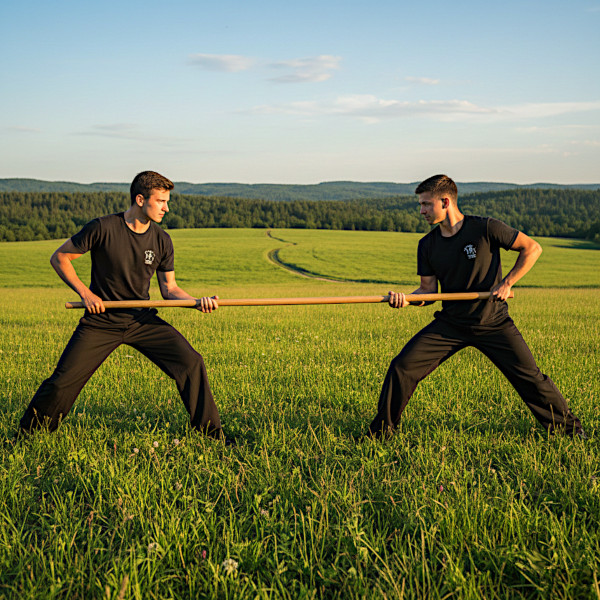 |
A clear physical demonstration of this phenomenon involves comparing the resistance of different lever lengths. If you hold a one-foot stick and have a partner push against it, you are experiencing a relatively direct transfer of energy. However, if you hold one end of a two-foot stick while your partner pushes the other end with the exact same amount of effort, the sensation changes drastically.The push from the longer stick feels twice as strong because torque is mathematically defined as the product of the force and the distance from the pivot, often called the lever arm. This is expressed by the formula:
τ = r × F sin(θ)
|
In this equation, r represents the length of the stick and θ is the angle at which the force is applied. When the force is applied perpendicularly (90°), the sine value is at its maximum of 1, making the torque equal to the force multiplied by the full length of the stick. By doubling the length (r), your partner has effectively doubled the torque acting upon your grip, creating a mechanical advantage that overwhelms simple linear resistance.
The Spiral: Torque in Motion (Silk Reeling)
In Taiji, spiral power (or silk reeling) is the dynamic application of this torque across multiple moving joints. While a simple lever uses a fixed pivot to multiply force, silk reeling creates a “helical” torque by rotating the bones within the soft tissue, transforming the entire body into a series of interconnected, rotating axles. When you spiral your arm or waist, you generate rotational force around the longitudinal axis of your limbs. This constant rotation ensures that any incoming linear force from an opponent is converted into a tangential vector, causing their strike to “glance off” a spinning surface—much like a ball bearing—while delivering power amplified by the body’s internal lever arms.
The Physics of the Rope: Vector Components in Pulling
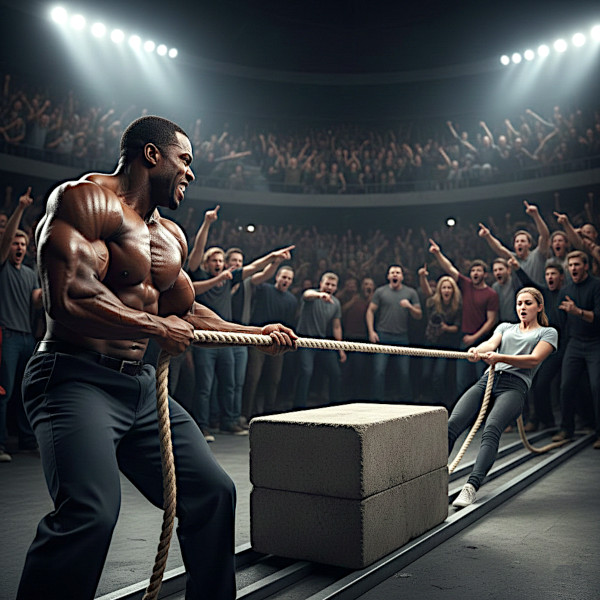
| While torque explains the “push,” positive indirect power in pulling is a result of the angle of force. Pulling an object with a 3-foot rope versus a 6-foot rope reveals a distinct mechanical difference: with the shorter rope, the pull occurs at a sharp upward angle, wasting energy by trying to lift the object off the ground. With a 6-foot rope, the angle is much shallower and closer to horizontal. Almost all the applied force goes directly into moving the object forward. This efficiency—increasing the distance for the anchor away from the contact point—is the physics explanation for effective indirect power in pulling actions. |
 |
The Synthesis: The Spiraling Draw
In Taiji, these two concepts—torque and vector angles—are unified. Pulling is rarely a static, linear event; it is a spiraling draw. By adding a silk-reeling spiral to a pull, the practitioner transforms a simple linear vector into a helical torque. Rotating the arm while pulling effectively changes the angle of force (θ) continuously. This prevents the opponent from “weighting” the pull or finding a static line to resist, as the point of contact is constantly revolving around a central axis.
Application in Taiji
In the realm of Taiji training, this synthesis forms the basis for Peng, the root of the Eight Techniques and the signature “expansive power” of the art. The opponent is no longer resisting a simple linear movement; they are caught in a powerful twisting force that uses their own position as a pivot. Whether pushing or pulling, the mechanics remain the same: utilizing geometry to create a “net addition” of power.
Master Chen concludes by contrasting this with simple force:
|
 |
In Taiji, geometry is the ultimate force multiplier. By maximizing lever arms and perfecting force vectors, the practitioner moves beyond the ‘one-on-one‘ struggle of direct power. This is the hidden physics of the art: a mathematical advantage that ensures you aren’t just meeting strength—you are multiplying it.
Positive Indirect Power A Practical Demonstration
Master Chen begins the demonstration on the mechanics of Positive Indirect Power by placing his right forearm against a student’s chest. This starting posture is similar to the position seen in Figure 39, which is used to demonstrate the idea of chest opening. He instructs the student to use both hands to hug and pin the forearm firmly, ensuring it is immobilized against the torso. Master Chen emphasizes the ease of the setup, noting, “We use this [right] arm to be very easy,” and advising the student to “hold it like this.”
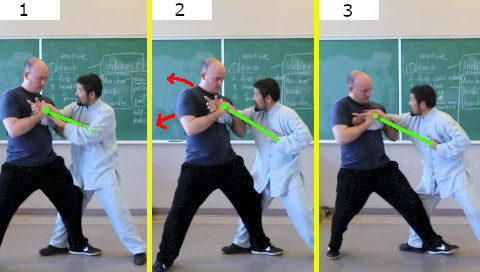 |
As Master Chen applies a small amount of initial force, the student can clearly feel the forearm push into the chest as shown in the initial setup of Figure 40-1. He identifies the forearm as “Point A” and the student’s chest as “Point B,” explaining that at this stage, “they [A and B] are together [forming a point of contact].” When Master Chen physically shakes the student’s chest using his forearm, he identifies this movement as the result of Direct Power. |
The Mechanics of Indirect Expansion
To illustrate the shift to Indirect Power, Master Chen establishes a strict requirement: the contact points “they [A and B] are together [and do not move].” He identifies an anchor point, designated as “Point C,” on the left side of his own chest. By increasing the spatial vector between Point A and Point C, Master Chen generates a force that the student feels immediately.
This expansion is illustrated in [Figure 40-2, where a green line depicts the increasing distance of line AC, while red arrows indicate the student’s retreating response. Master Chen observes that although he “never did anything [except stretching myself from A to C],” there is a visible “surge of power [and a physical reaction]” from the student. He describes this sensation as paradoxical, noting that “I do not know [about this surge since the effort usually associated with a physical action is not present]. I only increase the distance [in my body].”
This internal stretch does not require the heavy muscular tension typically needed to move a person. Figure 40-3 captures the student’s reaction to this Positive Indirect Power. Master Chen addresses the inherent confusion in this Taiji training, acknowledging that while the student feels a push, the master has not exerted physical effort.
|
 |
The secret lies in the mechanics: Point A remains a fixed constant against the student. By expanding the space at the anchor, Point C, the student is moved by the expansion of the frame rather than a manual shove.
Three-Dimensional Volume and the Balloon Analogy
| Master Chen further refines this concept by demonstrating that the increase in distance is not limited to a linear vector. Starting again from a pinned position [seen in Figure 41-1], he begins to hollow the chest and open his rear kua. He explains that he has increased “the size here [between the point of contact and the anchor on the body] by doing this.” |
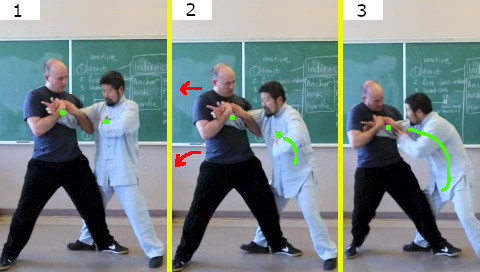 |
Figure 41-2 illustrates this new structure, with a curved green arrow highlighting the increased volume between the contact point and Master Chen’s body, resulting in the student moving backward. Despite the power generated, Master Chen maintains that he “never moved it [the point of contact] either,” concluding that “the volume here [between the point of contact and my body] changes.”
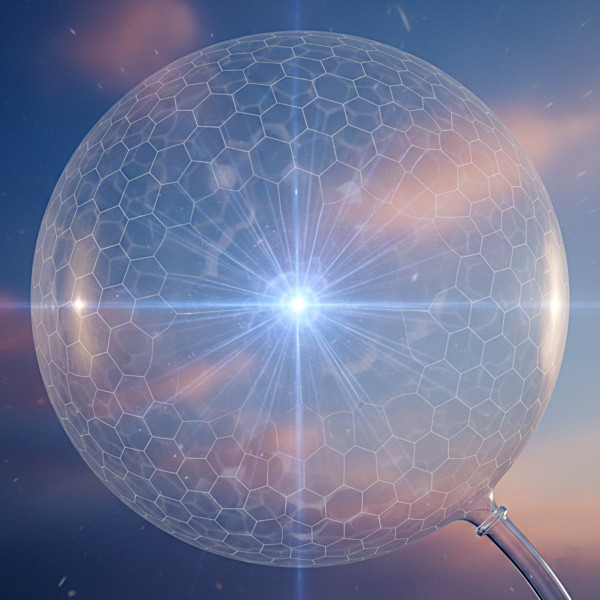
The final effect shown in Figure 41-3 demonstrates a significant volume increase that causes the student to fall back. Master Chen clarifies that Positive Indirect Power is a three-dimensional expansion, whereas earlier two-dimensional models were merely simplifications. He likens the process to inflating a balloon:
|
 |
Relative Stillness and Structural Change
Addressing a student’s question regarding whether the contact point moves relative to the back foot, Master Chen is emphatic: the contact point “does not move at all” relative to the opponent.
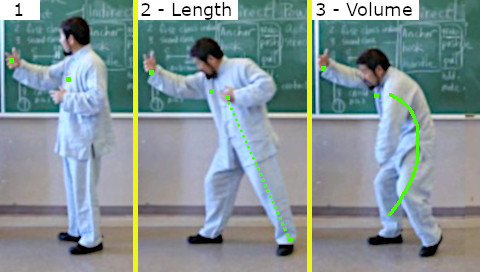 |
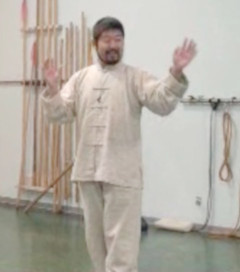
He demonstrates this by raising his right hand in a parallel stance [as seen in Figure 42-1]. As he steps his left leg backward, he creates a visible change in the length of his structure, explaining, “but see, I do this [stepping backwards showing the increase in length].” This technique of adding length is shown in Figure 42-2 via green dotted lines.In a final variation, Master Chen hollows the chest and opens his inner structure while taking only a small step back. |
He notes that while the student feels a push, “the point of contact does not move.” The change in body structure is not a direct push; rather, “because the volume changes, you feel I’m pushing you.” This change in structure is shown in Figure 42-3 with a curve line showing the increase in volume. This fundamental expansion defines the Positive Indirect Power – an expansion that is related to péng (掤) energy, one of the Four Primary Energies (正劲) in the Eight Methods of Taijiquan.