 |
Master Chen provides a strategic and philosophical foundation for the Taijiquan “Practical Method,” emphasizing the critical concept of Indirect Power. The core argument is derived from the Daoist principle of “leaping outside the Five Elements,” which Master Chen translates into a physical martial strategy: never fight against the opponent’s control.
Through various demonstration, Master Chen illustrates that struggling simply yields more control to the opponent. |
| The Taiji counter-strategy involves treating the controlled body part as a structural tool (“one fixed piece“) and generating power from outside the area of contact.This approach is clarified by the “Spool of Thread” analogy: instead of fighting the tightly gripped spool, the practitioner subtly pulls the loose thread until the entire structure unwinds. This method, known as Silk Reeling (纏絲功, Chán Sī Gōng), defines Indirect Power — a philosophical and technical imperative to operate outside the opponent’s sphere of control to achieve effectiveness and practicality. | |
| (This is is an articles is based on the Master Chen Zhonghua “Indirect Power” published by Michael Calandra Sep 3, 2021.) |
|
 |
Part 1. Don’t Eat with Your Hands
Part 2. Quantum Leap Outside of the Five Elements
Part 3. Learning How to Fish
Part 4. Yang Actions
Part 5. Yin Actions
Part 7. Not using force is a magic trick
|
Part 2. Quantum Leap Outside of the Five Elements
Establishing the “One Piece”
Master Chen begins his explanation by discussing a fundamental application of the Taiji principle known as Indirect Power. This principle asserts that for an action to be effective, its source must be located outside the immediate area of physical contact or struggle.
Structural Unification
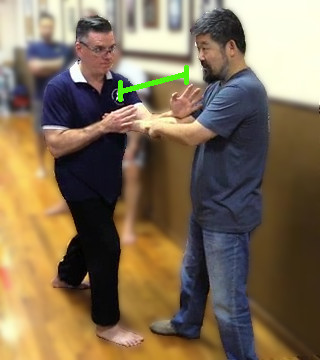 |
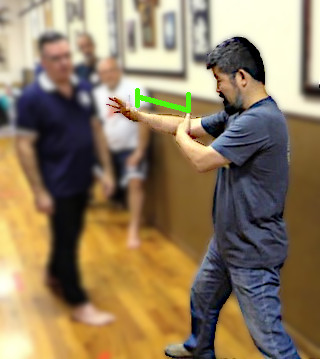
When the student performs the grab, the master acknowledges that the student has “stretched my forearm out.” The first crucial step is to treat the entire structure, extending “from the finger to elbow,” as one piece. Master Chen immediately solidifies his hand and forearm so that this held section remains a single, unified unit. This is shown in Figure 1 with a green line highlighting the one piece. |
Relocating the Source of Action
| By Taiji principles, once the held section is stabilized, “action cannot come within the struggle here” (referring to the held hand and forearm). Consequently, the origin of the action must be transferred outside the area of contact. Master Chen instructs that “the effective action comes from here [at the elbow]“. Figure 2 shows Master Chen pointing at the elbow which will be used to power the solid one piece. |
 |
Generating Force via the Elbow
With the hand and forearm fixed as a single piece, Master Chen emphasizes the elimination of all internal movement within that section. This means there is “no more [action] here [at the fingers,] no more [rotations of the wrist] here [and] no more [flexing of the forearm] here.” The force generation is now concentrated “just in here [at the elbow].”
The elbow becomes the primary driver for both offensive and defensive maneuvers. To execute a push against the opponent, Master Chen explains that he is “going to push him by opening this here [area between my right elbow and chest].” Conversely, to pull the opponent, the maneuver involves “not moving here [the section of the arm being held] at all,” with the pull originating only from this “elbow coming in.”
Incorporating the Trunk for Greater Power
Should the power generated solely from the elbow prove insufficient, Master Chen teaches that the action must be augmented by the next major joint: the trunk. He can “go [add an action from opening or closing the chest to drive the elbow.]”
Master Chen concludes by noting that this critical interaction—where the action originates “here [at the elbow and chest, away from the contact area, while] power is there [at the contact area]”—is the very definition of this principle. This method of force application is formally “called Indirect Power.”
The Baby and the Spoon (The Transition to Indirect Power)
To illustrate the nature of Indirect Power—specifically, the initial resistance to using an intermediary tool and the eventual efficiency gained—Master Chen employed the vivid, conversational analogy of a baby learning to eat.
The Primal, Direct Connection
Master Chen characterized the initial state as a primal, direct connection, declaring, “Never grab soup anymore.” He mimicked the inefficient, direct action of scooping with bare hands into an imaginary bowl, emphasizing, “No more of this [scooping with your bare hands] with soup.” Instead, he states, “you must only hold this spoon.”
 |
He continued by painting the scene of a baby’s early struggle: “You realize that babies at the very beginning—they want absolutely nothing to do with the spoon.” They “still insist on just doing this [scooping with their hands to their mouth] with the soup,” preferring the inefficient, direct connection. It takes them “many days of persistence and struggle before they even grudgingly learn how to hold the spoon.” |
Accepting the Tool
The analogy highlights the crucial shift that occurs once the indirect tool is accepted. “Once they finally master the clumsy grip on that spoon, the dynamic changes entirely!” The baby is no longer focused on the soup itself; they are “looking for things to conquer and eat with this new tool.” Master Chen concludes, noting that at the start, “whatever helpful thing you try to give them, they simply throw it away,” preferring the immediacy and directness of their own two hands over the indirectness of the tool.
Application in Taijiquan: Fighting with the Body
Master Chen then pivoted back to the technical application, explaining that in a Taijiquan technique, practitioners “have to go [and maintain the integrity of the contact area] until this [area] becomes active [as a tool for power transmission].”
He repeats the demonstration with another student using the same restrictive grip on his forearm. The student grabs Master Chen tightly with both hands.
Rejecting Local Struggle
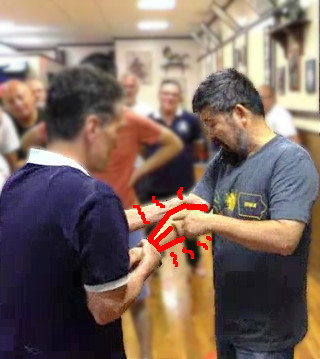 |
Master Chen first illustrates the common, incorrect reaction: “At the beginning we like to fight [at the area of contact.]” He demonstrates this local movement by trying to twist and turn his forearm to escape the grip. He notes that all such attempts are easily countered by the student. In Figure 3, the red area highlights the controlled forearm and the red wavy lines represent the local struggles occurring in this area. |
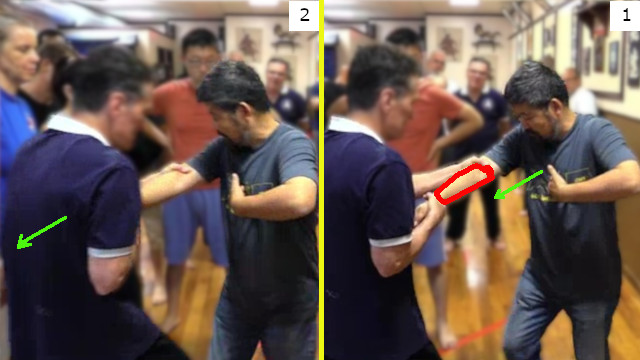
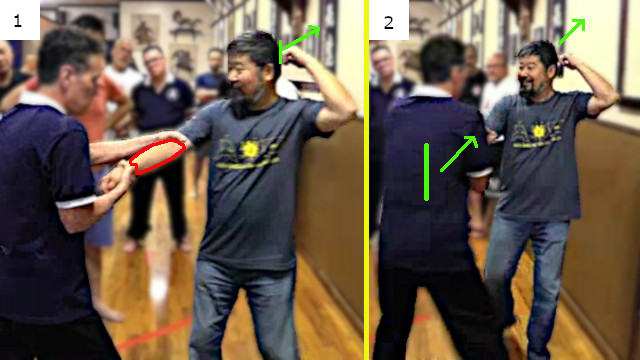
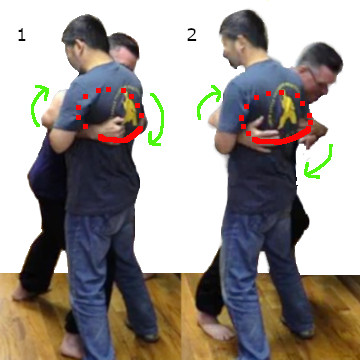
| He then immediately compares this to the correct Taiji response. He explains, “See he grabs it [my forearm.] I don’t care [about the forearm] anymore.” The correct strategy is to maintain the forearm’s structure and let the opponent hold it. Instead, “I’m using my body to fight [him.]” Figure 4-1 shows the student controlling the forearm (highlighted in red). The green arrow indicates force exerted by the body rather than just the forearm. In Figure 4-2, the student moves back; the green arrow illustrates Master Chen’s force penetrating the student’s body. |
 |
Driving Force from the Core
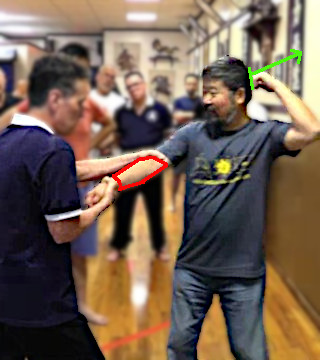 |
Master Chen illustrates this shift in force origin by pushing his body forward; the arm follows as a result, compelling the student to move backward. In a counter-example, Master Chen pulls his forearm back using the back of his head as the anchor point, and the student is simultaneously pulled forward. As seen in Figure 5, the student is again holding the forearm with both hands, highlighted by the red area. The green arrow near Master Chen’s represents the anchor point and the direction of the pull against the opponent.He concludes by summarizing the principle: “I’m using my body [to push or pull.] I’m not here [at the forearm where he is holding me] anymore. What does that mean? Indirect Power.” |
Leaping Outside the Five Elements
Master Chen elevates the discussion by introducing a profound philosophical concept from Daoist internal alchemy (内丹术, nèidān shù) and transcendent philosophy. He states, in a conversational summary of the concept, “In Chinese, we say ‘You must jump, quantum leap outside of the five elements.'”
The exact, highly significant phrase he is referencing is: “To leap outside the Three Realms, and be not within the Five Elements” (跳出三界外,不在五行中; tiào chū sān jiè wài, bù zài wŭ xíng zhōng).
Defining the ‘Cycle of Life‘
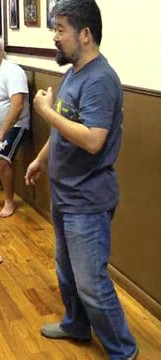
Master Chen defines the Five Elements (五行, wŭ xíng) in this context as representing the “cycle of life.” He then applies this general cosmological principle to the specific Taijiquan interaction:
|
 |
The Practical Leap
The goal of the Taiji action is therefore to “‘leap outside if the five elements‘.” Master Chen contrasts the normal, trapped action with the correct Taijiquan response:
|
 |
|
|
 |
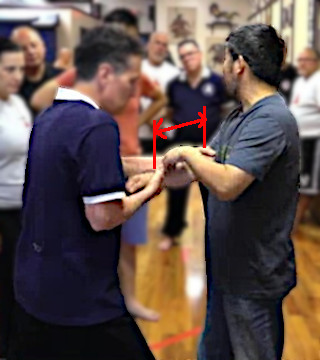
Strategy: Locating the Opponent’s Control
Master Chen then details how this concept is applied in Taijiquan fighting strategy. The first step is to immediately identify the opponent’s sphere of control:
 |
|
The Indirect Response
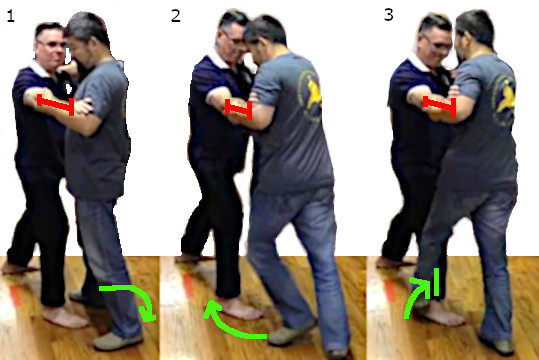
Once the opponent’s sphere of control is identified, the Taiji technique initiates at the furthest possible point from the struggle: “The Taiji technique now starting here with the rear foot.” This decision means, “So I’m not going to fight him here [at his forearm where his grip is strong] anymore.”
Master Chen then carries out a series of exaggerated movements with his feet without disturbing the opponent’s grip. He emphasizes the key takeaway: “And you see I’m fighting outside [his grip.] I’m not fighting inside [against his power.] That’s called ‘Indirect Power.'” Figure 7-2 and Figure 7-3 illustrates this series of foot movements, indicated by the green arrows.
Philosophical Underpinnings of Indirect Power
Master Chen’s explanation of Indirect Power offers a concise summary of profound philosophical concepts, linking the physical technique to deep philosophical principles of non-attachment and self-transcendence. He encapsulated this entire strategic approach in a striking Taiji vernacular: “Whatever you want, you can have. I don’t want any of it. Whatever you don’t want, I’m not giving you a single bit.”
Historical Context: Daoist and Buddhist Detachment
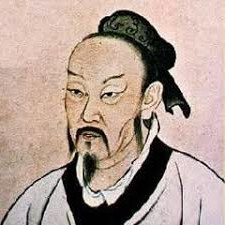
This seemingly simple saying is a clear representation of core Taoist and Buddhist principles. The master’s strategy directly reflects historical philosophical tenets:
|
 |
|
|
 |
Strategy in Action: The Physical Key to Bù Diū Bù Dǐng
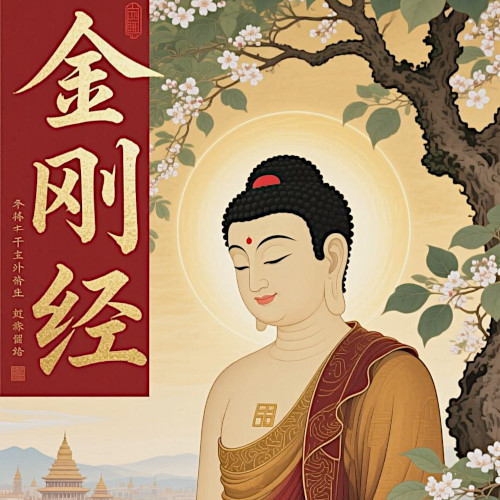
These historical philosophical concepts culminate in the fundamental martial arts strategy attributed to internal styles like Taijiquan: “Do not disconnect/disobey. Do not resist/oppose” (不丢不顶; Bù Diū Bù Dǐng).
Historically, concepts from the Zhuangzi and Diamond Sutra appeared to be based purely on thought and the control of the mind. However, Master Chen argues that the Practical Method system offers the missing physical element required to apply these ideas in practice:
The key to achieving the seemingly impossible Bù Diū Bù Dǐng is provided by Indirect Power. One does not disconnect or resist because the opponent is in control of his “Cycle” (the area of contact), but the technique itself exists outside of his cycle. This is the practical, physical essence of Indirect Power.
The Extreme Test: The Bear Hug and the Seven-Inch Knife
Master Chen uses a more extreme demonstration—the bear hug—to further cement the concept of Indirect Power.
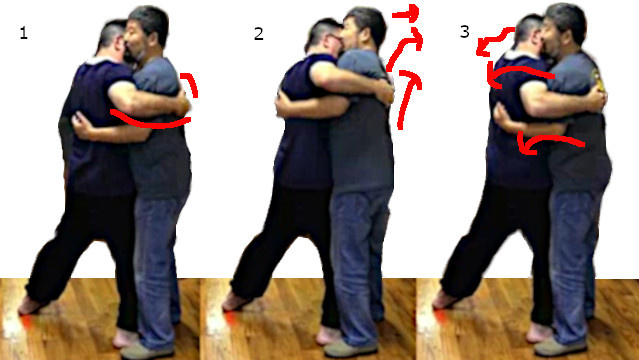 |
During the demonstration, Master Chen allowed his student to secure a tight bear hug to illustrate a common tactical error. He first simulated the typical, inefficient reaction—physically struggling and shifting his weight to break free. Master Chen explained this from the opponent’s perspective: “We all do this [struggle against the bear hug]. That secure bear hug and the sensation of my struggle against his power are what he craves most.” |
This physical dynamic is illustrated in the accompanying figures: the red curved line in Figure 8-1 highlights the bear hug’s primary area of control, which pins Master Chen’s arms firmly to his sides. Subsequently, the red wavy arrows in Figures 8-2 and 8-3 demonstrate the instinctive, yet ineffective, movements of a person attempting to toss and turn within the hold.
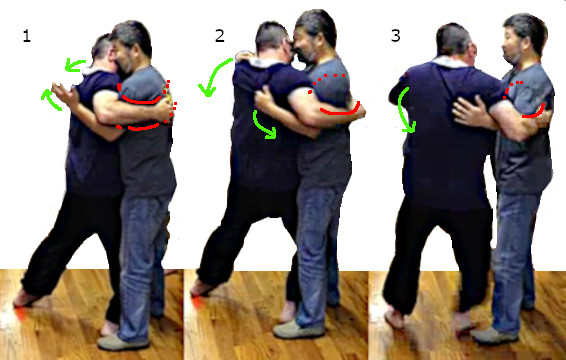
Master Chen then presents the Taiji approach, shifting the focus from the struggle to the opening. “But once he does that [secure the bear hug],” he explains, “he never got my hand.” To demonstrate, he shows how effortlessly he can move his hand where it rests on the student’s back, jokingly remarking, “Can you see [with my free hand,] I can tickle him.” The central lesson of this movement is that one should not struggle against what the opponent already controls.
| This strategic shift is visualized in Figure 9-1, where red curved lines highlight the area trapped by the bear hug, while a green arrow identifies Master Chen’s free hand remains active outside this control zone. The application of this leverage is further detailed in Figures 9-2 and 9-3, which show the simultaneous push of the right hand on the student’s shoulder and the pull of the left hand on the student’s back. |
 |
By utilizing the part of his body the opponent does not inhabit, Master Chen steers the student’s rotation and breaks the grip entirely. He emphatically concludes with a golden rule of Taiji: “So it’s very, very important that you never fight anything he already has.”
Yielding the Controlled Area
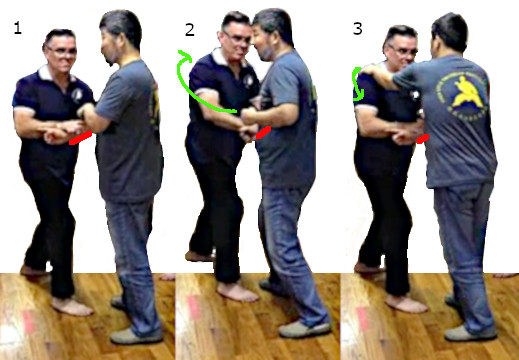 |
Master Chen returns to the initial forearm grip example to reinforce the core principle. As a student uses both hands to firmly grab his right forearm, Master Chen notes that the limb now “belongs to him from here [left hand] to here [right hand].” He acknowledges the reality of the situation, stating, “There’s no way he’s going to allow you to come out [and break the grip].” This point of contact is illustrated in Figure 10-1, where a red line indicates the “pinned” area that is under the opponent’s control. |
Instead of struggling locally, Master Chen immediately applies Indirect Power by using his left hand to reach for the student’s back. This movement demonstrates how the Taiji principle is used to counter a hold by acting outside the established sphere of control. He contrasts this with the common, incorrect reaction: “But we all get into this [using local power to fight at the point of contact].”
The transition to this superior position is shown in Figure 10-2, where a green arrow tracks the movement of Master Chen’s free left hand toward the student’s back. Finally, Figure 10-3 illustrates the application of this leverage, showing how Master Chen uses that free hand to pull the student’s shoulder. This action destabilizes the student’s base and effectively breaks the pin on the right arm without ever fighting the grip directly.
The Training Cornerstone: The Positive Circle
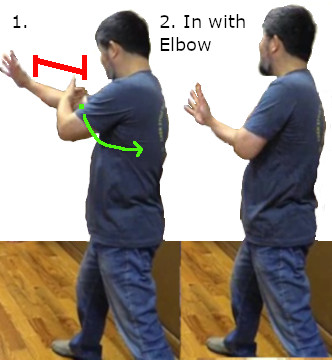
| Master Chen explains that the first step of drawing the Positive Circle is to establish a unified structure. He states, “So now you understand, ‘In with Elbow‘ is to make this [forearm] one piece.” Establishing this fixed, unified structure is the physical prerequisite for generating power from the elbow and chest. This concept is visualized in Figure 11-1, where a solid red line highlights the forearm acting as a singular, rigid unit.The completion of this movement is shown in Figure 11-2, which illustrates the final position of the “In with Elbow” action. This one piece structure—the fixed and unified hand and forearm—is a fundamental component of the system often referred to as the “Seven-Inch Knife.” |
 |
Applications of the Positive Circle
A Simple Pin
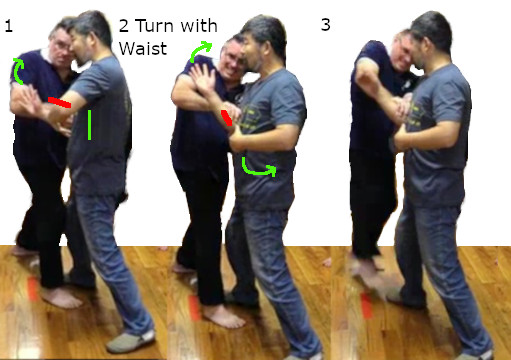 |
Following the first move of the Positive Circle, “In with Elbow,” the scenario assumes an opponent is in close quarters, pinning your elbow against your ribs. Master Chen demonstrates this by having a student use both hands to forcefully trap his arm against his torso. This position is captured in Figure 12-1, where a solid red line highlights the pin of the forearm against Master Chen’s side. Within this same figure, a green arrow emphasizes the outward stretch of the pinned forearm—reinforcing the “one-piece” structure—while a vertical green line illustrates the stable core that remains independent of the arm. |
Master Chen explains the mechanical advantage of this posture: “The opponent has pinned my arm, but they do not have control of my waist. Because my waist remains free behind the arm, I can still rotate.” This transition leads directly into the second move of the sequence, “Turn with Waist,” as shown in Figure 12-2. In this stage, a green arrow indicates the aim and stretch of the front hand, while a curved arrow illustrates the backward rotation of the waist that creates the necessary leverage.
Finally, he executes the third move, “Out with Hand,” which requires the opening of the rear kua and a strong connection to the rear foot. As shown in Figure 12-3, this coordination allows the front hand to continue its outward stretch, resulting in the student being propelled backward by the sudden release of power.
A Pin as well as controlling the Waist
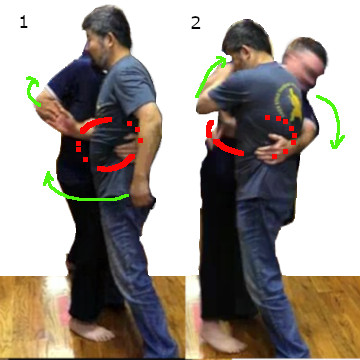
To further illustrate the principle of operating outside the opponent’s control, Master Chen modifies the drill by having the student pin his elbow with the right hand while using the left hand to firmly grip his waist. With his center now effectively neutralized, Master Chen explains the strategic shift required: “I will not attempt to move what is being held. I will only move what is outside his circle of control.”
| This tactical situation is visualized in Figure 13-1, where a red circle highlights the student’s area of dominance, spanning from Master Chen’s front elbow to his grabbed rear waist. Despite this containment, two key vectors of “indirect power” remain available. First, a green arrow indicates that although the right arm is pinned, the right hand can still continue to stretch forward. Simultaneously, another green arrow shows that the left hand remains free to move and push the student’s right shoulder.The combined action of the stretching right hand and the pushing left hand forces the student to rotate and lose their balance. Consequently, the student’s structural integrity fails, and the pin is broken by utilizing the parts of the body the opponent could not reach. |
 |
Strategic Philosophy: The Fly in a Bottle vs. Silk Reeling
Master Chen introduces the basic strategic thinking central to this approach: the fundamental need to operate outside of the opponent’s conventional control, thereby circumventing the established struggle.
The Five Elements and the Core Principle
Master Chen clarifies the philosophical foundation of the system’s strategy, rooted in the concept of the Five Elements (五行, wŭ xíng): “The Five Elements refer to a closed loop system, similar to how the four seasons close out a year.” Within a closed loop, actions are predictable and controllable.
He then presents the core principle derived from this idea of non-attachment and operating outside the loop: “According to Taiji philosophy, anything you control, I no longer want; anything that remains, I can use.”
Master Chen offers a critical caution regarding the nature of this concept: “This is a way of thinking—a theory—and therefore, it has no size.” By this, he means that the practical application of the theory is not governed by physical magnitude. Whether an opponent exerts a massive amount of power or occupies a significant amount of space, the mechanical principle remains the same. The theory is scalable and absolute, independent of the external scale of the conflict.
A Practical Demonstration: The Underhook
 |
To demonstrate the effectiveness and practicality of these principles, Master Chen applies them to a high-pressure grappling scenario. In this demonstration, a student rushes in and secures Master Chen with an underhook—a close-quarters wrestling technique that imposes powerful constraints similar to a bear hug. This position is illustrated in Figure 14-1, where a red circle highlights how the student effectively controls Master Chen’s upper body, a defining property of this wrestling maneuver.Master Chen uses this physically constraining situation to explain the core Taiji strategy: “The opponent has secured the majority of my body. All I have left is this minimal resource [referencing the free hand at the back].” |
As indicated by the green arrows in Figure 14-1, Master Chen’s hands remain free despite the student’s control of his torso. The immediate strategic concern is not the brute strength of this small, free part, but the discipline of the practitioner: “I can only afford to use this much.”
He concludes by emphasizing the strategic danger of fighting “inside the loop.” He warns that if a practitioner attempts to use any body part already within the opponent’s hold, they are simply yielding more control to the attacker. By fighting at the point of contact—the closed loop—the practitioner “will quickly become neutralized, have nothing left, and lose the exchange.” This transition to victory is shown in Figure 14-2, where Master Chen executes the Taiji strategy of pushing with the left hand and pulling with the right. This coordinated action turns and unbalances the student, eventually breaking the underhook entirely.
The Peril of Local Struggle: The Fly in the Bottle
| Master Chen provides a compelling physical analogy to explain the danger of local struggle versus the strategic power of Indirect Power. Master Chen likens struggling against the opponent’s strong, central grip to a fly bumping repeatedly into the side of a bottle: “The more the fly struggles against the walls, the deeper he is driven inside the bottle’s confines.”By continuously fighting the point of contact, the fly unwittingly allows the opponent (the bottle) to direct its movement. Eventually, the fly is “funneled down to the narrow bottom of the bottle.” At that point, the opponent “simply needs to put the cap on. The bottle is closed, and the fight is definitively lost.” This illustrates that engaging the opponent’s center of control only leads to deeper neutralization. |
 |
The Loose Thread: Fighting from the Outside
In stark contrast to this losing strategy, the Taiji approach focuses entirely on fighting from the outside.
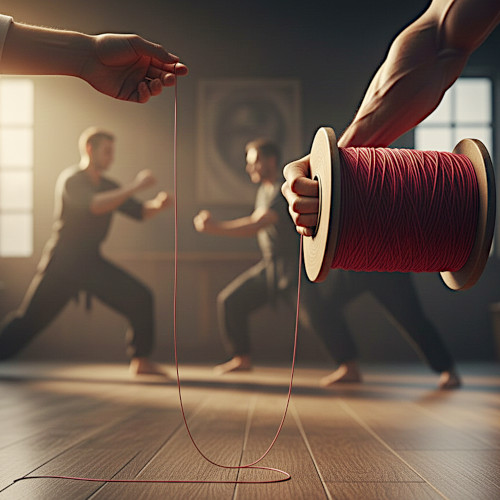 |
Master Chen uses a second, powerful analogy: “Imagine your opponent maintaining a tight grip on a large spool of thread. A single, loose thread is sticking out, the only part not under their control.”The Taiji practitioner’s strategy is to ignore the mass of the spool (the opponent’s power and grip) and instead focus on the single, free element. “As a Taiji practitioner, I continuously pull and tug on this loose thread until the entire spool begins to unwind and falls apart.” |
This core idea—emphasizing using things outside of the Five Elements to defeat the overwhelming control of your opponent—is precisely “how Taiji combat operates.” This strategic method of utilizing external, spiraling force is why the practice is famously known as ‘Silk Reeling‘ (纏絲功, Chán Sī Gōng).
More on The Positive Circle
Silk Reeling against a Pin
Master Chen illustrates the principle of operating outside an opponent’s sphere of control by utilizing the mechanics of the Positive Circle. He begins by allowing a student to pin his right arm firmly against his hip, acknowledging the disadvantage by stating, “You got me here.” He initially mimics a common tactical mistake by struggling against the pin with his arm, pointing out that such “normal action struggles are inside his sphere of control.”
| To demonstrate the correct Taiji action, Master Chen explains that he instead wants “a little bit of silk to come up,” referring to his right index finger, which remains just outside the student’s two-handed grip. As he leads with this finger toward the opponent, the lock begins to “loosen a little bit.” This subtle shift is visualized in Figure 15-1, where a red horizontal line establishes the area of the pinned forearm under the opponent’s control, while a green arrow near the right index finger highlights the remaining freedom of movement existing just outside that zone. |
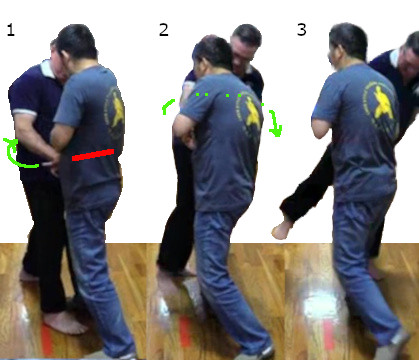 |
Master Chen explains that by allowing a small piece of the movement to “come out of the controlled area and letting that piece become bigger and bigger and bigger,” he eventually gains “more and better control.” This progression mirrors the essence of silk reeling—similar to tugging a single thread to unroll a spindle. Figures 15-2 and 15-3 illustrate this continuous action; the green arrow shows the expanding path of movement that eventually unbalances the student and breaks the pin.
Finally, Master Chen reminds the student of the danger of local resistance: “I don’t want to fight here,” he says, pointing to his pinned forearm. “The more I fight, the more you grow on me.” He demonstrates that a direct counter-struggle at the point of contact allows the student to gain total control of his center until “you see you got all of it,” at which point the student is able to easily push him back.
The Positive Circle and Segmented Movement
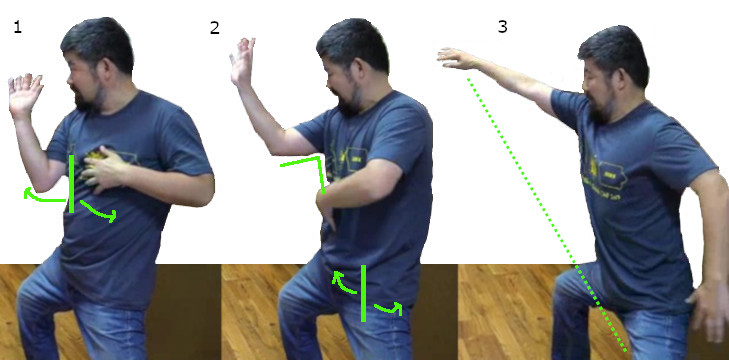 |
Master Chen reinforces this concept by relating it to the mechanics of Positive Circle training. He begins with the first move, “In With Elbow,” noting that once the elbow is withdrawn, the forearm must remain stationary because “this [movement of the elbow] is done.” This initial structural requirement is illustrated in Figure 16-1, which shows the forearm fixed in place as the elbow retracts. |
Moving to the second part of the sequence, “Turn with Waist,” he explains that the focus of the action has shifted: “Now it is here [at the waist].” He emphasizes that once the waist has rotated, that specific segment is also “done” and must not move further. The progression continues to the third sequence, “Out with Hand,” and is captured in Figure 16-2, where the hand stretches forward to return to its initial position while the previous structures remain locked.
To extend the reach even further without breaking these internal locks, Master Chen opens the chest and then the rear kua. As shown in Figure 16-3, this coordination creates a complete Positive Circle through a series of distinct, sequential moves. This method ensures a clear Yin-Yang separation, where stationary parts provide the foundation for moving parts to generate power.
Differentiation vs. Circular Motion
Master Chen contrasts the Practical Method with the “normal” way of drawing a circle. In a typical circle, where there is no clear differentiation between moving and stationary parts, he argues that actually nothing happens.
Because there is no internal structure, the opponent doesn’t need force to counter it; they can simply follow the movement. For example, as the hand moves back, the opponent can step in without fighting
and stay attached, leaving the practitioner with nothing.
In contrast, the Practical Method uses a definitive sequence to prevent the opponent from entering:
|
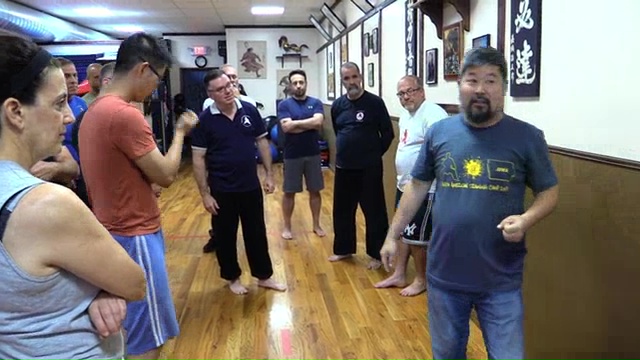 |
As the video fades to black, Master Chen leaves the students with a final instruction for their practice: Do the same exercise. Lock your forearm, only use your elbow to make the move—don’t get this forearm involved anymore…