 |
Indirect power is an absolutely vital concept in our practice; in fact, it is the primary pillar of the Chen Style Tai Chi Chuan Practical Method. To grasp this, consider a simple, everyday analogy: Think about eating—if we simply grab the food with our bare hand, that is direct, as there is no medium between the hand and the food; indirect, on the other hand, is when we use a utensil like a spoon or chopsticks, where we use our hand to manipulate the utensil, and the utensil then touches the food, meaning the force is transmitted, not applied directly. |
| In our Tai Chi practice, we learn to gain direct access to an opponent while ensuring they only ever have indirect access to us, effectively taking advantage of the situation. While this strategy may seem ‘unfair‘, it is the fundamental approach of our training. Through dedicated drills and understanding, we strive to reach a level where our contact exerts direct force on the opponent, yet their contact with us only results in a roundabout, indirect connection. Once this is accomplished, we establish control over the engagement, and the opponent does not have control over us. This strategic mindset aligns with a key principle drawn from Chinese classics such as The Art of War. Within Tai Chi, this ideal strategic blueprint is explained by Wang Zongyue in the Taijiquan Jing (太极拳经): “I know the other, but the other does not know me.” (人不知我,我獨知人。 – Rén bù zhī wǒ, wǒ dú zhī rén.). This principle describes the mastery of understanding their intent and connection while successfully obscuring our own methods, granting us the indispensable advantage. | |
| (This series of articles is based on the Indirect Power-Practical Method Terminology published Feb 8, 2021.) |
|
 |
Part 1. Don’t Eat With Your Hands
Part 3. Learning How to Fish
Part 4. Yang Actions
Part 5. Yin Actions
Part 7. Not using force is a magic trick
|
Introduction
The Practicality of Unified Power
The term “Indirect Power” is a foundational definition within the Practical Method taught by Master Chen Zhonghua. This idea is closely related to a fundamental principle in Taijiquan (Tai Chi) known as “Unified Jin” or “One Jin” (整劲, Zhěng Jìn). The core concept is that power is neither generated nor used in isolation by a single limb or joint; rather, it is the result of the entire body coordinating and moving as a single, integrated unit.
This principle is explicitly outlined in the Taijiquan Treatise (太极拳论, Taiji Quan Lun) attributed to Wang Zongyue (王宗岳):
|
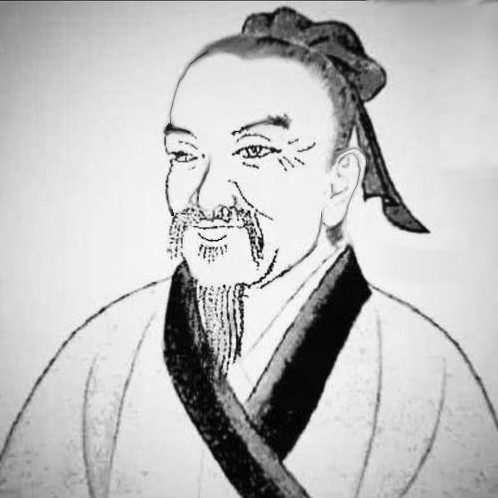 |
This passage clearly states that power originates from the ground, transmits sequentially through linked body segments, and is finally expressed at the point of contact (e.g., the hand). The hand does not act alone; it is merely the terminal point of a full-body wave.
Wang Zongyue further reinforces this required structural integration with the instruction:
|
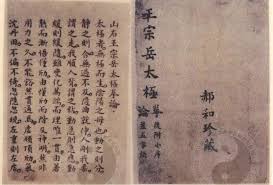 |
This classic guidance warns against having weak points, hollows, or interruptions in the body’s structure and movement—precisely the structural faults created by relying on isolated, or “local power.”
While these passages offer clear theoretical insights, the practical application of Zhěng Jìn remains elusive for many practitioners. Lacking a true understanding of how to achieve this unity in practice, many schools of Taijiquan inadvertently regress into systems of strength and endurance. When reduced to this level, Taijiquan fails to differentiate itself from external martial arts, sacrificing its unique strategic advantage.
Master Hong’s Refinement
Master Hong Junsheng (洪均生) refines and clarifies this concept with his usual practicality. In his seminal work, Chen Style Taijiquan Practical Method(《陈式太极拳实用拳法》), he makes this integrated power a central, governing principle. Master Hong’s core theory of “Use leverage, do not use local muscular strength” (“用杠杆, 不用力气”) and his detailed explanation of the body acting as a “three-dimensional spiral” (“立体螺旋”) or unified mechanical system represent the practical root of Master Chen’s teachings on “Indirect Power.”
Master Hong uses the simple act of pushing with the hand to illustrate this complex Taiji concept, breaking down why using “local power” (手臂之力, shǒubì zhī lì, arm strength) fails and how the whole body must act as one.
1. The Fault: “Local Power” (拙力 Zhuō Lì)
Master Hong would explain that if you try to push using only the strength of your arm and shoulder muscles, the power is localized and easily isolated by your opponent. You break the “six harmonies” (六合), and you become top-heavy and rootless, as your power is not sourced from the ground. The opponent can easily deflect your arm and uproot you because your force and your body’s center are not unified.
2. The Correct Method: “One Action with the Whole Body” (節節貫穿 Jiéjié Guànchuān)
The correct method, described as “Linked Through Every Joint,” requires the action of the hand to be the final result of a specific, mechanical sequence:
|
 |
Master Hong emphasized that if any part of this chain moves out of sequence or in isolation—if the shoulder moves before the waist, or the arm pushes before the foot presses—you have “broken the chain” (断劲 Duàn Jìn disconnected power) and reverted to local power.
Master Hong’s Governing Principle
Master Hong framed this not just as an energy concept but as a law of physics and mechanics. He concisely restated the classical principle by saying:
|
 |
In the context of “one action,” this means the intended action (e.g., a hand push) must involve the coordinated movement of every part: feet, legs, waist, spine, shoulders, and arms. His entire Practical Method is built on creating this unified body action through precise, mechanical rules, ensuring that power is always sourced from the ground, directed by the waist, and expressed through the limbs—never generated in the limbs themselves. This whole-body Jin (劲) is the practical application that allows for effective “Indirect Power” and is far more effective than localized Li (力, muscular strength).
Practical Application of Indirect Power
Master Chen Zhonghua distilled his intensive study with Master Hong Junsheng, integrating it with his command of Western concepts and his expertise as a translator. Coupled with decades of teaching experience, this effort resulted in a highly practical system for learning and achieving the difficult Taiji concept of Zhěng Jìn.
Master Chen uses the English term “Indirect Power” specifically to highlight a critical experiential outcome of this training: from the practitioner’s perspective, the generated power is not felt at the point of contact, but originates from structural anchors away from that point. From the opponent’s vantage, they react to the power but cannot fathom its source.
This approach transforms the practitioner from an individual reliant on local muscular force into a unified mechanical system. Effectively, the body itself becomes a sophisticated leveraging tool and not merely a collection of contracting muscles. This differentiation represents the ultimate strategic advantage of Taijiquan. Through demonstrations and drills, Master Chen consistently verifies the effectiveness and practicality of this precise, integrated training method, making the theoretical ideal of Unified Power an accessible reality.
How Indirect Power Works in Practice
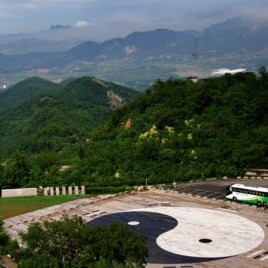
Based on the Indirect Power Mini Lesson 2012 at Daqingshan Mountain Resort.
 |
Master Chen begins the mini-lesson by articulating the fundamental principle for generating and applying force in Taijiquan (Tai Chi): power must be removed from the point of action. This core concept is what fundamentally distinguishes the Practical Method of Taijiquan.He explains the principle clearly, stating: “Here’s a little explanation about how to use power. The basic principle is this: ‘you cannot have local power. You can only have one action with one body part.’ So it’s called ‘power must be removed from the point of action‘.” |
The lesson’s core idea revolves around the critical difference between local power and indirect power. Local power refers to force generated solely by the body part in contact (e.g., just the hand), which is ineffective. Indirect power, in contrast, involves generating force from the core/whole body and channeling it to the point of contact, ensuring “one action with one body part.” The concept is explained through practical demonstrations with a partner.
Demo #01 – Pull
Isolating Action from Power
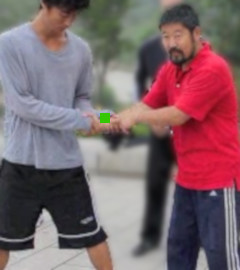 |
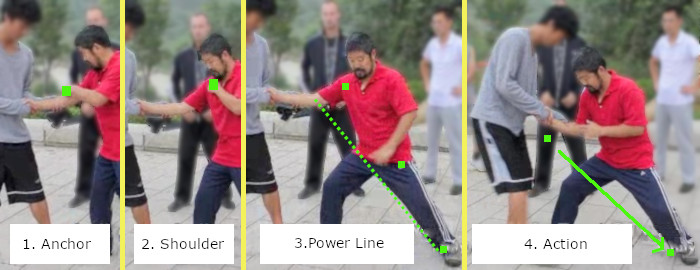
Master Chen demonstrate this idea with a student. He tells the student, “So if you grab me.” The student holds Master Chen’s right hand with his right hand, and then grabs his right forearm just below the elbow with his left hand.Master Chen points to his right hand (shown as a green square in Figure 1), stating, “This is where the action is. So hold it tight.” He then flexes his hand and pushes against the hold, explaining his own effort: “This is action [pull with my right hand but] my power cannot be here [at my right hand].” |
Indirect Power to Pull
The crucial principle Master Chen highlights is that power must be removed from the point of action. When the action is occurring at the hand, the actual source of power should be indirect.
He continues, illustrating the path of indirect power:, “So when this is the action [pull with my right hand,], the power is here [at the elbow] or here [at the front shoulder] or here [at the Dantian] or here [at the rear foot]. [The concept of indirect power,], it’s like that.”
|
 |
Identifying the Double Heavy Error
What people naturally tend to do is incorrect, according to Tai Chi principles. Master Chen explains, “Normally when action is here [on our hand], our power is also here [on the hand].”
“This position in space, where the action and the power source are the same, is called local. When the power for the action is also local“, he states, “[then we encounter the Tai chi error which] is double heavy.”
Double heavy means that “[in any Tai Chi technique] if this [location] is the action [then] this [location] cannot be the [source of] power [for the action.]” He concludes, “[Unfortunately,] we all are naturally born with this ability [to use only local action and local power] which is incorrect [according to Tai Chi principles.]”
Demo #02 – Press
Master Chen used another student to explicitly demonstrate the concept of local action and local power.
Setup
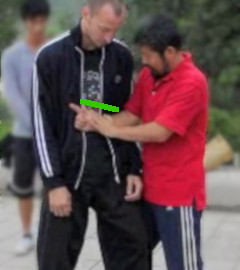 |
Master Chen placed his right forearm onto the student’s stomach. He then placed his left arm on top of his right forearm and pressed his forearm into the student. Shown as a green line in Figure 3.He explained the source of the force: “This is my action [pressing into the stomach with my forearm.] [I am using my left hand to press the right forearm so] my power is [also] here [on the forearm.]” Master Chen shows he can apply power from his forearm but his student can easy counter this power. |
Indirect Power to Press
Master Chen now shifts from demonstrating the error (local power) to demonstrating the goal (connected power).
He explains the desired outcome: “So what we want [in a Tai Chi technique] is [that] power has to be removed from the point of action.” He refers back to the previous setup: “This is [the] action [pressing into his stomach with the forearm.]”
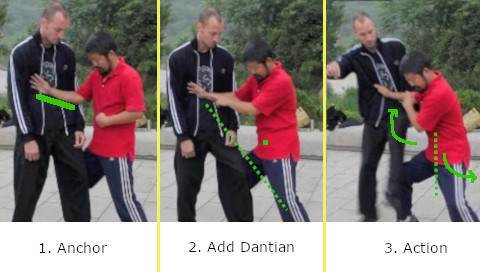
The Tai Chi goal is to use the forearm purely as an anchor. Master Chen elaborates: “[The Tai Chi technique is that] I only use here [the right forearm] to attach to him [at his stomach] but the power comes out of here [the Dantian] and then out of here [the rear foot].”
He emphasizes the role of the point of contact: “This [right forearm] is again just a connection. [This position on the right forearm is] not [the source of] power. So the power is here [away from the point of connection.]”
This series of action is shown in Figure 4.
|
 |
The Principle of Length
Once this principle of Indirect Power is understood, the source of power should move increasingly far away from the point of action.
Master Chen states: “The further it [the source of power] is [away from the point of action,], the more powerful we consider your [Tai Chi technique] to be.”
[In Tai Chi terminology,], he notes, this is called connected power. “Connected power must be long.” He clarifies that this length means the power is additive: “This power is additive [that source of power can be generated from different area of the body away from the point of action.]”
Master Chen concludes: “This is what you want to do [in a Tai Chi technique.]”
Demo #03 – Pull
Master Chen provides a further demonstration based on a pulling action with another student to contrast local power with connected power.
The Setup and Local Power
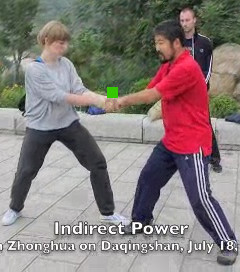 |
He begins, addressing the student, “I’m going to pull you and you can grab me here.” The student grabs Master Chen’s right hand with both hands. The green dot in Figure 5 shows this initial hold.Master Chen explains: “I’m going to pull. You sink down [to provide more resistance.]” Pointing at his held hand, he notes, “This is the ‘catch‘. Normally our power is also on the catch.” He then shakes and moves the grabbed hand, illustrating the idea of local action and local power. |
He then explains why this local method is ineffective for transmitting force: “If it’s here [on the hand,], the power stays here [at the hand. This is why you can move the hand.] It [the power] will not transmit [into the opponent’s body].” This made such techniques ineffective.
Sources of Connected Power
Master Chen then demonstrates the correct Tai Chi application, showing how force must originate away from the point of contact.
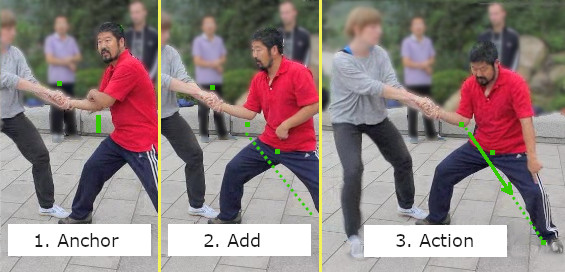
Master Chen continues: “Now the pull comes out of here [the right elbow.] Because of this [action from the elbow], power goes in [to the student’s body].”
He breaks down the chain of power generation: “So this [hand] is the catch. This [elbow] is [one source of] power. Then this [Dantian] is [another source of] power. [Finally,] this [rear foot] is [another source of] power.”
This series of action is shown in Figure 6.
|
 |
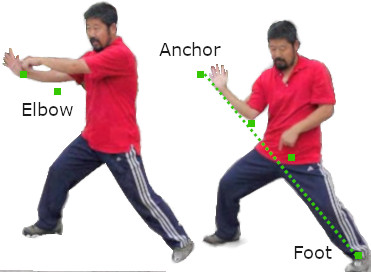 |
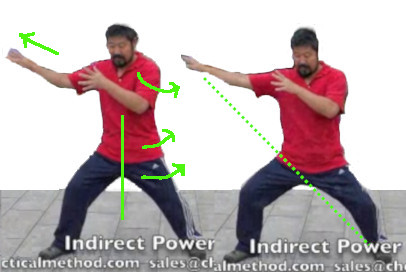
Master Chen then relates this practical demonstration to form practice. He reproduces the same action, but this time in the solo form [Figure 7].He describes his action, detailing the kinetic chain: “So now you see catch [right hand], power [through the withdraw of the right elbow], power [through the dropping of the right shoulder], power [through the turning of the Dantian], power [through the opening of rear kua and the rear leg].” He stresses the key takeaway: “[The key is that there is] no move here [the right hand – the catch].” |
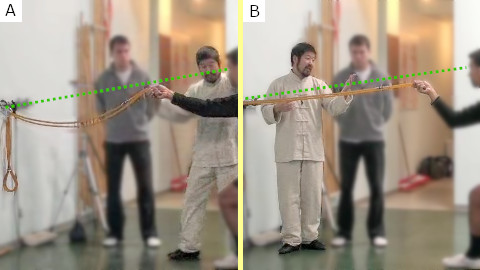
| Master Chen explains this action with a physical analogy: He said, “Just like pulling the rubber band. [You continue to stretch the rubber and remove the slack in the system resulting in increase in overall tension within the structure.]”
Master Chen then demonstrates incorrect form movements that violate this idea: He shows simple arm movements with local power, stating, “We don’t want this.” |
 |
Demo #04 – Push
Master Chen demonstrates a push action, illustrating how the same principle applies as in the pull action.
The Error in Local Push
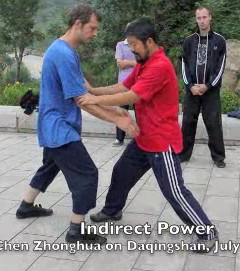 |
Master Chen begins: “I’ll show you [how the same concept apply to the action of] the push.”He then grabs the student’s arm at the bicep close to the elbow with each of his hands. This position is shown in Figure 8. Master Chen describes his hold as follows: “Now this is the catch, but now the push is here [from my hands].” He explains the consequence of this method: “So because of that [I am using local power], you have all sorts of mistakes.” Master Chen illustrates these mistakes by moving his student’s arm and his own body, emphasizing, “Everything is wrong [when you use local power].” |
The Connected Push
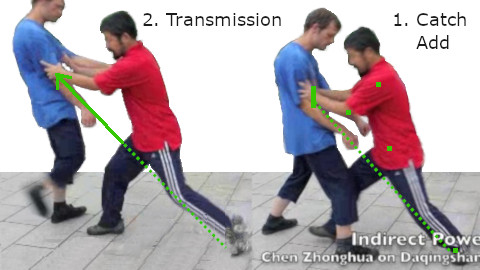
| Master Chen then demonstrates the Tai Chi approach. He maintains the hold on the student’s arm and reminds them: “But this is the catch.”He then outlines the correct sequence of power generation for the push: “The push is from here [right elbow], here [right shoulder], here [left elbow], here [left shoulder] and here [Dantian]. No power here [on the hands at the point of contact].” The process of catching, integrating power, and releasing the resulting energy is detailed as two steps in Figure 9. |
 |
The Long Transmission
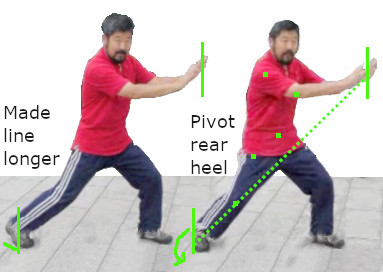 |
Master Chen demonstrates this contribution with exaggerated movements without the student. He describes the progressive length of power transmission: “[In a proper a Tai Chi technique, the power is progressively further away from the initial point of contact. First from the elbows and shoulders,], Then eventually here [at the Dantian], and then here [rear kua], and then [eventually to the] rear foot. Can you see? Not here [at the hands] anymore.” This progression is shown in Figure 10. |
He concludes: “So the [power] transmission goes longer, longer [and even] longer. Once you can transmit [the power] from rear foot to a finger and then you expand it [power line] by doing this [pivoting on the rear foot].” Master Chen summarized. “This [example] is basically the method of transmission. I’ll show you a more difficult example [to illustrate this idea].
Demo #04 – Defending Against a Push
Master Chen illustrates how the principle of connected power is used to neutralize a frontal push action.
The Common Error
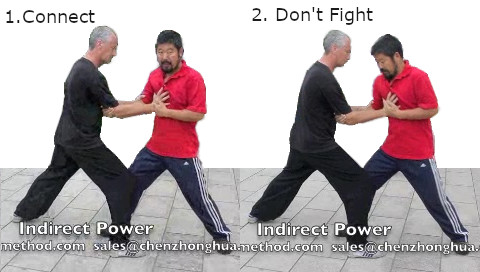 |
Master Chen begins the demonstration. A student steps forward and places both hands on Master Chen’s chest. Master Chen explains the student’s action: “He’s pushing me here [on my chest] and this is his power [on my chest pushing me backwards].” This initial position is shown in Figure 11-01.He highlights the typical, incorrect reaction: “We normally do this [push against his power by leaning forward so that I don’t fall back].” This is an example of meeting local power with opposing local power. This conflicting position is shown in Figure 11-02. |
The Tai Chi Solution: Activating the Kua
| Master Chen then demonstrates the correct Tai Chi action, starting from the same initial position with the student pushing on his chest. Master Chen stops the student’s forward progress by using his hands to hold the side of the student’s arms.He explains the redirection of force: “So now he’s here [pushing on my chest] and I use here [my rear kua to generate the power to move him back.]” This is shown in Figure 12. |
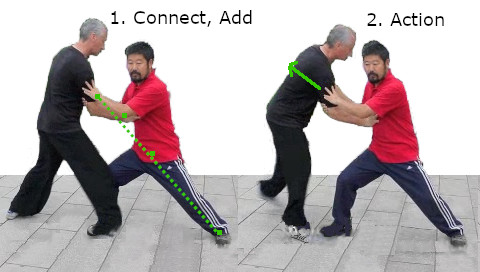 |
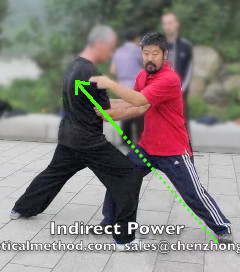 |
Master Chen provides more details on the effective pathway of this power: “It has to go up here [to my chest where his is pressing me] and [through his arms] connect here [to the back of his body].” This power transmission is shown as a green arrow in Figure 13.In order to facilitate this power transmission, he notes: “And as I do this here [dropping the rear kua. I need to], open here [my chest], [only then will] the power goes right through to him [and he reacts].” The student immediately falls upon the execution of this Tai Chi technique. |
Increasing Power Through Length and Subtle Actions
| Master Chen then explains how to significantly increase the power of the technique. The student stands at the initial position with two hands on Master Chen’s chest. Master Chen subtly re-positions his right arm at the student’s right armpit. Master Chen’s right forearm blocks the student’s forward progress.He explains the addition of multiple power sources: “And now, [power is] not only [from] this here [rear kua]. [For example, there is power] Here [from the rear leg towards the push on my chest].” This series of action is shown in Figure 14. |
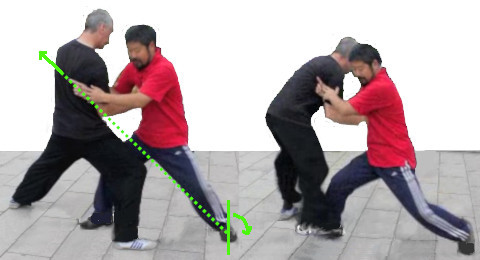 |
Master Chen points to the subtle but important details of the right hand: “Now, look at my [right] finger here [wedge under his armpit], [this finger it] goes this way [pointing right towards where I want to direct him]. And this [rear left] foot goes this way [the heel points backwards pivoting on the ball of the feet] to make it [the energy pathway] much longer. And then this [front shoulder drops] in [towards the energy line].”
Conclusion on Transmission
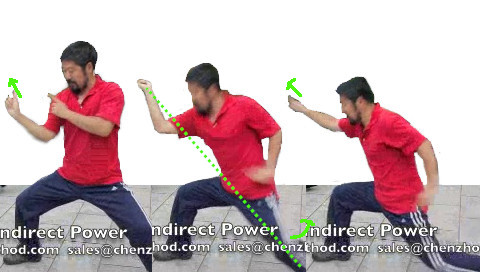 |
Master Chen then demonstrates the entire sequence with and without the presence of the student, showing that the practical example is just an application of the Form. As shown in Figure 15.Master Chen concludes the entire discussion: “So [in this example, there is more power then the previous example because the path for Power] transmission is longer. This is the method of power transmission. It sounds, again, very simple, but it’s very, very difficult to do because we always like [to use] local power. Why do we like it [using local power]? Because we can feel it [local power].” |
Demo #05 – Countering a Pin: The Instinct vs. Transmission
Master Chen offers a demonstration, illustrating the difference between an instinctual response and a proper Tai Chi power transmission when countering a static hold or pin.
The Error in Feeling Power
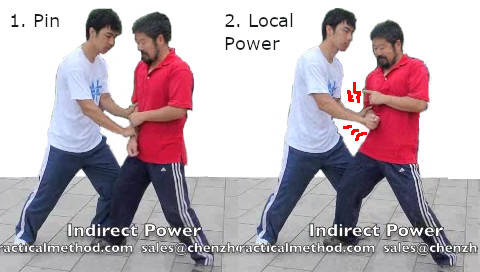 |
A student uses both hands to pin Master Chen’s right forearm into his right side near his hip. Master Chen first performs a normal counter to this pin by fighting and moving the forearm. This hold is shown in Figure 16-1.He explains the common error “Here, if I use local power, I can feel the power [of my counter move on my body], which is wrong [according to Tai Chi principle].” The struggle against the pin with local power is shown in Figure 16-2. |
Technique based on Power Transmission
| Master Chen then performs the counter move according to Tai Chi principles. Master Chen keeps the hold on his right forearm stationary, using it only as a connection point. His right finger, acting as a critical sight, points toward a target behind the line of contact, precisely guiding the transmission of his power. He then changes the internal structure of his body so that it is aligned to the direction of power. This is shown in Figure 17-1.Master Chen explained the correct response: “But if I transmit power from my rear foot. [My opponent moves away]”This is shown in Figure 17-2. |
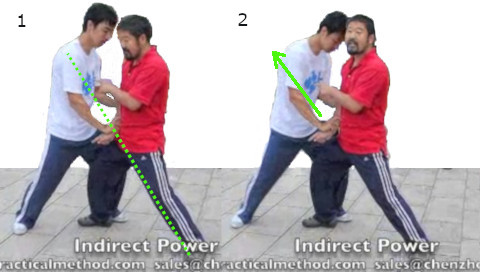 |
He adds a key observation about the internal experience of correct form: “I cannot feel power [in my actions] because it [the technique is based on power transmission. So my power] goes through [my body and my opponent is reacting to this power]. This is contrary to our instinct.
Demo #06 – Defending Against a Push
This is another example of how power transmission works in Tai Chi.
The Normal, Local Power Reaction
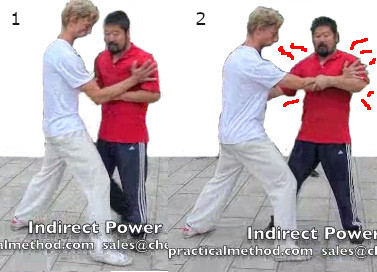 |
First, Master Chen demonstrates the common, or normal, reaction to the push. He used his hands to push against the student’s forearm. The student’s straight arms were so strong that Master Chen was simply bounced back. Master Chen tried again, adding more strength to his hands, but the result was the same. He couldn’t counter the student’s actions by pushing only against the straight arm. This hold is shown in Figure 18. The red lines shows Master Chen’s struggle against the push. |
Master Chen explained that this outcome is what happens when you use local power. He stated, “If I use local power. It’s like this [I cannot push him back].” The power is isolated and ineffective against a structurally strong opponent.
The Tai Chi Technique: Integrated Movement
| Next, Master Chen applied the Tai Chi technique, describing his actions as he performed them. The difference in result was immediate. This is shown in Figure 19.Master Chen broke down the technique: “[The Tai Chi techniques is as follows:] [First] Connect [by holding the forearm] and stretch here [at the rear kua].” As a direct result of these interconnected movements, the student was moved backward. |
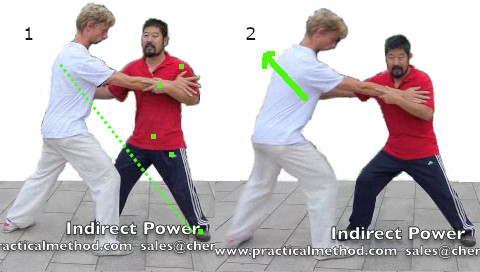 |
He demonstrated the Tai Chi action again, using the same initial posture. He instructed the students to “Here [aim with the hands, no power], Stretch [by opening the chest and the rear kua].”
Maximizing the Stretch (The Whole Body Connection)
| Master Chen emphasized that the key lies in the cumulative effect of the stretches. He continued, saying, “And if I stretch lots by [dropping the rear shoulder], lots [by using the rear leg], [all those actions are carried out with] no local power.” The action isn’t about arm strength. Instead, it involves integrating movements throughout the entire body—from the shoulder to the kua and down to the rear leg. Master Chen demonstrates those stretch using form training as seen in Figure 20. |
 |
In the end, the cumulative stretches—all performed without local power—caused the student to move much further back, demonstrating true power transmission through integrated body mechanics.
Demo #07 One hand push: Escaping and Extending
Master Chen continued his demonstration of power transmission with another student. He instructed her to “Do whatever,” and the student responded by using her right hand to push directly into Master Chen’s stomach.
The Problem with Local Power
Master Chen first reacted naturally by pushing back with his body. He described this common reaction: “Here, see, like [I am reacting with] local [power].” This use of isolated strength proves inefficient. He then showed that he could use his abdomen to shift and escape the push, but this doesn’t fully neutralize the incoming force.
The Tai Chi Counter: Entice, Stop, and Extend
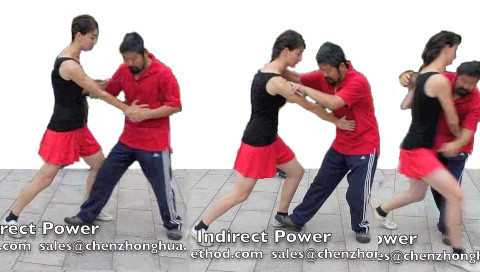
Master Chen then performed the counter based on Tai Chi principles. This series of action is shown in Figure 21 and can be described as follows:
 |
|
 |
He then highlighted the result: “And then, look, it [the contact point from my hand on her shoulder] becomes much longer [than the initial contact point of her hand on my stomach. Then I can make use of this increase length in my counter]. This is [an example of] how to move [the point of contact, in this case the stomach] and stop the local power [in this case with my hand on her shoulder].” By increasing the leverage distance, he is better positioned to pivot and deflect her away.
Master Chen executed the technique, and the student instantly lost her balance, stumbling forward as her own momentum was used against her.
Demo #08 Deflecting the Two-Hand Push
In this demonstration, a student attempted to push Master Chen with two hands placed firmly on his chest. Master Chen used this to illustrate how a slight structural change can neutralize an attack.
Neutralizing the Initial Push
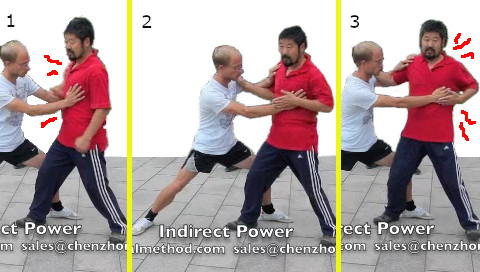 |
Master Chen explained his initial move: “Sure. See, now, his power is on the base [of his palms as he press on my chest].” The force is concentrated at the center of his chest.His immediate defense is a precise rotation: “So what I do is I turn [my chest towards the left]. Can you see? It [my chest] is open.” He clarified that pushing back without turning leaves his structure “closed,” forcing him to fight with local power. By turning, he opens the structure, disrupting the student’s straight line of force. |
He added an important caution regarding the degree of rotation: “[If I] Turn too much, it [contact] is lost. [If I] Turn not enough [then I am fighting him with local power].” The turn must be subtle and precisely calibrated to maintain contact while deflecting the direct line of attack.
The Subtle Anchor and Transmission
Master Chen then explained the finesse of the Tai Chi technique while the student continued pushing.
| As he began to turn his body left, he noted a critical moment: “As I turn here [my body towards the left], [he continues to] push, [at some point] he’s going to slide off [my chest and we will lose contact].”Before this slide could happen, he needed a new anchor point. He used his left hand to lightly hold the student’s right forearm: “Before that happens, I stop him here [by holding his right forearm with my left hand].” |
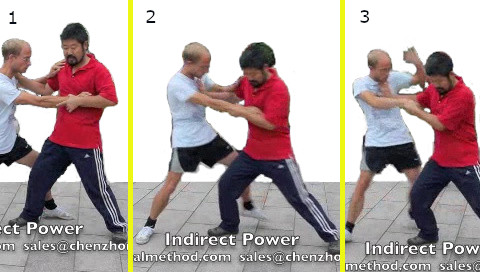 |
The power in this hand is minimal, “just one little bit,” just enough to prevent the student’s grip from slipping and losing the connection.
This subtle action completely changes the structure of the engagement. Master Chen is no longer fighting the force concentrated on his chest. The contact at the student’s forearm is now the anchor, allowing Master Chen to engage the principle of indirect power.
With the new anchor established, Master Chen shifts the source of his counter-force to the floor. He stated, “And now [once the contact at the forearm is complete], the power is here [at the rear foot].” The power is transmitted from the ground, up the leg, through the body, and out to the anchor point on the student’s forearm. This series of actions is shown in Figure 23.
Master Chen concluded the demonstration by stating, “So this is the transmission of power.”
Demo #09 Dissolving the Pull
Master Chen encouraged the students to practice the concepts in pairs: “So go to one side and try these things. Remember, the procedure is very simple.”
The Strong Tug and The Counter
A student approached Master Chen, holding Master Chen’s right hand with his right hand and his forearm with his left. The student then stepped back and delivered a strong, committed tug on Master Chen’s arm.
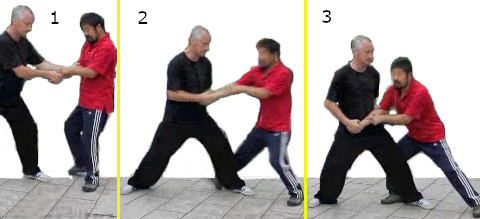 |
Master Chen immediately identified where the student’s power was focused: “See, now his power is here,” indicating the grabbed forearm. This is shown in Figure 24.Master Chen’s response was not resistance, but precise timing and structure. He executed his movement so that exactly as the student pulled backwards, Master Chen stepped forward into a wide stance. |
This forward movement simultaneously dissolved the student’s pulling force while maintaining the crucial contact point.
| The moment the student stopped pulling, Master Chen executed the Tai Chi technique. He explained the concept of power transmission: “So I transmit this power to here [the rear kua].”With this subtle structural shift, and without using local power, Master Chen made a slight move that caused the student to immediately stagger backward. This series of action is shown in Figure 25. |
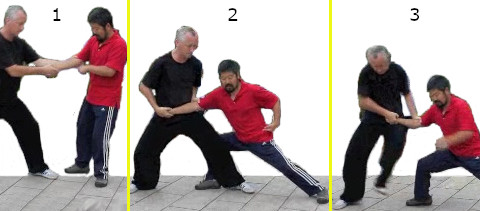 |
Master Chen then demonstrated the core action without the student to clarify the mechanics: “So I go [step forward, maintain forearm contact] and transmit [the power from my rear kua] to here [at the point of contact]. Do not fight locally [and struggle against his pull].” The emphasis is on using the kua and the rear leg to generate and transmit force, rather than battling the opponent’s strength directly.
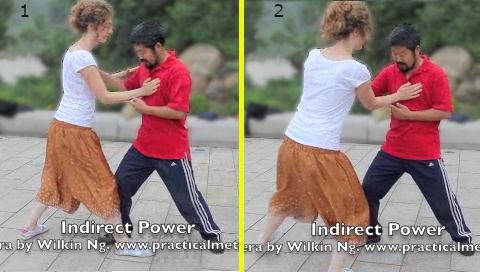 |
Master Chen reiterated the importance of slow, focused practice to internalize this concept: “Go [practice but perform your actions] very slowly so you can experience the cutoff of power and use the other part [of your body to generate the power]. It’s very, very important. Go slowly and try it. Here.” |
Practical Method and Engineering: The Conceptual Divide
Based on the Structural Force and Indirect Power article translated by Yuxin Liu on 2022/03/01.
Static vs. Dynamic Force: The Foundation of Structure
|
 |
 The Confusion of Force and Power: Engineering vs. Tai Chi
The Engineering Perspective: Math and Motion
P = F · v (Power equals Force times Velocity)
|
The Tai Chi Perspective: Concept and Quality
|
|
 |
Reconciling the Definitions
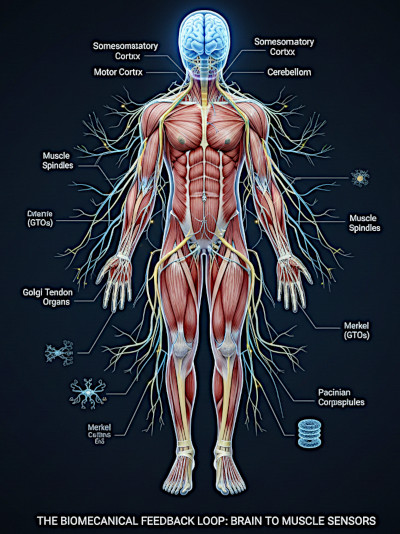
Mechanoreceptors and the Brain
|
 |
The Paradox of Effort: Practitioner vs. Opponent
The brain, via the Somatosensory Cortex, integrates these inputs to judge effort. However, Tai Chi training introduces a unique physiological paradox:
|
This sophisticated feedback loop is used to cultivate Jin (Indirect Power) — an efficient, subtle, and non-confrontational application of force that maximizes impact with minimal perceived velocity.
 Direct Power vs. Indirect Power: The Practical Distinction
Direct Power
|
Indirect Power
|
 |